GCSE Statistics Exam Board Differences: Do They Matter?
GCSE statistics exam board differences explained: compare AQA and Edexcel content, paper timing, grading and how to revise effectively for your course.
A paper from another exam board can look strangely unfamiliar. The wording feels different. The page layout changes. Even the amount of time on the clock may not match. It is easy to turn those differences into a larger fear: have I been entered for the harder course?
The short answer is no. GCSE statistics exam board differences matter for your preparation, but one board is not designed to make a particular grade easier or harder to achieve. AQA and Pearson Edexcel must work within national subject-content and assessment rules, while Ofqual oversees the comparability of grade standards. Their papers can still feel different, however, because their timing, question styles and specification details are not identical.
That distinction is the useful one. Do not worry about which board is supposedly easiest. Learn how your board examines statistics.
The exam board checklist
Before planning your revision, confirm:
- your exam board and specification code;
- whether you are taking foundation or higher tier;
- the length and structure of each paper;
- the wording and question styles used by your board;
- which specification statements apply to your tier;
- where to find matching past papers and mark schemes.
If you are uncertain, ask your teacher or check the front of a mock paper. You can also begin at the GCSE Statistics revision hub, where resources are organised by exam board.
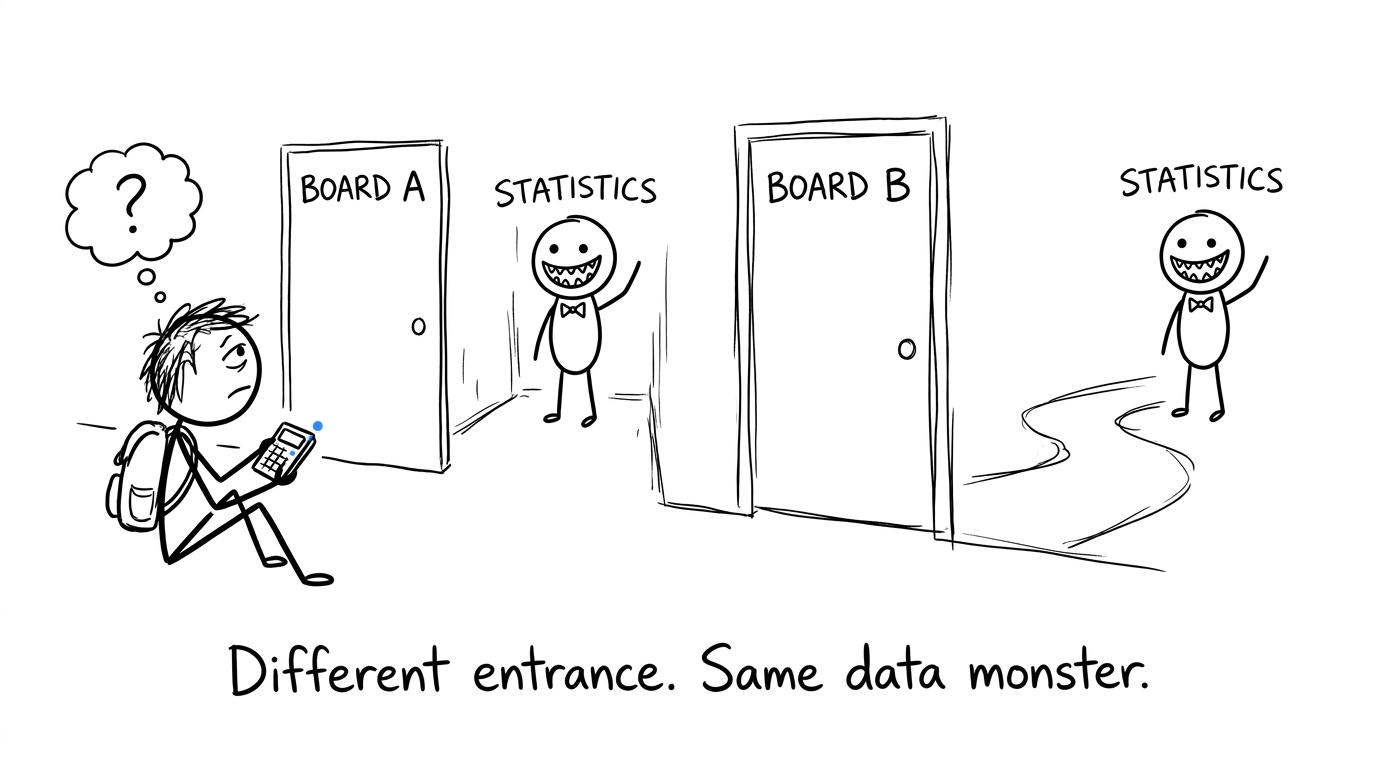 A student choosing between two doors leading to the same statistics monster
Does one GCSE Statistics exam board make the exam easier?
Not in the sense that matters most: the standard required for a grade.
Ofqual requires awarding organisations to cover the national GCSE Statistics subject content and assessment objectives. It also monitors awards across boards so that, as far as possible, achieving a particular grade is no easier or harder with one board than another.
Grade boundaries help account for differences in the demand of individual papers. A more accessible paper may produce higher boundaries; a more demanding paper may produce lower ones. This is why comparing raw boundaries without comparing the papers is misleading.
A lower boundary does not reveal an easier qualification. It usually indicates that students found that assessment more difficult. The history of GCSE Statistics grade boundaries shows why boundaries must always be matched to the correct board, tier and exam series.
There is an important personal qualification. One paper style may suit you better. A student who reads quickly may be comfortable with dense contexts, while another may prefer shorter prompts. That changes the experience of the exam, not the intended grade standard.
The main AQA and Edexcel differences
The two prominent standalone GCSE Statistics specifications in England are AQA Statistics 838283828382 and Pearson Edexcel Statistics 1ST01\text{ST}01ST0. OCR and Eduqas examine statistics within their GCSE Mathematics courses, but those sections should not be confused with a separate GCSE Statistics qualification.
Paper length and total marks
Both AQA and Edexcel use two externally examined papers. Each paper is worth 808080 marks and 50%50\%50% of the qualification, giving a total of 160160160 marks. Calculators are permitted on both papers, and content from across the specification can be assessed on either paper.
The clearest structural difference is time:
- AQA gives 111 hour 454545 minutes for each paper.
- Edexcel gives 111 hour 303030 minutes for each paper.
It would be tempting to conclude that AQA must be easier because it gives more time. That does not follow. Paper length, reading demand, question construction and expected response depth are considered together. Extra minutes do not automatically mean extra spare time.
Question style
AQA describes its papers as containing multiple-choice questions, short-answer questions and a Statistical Enquiry Cycle question. Edexcel describes short-response, medium-response and extended-response questions.
Both boards can test whether you can select an appropriate technique, interpret a result in context and evaluate the quality of an investigation. Statistics is not merely a collection of calculator procedures. The explanation surrounding a calculation can be where several marks are won or lost.
The national assessment objectives place approximately 55%55\%55% of the emphasis on statistical knowledge and techniques, 25%25\%25% on interpretation and reasoning, and 20%20\%20% on assessing methodologies and conclusions through the statistical enquiry cycle. Those shared objectives are one reason the intellectual core of the courses remains similar.
Foundation and higher tier
Both specifications offer foundation and higher tiers:
- foundation tier targets grades 111 to 555;
- higher tier targets grades 444 to 999.
Students take both papers at the same tier in the same series. Higher tier includes more demanding content and questions, so the tier decision matters more than rumours about boards. If you are unsure which tier is appropriate, discuss your current performance and target grade with your teacher.
Specification detail
National subject content creates a common foundation: planning investigations, collecting data, sampling, processing and representing data, summary statistics, probability, interpretation and evaluation.
Boards are still allowed some flexibility over depth, breadth and context. They may organise the material differently, use different terminology in guidance or specify slightly different expectations around particular techniques. Therefore, a general statistics resource can build understanding, but the final check should always be your own specification.
The right conclusion is not that the courses are identical. It is that their broad statistical purpose and intended grade standards are aligned, while their practical details differ.
Why another board's paper can feel harder
Familiarity has a quiet influence on difficulty. When you have seen the same instructions repeatedly, less mental effort is spent decoding what the examiner wants. An unfamiliar board removes that advantage.
Its commands may be phrased differently. Diagrams may be arranged in another style. A longer statistical context may appear earlier than expected. None of this necessarily represents harder statistics; it may simply be unfamiliar packaging.
This explains why casually attempting one paper from another board is a poor way to judge relative difficulty. You are comparing a familiar assessment language with an unfamiliar one.
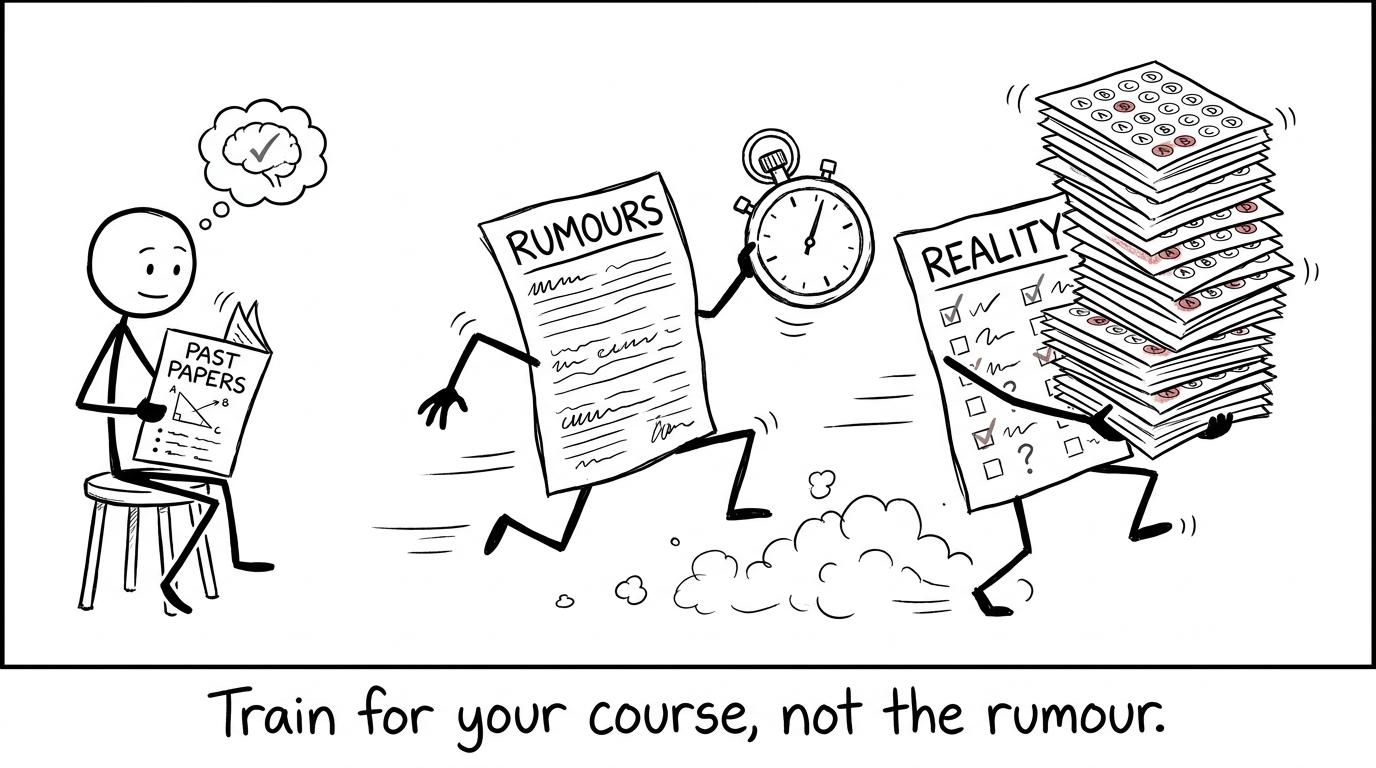 Two exam papers racing while a student trains calmly with a past paper
The useful response is board-specific practice. Edexcel students can use the Edexcel GCSE Statistics revision page, then move into Edexcel Statistics past papers once individual topics are secure.
What should be the same in your revision?
Whatever your board, strong revision follows the same cycle.
Understand the statistical enquiry cycle
You should be able to move logically from a question or hypothesis to data collection, processing, representation, interpretation and evaluation. A technically correct calculation cannot rescue an investigation built on a biased sample or an unsuitable conclusion.
Pay attention to words such as interpret, compare, evaluate, justify and comment. They signal different tasks. A comparison normally needs evidence about both centre and spread, while an evaluation should identify a specific limitation and explain its likely effect.
Build secure graphical understanding
Graphs are not decorative. Their scales, areas, intervals and summaries carry meaning. Supplementary GCSE Maths revision can strengthen shared skills through the MathsGenie guides on cumulative frequency, box plots and histograms.
These pages develop the underlying mathematics, but standalone GCSE Statistics students should still check their own board's specification and use board-matched questions for final preparation.
Learn from mark schemes
Mark schemes show how precision becomes marks. They reveal when a conclusion needs context, when a comparison requires two features and when a vague comment about bias is insufficient.
After marking a paper, classify each lost mark:
- missing statistical knowledge;
- incorrect method;
- weak interpretation;
- insufficient evaluation;
- misreading or avoidable error.
That classification turns a disappointing score into a revision plan. The purpose of a past paper is not to tell you that you are finished. It is to tell you what to do next.
How to revise for your actual exam board
Start with a short selection of mixed questions or part of a paper. Mark it carefully and identify the weakest specification areas. Relearn those topics using revision lessons, then complete focused practice questions without notes.
Next, use board-specific papers in three stages:
- complete untimed sections while concentrating on method and wording;
- complete timed sections to improve decision-making under pressure;
- sit full papers using the official time and permitted equipment.
Keep at least one suitable paper unseen until late in your revision. Record your total marks, but do not treat an old boundary as a prediction of a future result. Boundaries are set after each examination series.
Place these sessions into the MathsGenie revision planner. A simple schedule is more valuable than a complicated plan that is never followed: learn, practise, mark, correct and revisit.
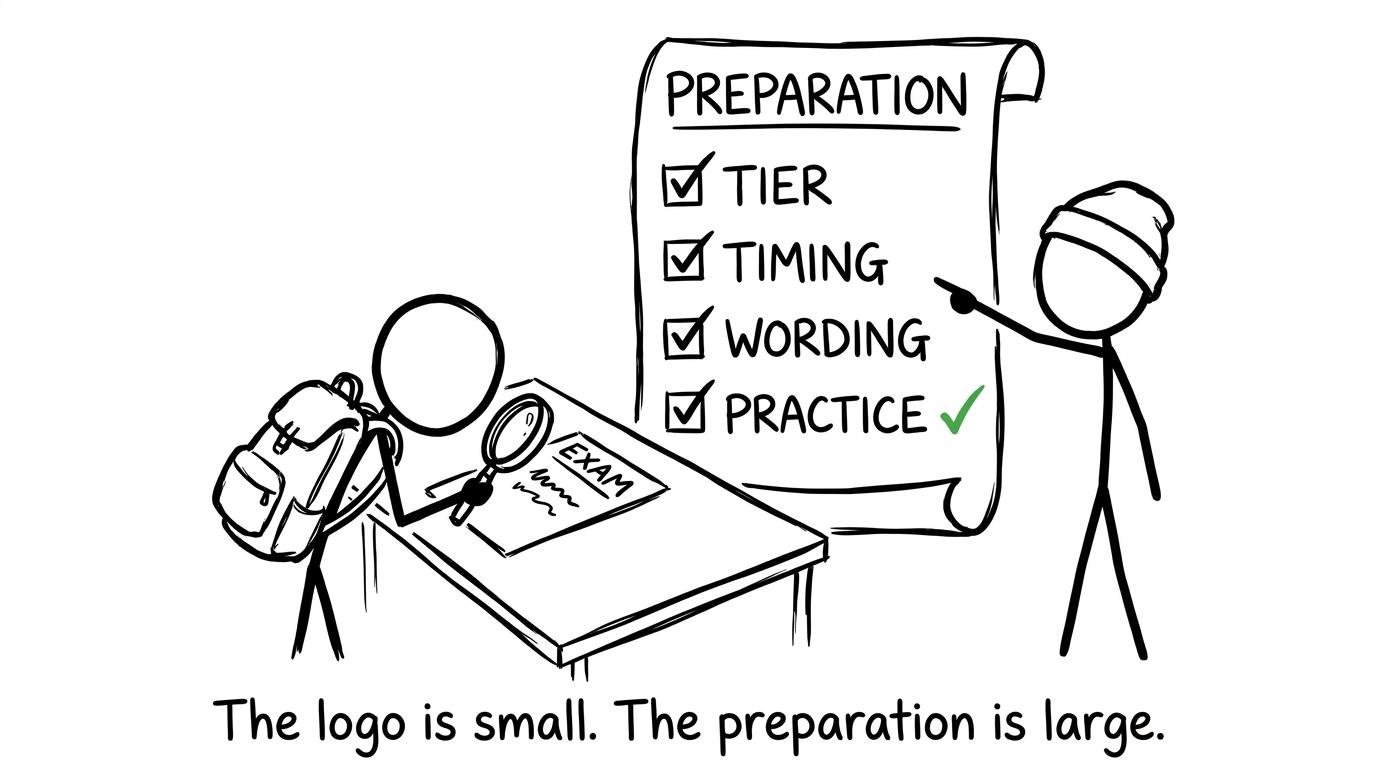 A student studying an exam-board logo while a friend points towards a preparation checklist
Common mistakes when comparing exam boards
Comparing grade boundaries in isolation
A boundary only makes sense beside the exact board, qualification, tier and series. Do not compare an AQA higher boundary with an Edexcel foundation boundary, or use an old boundary as a guaranteed target.
Assuming extra time means an easier paper
AQA's longer papers are designed around AQA's own assessment structure. The number of minutes cannot be separated from the questions those minutes are intended to serve.
Revising from the wrong specification
Most statistical ideas transfer, but small differences can matter. Check the specification code on every resource and paper, particularly for higher-tier techniques.
Practising calculations but avoiding written responses
Many students feel productive when pressing calculator keys. Yet interpretation and evaluation account for a substantial part of the qualification. Practise complete sentences that refer to the data and context.
Treating mock marks as fixed grades
A raw mark from one paper is evidence, not destiny. Use it to locate weaknesses. For a clearer view of how results should be interpreted, read the GCSE Statistics grade-boundary guide.
The board matters less than matching your preparation
The exam board matters because it determines your specification, timings, paper style and mark scheme. It does not provide a reliable shortcut to an easier grade.
The student with the advantage is not the one who has heard the best rumour. It is the one who knows the correct tier, has practised the right papers and understands why marks were lost.
Start at MathsGenie's free GCSE Statistics revision centre. Use the revision lessons and practice questions to repair individual topics, then build confidence with mini tests, past papers, predicted papers, mark schemes and video solutions where available. Train for the paper you will actually sit, and let careful preparation make the board name feel smaller.