GCSE Statistics Access Arrangements Guide
GCSE statistics access arrangements explained: extra time, evidence, school requests and approval timelines, with a clear checklist for students.
The hardest part of an exam is not always the statistics. Sometimes it is reading quickly enough, writing for a sustained period, managing concentration or accessing the printed paper.
GCSE statistics access arrangements are adjustments agreed before an assessment to remove barriers caused by a disability, learning difficulty, temporary illness or injury. They may include extra time, supervised rest breaks, a reader, a scribe, a word processor or a modified paper. They do not make the questions easier, change the mark scheme or lower the standard being assessed.
The most important first step is simple: speak to your school's SENCo, access arrangements coordinator or exams officer as early as possible. Your school or exam centre gathers the evidence and submits any required application. A student or parent cannot normally make the formal online application directly.
Your access arrangements checklist
If you think you may need support in GCSE Statistics, use this checklist:
- Tell your SENCo or access arrangements coordinator what creates a barrier in timed assessments.
- Explain what support you already use in lessons, tests and mock exams.
- Ask whether an assessment or further evidence is required.
- Trial the proposed arrangement during internal tests and mocks.
- Confirm which arrangements have been approved and for which examinations.
- Practise papers using the approved arrangement before the real exam.
- Check the room, start time and equipment instructions with your school.
Do not wait until the examination timetable arrives. Evidence takes time to gather, modified papers have early ordering deadlines, and schools often set internal deadlines well before the final JCQ date.
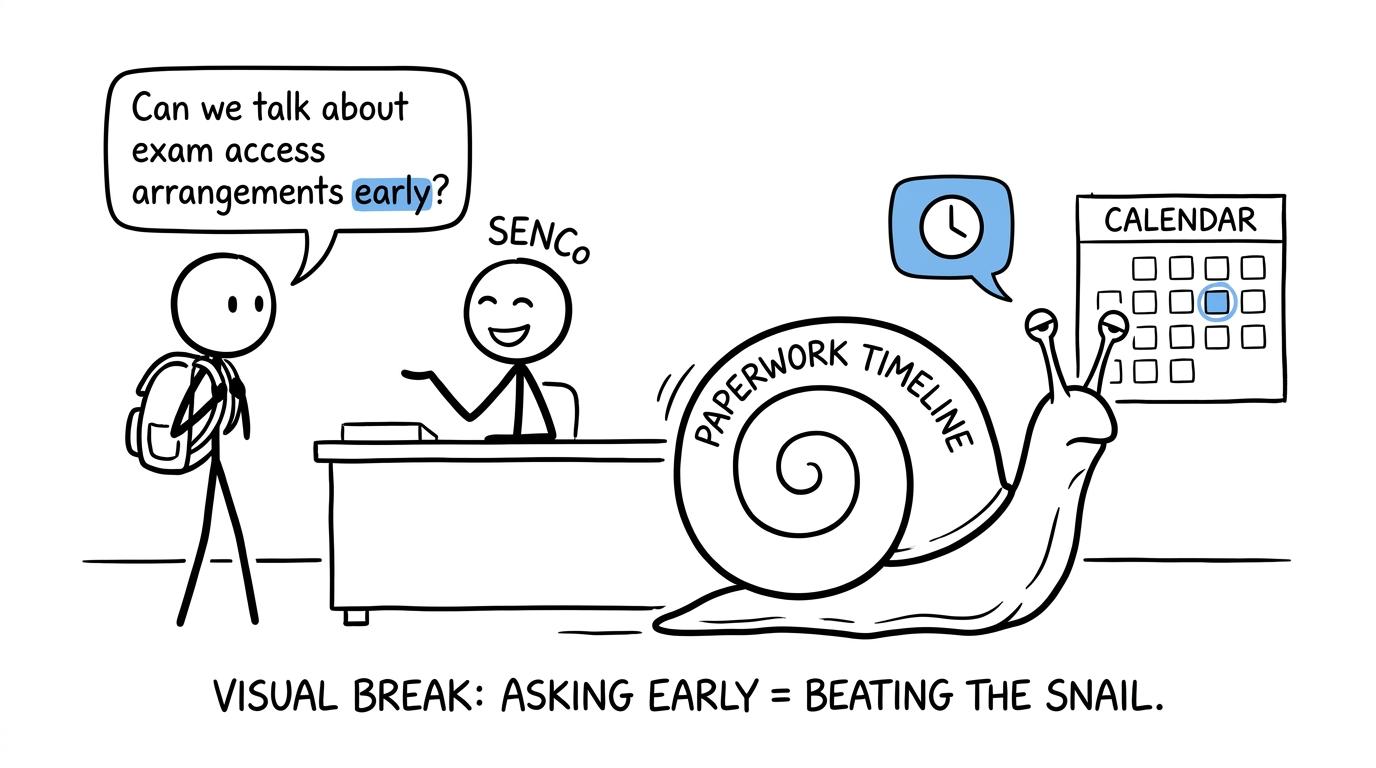 A student asking early while the paperwork timeline approaches slowly
What are GCSE Statistics access arrangements?
Access arrangements change how an assessment is taken while preserving what it assesses. The same GCSE Statistics content, grade boundaries and mark scheme still apply.
They are used across JCQ-regulated GCSE examinations. Your wider GCSE subjects may be with Edexcel, AQA, OCR or Eduqas, while the exact availability of GCSE Statistics qualifications depends on your centre and exam board. Your school will apply through the appropriate awarding organisation system where online approval is required.
Common arrangements include:
- 25%25\%25% extra time;
- extra time above 25%25\%25% in rare cases where stricter criteria are met;
- supervised rest breaks;
- use of a word processor;
- a computer reader or human reader where permitted;
- a scribe or speech-recognition technology;
- a prompter;
- coloured overlays or certain low-vision aids;
- modified papers, including Braille or modified enlarged print;
- a different room where this forms part of the appropriate support.
Not every arrangement requires an online application, but this does not mean it can be provided simply on request. Centre-delegated arrangements still need to reflect an established need and the student's normal way of working.
How extra time works in GCSE Statistics
The most common exam-board-approved arrangement is 25%25\%25% extra time. In general, the available duration becomes
adjusted duration=standard duration×1.25.\text{adjusted duration}=\text{standard duration}\times 1.25.adjusted duration=standard duration×1.25.Your exams officer and invigilator calculate and record the official finishing time. You do not have to work continuously until that time if you finish earlier, but you should practise using the allowance effectively.
Extra time does not mean spending longer on every calculation. A better approach is to use it where your access need affects you: reading a data source, processing a multi-stage question, organising written conclusions or checking that graphs and statistical comparisons have been communicated clearly.
GCSE Statistics can involve lengthy contexts, tables and interpretations alongside calculations. The arrangement is intended to give an eligible student fair access to those demands. It is not a reward for working slowly, and a diagnosis alone does not automatically produce a particular allowance.
You can build familiarity with the paper style through the GCSE Statistics revision hub. Edexcel students can also use the Edexcel GCSE Statistics revision resources to find board-specific questions, worksheets and papers.
Extra time compared with supervised rest breaks
These arrangements solve different problems.
Extra time increases the working time available. A supervised rest break pauses the examination clock while you stop working under the invigilator's supervision. During a break, you must follow the invigilator's instructions and cannot continue answering questions.
Rest breaks may be more appropriate where a condition affects concentration, fatigue, pain or the ability to work continuously. Some students may have both arrangements if the evidence supports both, but neither should be treated as automatic.
The purpose of trialling arrangements in mocks is to discover what genuinely removes the barrier. More time is not always the best answer. Sometimes a pause, suitable technology or a different way of recording answers is more effective.
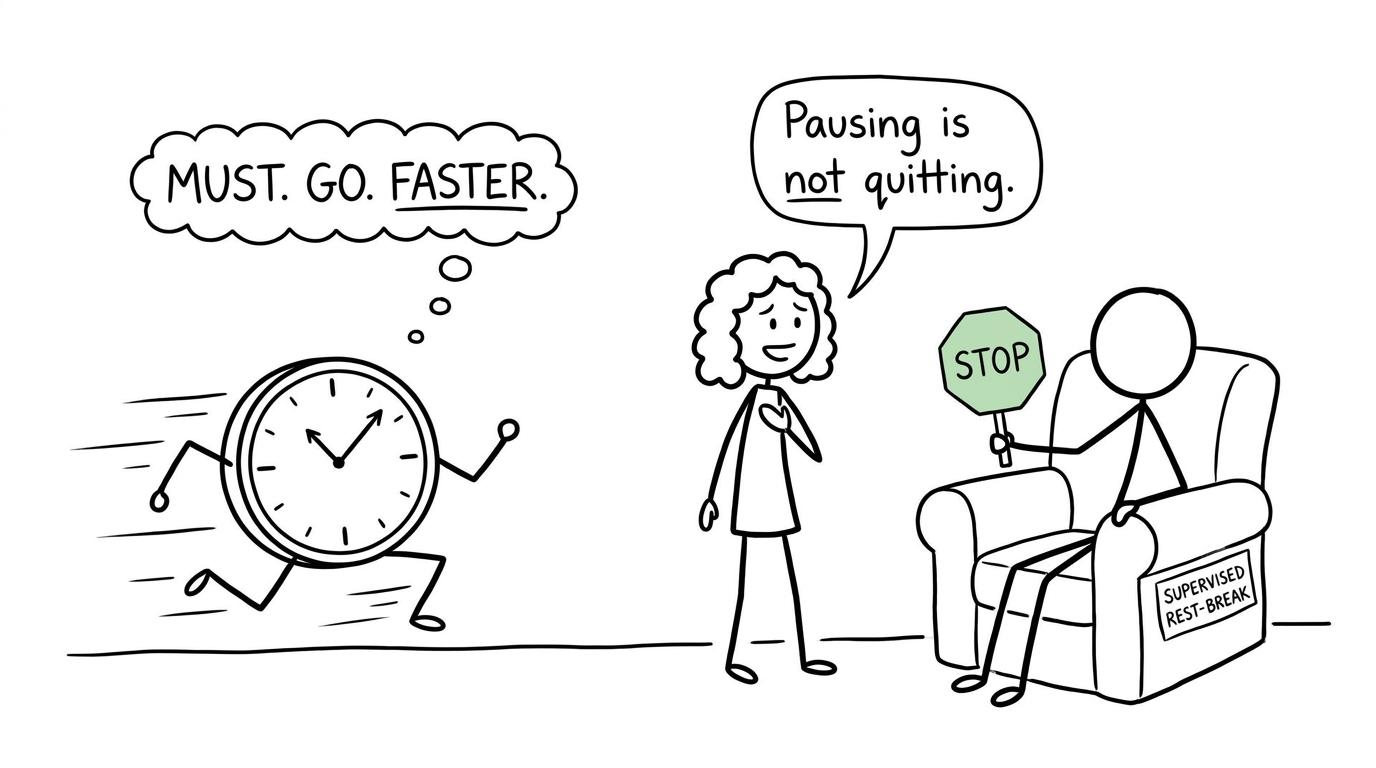 An exam clock meeting a calm supervised rest-break chair
How to request access arrangements
Speak to the right person
Start with your SENCo, learning-support team, access arrangements coordinator or exams officer. Tell them specifically what happens in timed work. For example, do you lose your place while reading, experience significant fatigue, struggle to produce legible writing or need technology that you routinely use in lessons?
Clear information is more useful than simply saying that exams feel difficult. It helps the school investigate the barrier and decide which support should be considered.
Let the school review your normal way of working
JCQ rules place strong emphasis on a student's normal way of working. The proposed arrangement should usually reflect support already used in lessons, internal tests or mock exams rather than appearing for the first time in the final examination.
Evidence may include teacher observations, marked internal assessments, mock scripts, work samples, records of classroom support and an assessment completed by the centre's appointed assessor. The precise evidence depends on the arrangement and the reason it is needed.
Under the latest full JCQ rules reviewed for the 2025/262025/262025/26 academic year, new applications for 25%25\%25% extra time generally required supporting internal-test or mock evidence across relevant subjects, together with teacher comments explaining why the time was needed and how it was used. Students sitting later series should ask their centre to check the JCQ regulations in force for that academic year, as requirements are updated.
Complete any required assessment
For some learning difficulties, the school may arrange an assessment using nationally standardised tests. Other needs may be supported through specialist medical evidence and detailed centre records. The SENCo decides which JCQ evidence route applies.
An external report can be useful, but arranging a private assessment independently does not force a school or awarding organisation to grant extra time. The evidence must satisfy current JCQ criteria and connect with what teachers observe in the centre.
Trial the arrangement in a mock
A mock is not only a rehearsal for content. It can show whether an arrangement works in practice.
Use suitable papers from MathsGenie's GCSE Maths revision resources or Statistics hub under the conditions set by your school. Afterwards, tell the relevant member of staff how the arrangement affected your ability to complete and check the paper. The school may also retain the script or an invigilator's record as evidence.
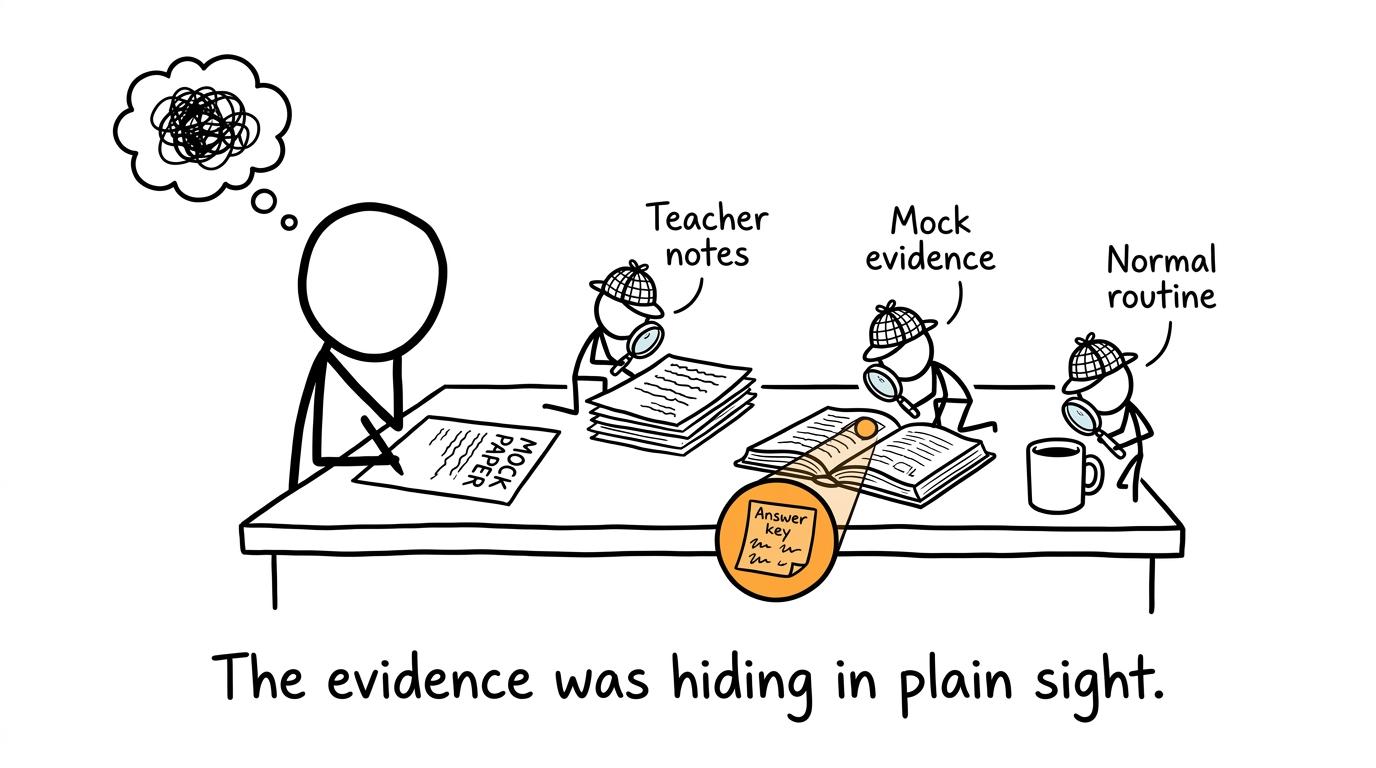 Teacher notes, mock evidence and normal routine investigating a practice paper
The centre submits the application
Where online approval is required, the school or registered exam centre applies through Access Arrangements Online. Some arrangements can be decided and recorded by the centre without an online application, provided current JCQ conditions are met.
Ask for confirmation once the process is complete. You should know what has been approved, how it will operate and whether you will sit in your usual examination room or another location.
The approval timeline
A calm timeline begins long before the final form is submitted.
Year 9 or early Year 10
Raise persistent difficulties and make sure teachers understand how they affect timed work. Support can then be observed and trialled naturally rather than reconstructed just before the examinations.
During Year 10
Use the arrangement consistently where appropriate. Your school can collect classroom evidence, internal assessments and teacher observations. If an assessor is required, the SENCo can plan this at the correct stage.
Autumn of Year 11
Meet the SENCo or access arrangements coordinator. Confirm whether more evidence is needed and use the proposed support in timed assessments. This is also a sensible time to begin structured revision with a realistic GCSE revision timetable.
Year 11 mock period
Mocks can provide important evidence, particularly for extra-time applications. Sit them under the agreed conditions and use the arrangement honestly. The goal is to establish whether it helps you demonstrate your knowledge, not simply whether it produces a higher raw mark.
Winter and early spring
Modified papers require particularly early orders. For context, the JCQ deadline for June 202620262026 modified papers was 313131 January 202620262026, while the deadline for other online access-arrangement applications was 212121 March 202620262026. Those dates have passed and must not be assumed for a later series. Ask your centre for the current deadline because annual regulations and centre deadlines can differ.
If you are a private candidate, contact potential exam centres much earlier. Before accepting an entry, a centre will need time to understand your needs, review evidence and decide whether it can provide the arrangement.
Preparing once an arrangement is approved
Approval is not the end of the process. You need to become comfortable using the support.
Start with topic practice, then timed sections, then complete papers. The guide on when to start GCSE past papers explains how to build towards full exam conditions. If graphs are a weaker area, revise cumulative frequency and box plots before testing the skills under timed conditions.
Mark each attempt carefully. Access arrangements remove a barrier, but they cannot replace knowledge of sampling, probability, distributions, correlation or the statistical enquiry cycle.
Common mistakes to avoid
Waiting until the final weeks: a centre needs time to gather evidence, arrange assessments and meet ordering or application deadlines.
Assuming a diagnosis guarantees extra time: eligibility depends on current rules, the impact on assessment and appropriate supporting evidence.
Requesting support that is never used in school: arrangements should normally reflect your established way of working.
Confusing access arrangements with special consideration: access arrangements are planned before an assessment. Special consideration is a separate process for illness, injury or adverse circumstances affecting a student at or around the time of an examination.
Never practising with the arrangement: unfamiliar rest breaks, technology or additional time can disrupt your rhythm. Trial the exact routine in mocks and timed practice.
Using extra time as a substitute for revision: continue to use practice questions, mark schemes and video solutions to improve the statistics itself.
Make the next step small and early
Requesting support can feel formal, but your first action does not need to be. Ask for a conversation. Explain the barrier. Let your school guide the evidence and approval process under the current JCQ rules.
Then return to the work you can control. Use MathsGenie's free GCSE Statistics resources for revision lessons, practice questions, worksheets and past papers. Build towards timed practice, review each paper with its mark scheme, and use video solutions, mini tests and predicted papers where available.
The right arrangement gives you access to the exam. Consistent, thoughtful revision helps you make that access count.