GCSE Spanish Results Day: Is Your Grade Wrong?
GCSE Spanish results day wrong grade? Check what to do in the first hour, how marking reviews work, and which deadlines, fees and risks matter.
Opening your results can turn months of uncertainty into a single line on a screen or sheet of paper. Sometimes that line feels wrong. Perhaps your Spanish grade is well below your mocks, your teacher predicted something higher, or the result simply does not match how the examinations felt.
A GCSE Spanish results day wrong grade concern should be investigated calmly and promptly. In the first hour, check the candidate details, exam board, tier, component marks and official grade boundary. Then speak to your Spanish teacher or exams officer about accessing marked work and whether a clerical re-check or review of marking is appropriate.
Do not submit a request based only on disappointment. But do not walk away because someone says, “Results are sometimes surprising.” Gather evidence while the right people are available.
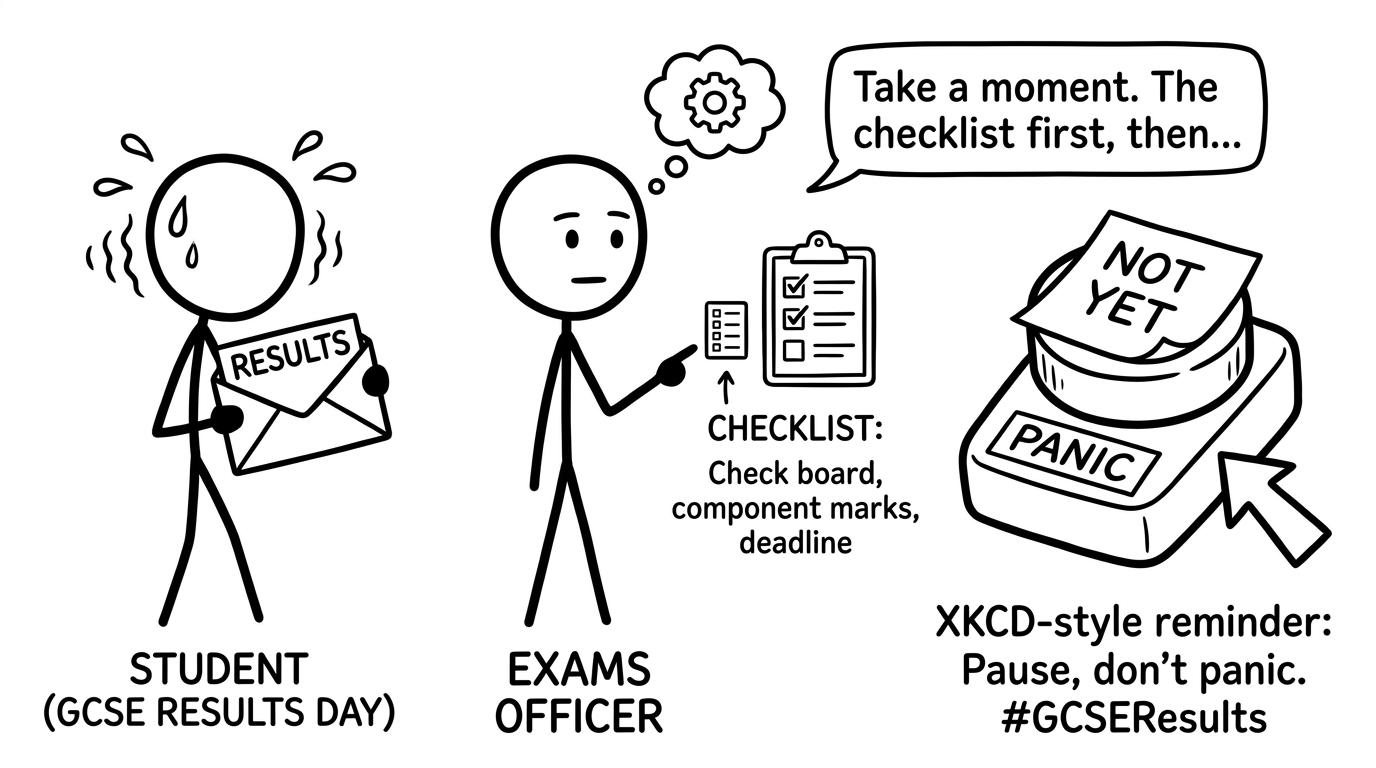 A student pauses before pressing the results-day panic button
Your first-hour checklist
Use this order on results day:
- Read the result again and confirm it belongs to you.
- Check the qualification, exam board and tier.
- Ask for your total mark and available component marks.
- Compare the total with the official boundary for that exact board and series.
- Speak to your Spanish teacher, head of department or exams officer.
- Ask whether marked scripts, recordings or other assessment materials can be accessed.
- Find out the school's internal deadline, possible fee and consent process.
- Tell your sixth form or college promptly if the grade affects your place.
- Write down what has been agreed and who will contact you next.
The same evidence-first approach applies across GCSE subjects. MathsGenie's guide to making a GCSE remark request explains the wider post-results process, while the GCSE grade boundaries collection helps you identify the correct board and examination series.
What to do during the first hour
The first ten minutes: check the basic information
Strong emotions make simple details easy to miss. Before discussing predicted grades, confirm:
- your name and candidate information are correct;
- the subject shown is GCSE Spanish;
- the result is for the expected exam board;
- the correct foundation or higher tier entry was used where applicable;
- there is no indication of a missing, incomplete or pending result.
If anything looks administratively unusual, take it directly to the exams officer. Do not rely on a photograph shared in a group chat or compare your result with a friend's boundary from another board.
Ten to twenty-five minutes: ask for the numbers behind the grade
A grade is the final label, but the marks provide the useful evidence. Ask for your overall subject mark, the official grade boundary and any available breakdown by component.
GCSE Spanish commonly assesses listening, speaking, reading and writing, although component numbering, weighting, scaling and reporting differ between specifications. That means you should not add figures together until your teacher or exams officer confirms what each figure represents.
Ask these precise questions:
- How many marks was I below the next grade?
- Are these raw, scaled or weighted marks?
- Is there an unexpectedly low component?
- Is every expected component present?
- Which post-results service would check the suspected problem?
Grade boundaries are specific to the exam board, specification and examination series. They are not fixed predictions made before the papers are marked. The GCSE grade boundaries explained guide gives a clear account of why the correct series matters.
Twenty-five to forty minutes: speak to a subject specialist
Your predicted grade and mocks provide context, but they do not prove that the awarded grade is wrong. Mock papers may have used different boundaries, content or marking conditions. Predictions are professional judgements rather than guaranteed results.
What matters now is whether there is a specific reason to investigate. A Spanish teacher may notice that one component is out of line with your usual performance, or may want to inspect available marked material against the relevant mark scheme.
Spanish contains both relatively objective questions and extended responses requiring examiner judgement. A low reading score may raise different questions from an unexpected writing or speaking mark. The useful conversation is not simply, “I normally get a grade 777.” It is, “Which component changed the result, and is there evidence that the marking or processing should be checked?”
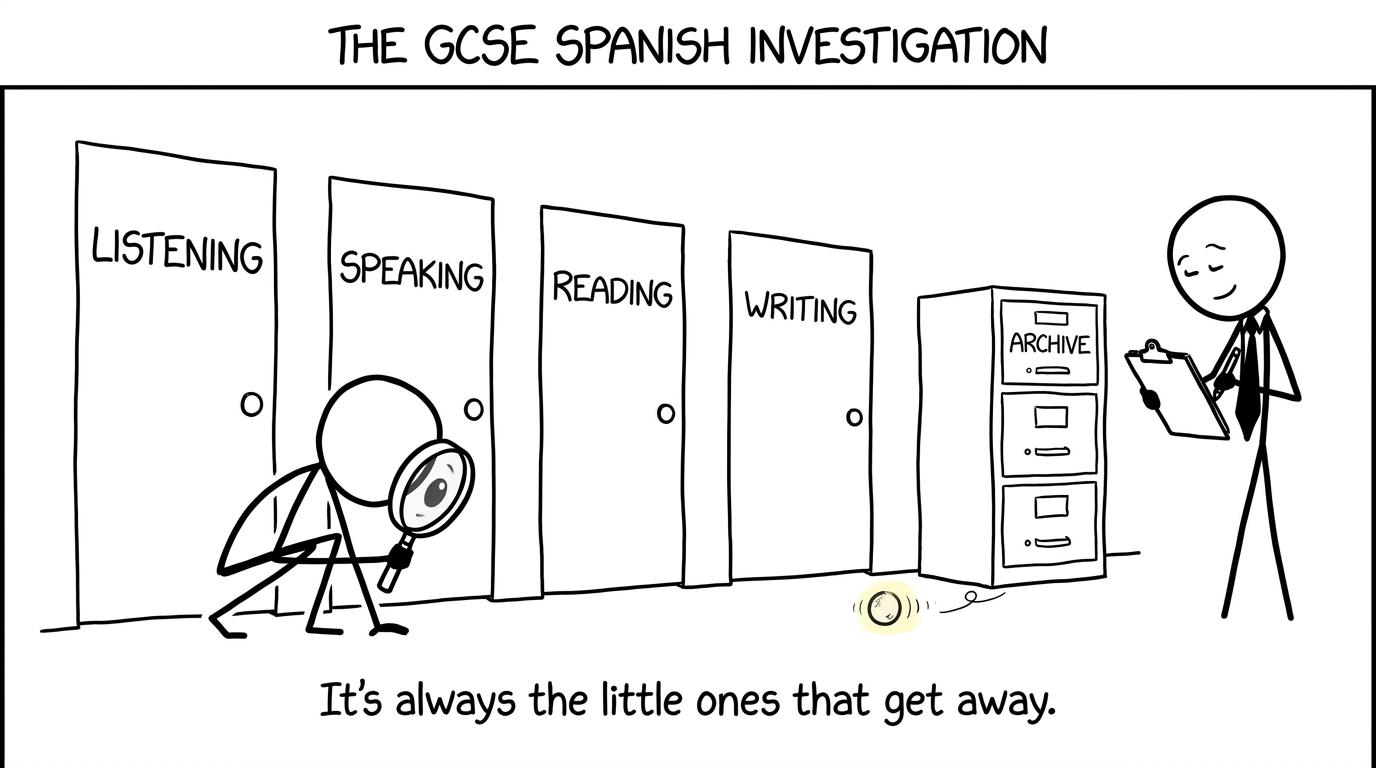 A results-day detective investigates the four Spanish components
Forty to fifty minutes: ask about access to marked work
Access to Scripts services allow centres to request marked examination material. Depending on the board and component, the available evidence might include a marked script or other assessed material. Your centre can explain what can be obtained for your Spanish specification.
A teacher can use this material to look for concerns such as:
- an unmarked page or response;
- marks that appear not to have been transferred or totalled correctly;
- a response that may not have been assessed in line with the mark scheme;
- an unusual difference between components that deserves closer inspection.
Requesting access does not itself change your result. It helps the centre make an informed decision before the review deadline. Board-specific access deadlines can be earlier than the final review deadline, so ask immediately rather than waiting several weeks.
The final ten minutes: record the next action
Before leaving, note:
- the name of the teacher or exams officer helping you;
- the component being investigated;
- whether access to marked material will be requested;
- the school's internal deadline;
- any fee and refund arrangements;
- when you should expect an update;
- whether your post-161616 provider needs to be contacted.
If an offer depends on the Spanish grade, contact the sixth form or college even if a review is being considered. Explain that you are checking the result and ask what evidence or timescale they require. A review is never guaranteed to produce a higher grade.
Which post-results service might apply?
The phrase “re-mark” is widely used, but the official process is normally called a review of results.
Clerical re-check
A clerical re-check examines administrative matters. It checks that the parts of the assessment were marked, that marks were totalled correctly and that the result was recorded accurately. It does not reconsider the academic judgement used when awarding marks.
This may be relevant if the concern is a missing mark, an unmarked response or an incorrect total.
Review of marking
A review of marking checks whether the mark scheme was applied correctly. It is not an automatic fresh marking exercise designed to search for extra marks. The reviewer identifies and corrects genuine marking errors.
Your mark and final grade can rise, stay unchanged or fall. For this reason, the centre must obtain your written consent after results have been published. Discuss the risk carefully, particularly if you are already close to the lower boundary of your awarded grade.
For the June 2026 series, GCSE results are released on Thursday 20 August 2026. The Joint Council for Qualifications lists Thursday 24 September 2026 as the deadline for awarding bodies to receive standard clerical re-check and review-of-marking requests. Schools often set earlier internal deadlines, and board-specific access-to-scripts arrangements vary.
There is no general JCQ priority review-of-marking service for GCSE equivalent to the priority service used when an A Level result affects a university place. However, exam boards may offer priority access to GCSE scripts. Your exams officer should check the rules for your board rather than assuming that every service is available.
Appeal after a review
An appeal is not the first step. It normally follows the outcome of a clerical re-check or review of marking and concerns a remaining marking or procedural error.
For a school candidate, the centre usually handles the process. JCQ's 2026 guidance says appeals against review outcomes must be made within thirty calendar days of the awarding organisation issuing the outcome. If your school decides not to request a marking review, it must provide an internal appeals route through which you can challenge that decision.
Private candidates can normally contact the awarding organisation directly or ask the centre that entered them for help.
How to judge whether a review is sensible
Being one mark below a boundary does not prove an error, just as being several marks away does not make an error impossible. Consider the evidence together:
- the distance from the next and lower boundaries;
- which component appears unusual;
- whether a teacher has inspected the available material;
- whether there is a plausible clerical or marking concern;
- the risk that the mark could decrease;
- the fee and the board's refund rules;
- the practical importance of the higher grade.
This is where calm judgement matters. The cost of a review and the refund conditions vary by exam board and centre, so obtain the current figures directly from your exams officer before consenting.
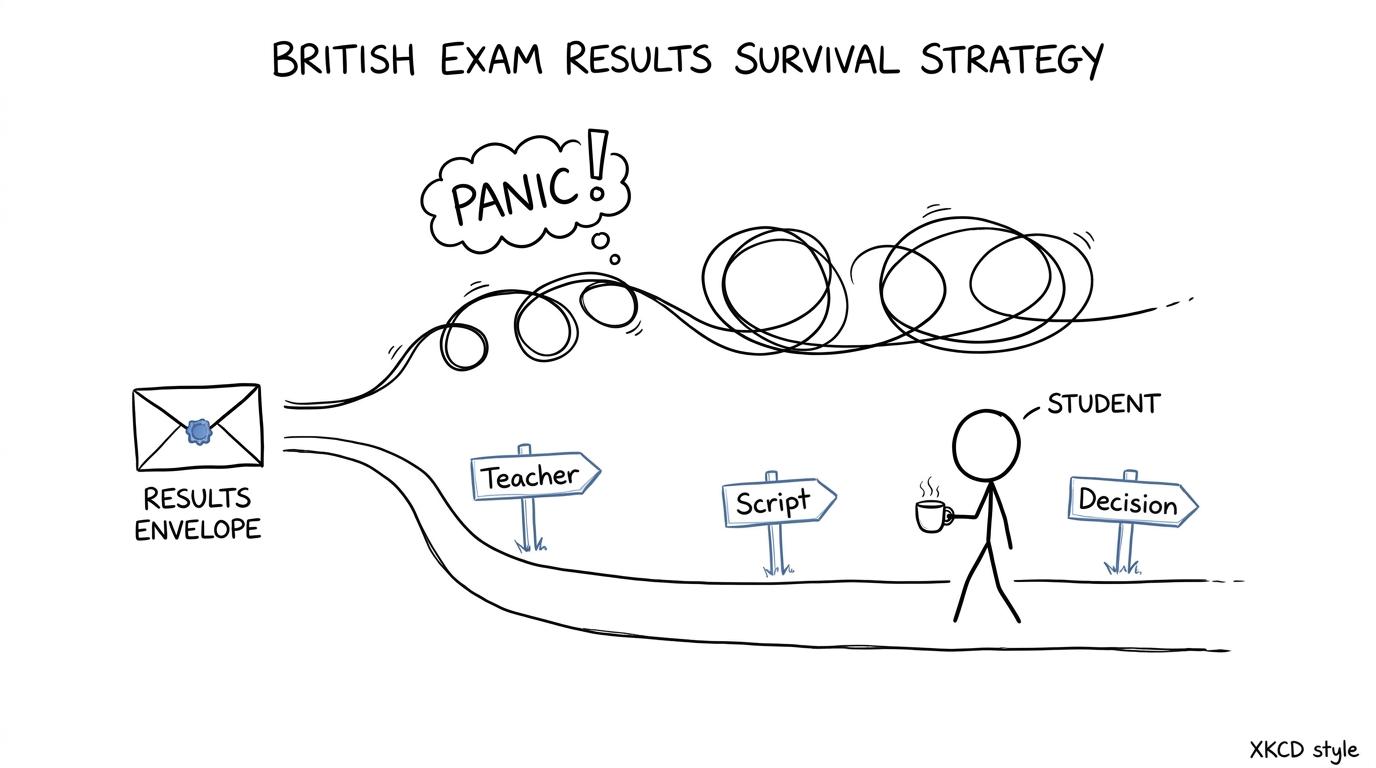 A student chooses the calm evidence path instead of the panic loop
Common mistakes when a Spanish grade looks wrong
Treating a predicted grade as proof
Predictions and mocks can justify a closer look, but the final award is based on the assessed work and the official boundaries. Use your previous performance as context, not as the whole case.
Comparing the wrong grade boundary
Do not use last year's boundary, another board's figures or an unofficial social-media table. Match the subject, specification, tier and series exactly.
Requesting every component immediately
A review is normally charged by component. First identify where the concern lies and ask whether a teacher can inspect the available material. A targeted request is often more rational than reviewing everything.
Forgetting that marks can fall
There is no grade protection in a review of marking. Your written consent confirms that you understand the result may go down, stay the same or go up.
Missing the school's earlier deadline
The awarding-body deadline is not necessarily your personal deadline. Exams staff need time to collect consent, payment and component details. Follow the date provided by your centre.
Waiting for the review before contacting a college
If your place is affected, contact the provider on results day. It may have its own deadline or be willing to consider your wider results while the review is pending.
Turn results-day uncertainty into a better next step
A surprising grade can feel like a verdict. It is better understood as a result that can be checked through a defined process. Verify the details, obtain the marks, ask for expert advice and make a decision based on evidence rather than the shock of opening the envelope.
Results day may also shift your wider revision plans. If you are moving into sixth form and want stronger mathematical foundations, start with the free GCSE Maths revision hub. If you are considering a maths resit, use the GCSE Maths resit results-day plan to turn the result into a focused programme.
MathsGenie brings together revision lessons, practice questions, mini tests, mark schemes, video solutions, GCSE maths past papers and predicted papers in the revision resources hub. You can then organise the work with the free revision planner.
For your Spanish result, begin with the exams officer. For the maths journey ahead, open MathsGenie and make the next step specific: one topic, one set of questions and one correction at a time.