GCSE Sociology Study Group: Make It Actually Work
GCSE sociology study group guide: choose members, set a clear agenda, use retrieval practice and make every focused revision session productive for exams.
A GCSE sociology study group can become one of two things. It can be a small, dependable revision team where everyone tests ideas, improves arguments and leaves knowing what to do next. Or it can become another group chat full of good intentions, unread messages and meetings that never quite happen.
The difference is not motivation. It is structure.
To make a group work, keep it to roughly three to five committed students, agree a fixed meeting time, set one measurable goal for every session and spend more time retrieving and applying knowledge than rereading notes. Use the group chat for logistics, not for the revision itself.
That is the short answer. The rest is about making the system dependable when exams, homework and everyone else's timetable begin competing for attention.
GCSE sociology study group checklist
Before inviting half your class, establish these basics:
- Choose three to five members who will participate consistently.
- Check that everyone follows the correct exam board specification.
- Meet at the same time and place each week where possible.
- Set the topic and tasks before the meeting begins.
- Give each person a practical role.
- Begin with closed-book retrieval.
- Include exam questions, not just discussion.
- Check answers against reliable notes and mark schemes.
- Record misconceptions and individual follow-up tasks.
- End by arranging the next meeting.
Evidence on collaborative learning suggests that small groups with a shared outcome are generally more promising than larger, loosely organised groups. It also makes an important point: productive collaboration does not happen automatically. Students need a task, responsibility and a way to check whether learning has improved.
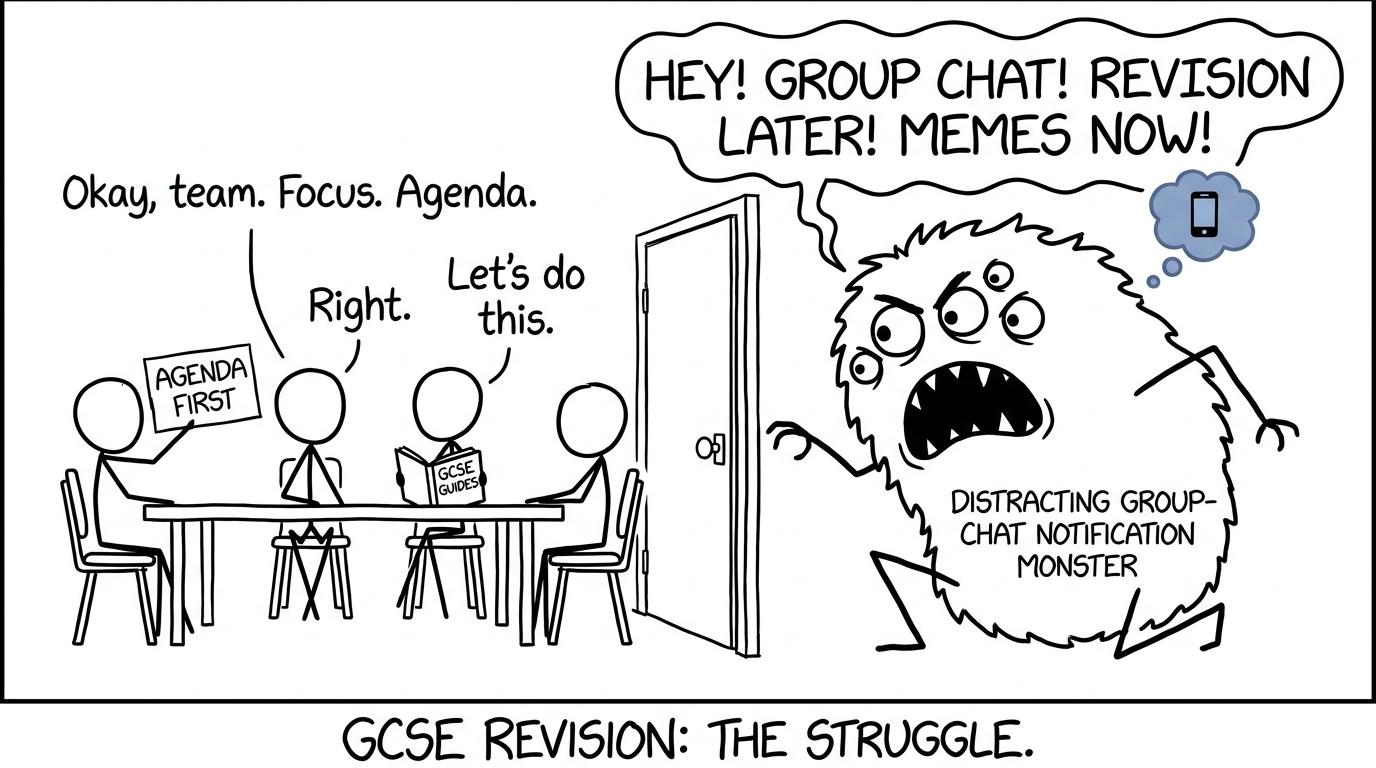 A study group keeps a distracting group-chat monster outside by using an agenda
Build the group around an outcome
A vague invitation produces a vague meeting. “Do you want to revise sociology sometime?” sounds friendly, but it leaves every important decision until later.
A better invitation identifies:
- who is joining;
- when and where you will meet;
- how long the session will last;
- which specification topic you will cover;
- what everyone must prepare;
- what you intend to finish.
For example, the outcome might be to recall key perspectives on education, plan two extended responses and identify three gaps to revisit independently. That is not a worked answer or a promise to “cover education”. It is a finish line.
Choose reliability over popularity
The best group is not necessarily made up of your closest friends or the students with the highest grades. It consists of people willing to arrive prepared, attempt answers and accept correction.
Three to five students is usually enough to create different viewpoints without letting anyone disappear into the background. If the group becomes much larger, split into smaller teams for quizzes or essay planning before comparing conclusions.
Different strengths can help. One student may remember studies accurately, another may explain theories clearly, while somebody else notices weak evaluation. The danger appears when those strengths become permanent jobs. Everyone still needs to retrieve knowledge, apply it and construct arguments independently because the examination is individual.
Check the specification first
GCSE Sociology content and question formats depend on the exam board. AQA and Eduqas both assess areas including families, education, crime and deviance, social stratification and research methods, but their paper structures and question demands are not identical.
Before creating a shared topic list, check the current specification supplied by your teacher or exam board. Do not assume that a resource made for another board uses the same wording, content boundaries or mark tariffs.
Give every meeting a repeatable structure
A study group becomes easier to attend when nobody has to reinvent it each week. A focused sixty-minute session could use this pattern:
| Stage | Suggested time | Purpose |
|---|---|---|
| Arrival and goal check | Five minutes | Confirm the topic, tasks and final output |
| Closed-book retrieval | Ten minutes | Recall concepts, evidence, methods and perspectives |
| Explanation and correction | Ten minutes | Compare answers and resolve disagreements |
| Exam-question practice | Twenty minutes | Plan or write responses under controlled conditions |
| Marking and feedback | Ten minutes | Use criteria, mark schemes and reliable course material |
| Exit plan | Five minutes | Record gaps and confirm the next meeting |
The exact timings can change. The order matters more: attempt, check, correct and plan.
This resembles the disciplined cycle used in MathsGenie's twenty-minute maths revision routine. Short sessions work when each minute has a job. A longer meeting without a clear task can produce less learning than a brief, purposeful one.
Rotate practical roles
Roles prevent one confident person from becoming an unpaid teacher while everyone else listens. Rotate them each session:
- Chair: keeps the group on the agreed topic.
- Quizzer: prepares retrieval questions in advance.
- Timer: protects each part of the agenda.
- Checker: finds the relevant specification wording or mark guidance.
- Recorder: writes down unresolved gaps and follow-up tasks.
In a group of fewer than five, one person can hold two roles. These are organisational responsibilities, not substitutes for doing the academic work.
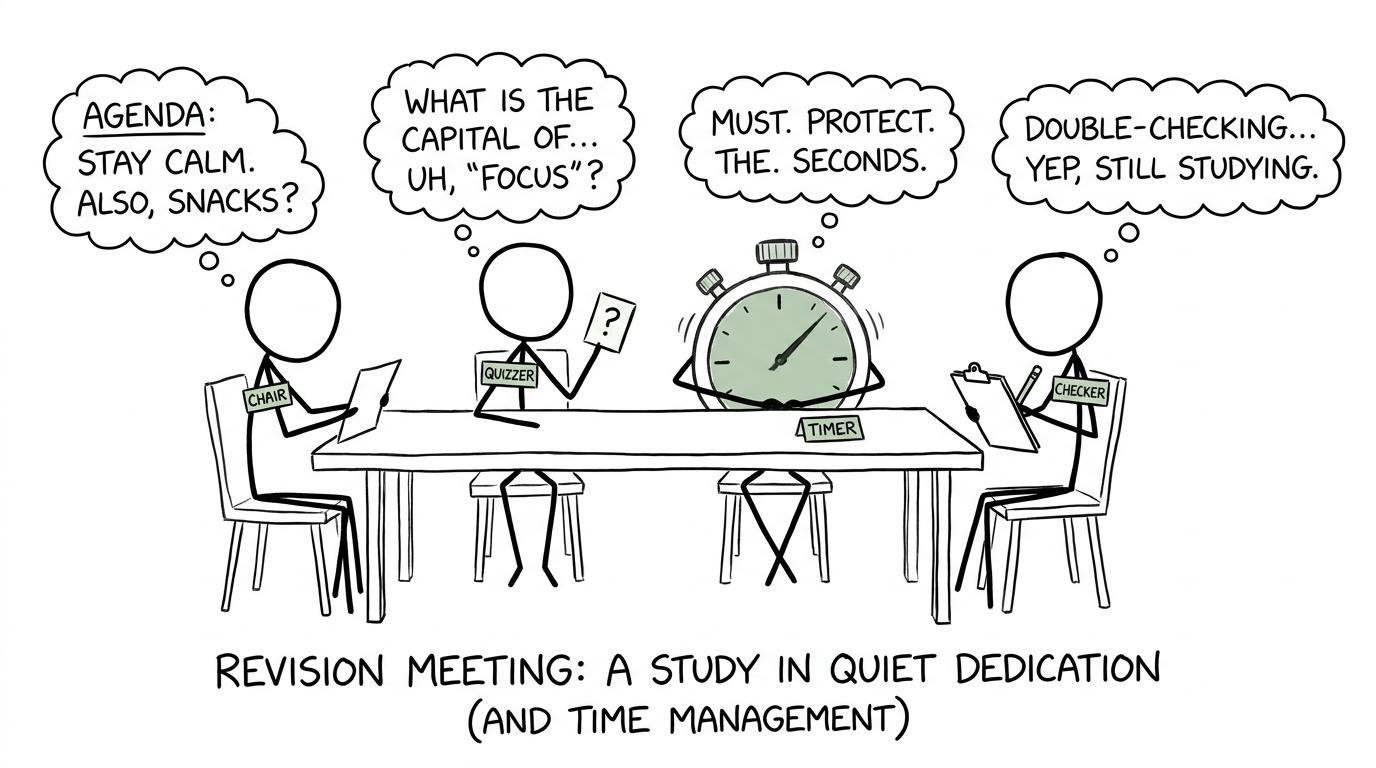 Students use rotating roles while an unusually serious timer guards the stopwatch
Use retrieval before discussion
Discussion can feel productive because familiar ideas become easier to recognise. Recognition, however, is not the same as recalling an idea unaided in an examination.
Begin with notes closed. Ask everyone to write what they can remember about a tightly defined area: a theory, concept, research method, named study or line of evaluation. Each student should attempt the task individually before answers are shared.
Educational research supports retrieval practice, but the useful part is the active attempt to remember. Feedback is also essential. If the group confidently repeats an inaccurate definition, the meeting may strengthen the very misconception it was meant to remove.
Use a trusted source to settle disagreements. That may be your teacher's material, the current specification, a textbook approved for your course or an official mark scheme. “I think it means…” is a starting point, not evidence that the answer is correct.
Move from recall to examination thinking
Sociology requires more than memorising definitions. Official specifications assess knowledge and understanding, application, analysis and evaluation. Your meetings therefore need several kinds of question:
- What does this concept mean?
- Which theory or evidence supports the claim?
- How could the idea be applied to the context in the question?
- What limitation or alternative explanation could be considered?
- What judgement follows from the argument?
After retrieval, plan or write an exam response individually. Then compare the reasoning rather than copying the longest answer. Look for accurate terminology, relevant application, developed explanation, balanced evaluation and a conclusion that follows from the discussion.
The same principle underpins effective maths revision: doing a question reveals more than watching someone else solve it. MathsGenie's guide to using GCSE past papers properly explains the useful cycle of attempting, marking, fixing and retesting.
Keep the group chat deliberately boring
A successful revision chat is mainly an administrative tool. Its job is to remove uncertainty.
Use it for:
- confirming the meeting time and place;
- posting the agenda;
- assigning preparation;
- sharing a specific approved resource;
- recording the next topic.
Do not use it as an endless substitute for meeting. Avoid conducting complicated debates through notifications, posting folders nobody has time to organise or changing plans repeatedly.
One pinned message can contain the standing rules, specification, topic tracker and schedule. After that, every meeting needs only a short message: topic, preparation, location and intended output.
If members repeatedly vote on dates but never attend, stop polling. Pick a regular slot and continue with whoever can commit to it.
Track gaps instead of measuring hours
Finishing a meeting is not proof that the topic is secure. The best record is a short gap log showing:
- the concept or question;
- what went wrong;
- the correct idea;
- who will verify it;
- when it will be retested.
Keep entries precise. “Research methods are bad” gives you nowhere to begin. “Cannot distinguish reliability from validity when evaluating interviews” creates an actionable revision task.
Maths students can use the same diagnosis process. The MathsGenie guide to finding your weakest GCSE topics shows how lost marks can guide the next round of practice. For broader maths preparation, the free GCSE Maths revision hub brings together topic lessons, questions, mini tests and paper practice.
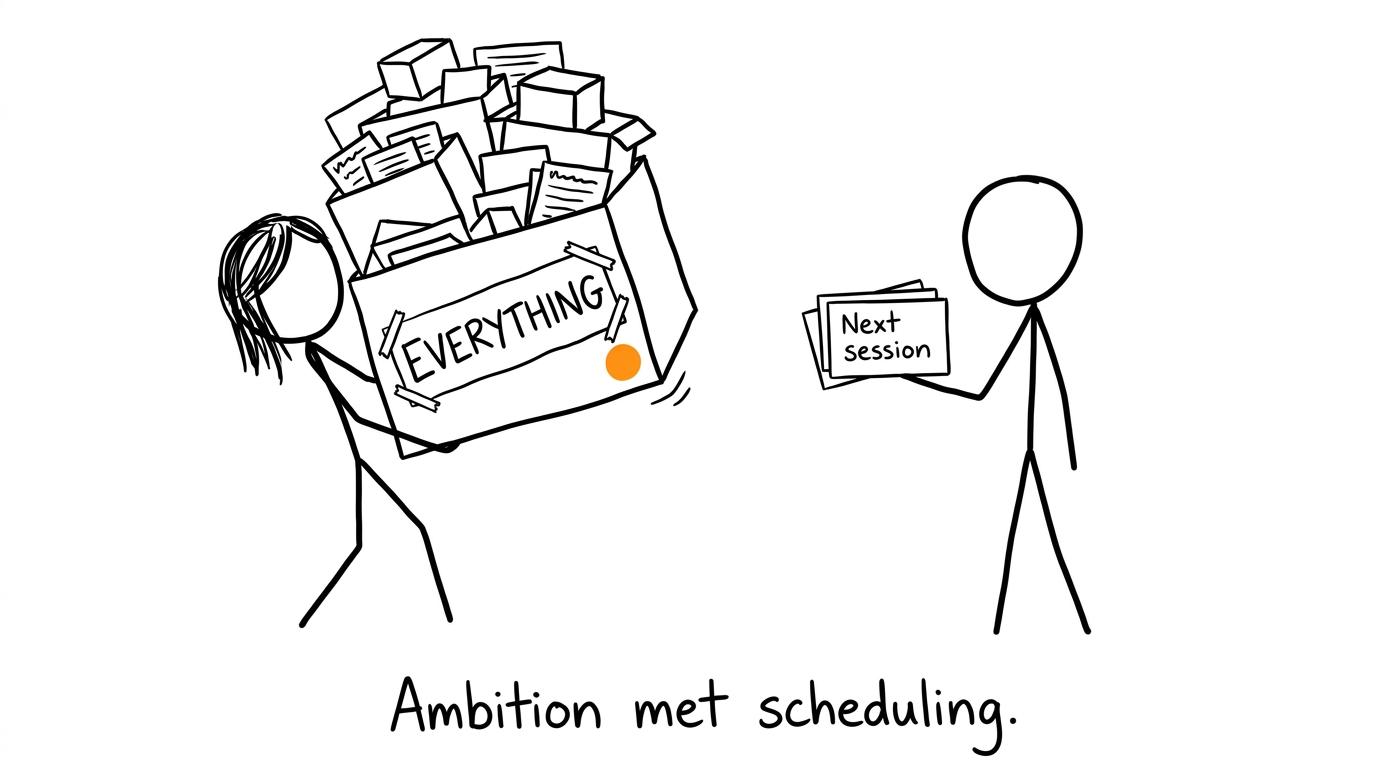 One student carries everything while another sensibly carries only the next three tasks
Protect your maths revision as well
A sociology group should not consume the time needed for your other GCSEs. Group work is valuable when discussion, explanation and feedback add something that independent revision cannot. Routine practice may still be better completed alone.
Put the sociology session inside a wider plan. Maths, in particular, requires regular individual question practice. If your exams are close, use the one-week GCSE maths revision plan to prioritise urgent gaps. With more time available, the one-month maths revision plan offers a steadier structure.
When practising maths papers, choose the correct exam board and tier. Students taking Edexcel can use the organised collection of Edexcel GCSE Maths past papers, complete the appropriate paper under timed conditions and then inspect where marks were lost.
The general lesson crosses subjects: collaboration is useful for explanation and challenge, but every student needs independent evidence that they can perform without the group.
Common GCSE sociology study group mistakes
Inviting too many people
A large group makes scheduling harder and creates space for passive participation. Begin small. Expansion is easier than asking uncommitted members to leave.
Turning explanations into lectures
If one person talks for most of the meeting, others may recognise the content without being able to retrieve it. Require everyone to write or answer before discussion begins.
Revising topics rather than questions
“Families” is too broad for one session. Choose a narrower concept, debate, research-method issue or examination skill and define what you will produce.
Trusting confident answers
Confidence is not a mark scheme. Verify disputed definitions, evidence and question requirements using authoritative course material.
Marking generously
Friendly feedback can become useless feedback. Apply the published criteria carefully and identify exactly what is missing. MathsGenie's advice on using GCSE mark schemes to improve shows why the correction stage matters across written and numerical subjects.
Leaving without a next action
End every session with a topic, date and preparation task for the next meeting. Otherwise, the group's momentum disappears as soon as everyone goes home.
Make the group prove its value
After several meetings, ask a simple question: are members becoming better at answering independently?
If attendance is unreliable, misconceptions remain uncorrected or meetings repeatedly drift into conversation, change the structure. Shorten the session, reduce the membership or return to individual revision for a while. A study group is a tool, not an obligation.
A productive group creates a useful rhythm: remember alone, explain together, verify carefully and practise independently. It does not remove the hard work. It makes the hard work visible.
Set the first agenda, choose a regular slot and give the meeting one clear outcome. Then protect the rest of your revision time with MathsGenie's free revision lessons, practice questions, mini tests, past papers, predicted papers, mark schemes and video solutions. Start at the GCSE Maths revision hub, choose your exam board and let your next completed task decide what happens after that.