

GCSE Sociology Group Chat Study Tips That Work
GCSE sociology group chat study tips to turn memes into useful retrieval practice, essay planning and accountability without making revision feel relentless.

A class group chat can become two completely different things during exam season. It can be a stream of memes, vague panic and messages asking, “What is on Paper 2?” Or it can become a small revision system that helps everyone recall evidence, test arguments and spot gaps before the exam does.
The difference is structure. Effective GCSE sociology group chat study does not mean banning jokes or remaining online all evening. It means giving the chat a clear job: short retrieval questions, focused discussion, answer checking and sensible accountability. This guide shows you how to create that system while protecting enough time and attention for your maths revision too.
The quick group chat checklist
Before the next message disappears beneath twenty reactions, agree on these basics:
- Keep the group limited to classmates you know.
- Choose one Sociology topic for each session.
- Set a start time, finish time and specific task.
- Make everyone retrieve knowledge before checking notes.
- Separate serious revision threads from general conversation.
- Check claims against your specification, textbook or teacher materials.
- Practise application and evaluation, not definitions alone.
- Mute the chat outside agreed revision periods.
- Never share personal information, passwords or private images.
- Report bullying, harassment or worrying content to a trusted adult.
That is enough. A revision group does not need an elaborate constitution. It needs a few rules that make useful behaviour easier than distraction.
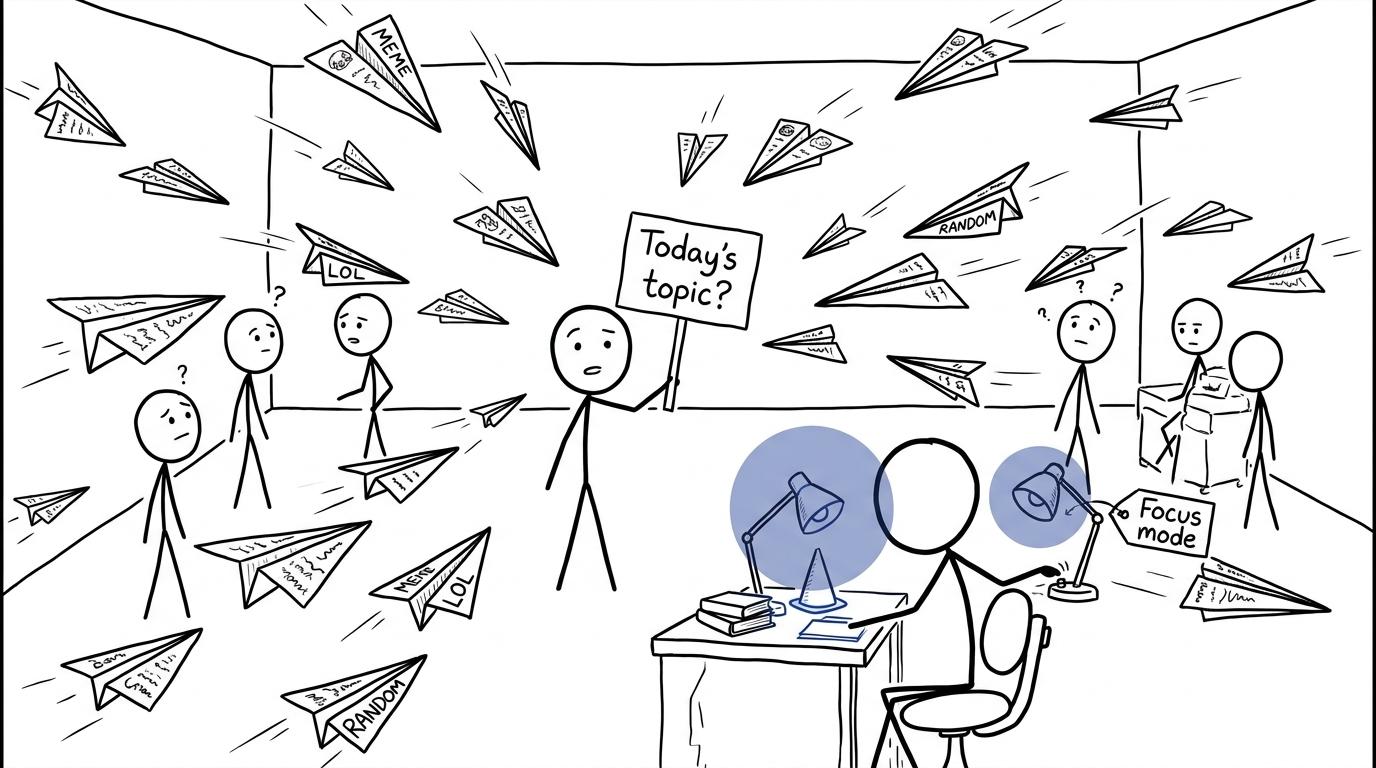 A chaotic class chat becomes focused revision
Give the GCSE Sociology group chat one clear purpose
Most unproductive chats are not filled with lazy students. They are filled with students who have never agreed what the chat is for.
Create a short pinned message explaining that the group exists to:
- test knowledge;
- compare interpretations;
- plan exam responses;
- identify uncertain material;
- share reminders about agreed revision tasks.
Memes can stay, but give them a separate time or channel. A simple rule such as “revision from 7:007{:}007:00 to 7:257{:}257:25, general chat afterwards” preserves the social side without allowing it to consume the session.
Keep the purpose narrow. The chat is not a replacement for lessons, independent revision or teacher feedback. It is a place to practise recalling and explaining what you have already encountered.
Build each session around active recall
Sending a photograph of six pages of notes may feel productive because information has moved from one phone to another. But revision requires more than moving information. Someone has to retrieve it, use it and check it.
One student can post a short set of questions without answers. Everyone replies privately on paper or in a notes app before comparing responses. Useful prompts include:
- Define a key sociological concept.
- Name a relevant sociologist or study.
- Explain one theoretical view.
- Apply a concept to a short scenario.
- Give one strength and one limitation of an argument.
- Suggest an appropriate research method and justify it.
Rotate the question writer so that one person does not carry the group. Creating a good question is itself useful revision because it requires you to distinguish important knowledge from minor detail.
This approach also works for maths. Rather than posting completed solutions immediately, one person can choose a topic from the GCSE Maths revision hub, and everyone attempts the questions independently before using the available mark schemes or video solutions.
Match messages to Sociology assessment skills
GCSE Sociology is not only a memory test. Across GCSE specifications, the assessment objectives cover knowledge and understanding, application, and analysis and evaluation. Exact paper structures and content depend on your exam board, so check the specification used by your school.
Your chat should therefore practise three distinct kinds of thinking.
Knowledge and understanding
Ask for accurate definitions, theories, evidence, methods and named sociologists where required by your course. Answers should use sociological terminology rather than everyday approximations.
Application
Post a short source, claim or hypothetical social situation and ask how a concept applies. The important question is not merely “What does labelling mean?” but “Which detail makes labelling relevant here?”
Analysis and evaluation
Ask members to challenge an explanation, compare perspectives or reach a justified conclusion. A reply such as “Marxists disagree” is only a starting point. The student must explain the disagreement and connect it to the question.
For example, AQA currently organises GCSE Sociology around families, education, crime and deviance, social stratification, theory and research methods. Other specifications may organise or emphasise content differently. Do not let a confident message from a friend overrule your own specification.
Use a simple weekly rhythm
A good group chat routine should reduce decisions rather than create another timetable to manage.
| Day | Group chat task |
|---|---|
| Monday | Post the week’s topic and five retrieval prompts |
| Wednesday | Compare one theory, concept or research method |
| Friday | Plan one exam response and check it against guidance |
| Sunday | Post three weak areas for the following week |
Keep each live session to roughly 202020 to 303030 minutes. Afterwards, everyone leaves the chat and completes their own revision. Long online discussions can create the comforting appearance of work while leaving very little written practice behind.
If GCSE maths needs a more formal schedule, use the GCSE maths revision timetable guide to balance topic practice, marking and timed papers around your other subjects.
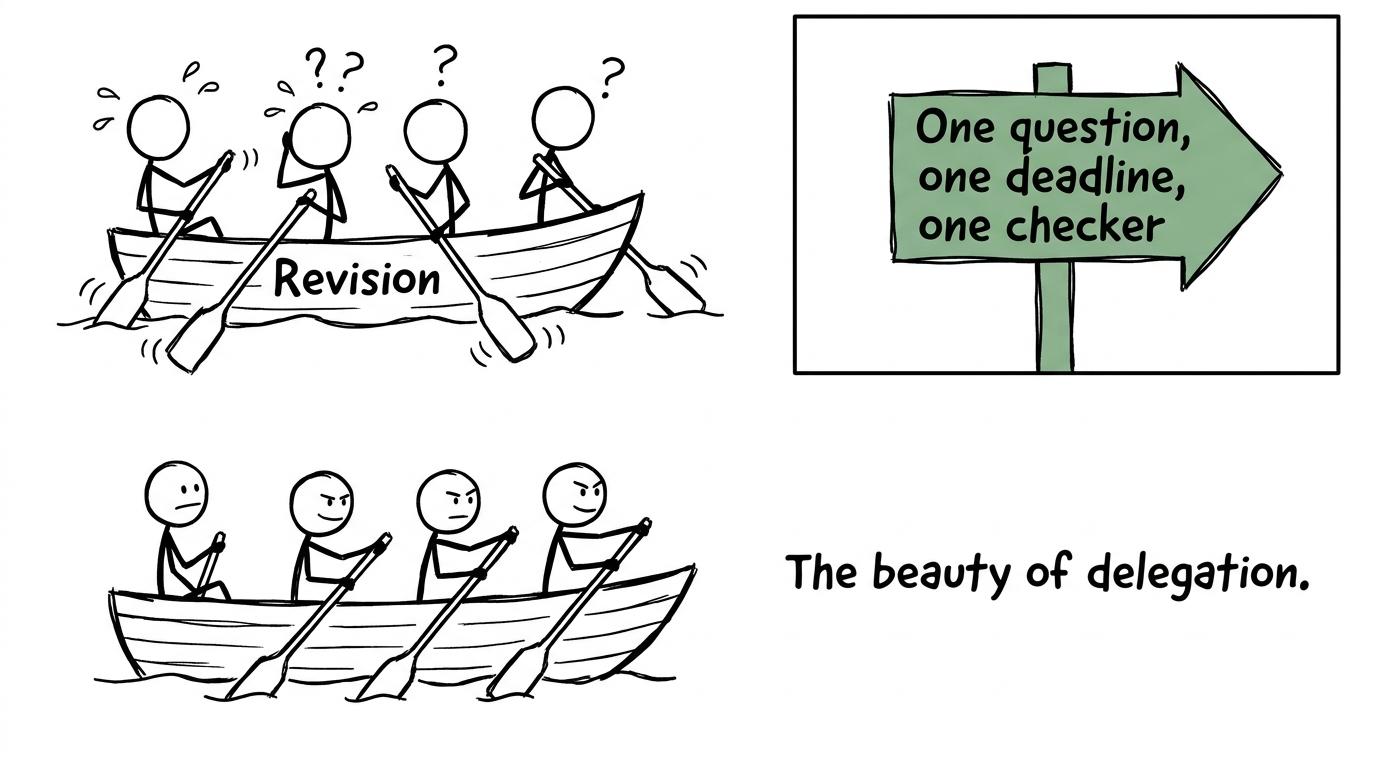 A revision group finally rows in the same direction
Assign small roles without making the chat feel like school
Roles prevent the familiar situation in which one organised person posts everything while everyone else adds a thumbs-up.
Rotate four lightweight responsibilities:
- Host: names the topic and opens the session.
- Questioner: posts the retrieval prompts.
- Checker: compares responses with trusted course material.
- Summariser: posts the final list of uncertainties and next actions.
The checker is especially important. Group chats can spread errors quickly because repeated information begins to feel true. If nobody can verify a claim using the specification, teacher resources, a textbook or an official mark scheme, label it as uncertain and ask your teacher.
For maths, checking is more direct. Students can compare attempts with AQA GCSE Maths past papers and mark schemes, OCR GCSE Maths past papers or the Edexcel GCSE Maths revision hub, depending on their board.
Turn essay discussion into visible practice
Typing “I would mention feminism” is not the same as constructing an argument under exam conditions. Use the chat for planning, then move away from the phone and write.
A focused planning thread might ask each member to contribute one of the following:
- a clear argument;
- relevant evidence or theory;
- an explanation of how it answers the question;
- a counterargument;
- a reasoned judgement.
The group can compare the ingredients, but each student should produce an independent response. This matters because an exam measures what you can organise without live prompts from five classmates.
Do not circulate essays for copying. Instead, discuss why a paragraph is convincing, where application is missing and whether the conclusion follows from the evidence. If your teacher provides a mark scheme or feedback grid, use its wording carefully rather than inventing your own marking rules.
Make accountability specific and kind
“Has everyone revised?” is too vague to be useful. Better check-ins describe an action:
- “Have you completed the five retrieval questions?”
- “Which concept still needs checking?”
- “Have you written the response without the chat open?”
- “What will you revisit tomorrow?”
Avoid public scoreboards, grade comparisons and messages designed to shame absent members. Students have different schedules, responsibilities and support needs. Accountability should make the next step clearer, not turn revision into social pressure.
The same principle improves maths revision. After completing a paper, report the topic that needs attention rather than broadcasting a total mark. MathsGenie’s guide to using GCSE past papers properly explains the useful cycle: attempt, mark, diagnose, repair and retest.
Protect attention, privacy and wellbeing
A study chat stops helping when notifications follow you through dinner, homework and sleep. Agree on quiet hours and use mute settings. Nobody should be expected to answer instantly.
Only include people you know, follow your school’s online behaviour rules and keep personal details private. Do not share passwords, home addresses, live locations, private photographs or another person’s work without permission. Remember that messages and images can be copied or forwarded.
Government safeguarding guidance recognises that harm between children can occur online, including through chat groups. If messages become abusive, threatening, sexual, discriminatory or otherwise worrying, save relevant evidence where safe, leave or mute the conversation, and tell a parent, carer, teacher or your school’s designated safeguarding lead. A revision group is never more important than your safety.
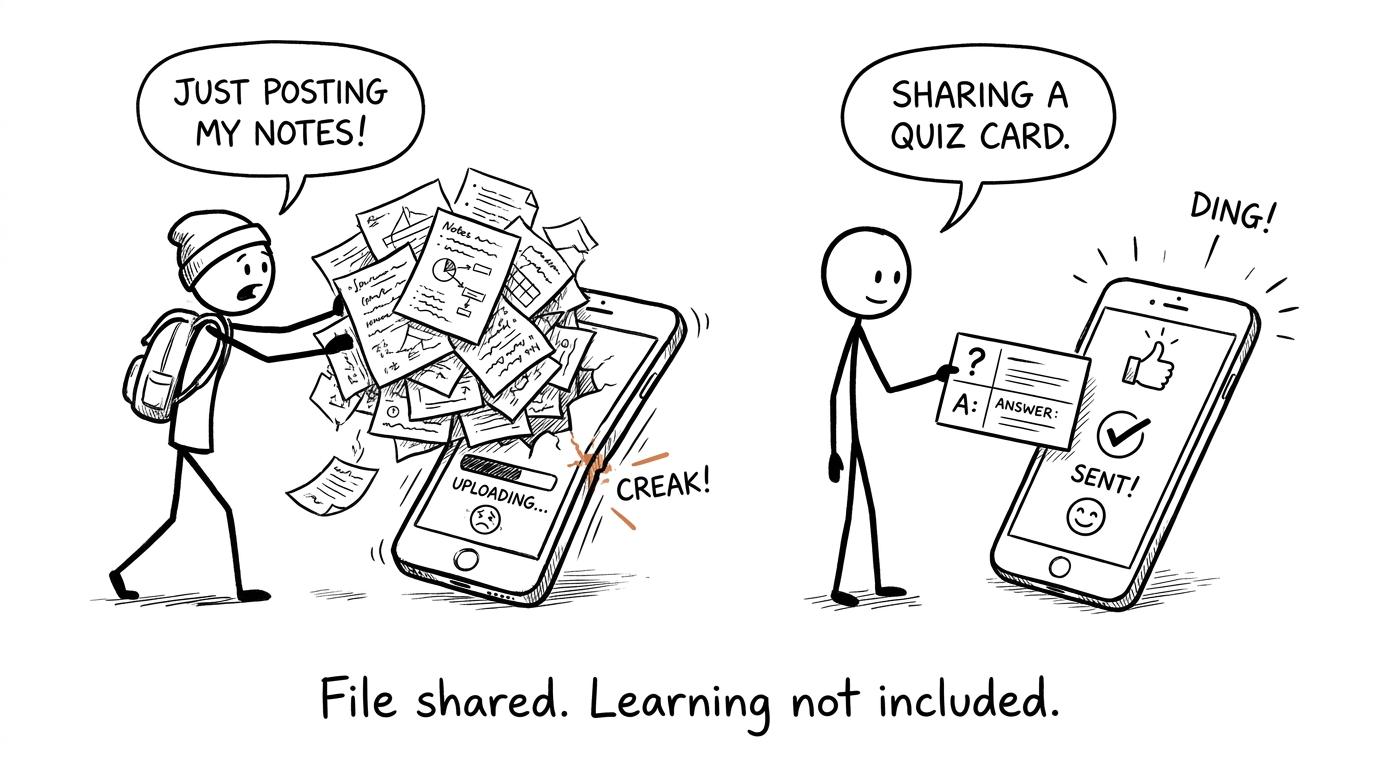 A phone struggles under passive notes but welcomes one useful quiz
Common GCSE Sociology group chat study mistakes
Sharing notes without testing anyone
A folder full of resources is storage, not proof of learning. Follow every shared summary with closed-book questions.
Allowing the fastest reply to dominate
Speed is not the same as accuracy. Give everyone private thinking time before answers appear in the chat.
Trusting confident but unsupported claims
Ask for the source and check it against your specification or teacher materials. Mark uncertain information clearly.
Discussing essays but never writing them
Finish the chat session with independent, timed writing. Planning together cannot replace producing a complete response alone.
Turning every evening into a live session
Constant contact fragments attention. Use a few short sessions and preserve uninterrupted time for Sociology, maths and other subjects.
Mixing exam boards and specifications
A useful resource for one course may contain different topics, studies or paper structures from yours. Confirm your board and specification before revising from shared material.
Letting the chat replace maths practice
Conversation can help with ideas, but maths improvement requires written questions, corrections and repeated attempts. Use Edexcel GCSE Maths mini tests for shorter practice, then move towards Edexcel predicted papers and official past papers when you are ready for exam conditions.
Make the chat smaller than the revision
The best study group chat is almost modest. It starts on time, asks questions that require thought, checks uncertainty and then becomes quiet again. Its value lies in what happens after the phone is put down: recalling a theory, writing an argument, completing a maths question and correcting an error.
Set one topic for your next Sociology session. Post five retrieval prompts, appoint a checker and finish with one independent written task. Then protect a separate block for maths.
MathsGenie can provide the structure for that part of your week. Start with free revision lessons and practice questions, use mini tests to find fragile skills, and progress to past papers, mark schemes, video solutions and predicted papers. A good group can create momentum. Deliberate individual practice is what turns that momentum into marks.











