GCSE Sociology Flashcards Quizlet: Best Decks
GCSE sociology flashcards Quizlet guide: find reliable AQA and Eduqas decks, avoid weak sets, and build accurate cards quickly for active-recall revision.
A large flashcard deck can feel reassuring. Hundreds of definitions sit in neat digital rows, giving the impression that revision is under control. Then you attempt an exam question and discover that recognising a term is not the same as explaining it.
The best GCSE sociology flashcards Quizlet sets are matched to your exact exam board, divided into manageable topics and written as questions that force genuine recall. For AQA, look for separate decks covering families, education, crime and deviance, social stratification, research methods and named sociologists. Eduqas students need decks aligned with their own specification rather than a set carrying only the broad label “GCSE Sociology”.
This guide explains which decks are worth your time, how to check them and how to build a reliable set quickly. If you are balancing sociology with GCSE maths, it also shows how to keep flashcard revision from swallowing the time needed for questions and papers.
The quick checklist for choosing a deck
Before committing to any public Quizlet set, check the following:
- Correct exam board: AQA and Eduqas organise GCSE Sociology content differently.
- Current specification: compare the deck headings with the specification used by your school.
- Complete coverage: definitions alone are not enough; you need theories, studies, methods, evidence and evaluation.
- Short, testable cards: each prompt should have one clear job.
- Accurate attribution: theories and findings must be connected to the correct sociologist.
- Useful topic divisions: smaller decks make weak areas easier to identify.
- Active-recall prompts: questions should make you produce an answer before revealing it.
- Editable content: copy a useful public set and correct or personalise it where necessary.
A deck that passes these checks is usually more valuable than the one with the most cards, likes or colourful images.
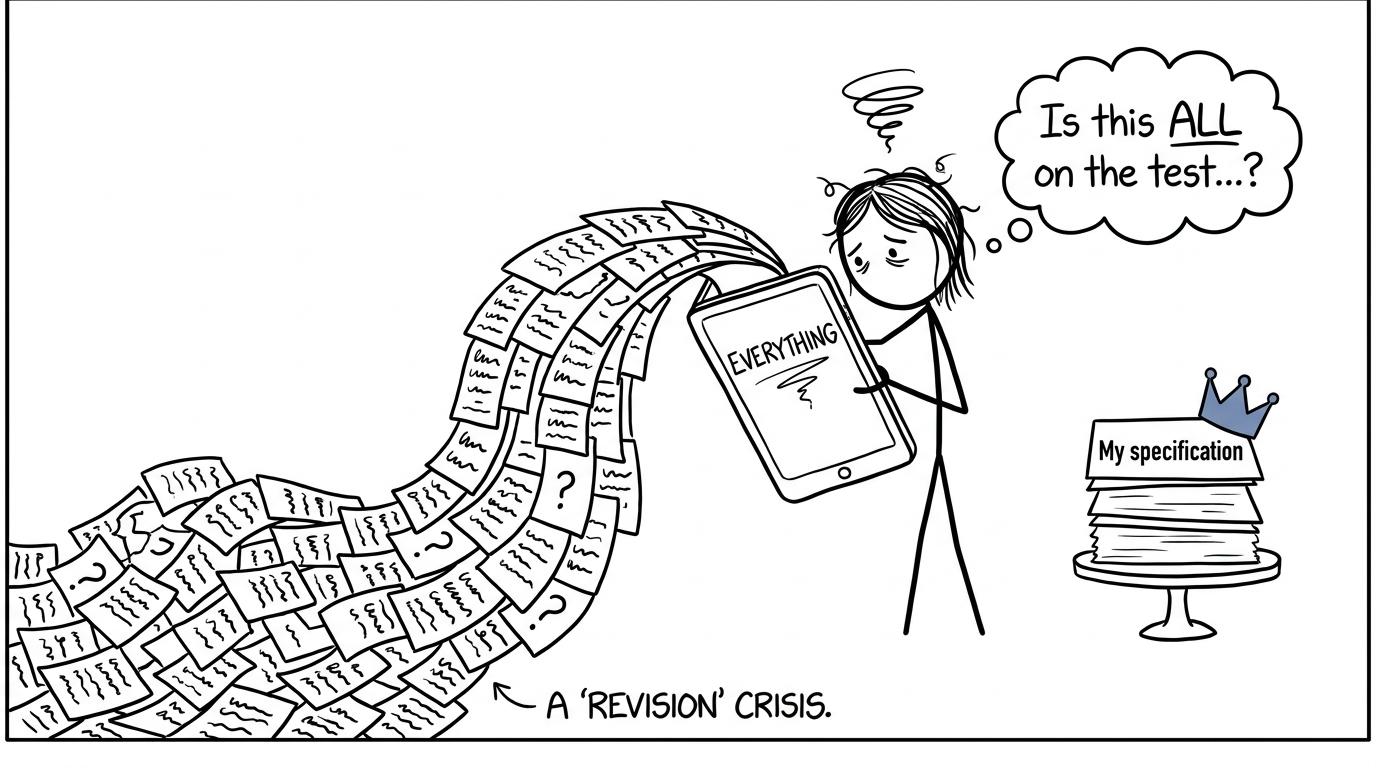 A student chooses a small specification deck over an endless pile of flashcards
Which GCSE Sociology Quizlet decks are worth using?
Public Quizlet sets can be edited, removed or created anonymously, so a permanent league table of individual decks would be misleading. A better approach is to search for specific deck types and audit each one against your official specification.
Board-specific topic decks
These should form the core of your collection. AQA GCSE Sociology specification 8192 covers the sociological approach, families, education, crime and deviance, social stratification and sociological research methods. Its two written papers are each worth half of the qualification, with families and education assessed in Paper 1 and crime and deviance and social stratification in Paper 2. Relevant theory and methodology appear across the course.
Useful AQA search phrases therefore include:
- “AQA GCSE Sociology 8192 families”
- “AQA GCSE Sociology education”
- “AQA GCSE Sociology crime and deviance”
- “AQA GCSE Sociology social stratification”
- “AQA GCSE Sociology research methods”
Eduqas also assesses families, education, crime and deviance, social stratification and research methods, but its content and component structure must be checked against the Eduqas specification. Search for “Eduqas GCSE Sociology” followed by the precise theme you are revising. A public set titled GCSE Sociology EDUQAS: Basic Concepts can be a starting point for terminology, but it should not replace full topic coverage or an accuracy check.
Avoid assuming that a deck is appropriate because its title includes “GCSE”. Unlike maths, where students may be following Edexcel, AQA, OCR or Eduqas, GCSE Sociology availability is more limited. Always use the board named by your school.
Key-concept and definition decks
Concept decks are useful for short retrieval sessions. They should cover terms such as socialisation, norms, values, culture, identity, social control and social stratification, alongside specification-specific vocabulary.
The strongest cards ask for a precise definition and, where appropriate, its sociological significance. Weak cards simply pair a term with a paragraph copied from a textbook. If the answer is too long to recall and check quickly, split it into separate prompts.
Named sociologists and studies decks
Sociology exams require more than anonymous theories. A worthwhile deck connects each named sociologist to the correct topic, argument, evidence and possible criticism. For AQA, compare every name with the specification’s named studies and key ideas rather than trusting a creator’s memory.
This is an area where public sets often become unreliable. A deck may contain A Level material, omit a required study or confuse a broad theoretical perspective with one researcher’s specific argument. Extra knowledge is not automatically helpful if it crowds out what your GCSE mark scheme rewards.
Research-methods decks
Research methods deserve their own set because the vocabulary is dense and the distinctions matter. Look for prompts covering primary and secondary data, qualitative and quantitative data, sampling, questionnaires, interviews, observations, official statistics, validity, reliability, representativeness, practical issues and ethical issues.
The best decks do not stop at definitions. They also test which strengths and limitations apply in a sociological context. That supports the analysis and evaluation demanded by GCSE specifications.
Theory and evaluation decks
Separate comparison decks can help you distinguish functionalist, Marxist, feminist and interactionist explanations. Their purpose is not to memorise an entire essay. They should help you retrieve contrasts, supporting evidence and concise criticisms that can later be developed in exam answers.
How to judge a public Quizlet set in five minutes
Open the deck and inspect a sample from the beginning, middle and end. Then ask three questions.
First, does it follow the specification? Keep the official subject-content list beside you and tick off the headings. A polished deck can still belong to an old course or another exam board.
Second, can each answer be verified? Check unfamiliar claims against class materials, an approved textbook or official exam-board resources. Quizlet lets students and teachers publish sets, but publication is not the same as examination-board approval.
Third, does it prepare you to write? A set consisting entirely of one-word definitions may support basic knowledge, but GCSE Sociology also expects application, analysis, evaluation, reasoned arguments and conclusions. You will still need exam questions and mark schemes.
This principle carries directly into maths. Flashcards can retrieve a formula or method cue, but only questions reveal whether you can use it. MathsGenie’s GCSE maths revision hub combines active-recall flashcards with revision lessons, practice questions, mini tests and papers so recall is followed by application.
How to build your own sociology flashcards fast
Creating every card from scratch can become an elaborate form of avoidance. The aim is not to produce a beautiful archive. It is to create prompts you will actually answer.
Start with the specification headings
Create one Quizlet set for each major topic. Copy the relevant specification headings into a temporary checklist, then turn each assessable idea into a question. This prevents over-revising familiar chapters while missing a smaller required area.
Use reusable card templates
Build prompts around a small group of purposes:
- define a key concept;
- identify a sociologist’s argument;
- recall evidence or a conclusion;
- state a strength or limitation of a method;
- compare two perspectives;
- identify evidence that could support or challenge a view;
- explain how a concept applies within a named topic.
Keep the back concise enough to check, but complete enough to be accurate. If a response contains several independent facts, make several cards.
Import rather than type everything individually
Quizlet supports creating sets from term-and-definition pairs and importing prepared material. Draft the cards in a document or spreadsheet, placing one prompt and answer on each line with a consistent separator. Import the list, inspect the formatting and test a few cards before adding the rest.
Automated tools can accelerate drafting, but they can also introduce incorrect names, vague definitions or content from the wrong qualification. Treat generated cards as a first draft. The specification and your approved materials remain the accuracy check.
Tag the source and topic
Add the board and topic to the title, then record a short source note where helpful. Clear naming matters when your library grows. “AQA GCSE Sociology: Education: Achievement” is more useful than “Sociology Set 7”.
 A student discovers that recognising a flashcard is not the same as recalling it
How to use flashcards so they improve recall
Research on learning consistently supports retrieval practice and spacing. In practical terms, attempt the answer before flipping the card, check it immediately and return to the material across separate sessions rather than cramming it once.
A simple routine is:
- say or write the answer without looking;
- reveal the card and compare precisely;
- mark uncertain answers as still learning;
- revisit difficult cards sooner;
- retest secure cards after a longer gap;
- finish with an exam question that uses the knowledge.
Do not count a card as secure because the answer “looked familiar”. Recognition is easier than recall. Written mode can be especially useful for names and precise concepts because it exposes answers that are nearly right but not accurate enough.
If you are managing several GCSE subjects, place short flashcard sessions inside a wider timetable. MathsGenie’s guide to a realistic GCSE revision timetable explains how to combine recall, practice and marking without turning every evening into a marathon. The twenty-minute maths revision routine offers another compact structure for busy school days.
Flashcards are the beginning, not the exam
A sociology card can help you retrieve a theory. It cannot show whether you can select relevant material, apply it to an item, develop an argument or reach a substantiated judgement. Follow card practice with short and extended exam questions, then compare your response with a mark scheme or teacher guidance.
The same distinction matters in GCSE maths. Knowing a formula feels good; choosing and applying it under time pressure earns marks. Use the guide to finding your weakest GCSE topics to identify gaps, then test them through questions rather than relying on familiarity. As exams approach, start past papers at the right stage and use board-specific resources such as Edexcel GCSE Maths past papers.
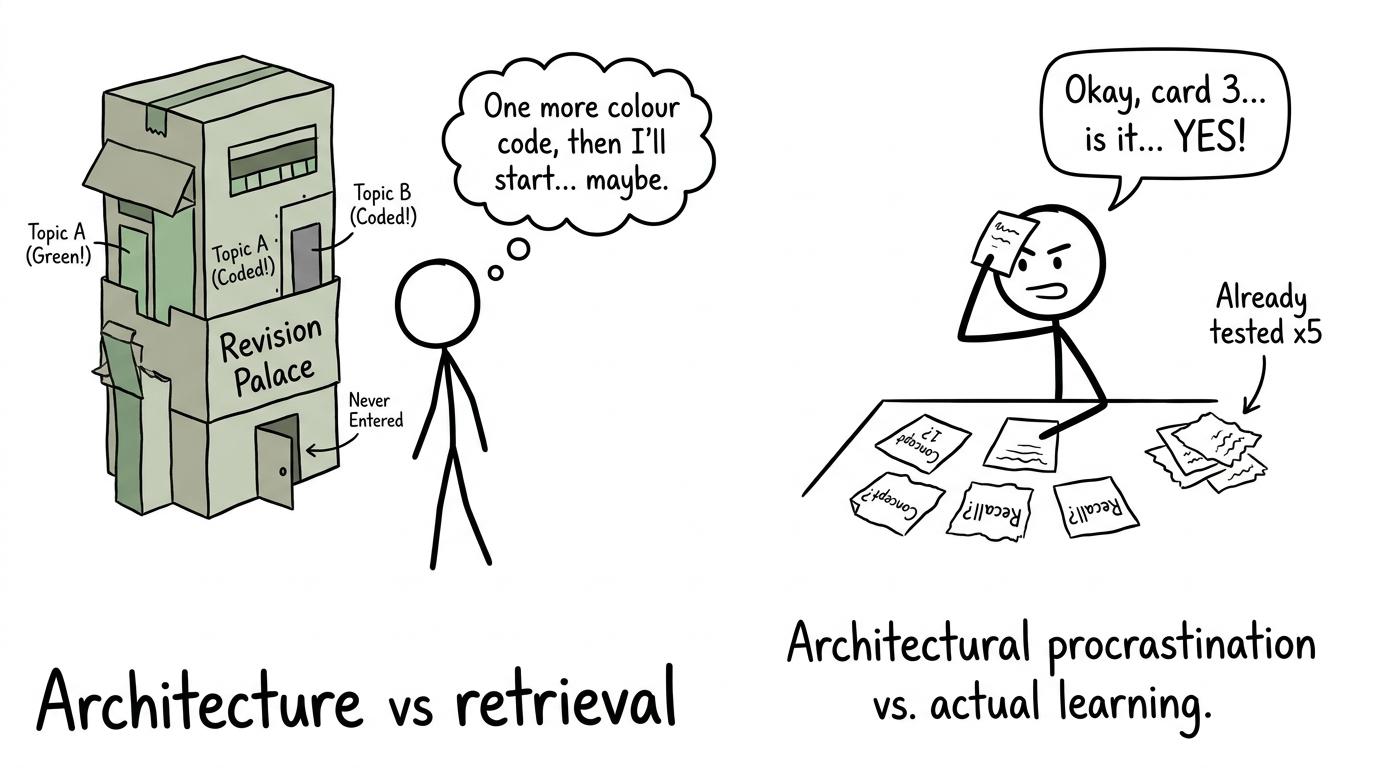 One student builds a flashcard palace while another begins retrieval practice
Common mistakes with GCSE Sociology flashcards
Choosing the biggest deck
A huge deck may mix boards, qualification levels and outdated material. Coverage should be measured against your specification, not the card count.
Copying without checking
Public sets can contain errors. Verify sociologists, theories, findings and definitions before repeated revision makes an error feel familiar.
Reading instead of retrieving
Flipping quickly through visible answers is revision theatre. Hide the answer, commit to a response and then check it.
Writing essay-length cards
Long answers are difficult to retrieve and diagnose. Split complex material into focused prompts, then practise assembling those ideas in exam questions.
Learning only definitions
Definitions support knowledge, but higher-quality answers also need application, analysis and evaluation. Include studies, comparisons, evidence and criticisms.
Ignoring difficult cards
Students naturally enjoy revising what they already know. Use the “still learning” pile as your priority list, just as a marked paper should direct your next maths session.
Replacing exam practice with Quizlet
Flashcards strengthen memory; they do not reproduce the demands of an examination. Build towards timed writing in sociology and timed questions in maths. MathsGenie’s one-month GCSE revision plan demonstrates how retrieval, topic practice, mini tests and papers can work together.
Build a smaller deck and use it better
The best GCSE Sociology deck is not necessarily the one everyone else has saved. It is the one that matches your board, covers the specification accurately, separates topics clearly and makes you retrieve knowledge before revealing it.
Begin with a carefully checked public set if it saves time. Copy it, remove irrelevant cards, correct weak definitions and add the studies or evaluation points your course requires. Then use the cards over spaced sessions and prove the learning through exam questions.
For the maths side of your GCSE revision, make MathsGenie your next step. Open the free GCSE maths revision area, choose your board and tier, and move from active-recall flashcards to revision lessons, practice questions and mini tests. Finish with past papers, predicted papers, mark schemes and video solutions. Memory starts the process. Carefully marked practice completes it.