

GCSE Results Day Timeline: August to September
GCSE results day timeline for 2026, covering grades, sixth-form or college enrolment, reviews, resits and induction from August to September.
Results day can feel as though your entire future has been folded into one small envelope or login screen. In reality, it is the beginning of a process, not a single verdict. This GCSE results day timeline explains what happens after GCSE results: collecting your grades, confirming a sixth-form or college place, considering a review, arranging any maths resit and attending induction.
For 2026, GCSE results are released to students on Thursday 20 August. Your school decides its collection arrangements, so check its email, website or letter before travelling.
Your results day checklist
Have these ready before results day:
- your school’s collection time and login details, if results are online
- your sixth form or college offer and its entry requirements
- enrolment instructions, deadlines and contact details
- photographic identification if either institution requests it
- a charged phone, pen and folder for documents
- a parent, carer or trusted adult who can help you think calmly
- a realistic second choice, even if you expect to meet your offer
The useful question is not simply, “Are these grades good?” It is, “What do these grades allow me to do next?”
GCSE results day timeline at a glance
This table is a practical timeline graphic description for the journey from results morning to the start of term. Exact enrolment and induction dates vary by provider.
| Time | What usually happens | Your next action |
|---|---|---|
| Before 20 August | Schools publish collection or online-access instructions | Check times, documents and offer conditions |
| 20 August, results day | You receive grades and speak to school staff | Compare results with course requirements |
| Results day to late August | Sixth forms and colleges confirm places and subjects | Enrol promptly or discuss alternatives |
| Late August | Course changes, waiting lists and post-results discussions continue | Keep written records and reply to messages |
| Early September | Induction, timetable collection and initial assessments begin | Attend every session and ask questions |
| By 24 September | The 2026 JCQ deadline for most June-series reviews of results arrives | Raise concerns with your school well beforehand |
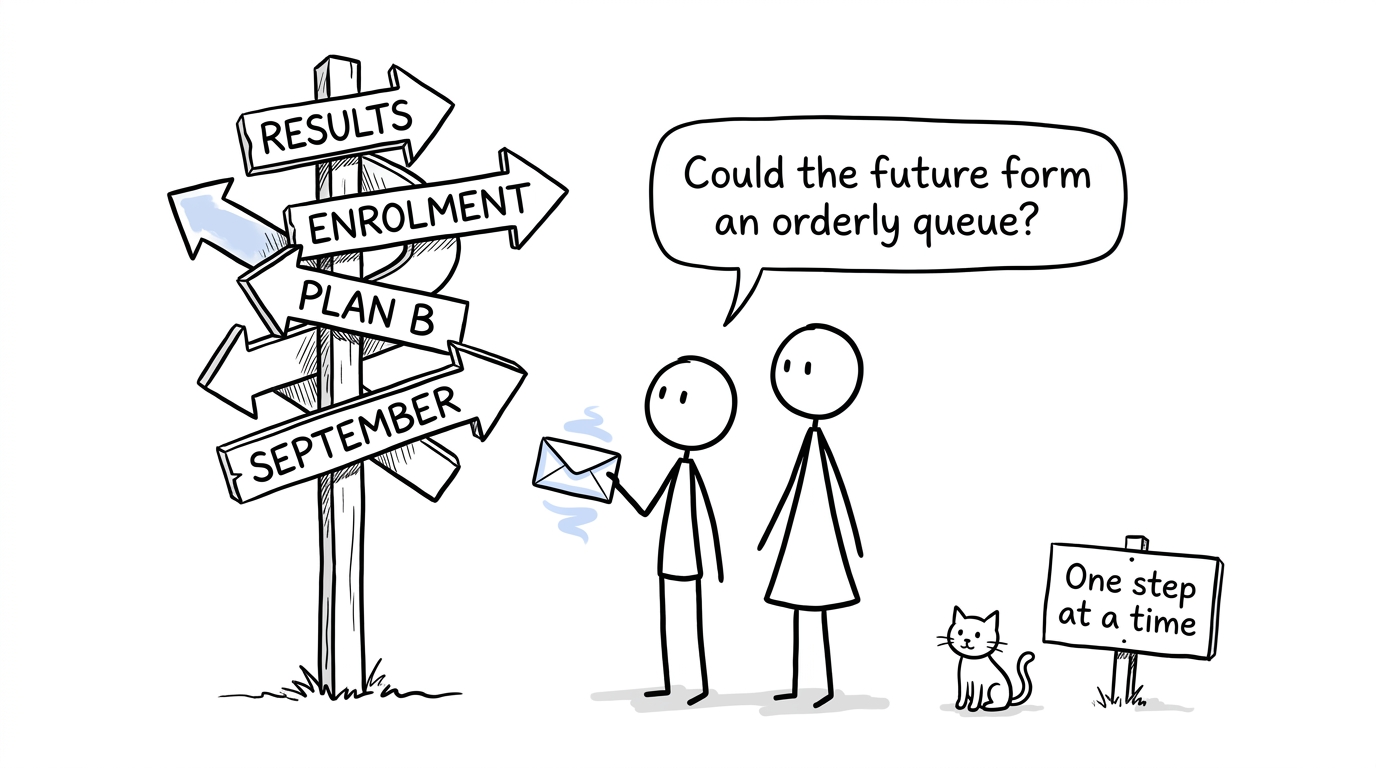 A student and parent navigating a comically complicated results-day signpost
Results morning: collect, read and pause
GCSE results cannot be released to candidates before 8:00 am on 20 August 2026, although your school may open later. You will normally receive a results slip showing each subject and grade. Certificates follow later and should be stored safely.
Read the whole slip before reacting to one result. Then speak to the teachers, careers staff or exams officer available. If a grade affects your next destination, contact the sixth form or college immediately rather than assuming the answer is no.
Parents can help by keeping documents together, noting names and deadlines, and letting the student lead conversations where possible. Results morning rewards calm administration more than instant certainty.
Results day to late August: enrolment and course decisions
If you meet your offer, follow the provider’s enrolment instructions. Some enrol students on results day; others use online forms or appointments during the following week. A place is not always fully secured until you complete the requested steps.
If you narrowly miss an entry grade, speak to the provider. It may consider your complete results profile, offer a related course or suggest a different subject combination. Flexibility is never guaranteed, but a conversation gives you more information than silence.
Bring or upload the evidence requested by the provider. JCQ advises that sixth forms and further education colleges may require centre-endorsed results, such as a school-issued printout. A screenshot may not be sufficient.
Students hoping to take A Level Maths should check the provider’s specific GCSE Maths requirement. If the course is confirmed, GCSE to A Level Maths guidance explains how the curriculum develops. You can then explore the free A Level Maths revision hub without trying to learn the entire course before September.
When a grade is lower than expected
First, separate disappointment from evidence. Being close to a grade boundary does not automatically mean the marking was wrong.
Ask your school or college about access to scripts. A teacher may inspect the marked paper and advise whether there appears to be a genuine marking error. Your centre can then request an administrative re-check or review of marking from the exam board.
A review is not a fresh attempt to award extra marks. The mark and grade can remain unchanged, rise or fall, and your written consent is required. Fees and the centre’s internal deadline can vary. For the June 2026 series, awarding bodies must receive most review requests by 24 September 2026, so schools commonly set earlier internal deadlines.
Planning a GCSE Maths resit
In England, students on relevant post-16 programmes who have not achieved grade 4 in GCSE Maths or English generally need to continue studying the subject. Your college or sixth form will explain whether and when it intends to enter you.
GCSE Maths and English Language are available in the November series for eligible students aged at least 16 by 31 August. Other GCSE subjects are normally retaken in a later summer series. Rules can differ across the UK, so follow guidance from your school, provider and exam board.
A lower maths grade does not erase what you already know. It identifies the next task. Read what happens if you do not pass GCSE Maths, then use the GCSE Maths revision hub to find resources for AQA, Edexcel, OCR and Eduqas.
For focused preparation, choose your board’s materials, such as Edexcel GCSE Maths revision or AQA GCSE Maths revision. Start with topic practice, use mini tests to expose gaps, and only then return to timed papers.
Early September: induction and the first week
Induction turns an offer into an ordinary routine. You may receive your timetable, meet tutors, confirm subjects, learn attendance expectations and complete baseline activities. Attend even if a review is pending unless your provider tells you otherwise.
If your subjects change, ask what work you need to catch up. If you are resitting maths, confirm the lessons, likely exam series and who manages entries. Keep checking your student email because timetable and room changes are common at the start of term.
 A student bringing every possible worry to sixth-form induction
Common mistakes after GCSE results
Waiting before contacting the provider
Enrolment windows can be short. Contact the sixth form or college on results day if a grade affects your place.
Treating a review as risk-free
Marks can move down as well as up. Discuss the script, cost, deadline and likely benefit with your school before consenting.
Assuming a maths resit will be arranged automatically
Ask your new provider who will enter you and when. Do not leave the conversation until the entry deadline approaches.
Revising everything at once
A resit plan should begin with diagnosis. Use MathsGenie’s revision planner and the GCSE resources collection to organise lessons, practice questions, mark schemes, mini tests, past papers and predicted papers.
From one envelope to a workable plan
What happens after GCSE results is usually less dramatic than it first appears: you read, ask, enrol, confirm and prepare. One grade may alter the route, but it rarely removes every route.
Once your destination is settled, make MathsGenie your next practical step. Review GCSE foundations, prepare for a resit or begin the transition to A Level with free revision lessons, practice questions, video solutions, mark schemes, past papers and predicted papers. Start with the resource that matches your next course, then take the next decision one at a time.











