

GCSE Religious Studies Resit: Your Revision Plan
GCSE Religious Studies resit plan covering entries, specifications, weekly milestones, past papers, mark schemes and focused exam practice after results day.
Results day can make one grade feel larger than everything else on the page. But a GCSE Religious Studies resit is not a judgement on your ability. It is a second attempt made with something valuable you did not have before: evidence about what went wrong.
Your first actions are practical. Speak to your school or college, confirm the exam board and specification, and ask whether it can enter you for the next available series. Religious Studies is normally retaken in the following summer exam period rather than the November series used for GCSE English Language and maths. Resitting Religious Studies is optional, but it may be worthwhile if a higher grade supports your next step.
Your resit checklist after results day
Before beginning GCSE Religious Studies retake revision, complete these tasks:
- ask your exams officer whether a review of marking should be considered;
- confirm whether you will resit through your school, college or an approved private centre;
- identify your exact exam board and specification code;
- check which religions, themes and components you must prepare;
- ask about entry deadlines, centre fees and access arrangements;
- obtain your original marks or paper breakdown where available;
- set a realistic target grade and weekly revision time.
Do not assume that every Religious Studies course assesses the same content. AQA, Pearson Edexcel, OCR, Eduqas and WJEC use different paper structures, options and command words. Start from the GCSE Religious Studies revision hub, then choose the correct board rather than revising whichever resources appear first in a search.
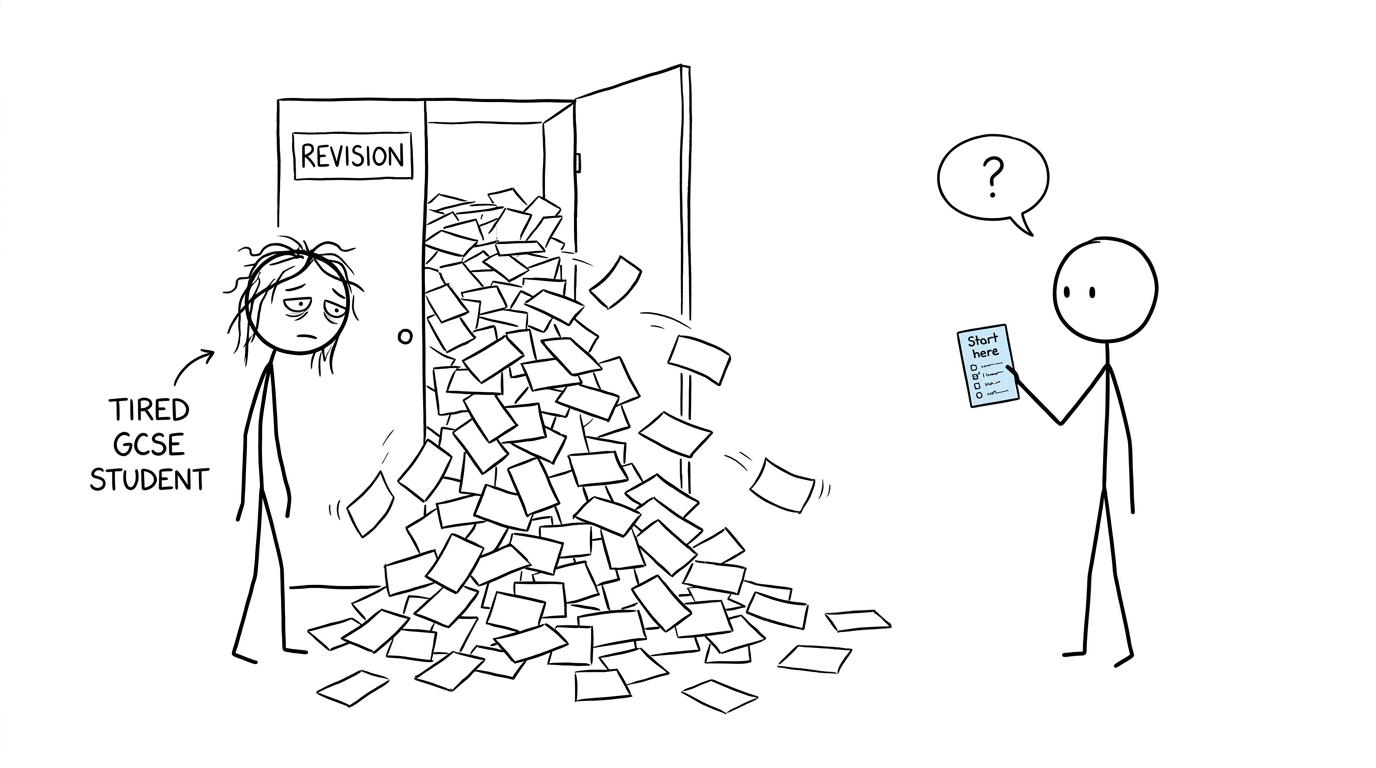 A student chooses a small revision checklist instead of a cupboard overflowing with flashcards
Milestone one: diagnose the lost marks
During the first week, resist the urge to reread the entire textbook. Begin with diagnosis.
If your school can provide a component breakdown, compare performance across papers. Then complete one past-paper section under timed conditions and mark it strictly. Record each lost mark under one of four headings:
- knowledge: a belief, practice or teaching was missing or inaccurate;
- evidence: the answer lacked a relevant source of wisdom or authority;
- explanation: a point was stated but not developed;
- evaluation: arguments were listed without analysis, comparison or a justified conclusion.
This turns disappointment into a manageable list. The same evidence-led process is explained in MathsGenie's guide to finding your weakest GCSE topics.
Assessment objectives matter here. Across GCSE Religious Studies specifications, AO1 concerns knowledge and understanding, while AO2 concerns analysis and evaluation. They are generally weighted equally, so memorising content without practising arguments leaves a major part of the qualification untouched.
Milestone two: rebuild specification knowledge
Spend the next four to six weeks repairing the gaps revealed by your diagnosis. Divide the specification into small units: beliefs, teachings, practices, sources of authority and ethical themes.
For each unit, create a one-page summary containing:
- precise definitions of specialist terms;
- two or three central beliefs;
- relevant practices and their significance;
- short, accurate sources of wisdom or authority;
- similarities and differences within or between traditions;
- contrasting religious and non-religious viewpoints where required.
Use active recall rather than copying. Close your notes and explain a belief aloud, complete flashcards from memory, or write everything you remember before checking for omissions. If you take AQA A, the AQA A Religious Studies revision page brings together lessons, revision guides, flashcards, questions and papers. Short-course candidates should use the separate AQA Short Course resources.
Check that resources match your chosen options. For example, an AQA candidate preparing Hinduism can use the Hinduism beliefs and teachings guide, while a candidate revising ethical issues may need the religion and life revision guide. OCR students can find focused material such as the peace and peacemaking revision guide.
AQA A and AQA Short Course introduced some question changes from summer 2026 onwards, while AQA B was unaffected by that update. If you are resitting later, use current specification material and sample assessment resources rather than relying only on an older paper's wording.
Milestone three: turn knowledge into answers
Once your knowledge is secure, spend four weeks practising exam responses. Your aim is not to produce one memorised essay. It is to become flexible enough to answer the wording in front of you.
Use short questions to test accurate recall, then move to explanation and evaluation tasks. When evaluating, develop arguments on both sides, connect them to religious teaching and reach a conclusion that explains why one argument is more convincing. A conclusion that merely repeats the statement adds little.
After every task, use the mark scheme. Highlight the phrase or idea that would have earned each missing mark, then rewrite only the weakest paragraph. This is faster and more useful than repeatedly writing complete answers without correction.
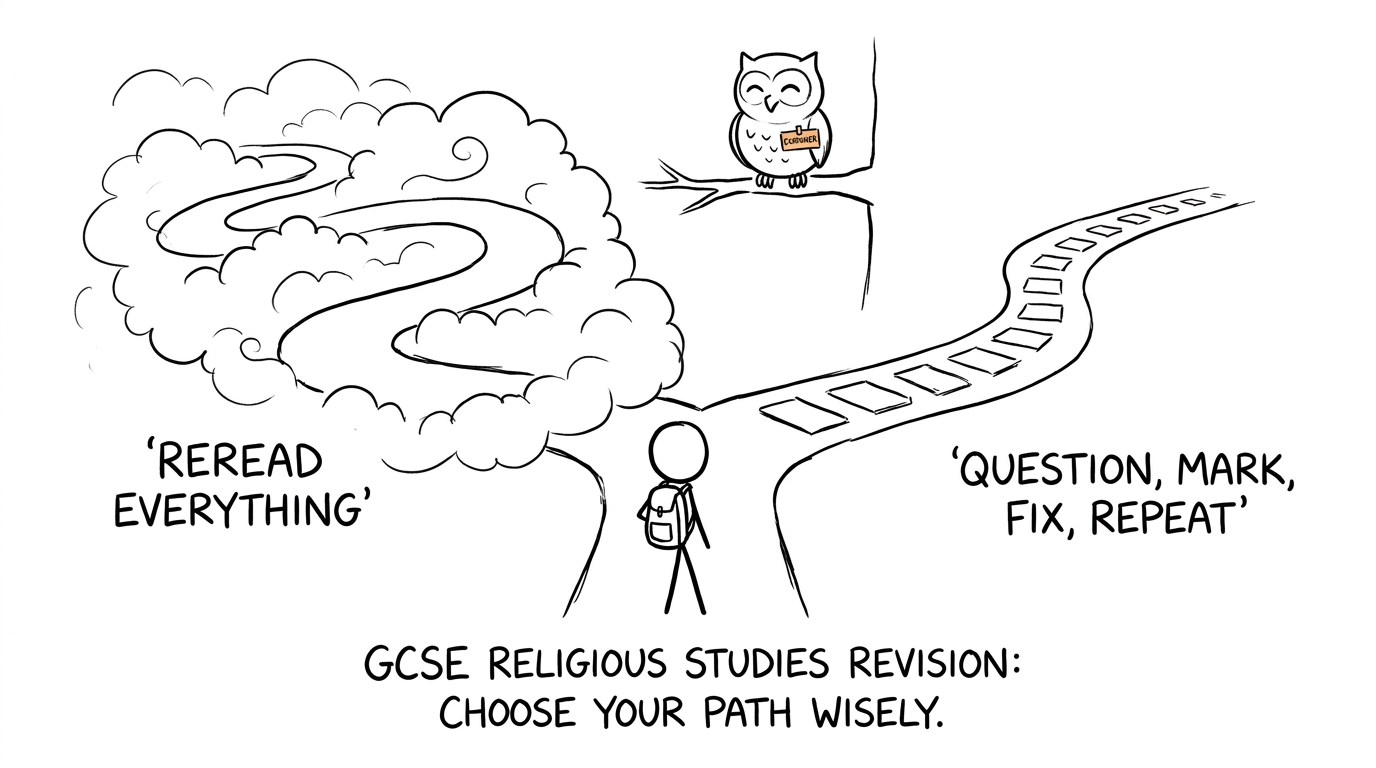 A student takes the stepping-stone path labelled question, mark, fix and repeat
Milestone four: build timed-paper confidence
In the final six to eight weeks, complete increasingly long timed sections before attempting full papers. Use this cycle:
- sit the correct paper without notes;
- mark it immediately using the official mark scheme;
- update your error log;
- revise the two most expensive weaknesses;
- answer fresh questions on those areas;
- retest them several days later.
A past paper is a diagnosis until you act on its results. MathsGenie's guide to using GCSE past papers properly explains how to move from paper to mark scheme, correction and retesting. The Religious Studies hub provides board-specific past papers, worksheets and revision material in one place.
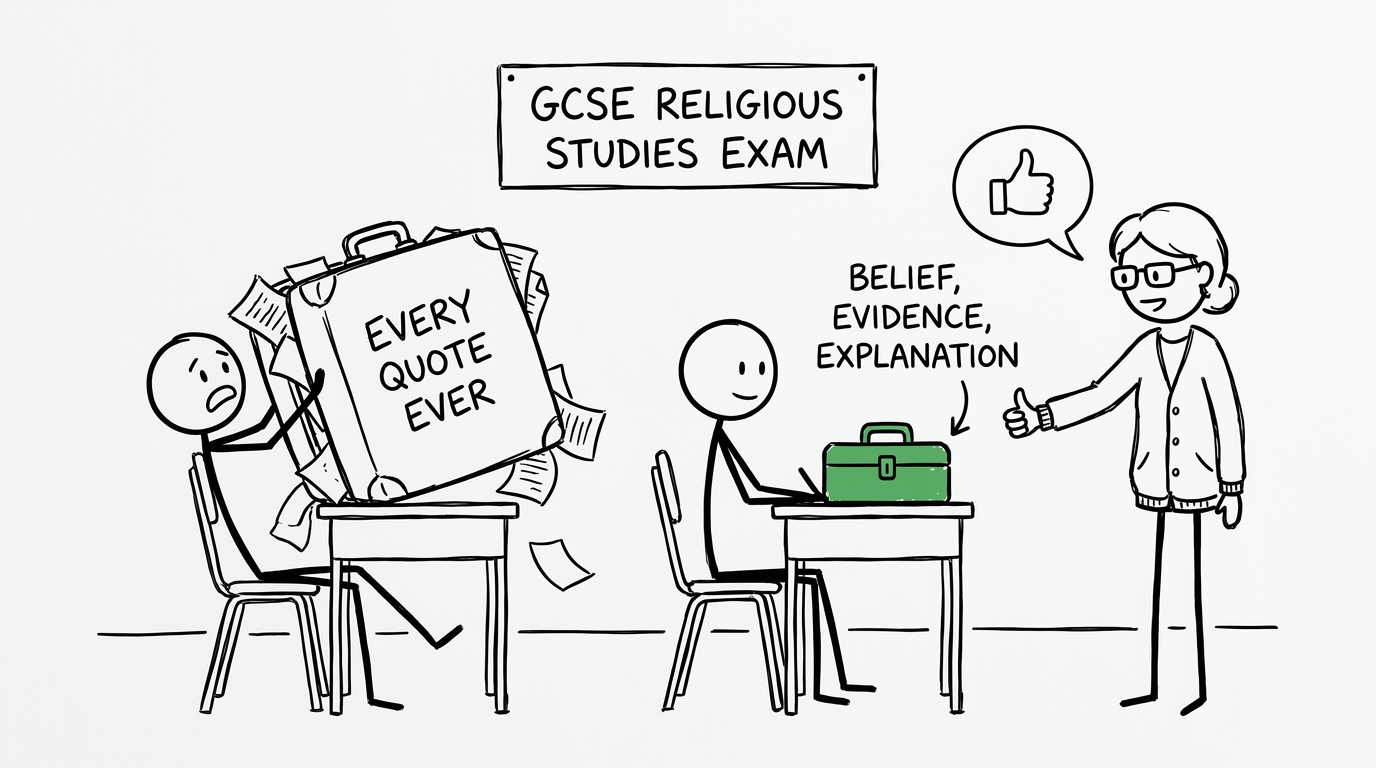 One student brings every quotation in a suitcase while another carries a small organised evidence toolbox
A sustainable weekly resit routine
A practical week might include three focused sessions:
- Session one: retrieve one beliefs or practices unit, then correct gaps;
- Session two: complete short and extended questions on one theme;
- Session three: sit a timed section, mark it and update the error log.
Add a brief review of older content at the start of each session. This matters when you are balancing a resit with a new course or compulsory English and maths revision. If maths is also part of your workload, keep its materials separate in the GCSE Maths revision hub so each subject has a clear plan.
Common GCSE Religious Studies resit mistakes
Revising the wrong option: Exam boards offer different religions, routes and themes. Check your statement of entry and specification.
Collecting too many quotations: A smaller bank of accurate, versatile sources is more useful than dozens you cannot apply.
Rereading without retrieval: Familiar notes can create an illusion of knowledge. Close the page and test what you can reproduce.
Ignoring AO2: Strong factual recall cannot replace analysis, comparison and reasoned evaluation.
Completing papers without fixing errors: Your grade improves during the correction and retesting stage, not when another unmarked paper joins the pile.
Leaving the entry arrangement too late: Schools, colleges and private centres set deadlines and may charge different fees. Contact the exams officer early and check your statement of entry carefully.
Make the second attempt more deliberate
Resitting GCSE Religious Studies is not about repeating the same year with more determination. It is about changing the system: correct specification, smaller revision units, active recall, timed answers and honest use of mark schemes.
Begin at MathsGenie's GCSE Religious Studies past papers and worksheets hub. Choose your exam board, diagnose one paper and build your next week around the marks you lost. With free revision lessons, practice questions, worksheets, past papers, predicted papers, mini tests and mark schemes, your resit can become a structured project rather than a lingering worry.











