GCSE Religious Studies Exam Clash Same Week Plan
GCSE religious studies exam clash same week? Balance RS and maths with active recall, targeted practice, sensible priorities and calm exam routines.
There is a particular kind of panic that arrives when you look at your exam timetable and see Religious Studies surrounded by maths, science, English or another demanding subject. Every paper seems urgent. Every evening already feels claimed.
If you are searching for help with a GCSE religious studies exam clash same week, the immediate answer is this: prioritise the next exam without abandoning the subjects that follow. Give Religious Studies short, active recall sessions; protect regular maths practice; and reduce the workload after each paper rather than trying to revise everything equally every day.
A crowded week is not solved by finding endless hours. It is solved by making fewer, better decisions.
Your same-week revision checklist
Before planning individual sessions:
- Check your personalised timetable, including morning and afternoon sessions.
- Confirm the exam board, paper, component and duration for every exam.
- Ask your school’s exams officer immediately if two papers appear to be in the same session.
- Identify what must be recalled for Religious Studies and what must be practised for maths.
- Give the nearest paper the largest share of your attention.
- Keep later subjects alive with short maintenance sessions.
- Mark practice instead of merely completing it.
- Protect sleep, meals, travel time and breaks.
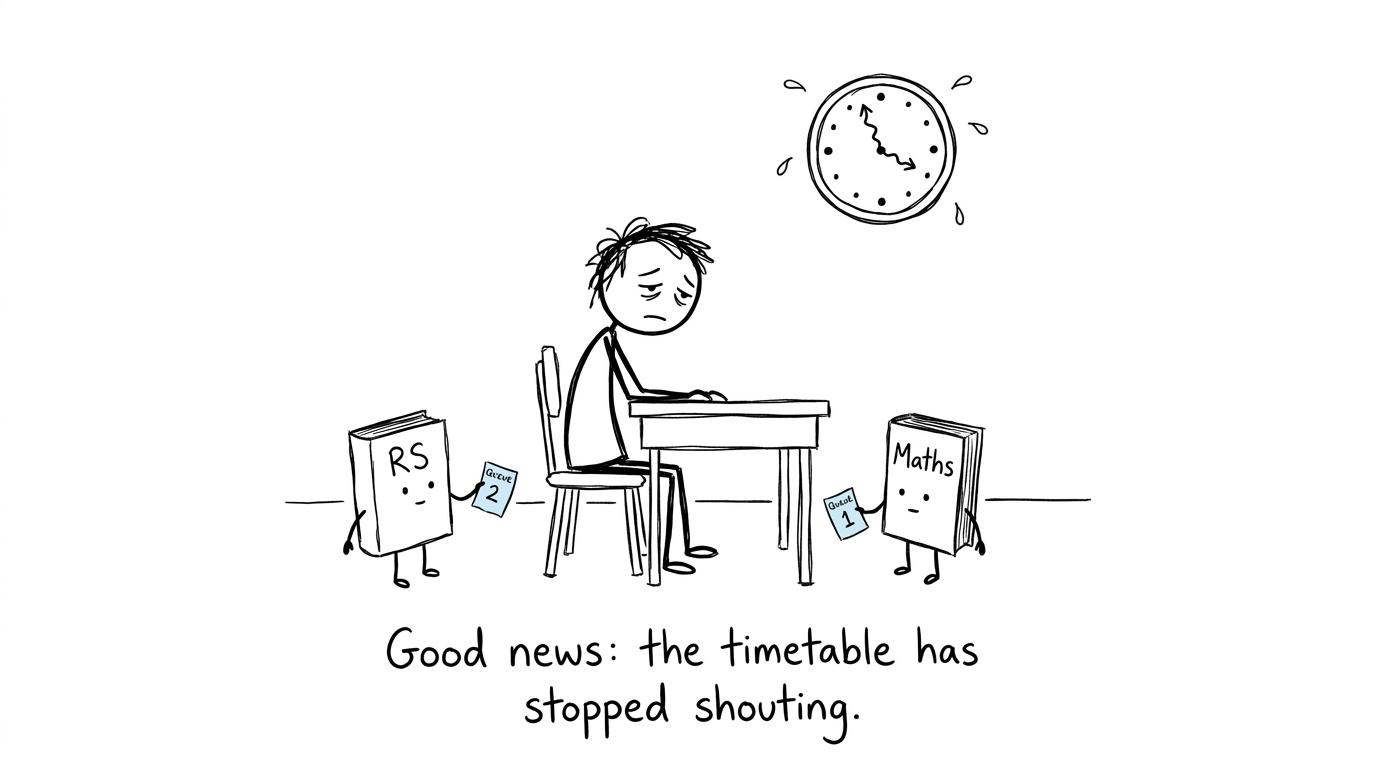 Two revision books calmly take their places in the timetable
Is it an exam clash or simply a difficult week?
Students often use “clash” to describe two different problems.
A same-week pressure problem means that several exams fall within a few days. You can manage this through prioritisation and careful revision blocks.
A formal timetable clash means that two examinations for which you are entered have been scheduled in the same session. GCSE papers are placed into common morning and afternoon sessions, but individual subject combinations can still create complications. Your school must manage the arrangements under the relevant examination rules.
Do not attempt to solve a formal clash yourself. Speak to your exams officer as soon as you notice it and follow the arrangements your school provides. Do not rely on a general online timetable because your personal entry, paper code and component choices matter.
For an ordinary same-week squeeze, however, the solution belongs on your revision plan.
Split attention according to urgency and need
Equal time sounds fair but is rarely sensible. Subjects do not have identical demands, and papers do not arrive at identical times.
Think of your available revision time as:
Ttotal=TRS+Tmaths+Tother+TrestT_{\mathrm{total}} = T_{\mathrm{RS}} + T_{\mathrm{maths}} + T_{\mathrm{other}} + T_{\mathrm{rest}}Ttotal=TRS+Tmaths+Tother+TrestRest belongs in the equation. If you pretend it does not, it will usually reappear as slower thinking, drifting attention or an evening in which little useful work happens.
Give the next exam priority
The exam happening tomorrow should normally receive the largest block today. That does not mean giving it the entire evening.
If Religious Studies comes first, use the main session for beliefs, teachings, practices, themes, quotations and answer planning. Keep maths moving with a short set of questions from one weak topic.
If maths comes first, reverse the balance. Use the longer block for mathematical questions and corrections, then complete a compact RS recall session.
This is rolling prioritisation. Once one paper finishes, the next paper inherits the main block.
Adjust for weakness as well as date
Urgency is only one factor. A subject in which you are currently dropping many marks may need more attention than a later paper you already handle confidently.
Use evidence rather than anxiety. A marked paper, mini test or teacher assessment tells you more than the feeling that you are “bad at everything”. The MathsGenie guide to finding your weakest GCSE topics can help you turn lost marks into a manageable shortlist.
Revise RS and maths differently
Religious Studies and maths place different demands on you. Treating them as though they require the same revision method wastes time.
Use retrieval and answer plans for Religious Studies
RS revision should make knowledge available without the textbook open. Useful tasks include:
- recalling beliefs, teachings and practices from memory;
- matching teachings or sources of authority to specification topics;
- creating brief plans for extended responses;
- comparing religious and non-religious viewpoints where required;
- checking how your exam board awards marks;
- correcting missing knowledge after self-testing.
The exact paper structure differs between AQA, Edexcel, OCR and Eduqas, so use your own specification and teacher guidance. Do not copy a revision plan designed for a different board and assume the components match.
Avoid spending the entire session decorating notes. A neat page may organise information, but it does not prove that you can retrieve or apply it under exam conditions.
Use questions and feedback for maths
Maths needs active performance. Reading a method can remind you what to do, but only questions reveal whether you can select and carry out that method independently.
Start at the GCSE Maths revision hub, choose your exam board and work at the correct foundation or higher tier. A productive short session has four parts:
- choose one precise weakness;
- review the relevant revision lesson;
- attempt practice questions without copying;
- use the mark scheme or video solution to correct errors.
During a crowded week, focused questions are often more useful than beginning a complete paper you do not have time to mark. If you need a broader structure, use the GCSE one-week maths revision plan.
Build a rolling plan around the papers
A useful plan has three layers rather than a minute-by-minute schedule that collapses after one delay.
The main block
Reserve your longest session for the nearest demanding exam. Decide the output before starting: a set of RS themes retrieved from memory, an extended-response plan, a maths mini test or a section of a paper.
“Revise RS” is too vague. “Recall the key teachings for one specified theme and plan two responses” gives the session an ending.
The maintenance block
Use a shorter block to stop the next subject becoming cold. For maths, that might mean a mini test, several questions from an error log or corrections from a marked paper. For RS, it could be flashcard retrieval or one answer plan.
Maintenance matters because restarting a completely neglected subject can feel harder than continuing one you have touched briefly each day.
The buffer
Leave part of the evening unallocated. School may finish late. An exam may be tiring. A question set may take longer than expected.
A plan with no buffer assumes a perfect day. Exam week rarely provides one.
The MathsGenie GCSE revision timetable guide explains how to build repeatable sessions around weak topics, timed work and corrections.
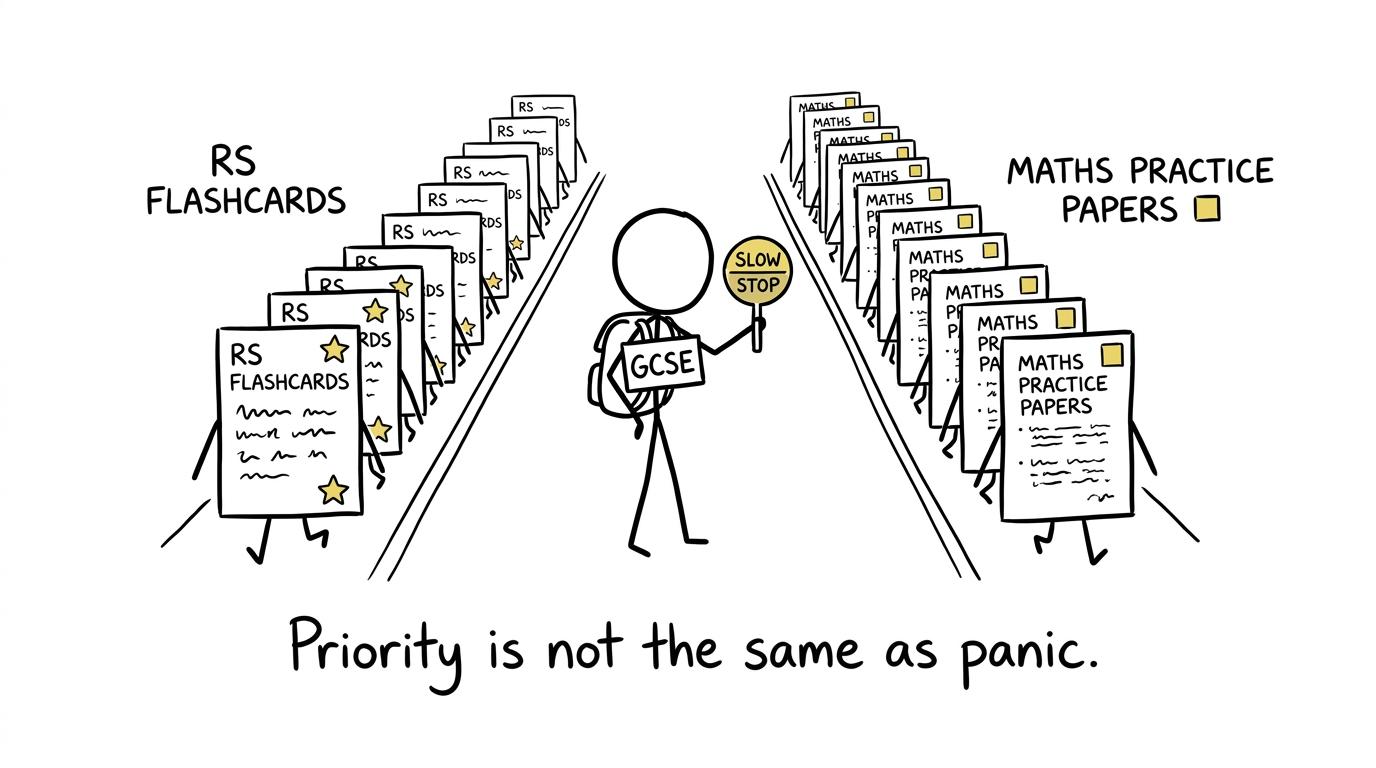 A student calmly directs RS flashcards and maths papers
Make maths practice fit around RS revision
When RS is taking the main share of attention, maths sessions should become smaller and sharper rather than disappearing.
Use one of these formats:
- a topic-focused mini test;
- a short section from a paper;
- corrections from your latest marked work;
- questions on one repeated error;
- a brief non-calculator or calculator skills check matching the next paper.
Past papers become valuable when you have enough time to attempt and review them properly. MathsGenie’s guide to when to start GCSE past papers explains how to move from short diagnostic work towards full timed practice.
If you have already completed a paper, do not automatically seek a new one. Revisiting mistakes after targeted practice can be more revealing. Read how to redo GCSE past papers effectively before deciding what will produce the best feedback.
Predicted papers can also provide unseen practice near the exam, but they are not forecasts or substitutes for the specification. Edexcel students can use the GCSE Maths predicted papers, then mark the work and return to the topics that caused difficulty.
What to do between two exams on the same day
If you have a morning paper and an afternoon paper, the gap is not a full revision day.
Follow your school’s instructions, especially if formal clash supervision applies. Otherwise, use the interval to:
- eat and drink;
- avoid conducting a detailed post-mortem of the first paper;
- check only a small set of prompts for the afternoon exam;
- organise the correct equipment;
- settle your attention before entering the next room.
Trying to learn an entire RS theme or repair a major maths weakness in the gap is unlikely to be the best use of limited energy. The purpose of this period is readiness, not transformation.
Protect the night before each paper
The final evening should narrow uncertainty, not create more of it.
For RS, retrieve core material, review a few planned structures and confirm which component you are sitting. For maths, complete a short familiar set, inspect your error reminders and pack the correct equipment. Check whether the paper permits a calculator and follow the instructions from your school and exam board.
Avoid beginning an exhausting full paper late at night. If maths is next, the GCSE maths night-before plan offers a focused alternative based on short practice, corrections and preparation.
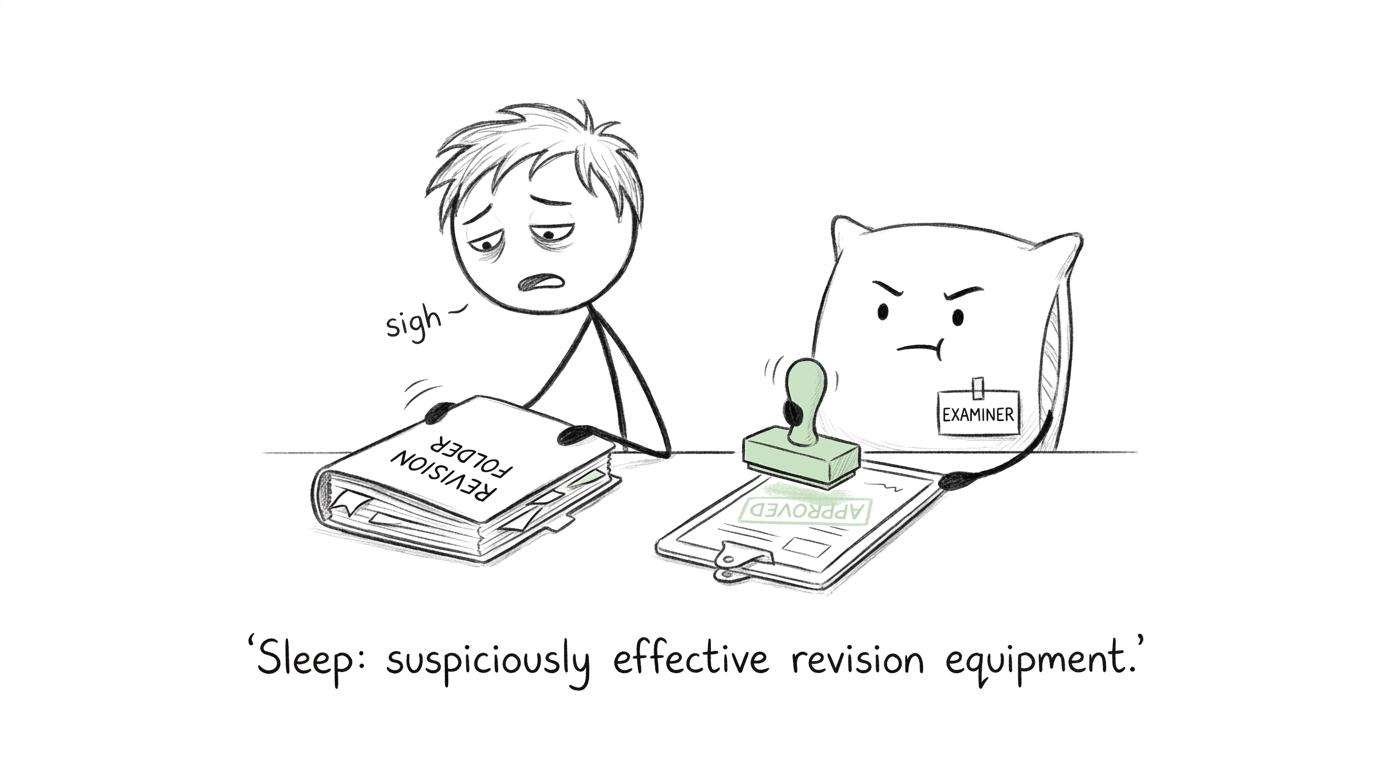 Sleep receives official approval as revision equipment
Common mistakes when exams crowd together
Dividing every evening equally
Equal allocation ignores exam order, confidence and the type of work each subject requires. Rebalance the plan after every paper.
Dropping maths completely for several days
Maths methods become harder to access when practice stops. Preserve a short maintenance block even while RS receives priority.
Revising RS only by rereading
Recognition is not recall. Close the notes, retrieve the content and plan how you would use it in an answer.
Completing work without marking it
An unmarked maths paper provides activity but limited direction. Mark schemes and video solutions show where methods, accuracy or interpretation failed.
Treating predicted papers as predictions
A predicted paper is practice, not a promise about the live examination. Revise the full content required by your specification.
Sacrificing sleep to rescue the timetable
Late-night revision can feel like commitment, but fatigue makes the next day harder. Set a stopping time and keep it.
A calm plan can survive a crowded week
A difficult exam week does not require equal attention to every subject. It requires a rolling decision: what is next, what is weakest and what small action will keep the following paper alive?
Give Religious Studies active recall and answer planning. Give maths regular questions, immediate marking and precise corrections. After each exam, release it and move the main block forward.
MathsGenie can carry the maths side of that plan without adding more decisions. Open the free GCSE Maths revision hub, choose your board and tier, and combine revision lessons with practice questions, mini tests, past papers, predicted papers, mark schemes and video solutions. Start with one weak topic today. Practise it, mark it and let the evidence decide what comes next.