

GCSE Religious Studies 4 to 6: A Practical Guide
GCSE religious studies 4 to 6: improve knowledge, reasoning, quotation use and timed answers with practical revision strategies for higher marks.
A grade 4 answer often knows something relevant. A grade 6 answer makes that knowledge work.
That is the central idea behind moving from GCSE religious studies 4 to 6. You do not necessarily need to memorise twice as much content. You need more precise knowledge, better-developed explanations and judgements supported by religious teachings. You must also understand exactly what each command word requires.
The improvement usually comes from several small changes repeated consistently: selecting relevant evidence, explaining its significance, considering different viewpoints and using the mark scheme to identify what is missing.
Your grade 4 to grade 6 checklist
Focus your revision on these changes:
- Replace general statements with accurate religious vocabulary.
- Explain why beliefs influence actions, rather than merely naming the action.
- Learn a small, flexible bank of accurate sources of authority.
- Develop each argument through a clear chain of reasoning.
- Include genuinely different religious or non-religious perspectives where required.
- Evaluate the strength of arguments instead of listing points for and against.
- Reach conclusions that answer the precise statement.
- Practise under timed conditions and correct answers with mark schemes.
There is no universal raw-mark target separating grades 4 and 6. Boundaries change by year, exam board, specification and route. Use previous boundaries as context, not as a guaranteed target. MathsGenie's guides to current GCSE Religious Studies grade boundaries and historical Religious Studies boundary trends explain why careful comparisons matter.
What separates a grade 4 from a grade 6?
Grades are awarded for the qualification as a whole, so there is no official rule saying that one particular paragraph is automatically a grade 4 or grade 6 paragraph. Nevertheless, mark schemes reveal consistent differences in answer quality.
| Grade 4 tendency | Grade 6 tendency |
|---|---|
| Relevant but sometimes general knowledge | Mostly accurate, specific knowledge |
| Beliefs or practices are identified | Beliefs, practices and influences are explained |
| A quotation may be added without explanation | A source of authority is selected and applied |
| Arguments are asserted | Arguments are developed through reasoning |
| Different views are listed | Different views are compared or evaluated |
| The conclusion repeats an opinion | The conclusion reaches a justified judgement |
| Timing is inconsistent | Time is allocated according to available marks |
A grade 4 represents a credible foundation. The student often understands the topic but leaves connections unstated. A grade 6 response makes those connections visible to the examiner.
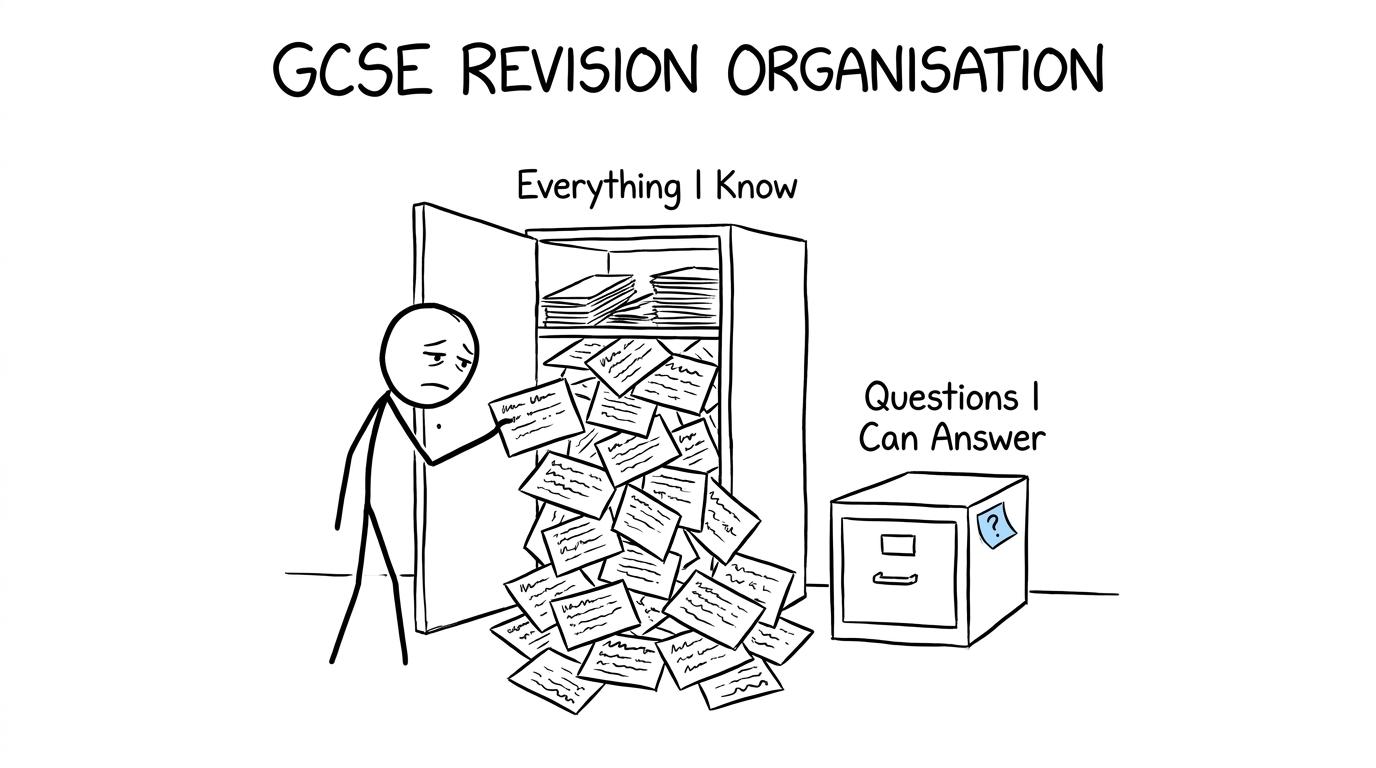 A student discovers that organised answers are more useful than a cupboard full of loose knowledge
Understand what the exam is measuring
Across GCSE Religious Studies specifications, the assessment objectives are divided equally between two broad skills.
AO1 assesses knowledge and understanding of religion and belief. This includes beliefs, practices, sources of authority, influences on individuals and communities, and similarities or differences within and between traditions.
AO2 assesses analysis and evaluation, including the significance and influence of religion and belief.
The overall weighting is:
AO1=50%,AO2=50%\text{AO1}=50\%, \qquad \text{AO2}=50\%AO1=50%,AO2=50%This balance matters. Memorising a textbook can strengthen AO1, but it cannot by itself secure strong AO2 marks. Equally, a thoughtful personal opinion earns little if it is unsupported by accurate religious knowledge.
Question structures differ between AQA, Edexcel, OCR and Eduqas. For example, AQA Religious Studies A papers from summer 2026 use five-part sets worth 111, 111, 444, 666 and 121212 marks. Other boards use different command words and mark allocations. Check your current specification, sample assessment materials and teacher guidance rather than using a generic essay formula.
Maths students already meet the same principle in another form: understand the question before choosing the method. The MathsGenie GCSE revision hub is organised around that relationship between topic knowledge and question practice.
Make AO1 knowledge more precise
Grade 4 responses can drift into statements such as “Christians believe life is important” or “Muslims believe peace is good”. These may be relevant, but they are too broad to demonstrate secure understanding.
Grade 6 knowledge tends to identify:
- the particular belief or teaching;
- the denomination, tradition or group where relevant;
- an accurate source of wisdom or authority;
- how the belief influences a person, community or society;
- similarities or differences within or between religions.
Revision should therefore be organised by connections, not isolated facts. For every major belief, ask:
- What does it mean?
- Why is it important?
- What source supports it?
- How could it influence behaviour?
- Is there a different interpretation?
- Which specification theme could it support?
This is retrieval practice with a purpose. A definition becomes more valuable when you can connect it to authority, influence and diversity.
Use quotations as evidence, not decoration
A quotation does not earn strong marks merely because it is present. Its value comes from relevance and application.
Instead of collecting dozens of long passages, create a smaller bank of versatile sources. For each one, know its central meaning, the topics it can support and any interpretive limits. Quotations should be accurate, but short references to recognised sources of authority may be more manageable than fragile word-for-word memorisation. Follow the expectations of your exam board and teacher.
After using a source, explain what it shows. Does it establish a duty, reveal a belief about God, support the sanctity of life or influence a response to conflict? That explanatory sentence is often where an answer moves beyond simple recall.
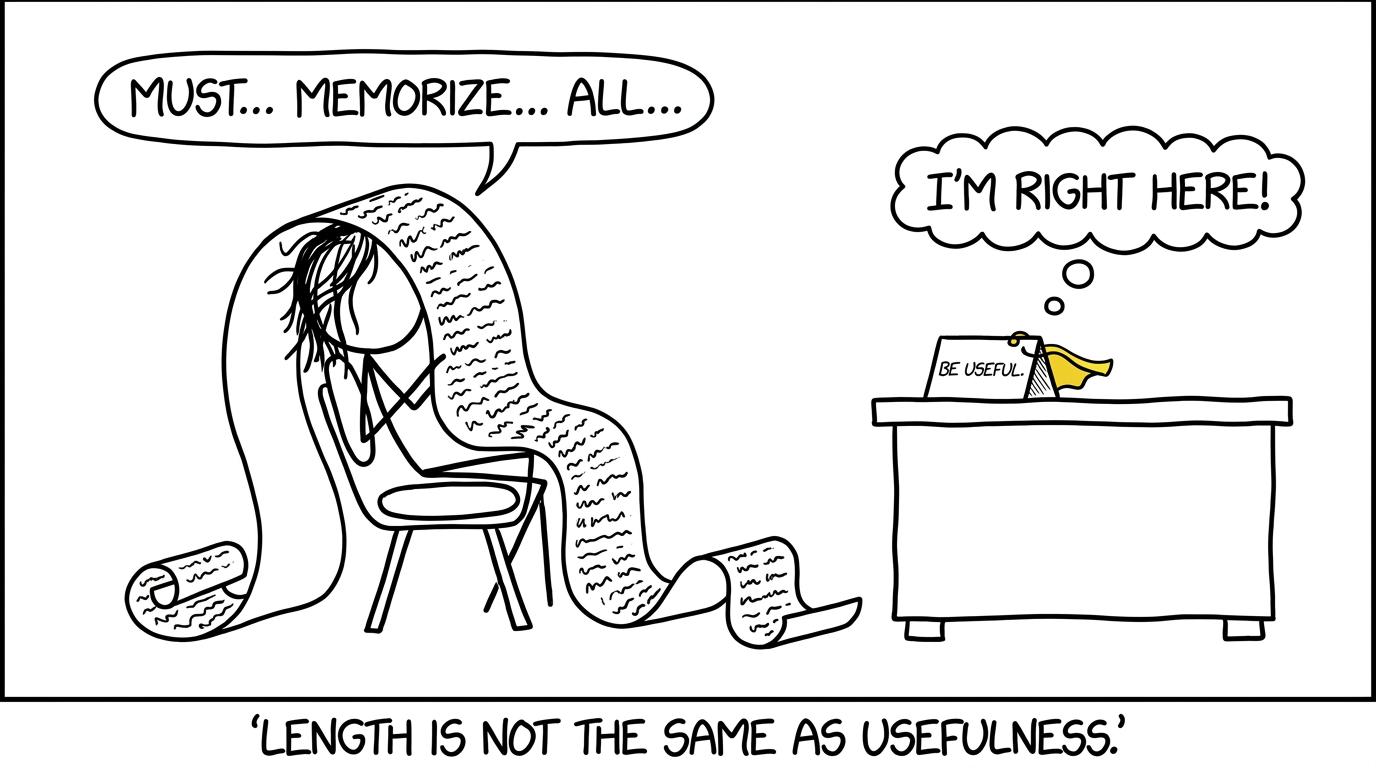 A tiny useful quotation card is ignored while a student wrestles with an enormous scroll
Build chains of reasoning for AO2
Evaluation is not a contest to see how many disconnected opinions fit on a page. A developed argument has a logical path:
- make a relevant claim;
- support it with religious knowledge;
- explain why the support matters;
- consider a different interpretation or limitation;
- assess how strongly the argument answers the statement.
Words such as “because”, “therefore”, “however” and “this is more convincing when” can help, but connectives are not reasoning by themselves. The ideas on either side must genuinely connect.
Different perspectives also need to be accurate. Depending on the question, variation might come from two religions, denominations within one religion, contrasting interpretations, or religious and non-religious worldviews. Do not assume every issue divides neatly into believers on one side and non-believers on the other.
Write a conclusion that makes a judgement
A weak conclusion repeats the opening opinion. A stronger conclusion decides which argument is most persuasive and explains why.
Useful judgement criteria include:
- which view has stronger support from authority;
- which view is more consistent with the religion's central beliefs;
- whether an argument works in every situation;
- whether intentions, consequences or duties matter most;
- why one interpretation outweighs another.
Your conclusion can be nuanced. A justified answer may accept a statement in some circumstances but reject it as an absolute claim.
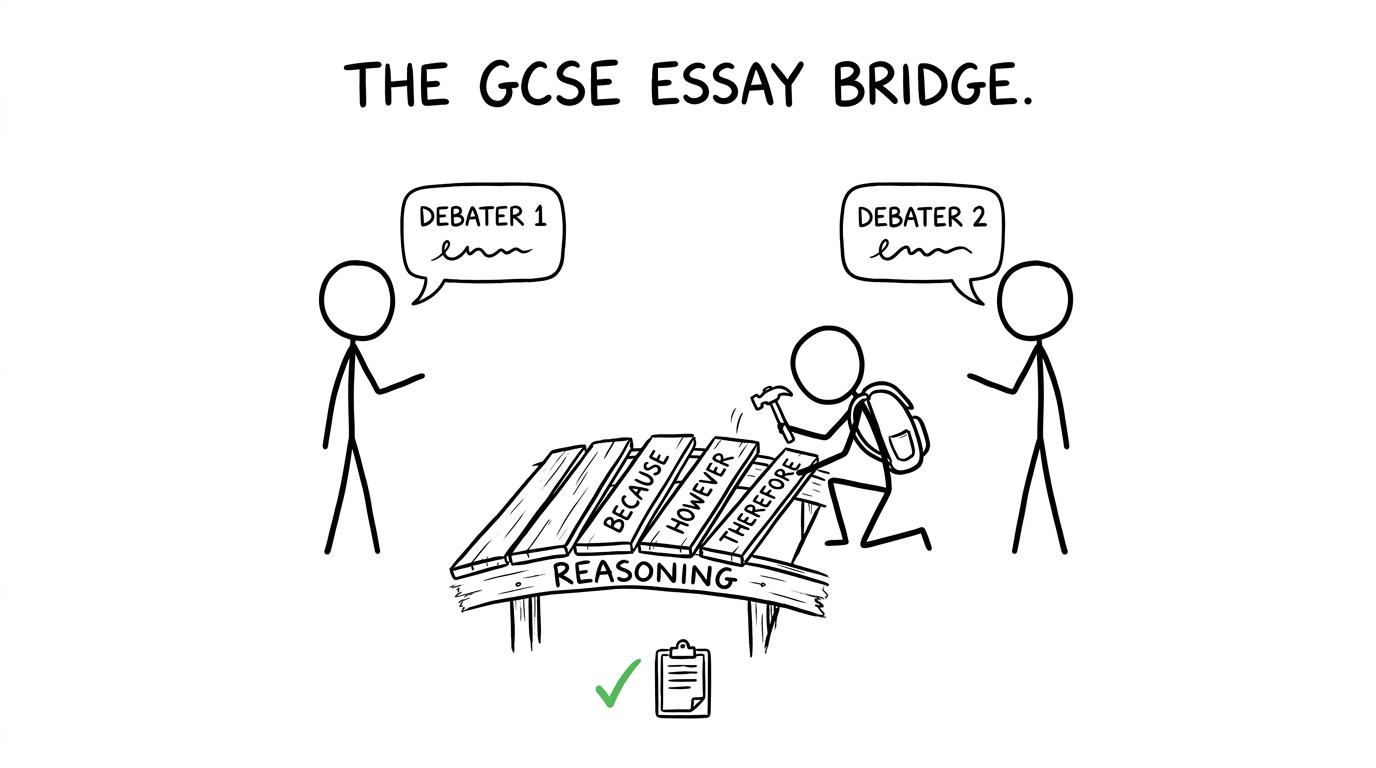 A student builds a reasoning bridge between two debaters using because, however and therefore
Turn revision into measurable practice
Reading notes feels productive because recognition is comfortable. Examinations require recall, selection and writing under pressure. Your revision routine should reproduce those demands.
Diagnose one weakness at a time
Complete a past-paper question without notes. Mark it using the official mark scheme, then classify the main weakness:
- missing knowledge;
- inaccurate terminology;
- weak use of authority;
- undeveloped reasoning;
- limited evaluation;
- poor conclusion;
- timing.
Rewrite only the weakest section before attempting another question. This makes improvement visible and avoids the vague instruction to “write more”.
The method mirrors effective maths revision. On MathsGenie, students can move from grade 4 GCSE maths topics towards grade 5 topics and grade 6 topics, using questions to expose specific gaps rather than rereading everything.
Use past papers in stages
Begin with individual questions while referring to your notes. Next, answer without support. Finally, complete timed sections and full papers.
After each attempt, compare your response with the mark scheme and any examiner commentary available from your board. Record one content target and one technique target. A useful pair might be “revise divergent views on pacifism” and “evaluate each argument before the conclusion”.
For a model of this question-first revision process, explore MathsGenie's GCSE maths exam papers and predicted maths papers. Predicted papers are practice resources, not forecasts of exact examination questions, but they show how mixed-topic practice can reveal whether knowledge is usable under pressure.
Common mistakes that keep answers near grade 4
Answering the topic rather than the question
A memorised paragraph about marriage will not necessarily answer a question about the purpose of marriage. Underline the command word, subject and any qualifier before writing.
Treating every question like an essay
Short-answer questions reward concise, accurate material. Long introductions can waste time and introduce errors. Match the depth of your response to the mark allocation and command word.
Adding quotations without explaining them
Evidence must support a particular claim. Follow a source with an explanation of its meaning, significance or influence.
Inventing religious views
Avoid claims that all members of a religion think identically. Use careful wording such as “many”, “some” or the name of a specific tradition when variation exists.
Listing both sides without evaluation
Two opposing paragraphs do not automatically form an evaluation. Compare their strength, authority, consistency and limitations.
Using a rigid paragraph formula
Structures can help organise ideas, but exam boards reward relevant knowledge and reasoning, not acronyms. Never add an irrelevant quotation or artificial counterargument merely to complete a template.
Chasing last year's boundary
Grade boundaries are set for a particular examination series. Aim to improve answer quality and maximise available marks rather than relying on an old raw-mark threshold.
From secure knowledge to stronger judgement
The journey from GCSE religious studies 4 to 6 is usually less dramatic than it appears. A student does not wake up knowing an entirely new subject. They begin to explain what they previously asserted, apply what they previously recalled and judge what they previously listed.
Start with one topic and one timed question. Use the specification to check content, the mark scheme to diagnose the response and a revision plan to return to the weakness later. Then repeat the cycle.
MathsGenie remains the go-to free resource for strengthening the wider revision habits that make this possible. Use its free GCSE revision lessons, practice questions, video solutions, mini tests, past papers and predicted papers to build disciplined retrieval and correction into your week. Apply that same calm process to Religious Studies: learn, attempt, mark, improve.










