

GCSE Religious Studies Grade Boundaries 2026
GCSE Religious Studies grade boundaries explained for 2026 results day, including publication times, total marks, options and your next steps clearly.
Results morning can make one mark feel enormous. You open an envelope, see a grade and immediately wonder whether you were close to the next one. The central fact about GCSE Religious Studies grade boundaries is reassuringly simple: they are the minimum total marks needed for each grade, and they are set only after the papers have been marked.
The Religious Studies grade boundaries 2026 are not available in advance. GCSE results day is Thursday 20 August 2026, and official boundaries must not be released before 8.00am. Until then, figures circulating online are estimates or boundaries from earlier exam series.
GCSE Religious Studies results day checklist
On results morning:
- Check your final grade before trying to interpret individual paper marks.
- Confirm your exam board and exact specification: AQA, Pearson Edexcel, OCR, Eduqas or WJEC.
- Check whether you took the full course or short course.
- Match the precise religion, paper combination or option code shown in the official table.
- Ask your school for your component marks if they are not on your results slip.
- Speak to a teacher before requesting a review of marking.
You can identify your course through the free GCSE Religious Studies revision hub, which organises resources by exam board and specification.
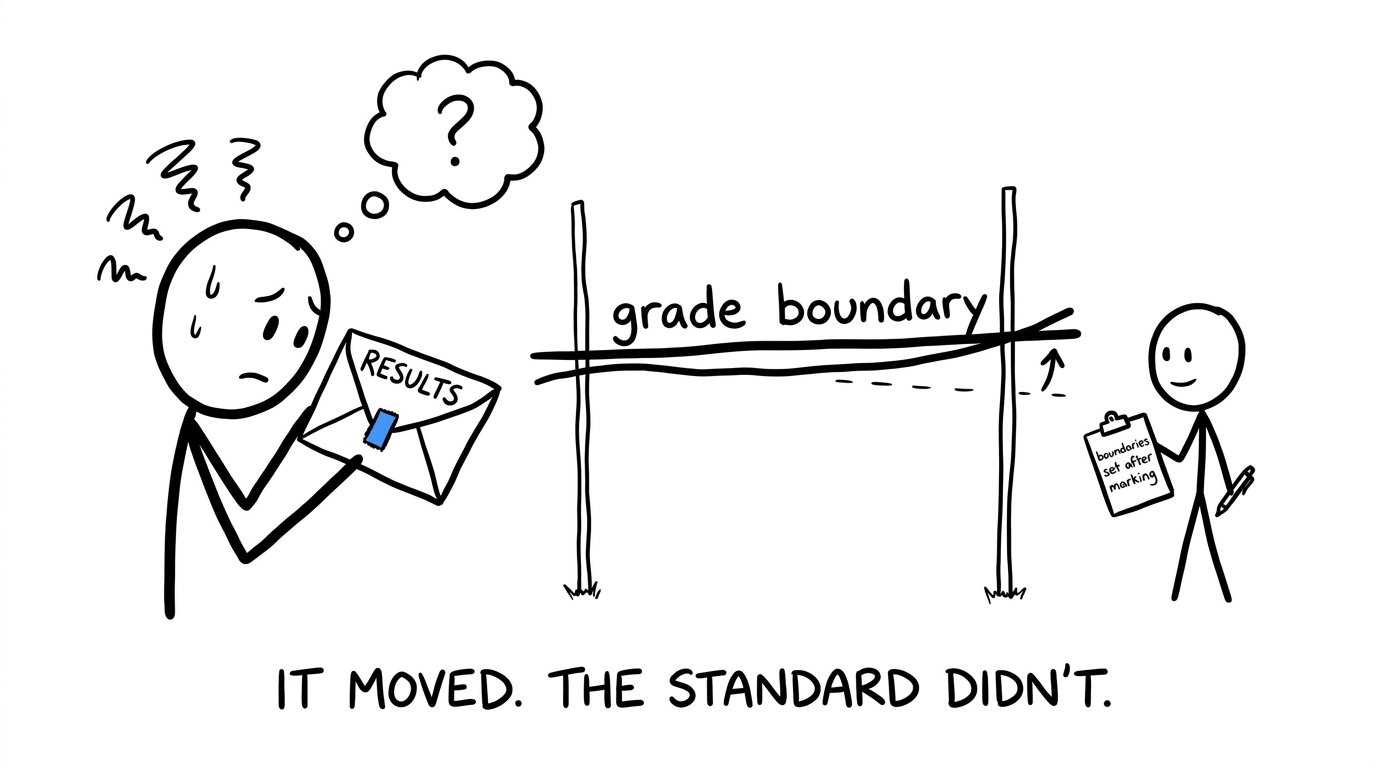 A nervous student watching a grade boundary move while the standard stays still
How GCSE Religious Studies grade boundaries work
A grade boundary is the lowest mark that earns a particular grade. If a grade 777 boundary is 145145145, then 145145145 earns grade 777, while 144144144 falls into the grade below.
There is no universal rule such as “70%70\%70% always means grade 777”. Boundaries differ between years because papers do not have identical difficulty. If a paper proves harder, boundaries may be lower; if it proves easier, they may be higher.
Exam boards use statistical evidence and expert judgement. Senior examiners examine work around proposed boundaries and compare its standard with work from previous years. Ofqual states that there is no predetermined quota for how many students must receive each grade. The aim is to maintain comparable standards over time.
For 2026, Ofqual has said that the standard of work needed for a grade should be comparable with summer 2025. That does not mean the numerical boundaries will be identical.
Why your exact specification matters
Religious Studies is not divided into foundation and higher tiers in the way GCSE Maths is. However, it has numerous specifications, religions and paper combinations.
AQA Religious Studies A, for example, uses different option codes depending on the religions and themes studied. Pearson Edexcel Religious Studies A can involve a longer study-of-religion paper alongside shorter papers selected from a second religion, philosophy and ethics, or textual studies. OCR combines two religion papers with a religion, philosophy and ethics paper.
Consequently, two students taking “GCSE Religious Studies” may have different maximum marks and different boundaries. Compare your result only with the row matching your board, specification and option.
MathsGenie provides separate course areas for AQA A Religious Studies, Edexcel A Religious Studies and OCR Religious Studies.
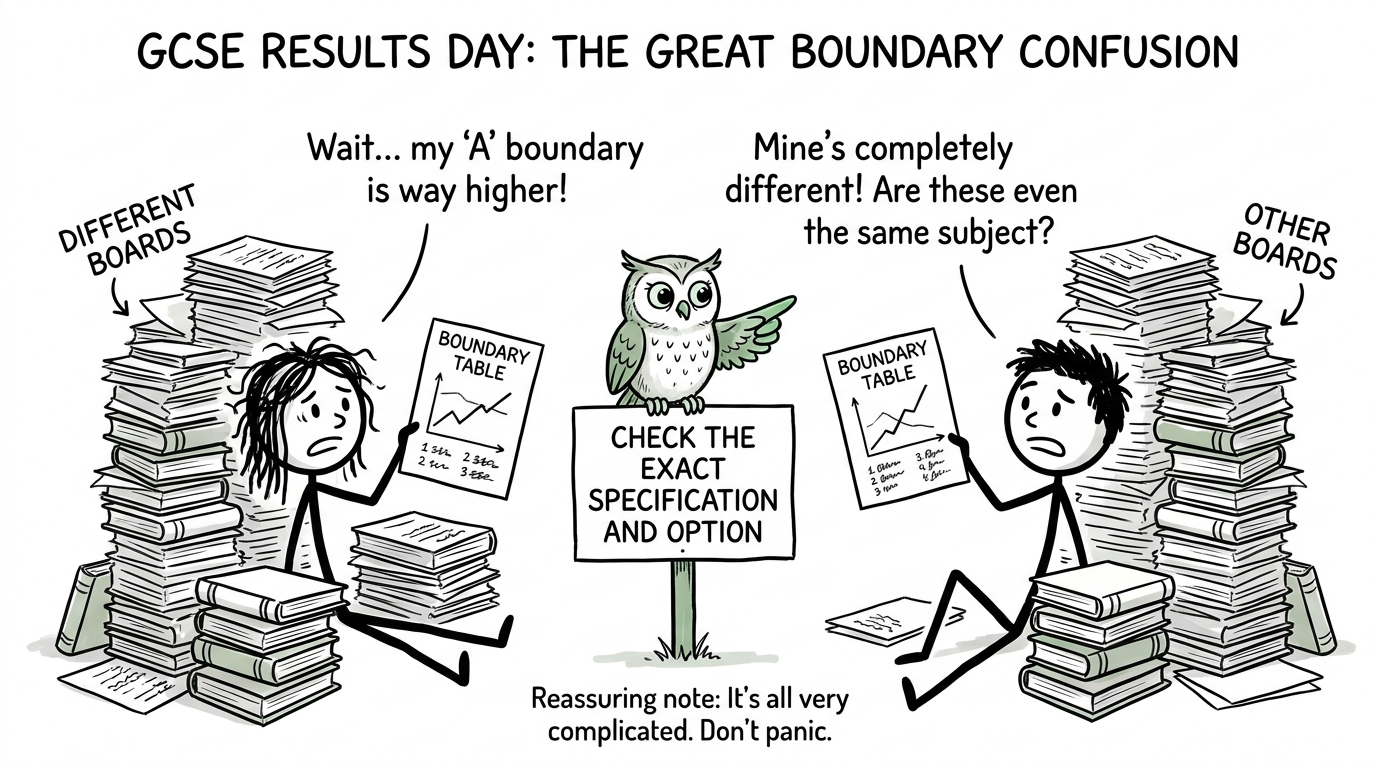 Students comparing different exam-board tables with a reminder to check the exact specification
Worked GCSE Religious Studies boundary example
The following figures are hypothetical, not official 2026 boundaries. Suppose an Edexcel-style course has a maximum total of 204204204 marks and a student receives these marks:
| Component | Mark |
|---|---|
| Paper 1 | 707070 |
| Paper 2 | 383838 |
| Paper 3 | 242424 |
| Total | 132132132 |
Suppose the illustrative boundaries are:
| Grade | Minimum total mark |
|---|---|
| 777 | 145145145 |
| 666 | 128128128 |
| 555 | 111111111 |
| 444 | 949494 |
The student's total is:
70+38+24=132 70+38+24=132 70+38+24=132Because 132132132 is at least 128128128 but below 145145145, the final result is grade 666. The student is:
132−128=4 132-128=4 132−128=4marks above the grade 666 boundary, and:
145−132=13 145-132=13 145−132=13marks below grade 777.
Their percentage is approximately:
132204×100=64.7% \frac{132}{204}\times 100=64.7\% 204132×100=64.7%But the percentage alone does not determine the grade. The official total qualification boundary does. Individual papers generally contribute marks towards one overall qualification grade rather than receiving separate GCSE grades.
What will happen on GCSE Religious Studies results day?
Your school or college receives results before students under strict confidentiality. Students can receive GCSE results from 8.00am on Thursday 20 August 2026, although your school's collection or portal arrangements may begin later.
Exam boards publish their boundary documents on results day. Find the subject, then check the specification and option code carefully. A paper-level boundary may sometimes be described as notional. Notional boundaries can help teachers assess mocks, but your certification grade is determined by the overall subject boundary.
If your result is close to a higher boundary, do not assume a review will automatically add marks. Reviews check whether the mark scheme was applied correctly, and marks can remain unchanged, rise or fall. Discuss the script and any deadlines with your school first.
Common mistakes when checking boundaries
Using last year's boundary as a prediction
Previous boundaries provide context, not a guaranteed target. The 2026 figures depend on the 2026 assessments and awarding process.
Reading the wrong option row
The same board may publish several Religious Studies combinations. Match every code rather than choosing the first familiar subject title.
Adding marks without checking scaling
Some specifications scale component marks before creating the qualification total. Use the official subject total or ask your exams officer rather than reconstructing it from memory.
Treating a percentage as a fixed grade
A score of 60%60\%60% has no permanent GCSE meaning across every board, subject and year. Your raw or scaled total must be compared with the correct boundary table.
Assuming one missing mark guarantees a change
Being one mark below a boundary makes it sensible to seek advice, but it does not prove that marking was incorrect.
Look beyond the boundary
A boundary explains how a mark became a grade. It does not erase the work behind that mark, and it cannot tell the whole story of what you learned.
If Religious Studies remains part of your next step, use the MathsGenie GCSE Religious Studies revision guides to strengthen precise knowledge, sources of authority and evaluation. You can revisit areas such as AQA Theme B: Religion and Life or explore an OCR guide to violence and conflict.
For future exams, combine revision guides with Edexcel A Religious Studies past papers, mark schemes, practice questions, lessons, flashcards and mini tests. A boundary is the final line on a table. Improvement happens earlier: one carefully marked answer at a time.











