GCSE Religious Studies Grade Boundary Trends
GCSE Religious Studies grade boundaries history explained with a year-by-year table, recent trends and practical advice for interpreting past marks.
A grade boundary can feel like a finish line that moves while you are running towards it. One year a mark earns a grade; another year, it falls just short. Yet the GCSE Religious Studies grade boundaries history is less mysterious than it first appears: boundaries changed between recent exam series because papers and grading arrangements changed, not because exam boards chose a permanently easier or harder standard.
The central lesson is simple. Past boundaries are useful for setting a sensible range, but they cannot predict this year’s result exactly.
GCSE Religious Studies grade boundary trends at a glance
Before examining the figures, keep this checklist in mind:
- Compare the same exam board, specification and option.
- Check whether figures cover the full qualification or one component.
- Compare raw marks only when the maximum mark is unchanged.
- Treat 202020202020 and 202120212021 separately because normal summer GCSE exams were cancelled.
- Use several years as a planning range, not one boundary as a promise.
- Confirm final boundaries after results are published.
MathsGenie’s GCSE Religious Studies revision hub brings together board-specific past papers and revision resources. Its wider GCSE grade boundaries archive also makes it easier to compare years without mixing unrelated qualifications.
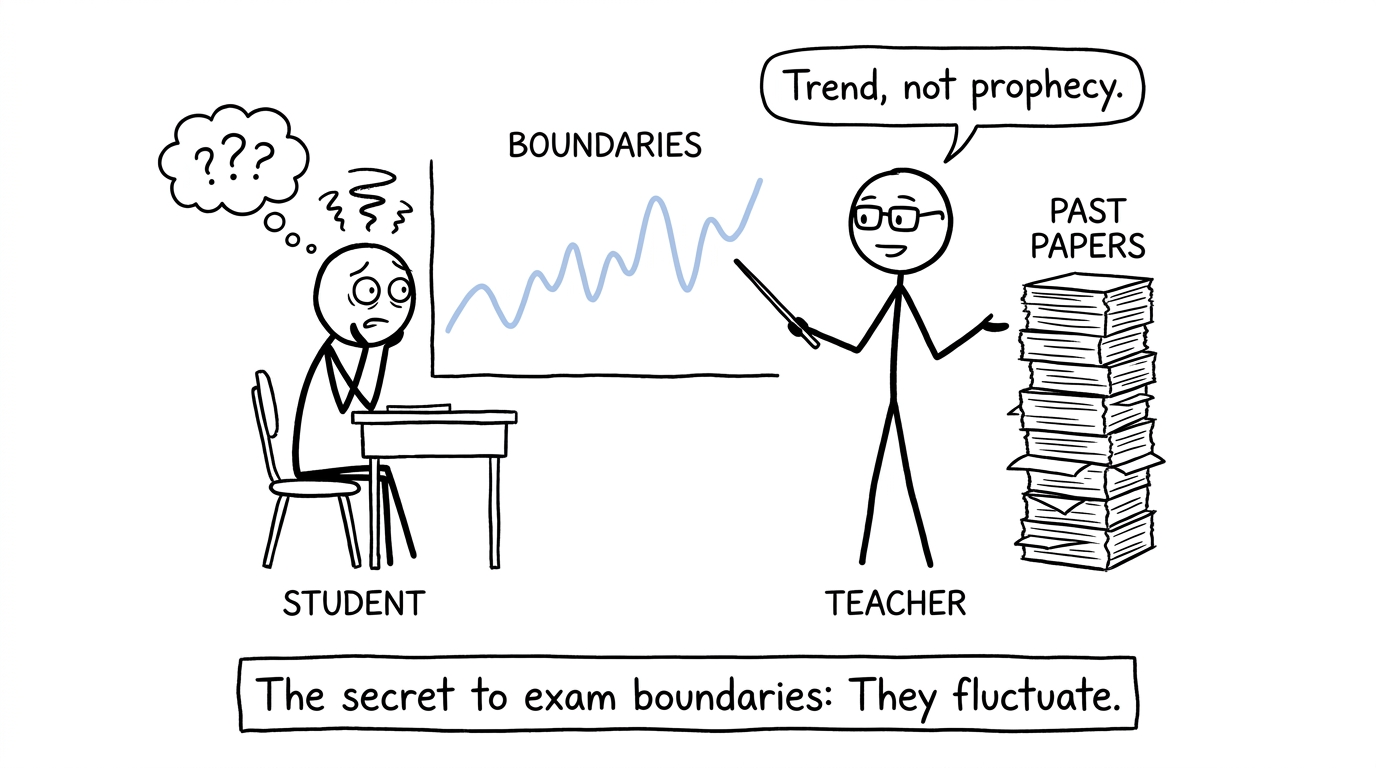 A student mistakes a grade-boundary trend for a prophecy
Past GCSE Religious Studies grade boundaries by year
The table below uses Eduqas Full Course Route A1 as one consistent illustration. It has a maximum mark of 252252252, allowing a meaningful year-by-year comparison. These figures must not be applied to AQA, Edexcel, OCR, another Eduqas route or a short course.
| Exam year | Grade 999 | Grade 777 | Grade 555 | Grade 444 | Context |
|---|---|---|---|---|---|
| 201920192019 | 196196196 | 157157157 | 117117117 | 979797 | Last summer series before the pandemic |
| 202020202020 | Not applicable | Not applicable | Not applicable | Not applicable | Summer exams cancelled |
| 202120212021 | Not applicable | Not applicable | Not applicable | Not applicable | Summer exams cancelled |
| 202220222022 | 195195195 | 159159159 | 115115115 | 939393 | Exams returned with transitional grading |
| 202320232023 | 207207207 | 173173173 | 129129129 | 108108108 | Return towards pre-pandemic grading standards |
| 202420242024 | 207207207 | 175175175 | 131131131 | 110110110 | Normal post-pandemic exam series |
| 202520252025 | 212212212 | 178178178 | 134134134 | 112112112 | Latest confirmed summer boundary in this series |
You can inspect every grade in the Eduqas Religious Studies grade-boundary tables or use the Eduqas Religious Studies predicted-grade calculator.
The 201920192019 baseline
The 201920192019 series is important because it was the final summer examination series before pandemic disruption. For this route, grade 444 required 979797 marks and grade 999 required 196196196.
That does not make 201920192019 the “correct” boundary for every future paper. It simply offers a useful pre-pandemic reference point.
Why 202020202020 and 202120212021 form a gap
There were no normal summer GCSE examinations in 202020202020 or 202120212021. Grades were awarded through exceptional arrangements, so there is no directly comparable set of summer-paper boundaries to place in this sequence.
Using November boundaries as substitutes can also mislead. November entries involve a different cohort and are a separate exam series.
The return of examinations in 202220222022
Summer examinations returned in 202220222022. Ofqual’s grading approach was intended to represent a transition between the unusually high national outcomes of 202120212021 and the pre-pandemic position in 201920192019.
In the Eduqas example, grade 444 fell from 979797 in 201920192019 to 939393 in 202220222022, while grade 999 moved only from 196196196 to 195195195. Different parts of the grade scale do not necessarily move by identical amounts.
The shift in 202320232023
England returned to pre-pandemic grading standards in 202320232023, with protection recognising disruption experienced by that cohort. Ofqual also made clear that boundaries are set after papers have been taken and much of the marking has been completed.
The illustrative grade 444 boundary rose to 108108108, while grade 999 rose to 207207207. This does not prove that Religious Studies suddenly became easier or that examiners became harsher. A higher raw boundary can reflect a more accessible paper or stronger performance.
What 202420242024 and 202520252025 show
Boundaries in this Eduqas route continued upwards at several grades. By 202520252025, grade 444 required 112112112 marks and grade 999 required 212212212.
However, this is one route, not a universal GCSE Religious Studies trend. AQA has numerous option combinations, while Edexcel Religious Studies A and B also use different paper combinations. Check the precise entry code in the AQA Religious Studies boundary archive or the Edexcel GCSE grade-boundary tables before comparing results.
What actually causes boundaries to change?
Grade boundaries compensate for differences in assessment demand. If one paper proves more demanding, a lower raw mark may demonstrate the same level of attainment. If it is more accessible, the comparable boundary may be higher.
Senior examiners consider evidence from students’ work and statistical information. There is no fixed national quota limiting how many students may receive a particular grade. Nor is a boundary normally decided before students sit the paper.
This is why past GCSE Religious Studies grade boundaries are evidence, not forecasts. They reveal a range of previous outcomes, but they cannot tell you the difficulty of an unseen paper.
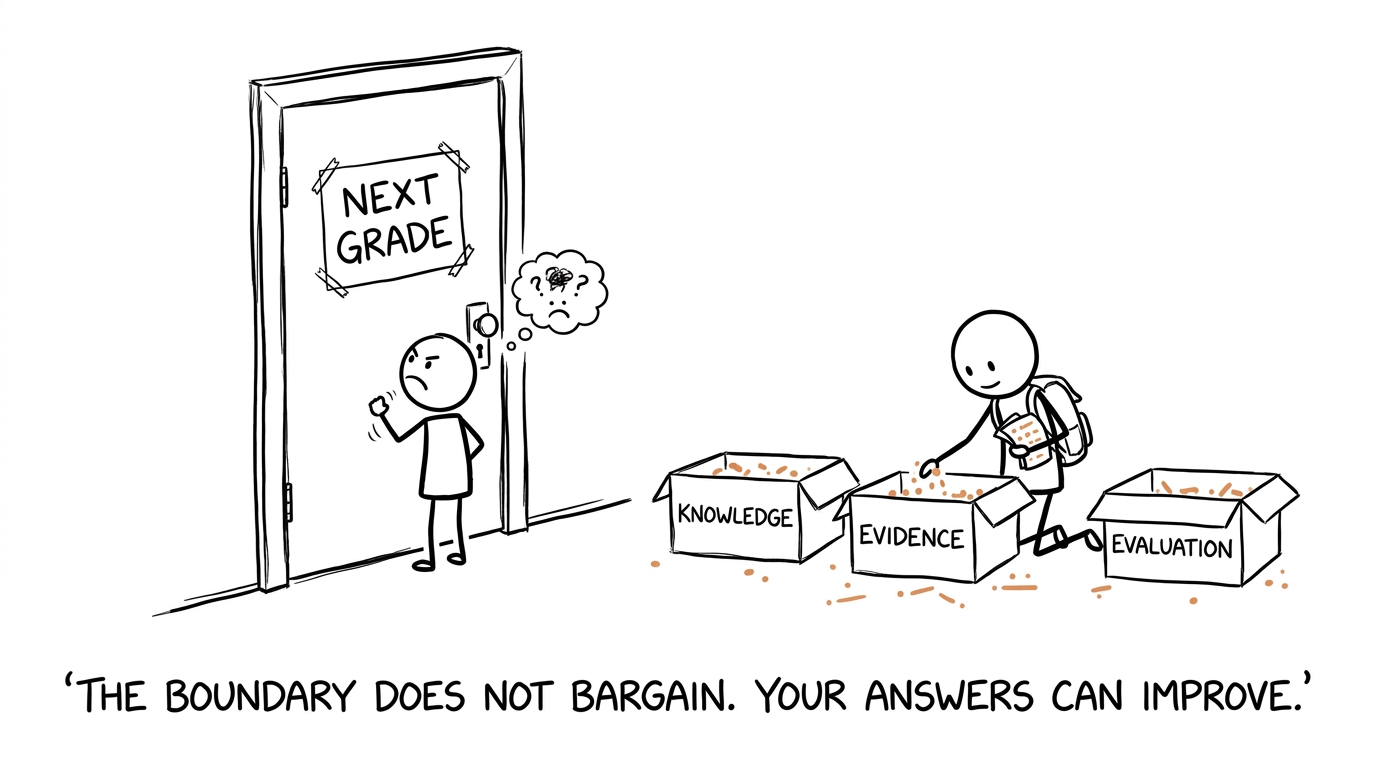 A student tries to bargain with a grade boundary while another collects marks
How students and teachers should use the data
Start with the correct specification. Then complete a timed paper, apply its original mark scheme and compare the total with the boundary from that same series. This produces a historically accurate result for that paper.
Afterwards, focus on lost marks rather than the estimated grade. Separate gaps in knowledge from weak evidence, incomplete evaluation and poor timing. Maths students will recognise the same principle: the score diagnoses the problem, but the repair work creates improvement. The guide to using GCSE past papers properly explains this paper, mark, fix and retest cycle.
Teachers can also use a range of recent boundaries when setting internal targets. A single historical cut-off creates false precision; several comparable series give a more cautious picture.
Common mistakes when analysing boundaries
Comparing different options
AQA and Edexcel publish different boundaries for different combinations of papers. Two students on the same board may therefore have different valid boundaries.
Comparing raw marks without checking the maximum
A score from a qualification marked out of 204204204 is not directly comparable with one marked out of 252252252. Course type, route and total available marks must match.
Treating a component boundary as an official grade
Notional component boundaries show how performance might be interpreted within one paper. The final qualification grade is based on the combined subject mark.
Assuming the highest past boundary will return
Choosing a cautious target is sensible, but no past figure can guarantee a future boundary. Build a margin through stronger answers rather than trying to guess the exact cut-off.
Turn boundary history into better revision
The history shows movement, interruption and recovery, not a dependable formula for next summer. Your safest response is to earn every available mark and regard the eventual boundary as something outside your control.
Start with MathsGenie’s free GCSE Religious Studies past papers, select your exact board and specification, and practise under timed conditions. Mark each paper carefully, repair weak topics, then repeat. For broader exam preparation, the GCSE papers collection provides a clear route into past papers, predicted papers and mini tests, supported across MathsGenie by revision lessons, practice questions, mark schemes and video solutions.