GCSE Psychology Time Pressure Mistakes to Avoid
GCSE psychology time pressure mistakes can cost avoidable marks. Learn how to manage command words, scenarios, calculations and extended answers calmly.
The last ten minutes of an exam can make familiar knowledge feel strangely distant. A command word gets missed. A scenario is ignored. Three valuable minutes disappear into a one-mark question. Most GCSE psychology time pressure mistakes are not caused by knowing too little. They happen when urgency disrupts decisions.
The solution is not simply to write faster. It is to make fewer unnecessary decisions: read the task precisely, allocate time in proportion to the marks, answer directly and move on when a question begins consuming more time than it deserves.
This guide explains the most common ways students lose accessible marks in GCSE Psychology and how to prevent them. The same habits are particularly useful for research methods and the mathematical parts of the course.
Your time-pressure checklist
Before exploring each mistake, remember this compact routine:
- Circle or underline the command word.
- Identify the exact topic and any scenario you must use.
- Notice the number of marks before writing.
- Give each sentence a clear job.
- Show working in calculations and follow rounding instructions.
- Move on when your planned time has passed.
- Leave a visible reminder beside anything you intend to revisit.
- Use the final minutes to find omissions, not to rewrite good answers.
Exam technique becomes dependable through rehearsal. Maths students can develop the same habits with the timed resources on the GCSE Maths revision hub, where practice papers, past papers and short tests make time management measurable.
Treating every question as equally expensive
A minute has an opportunity cost. Spending it polishing a short response means it cannot be used to begin an extended answer elsewhere.
AQA GCSE Psychology currently has two papers, each lasting 105105105 minutes and carrying 100100100 marks. That gives a rough overall rate of
105100=1.05 minutes per mark.\frac{105}{100}=1.05\text{ minutes per mark}.100105=1.05 minutes per mark.Pearson Edexcel uses different paper structures. Paper 1 lasts 105105105 minutes for 989898 marks, while Paper 2 lasts 808080 minutes for 797979 marks. Their approximate rates are therefore
10598≈1.07 minutes per mark\frac{105}{98}\approx1.07\text{ minutes per mark}98105≈1.07 minutes per markand
8079≈1.01 minutes per mark.\frac{80}{79}\approx1.01\text{ minutes per mark}.7980≈1.01 minutes per mark.These are planning guides, not rigid countdowns. Reading a scenario, checking instructions and planning an extended response all require time. Your own paper may also differ, so confirm the current specification and format with your teacher or exam board.
The important principle is proportionality. A low-mark question should receive a concise answer. A higher-mark response needs more development and may deserve a brief plan. Practise that judgement before the real exam, just as you would when following a structured GCSE revision timetable.
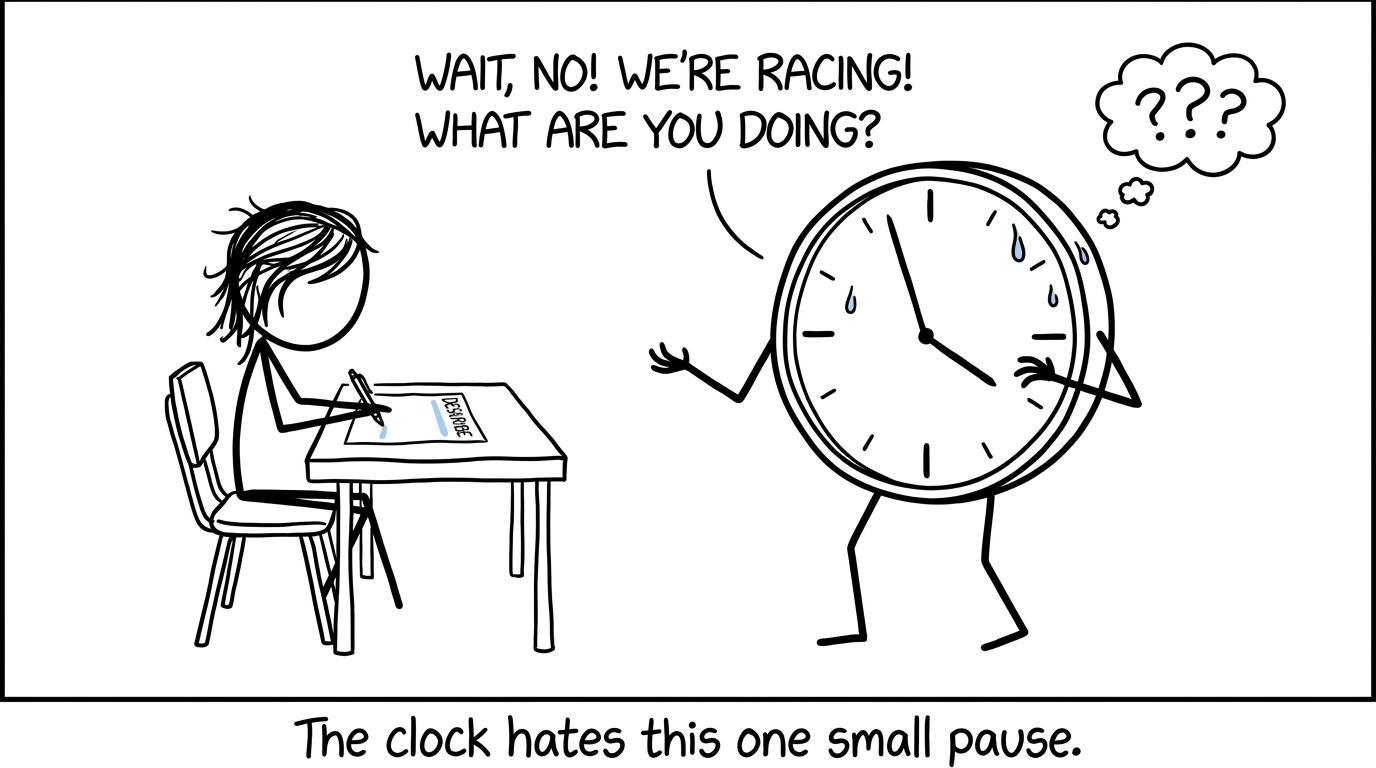 A student calmly pauses to identify the command word while racing an exam clock
Reading the topic but missing the command word
Under pressure, students often recognise the topic and begin unloading everything they remember. Unfortunately, examiners mark the task that was set, not the quantity of related knowledge on the page.
AQA defines common commands carefully. For example:
- Identify asks you to name or characterise something.
- Outline asks for its main characteristics.
- Describe requires an account.
- Explain requires purposes, reasons or a process.
- Evaluate asks you to judge using the available evidence.
- Discuss requires key points about different ideas, or strengths and weaknesses.
A question can contain more than one instruction. If it asks you to describe and evaluate, doing only the description leaves part of the task unanswered, however accurate that description may be.
Use a short decoding pause: command word, content, context and marks. Ten calm seconds can prevent several minutes of irrelevant writing.
Forgetting to apply knowledge to the scenario
Application is easy to sacrifice when the clock is loud. Students may define a theory correctly but never connect it to the person, behaviour or investigation in the question.
That matters because the assessment objectives distinguish between knowing psychology and using it. Across AQA and Pearson Edexcel GCSE Psychology, the published overall weightings are approximately 35%35\%35% for knowledge and understanding, 35%35\%35% for application, and 30%30\%30% for analysis and evaluation. An answer consisting entirely of recalled knowledge therefore cannot meet every kind of demand.
When a scenario is provided, select its most diagnostic details before writing. Names, behaviours, conditions and outcomes are usually there for a reason. Refer to those details explicitly and explain the connection rather than copying a line from the source material.
A useful final check is: Could this answer have been written without reading the scenario? If the answer is yes, your application may be too generic.
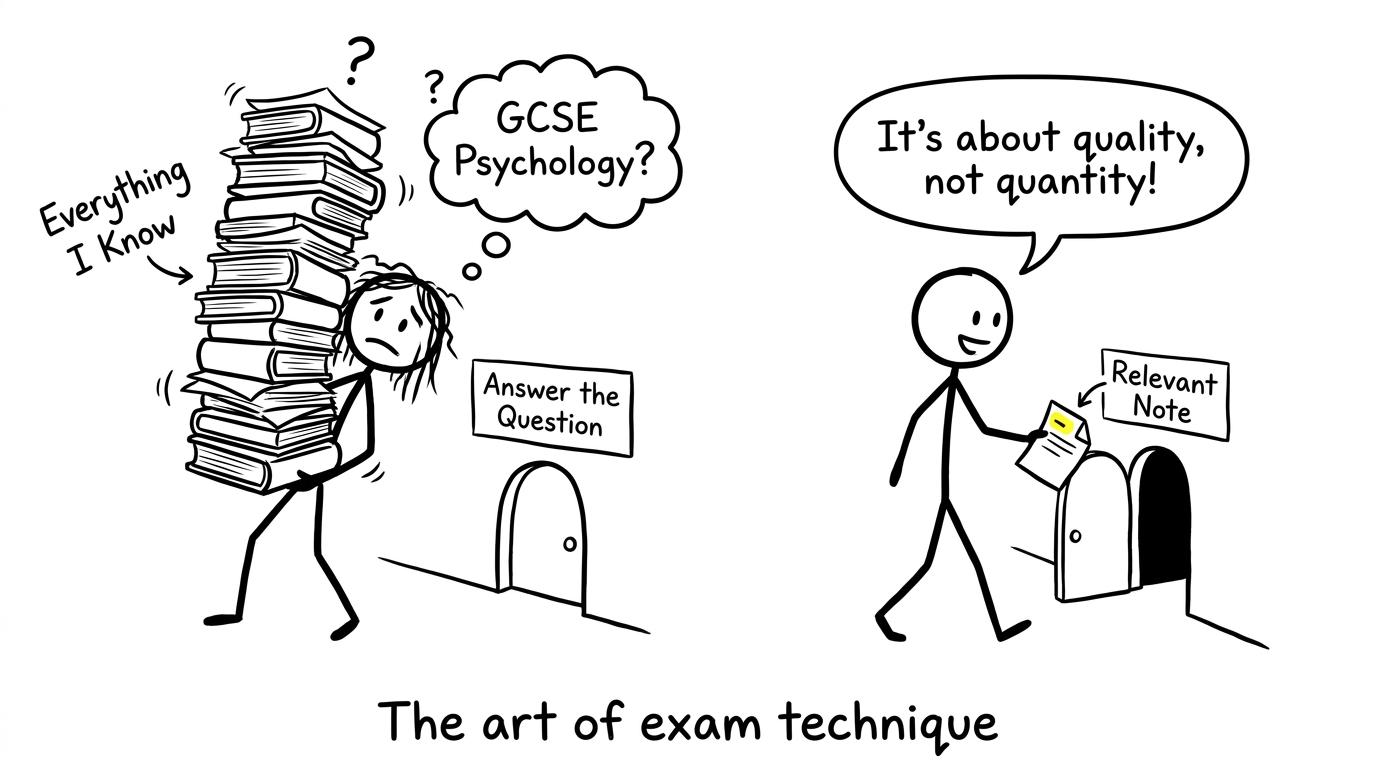 One student carries everything they know while another takes only the relevant idea through the answer doorway
Writing too much knowledge and too little evaluation
Recall often feels safer than evaluation. When time is short, it is tempting to continue describing a theory or study because the facts come readily. Yet an evaluation question requires a judgement supported by reasoning.
A useful evaluative point does more than attach a label such as “low validity” or “unrepresentative sample”. It explains:
- what the strength or limitation is;
- why it affects the evidence;
- what consequence it has for the conclusion; and
- how it answers the exact question.
The reverse mistake also occurs: producing memorised evaluation points that do not apply to the study, theory or method named. Relevance matters more than the number of criticisms you can list.
Planning with a few keywords can stop descriptive material taking over. Do not write a polished introduction unless it contributes directly to the answer. In an exam, structure is valuable; ceremony is not.
Panicking over research methods and calculations
Research methods questions combine psychological understanding with precise reading. Students may confuse the independent and dependent variables, identify a sampling method without using the scenario, or give a hypothesis that is not operationalised.
Calculations create another cluster of avoidable errors:
- copying a value incorrectly from a table;
- using the wrong denominator;
- confusing mean, median, mode and range;
- omitting working;
- rounding too early; or
- ignoring a required number of decimal places or significant figures.
AQA examiner feedback has specifically warned that students can lose marks by failing to follow significant-figure instructions. It has also highlighted answers that do not relate closely enough to the question or stem.
Keep the calculation process visible. Write the relevant values, choose the operation, retain unrounded figures during intermediate steps and round only the final answer unless instructed otherwise. Then ask whether the result is plausible in context.
If numerical confidence is a weakness, MathsGenie’s free GCSE Maths revision resources cover averages, percentages, graphs and other transferable skills. The advice in how to find your weakest GCSE topics can also help you turn recurring calculation errors into a focused practice list.
Getting trapped by one difficult question
A blank mind often leads to a costly bargain: “I will stay here until I remember.” But memory does not always respond to force, and the unanswered questions later in the paper may be more accessible.
When your planned time has passed:
- write any relevant term, definition or starting point you can justify;
- leave enough space if appropriate;
- mark the question clearly for review; and
- move to the next available marks.
Returning later is not giving up. It is protecting the rest of the paper. Another question may even provide a cue that restores the missing knowledge.
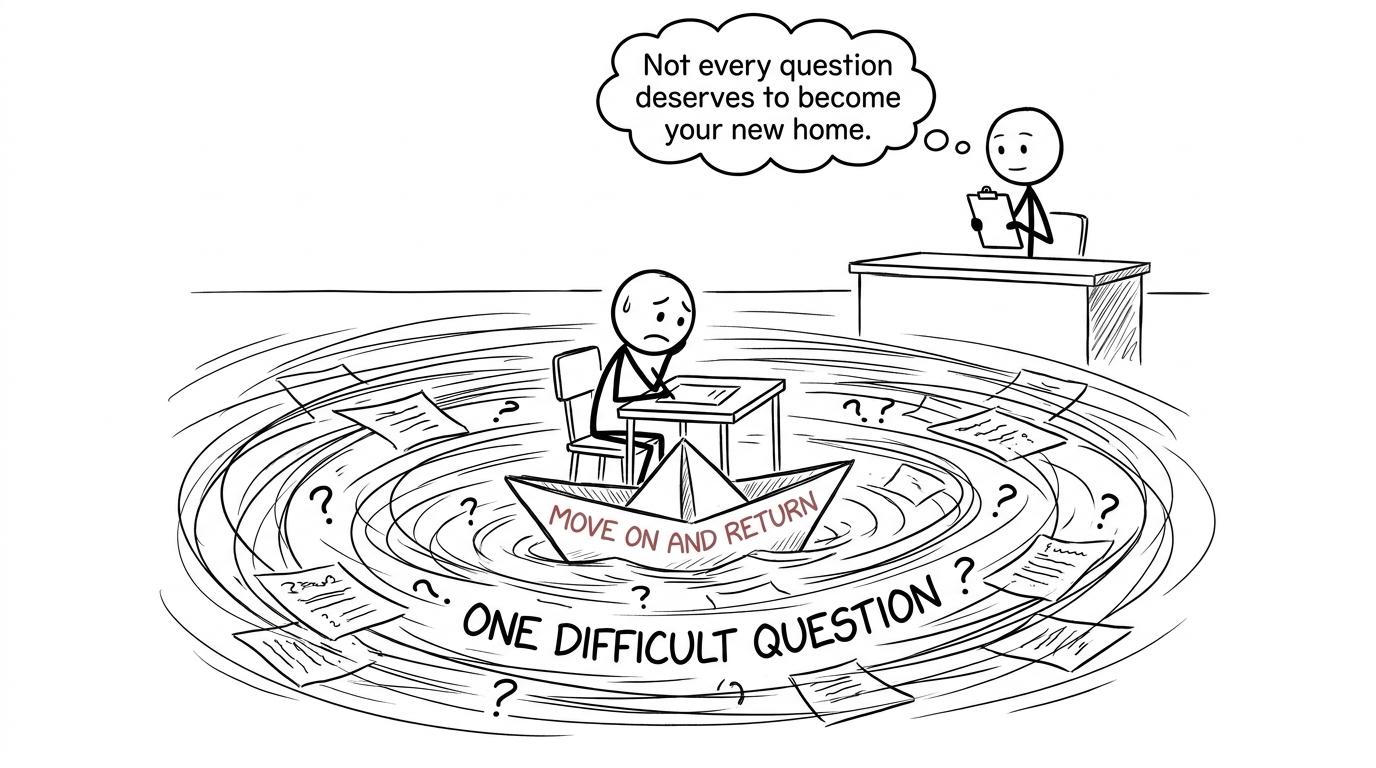 A student escapes a difficult-question whirlpool in a boat labelled Move On and Return
Common mistakes in the final minutes
Starting a new essay without a quick plan
Urgency can produce repetition. Before a longer response, jot down the essential knowledge, application and evaluation points. A tiny plan is useful when it prevents two paragraphs from making the same argument.
Giving a list instead of developed reasoning
Several undeveloped strengths and weaknesses may look substantial but earn less than fewer points whose consequences are explained. Lists are suitable for private planning; the final response should show the reasoning the command word requires.
Changing correct answers without evidence
Checking does not mean doubting everything. Change an answer when you identify a specific error: a missed instruction, contradictory wording, faulty calculation or overlooked scenario detail. Do not replace a supported answer merely because the clock has made it feel unfamiliar.
Writing outside the intended answer area
Official examiner guidance can include important administrative details. AQA has warned that papers are marked on screen and that material placed in margins or unsuitable blank spaces may not scan correctly. Follow the instructions on your paper and use designated additional pages where required, labelling continued answers clearly.
Leaving command words or question parts unanswered
Use the final minutes for a mechanical scan. Check every page, question number and subpart. Look for blank responses, unfinished calculations and multi-command questions where only one instruction was addressed.
How to train calm decisions before the exam
Time management improves when practice includes consequences. Untimed revision can build knowledge, but it cannot fully reveal whether you overwrite short answers, freeze on calculations or neglect later sections.
Use this practice loop:
- Complete a short timed section under quiet, closed-book conditions.
- Mark it using the official mark scheme where available.
- Record whether each lost mark came from knowledge, application, evaluation, calculation, reading or time.
- Rewrite only the flawed part of the response.
- Repeat the skill under a similar time limit several days later.
MathsGenie applies this evidence-led approach across maths revision. You can begin with advice on when to start GCSE past papers, then learn how to use past papers properly. Shorter sessions can follow the 20-minute GCSE revision routine, while the GCSE night-before plan helps prevent last-minute revision from becoming exhausting.
Make the clock less important through practice
The clock becomes frightening when every question demands a fresh decision. Rehearsal replaces those decisions with habits: decode the command, respect the marks, use the scenario, show the calculation, evaluate with a consequence and move on when necessary.
That is how the most common GCSE psychology time pressure mistakes become preventable rather than mysterious.
For your maths exams, make MathsGenie your free revision base. Use revision lessons and practice questions to repair weak topics, mini tests to build speed, and past papers or predicted papers to rehearse under timed conditions. Mark each attempt with the mark scheme, use video solutions when a method is unclear, and let your mistakes decide what you practise next.