

GCSE Portuguese: Revise Every Day or Rest?
GCSE Portuguese revise every day or rest? Learn how spacing, retrieval and proper breaks improve retention without exhausting your exam revision.
Revision can create a peculiar kind of guilt. Take an evening off and it feels as though someone else is learning fifty verbs while you are standing still. Keep working every evening and, eventually, the words begin to blur.
If you searched “gcse portuguese revise every day or rest”, the short answer is this: revise Portuguese regularly, but include proper rest days. Brief daily contact can help with vocabulary and fluency, yet demanding sessions should be spaced across the week. Rest, especially adequate sleep, supports learning rather than interrupting it.
The best plan is not the one containing the most hours. It is the one you can repeat while still giving maths and your other GCSE subjects enough attention.
The quick answer: consistency needs recovery
A balanced Portuguese revision week should usually include:
- short vocabulary retrieval on several days;
- focused listening, speaking, reading and writing sessions;
- gaps before important material is tested again;
- at least one genuine rest day or very light day;
- enough sleep to arrive at the next session alert;
- protected time for maths and other subjects.
The distinction between daily contact and daily intensive revision matters. Spending a few minutes recalling vocabulary is not the same as completing a long listening paper, writing task and grammar session every evening.
A short review can maintain familiarity. Harder practice creates the challenge from which you need to recover.
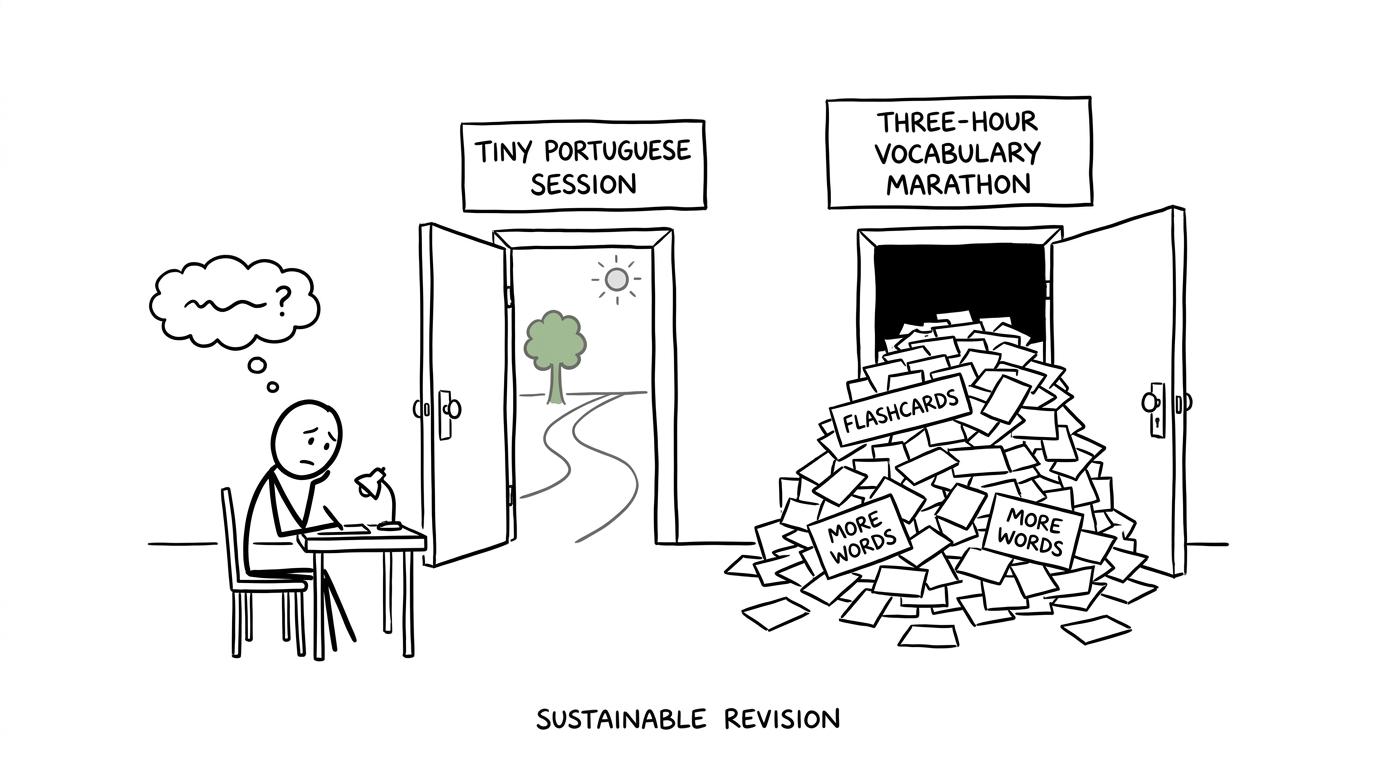 A student chooses between a small Portuguese session and a mountain of flashcards
Why revising every day can help
Languages depend partly on fast access to information. In an examination, you do not simply need to have seen a word before. You need to recognise or produce it while listening, reading, speaking or writing.
Frequent retrieval gives you more opportunities to practise that access. Instead of rereading a vocabulary list, cover the Portuguese, recall it from memory and then check. The effort is useful: retrieval practice strengthens later recall and reveals which words are not yet secure.
Daily contact can be especially effective for:
- recalling a small group of vocabulary items;
- saying useful phrases aloud;
- reviewing verb forms from memory;
- listening briefly to clear Portuguese;
- correcting errors from an earlier task.
The session does not need to be long. On a busy school day, ten focused minutes may be more sustainable than promising yourself an hour and repeatedly postponing it.
Maths revision benefits from the same low-friction approach. MathsGenie’s twenty-minute maths revision routine shows how a small, repeatable structure can protect progress when several subjects are competing for attention.
Why rest days improve retention
Learning is not measured by how familiar something feels at the end of a session. It is measured by whether you can retrieve and use it later.
Research reviews identify spaced practice and retrieval practice as reliable ways to improve long-term retention. Spacing means distributing encounters with material over time rather than compressing them into one marathon. The gap permits some forgetting, making the next retrieval more demanding and informative.
That is why a rest day need not mean lost progress. If you learn vocabulary on Monday and test it again on Wednesday or Thursday, the interval is part of the learning design.
Sleep matters too. Memory consolidation continues after practice, and sleep supports the processes through which recently encountered information becomes more stable. Sacrificing sleep for late-night revision can also weaken attention during the next day’s lessons and practice.
Rest has a practical role as well. A schedule without spare capacity is fragile. One difficult homework evening, family commitment or poor night’s sleep can destroy it. A plan containing lighter days can bend without breaking.
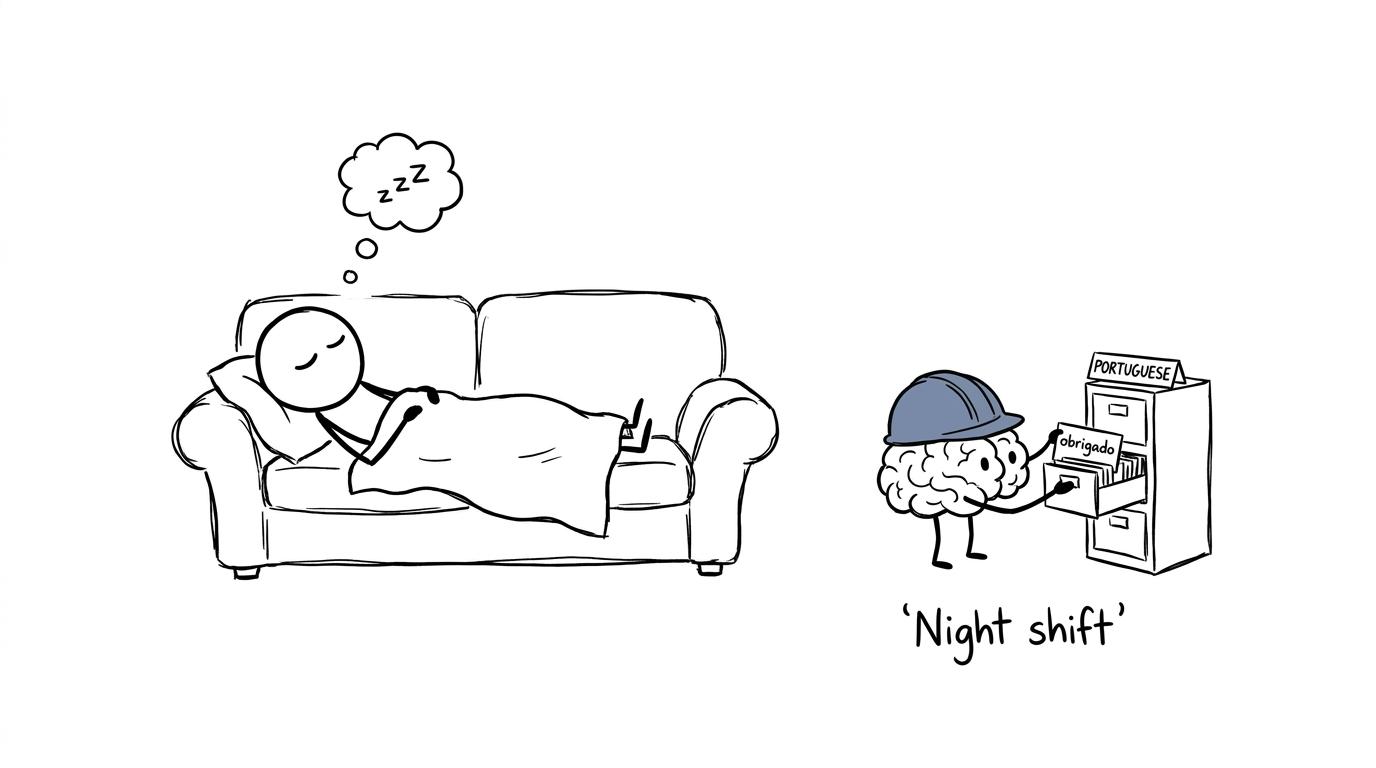 A tiny brain files vocabulary cards while a student rests
Daily contact is not the same as daily pressure
A useful compromise is to separate maintenance from development.
Maintenance sessions
Maintenance keeps material available. These sessions might include a brief flashcard review, a few spoken sentences or a quick correction of previous errors. They should finish while your attention is still reasonably fresh.
Development sessions
Development asks more of you. It could involve a timed reading section, extended writing, focused grammar practice, sustained listening or a recorded speaking response. These sessions need concentration and feedback, so they should not automatically appear every day.
This gives you a calmer rule: Portuguese can appear frequently in your timetable without every appearance becoming a major task.
The same distinction helps with maths. A few formula recall prompts are maintenance; a timed paper is development. MathsGenie’s guide to building a GCSE maths revision timetable explains how to combine targeted sessions with rest and catch-up space.
A sensible weekly pattern for Portuguese and maths
There is no universal timetable because students have different starting points, school workloads and examination dates. A practical starting pattern is:
- three focused Portuguese sessions across the week;
- two or three very short retrieval reviews;
- one day with no Portuguese at all;
- separate maths blocks based on your weakest topics;
- one flexible slot that can become rest or catch-up.
Avoid placing every difficult subject on every evening. You might alternate a demanding Portuguese session with a demanding maths session, using lighter recall for the other subject.
For maths, begin with evidence rather than guesswork. The MathsGenie GCSE maths revision hub provides free revision lessons, topic questions, worksheets, mini tests and papers across boards including Edexcel, AQA, OCR and Eduqas. The guide to finding your weakest GCSE topics can help you decide where those maths blocks belong.
Every fortnight, review the timetable itself. If recall is improving and you feel alert, the balance is probably workable. If you are repeatedly skipping sessions, sleeping too little or confusing familiar words under pressure, reduce the load and improve the quality of practice.
Match revision to the Portuguese assessment
Your schedule should reflect the qualification you are actually taking. Check the current specification and instructions supplied by your school or exam board rather than relying on an old revision guide.
For the current Pearson Edexcel GCSE Portuguese qualification, listening, speaking, reading and writing are assessed through four papers, with each skill contributing 25%25\%25% of the qualification. Foundation and Higher papers are available, and students enter the same tier across the papers.
That structure makes balance important. A timetable made entirely of vocabulary flashcards may improve word recognition but does not reproduce the demands of sustained listening, spontaneous speech, translation or extended writing.
Across the week, include all four skills:
- Listening: identify overall meaning, details and opinions without pausing constantly.
- Speaking: answer aloud and develop responses rather than only rehearsing silently.
- Reading: infer meaning from context and respond precisely to the question.
- Writing: produce accurate language, check verb forms and communicate across time frames.
Use retrieval inside each skill. After listening, summarise what you understood before checking. After reading, recall key phrases without looking. After writing, record recurring errors and test the corrected forms later.
How to tell whether you need another session or a break
Do not decide solely from guilt. Use evidence.
Continue with a short session when you can focus, have a specific target and will still protect your sleep. Take a break when you are rereading without processing, making unusual errors through fatigue or extending revision merely to satisfy a time target.
Also distinguish avoidance from exhaustion. If you feel reluctant before every session but concentrate once you begin, lower the starting barrier: commit to five minutes of retrieval. If concentration remains poor after starting, rest may be the more productive choice.
For maths, a mini test can provide similar evidence. Instead of revising everything because you feel uncertain, test a small area, mark it and respond to the result. MathsGenie’s one-month GCSE maths plan builds revision around diagnosis, spaced review and paper practice rather than anxious guesswork.
Common mistakes when planning daily revision
Treating time spent as proof of learning
A long session can produce neat notes without improving recall. Finish sessions with an attempt to retrieve, explain or apply what you studied.
Using flashcards only for recognition
Seeing the Portuguese and thinking “I knew that” is weaker than producing the answer before turning the card. Shuffle the direction so you practise both recognition and production.
Revising one language skill repeatedly
Students often choose the activity that feels safest. Balance matters because Portuguese assessment requires listening, speaking, reading and writing, not simply vocabulary recognition.
Turning rest into unplanned avoidance
A rest day should be intentional. Decide when work resumes and what the first small task will be. This prevents one missed session from becoming a week of uncertainty.
Letting Portuguese consume maths time
Language vocabulary can feel endless, but maths also requires repeated problem solving. Keep subject blocks visible in one timetable. When it is time for maths, use GCSE past papers effectively: complete the correct board and tier, mark carefully, repair weak topics and retest them.
Completing papers without learning from them
A paper is diagnostic evidence, not merely a score. For Edexcel maths students, Edexcel GCSE maths past papers include official mark schemes and worked solutions where available. Use mistakes to choose the next revision lesson rather than immediately starting another paper.
Build a schedule you can still follow next month
The daily-versus-rest debate is really a question about sustainability. Daily light contact with Portuguese can keep vocabulary and sentence structures accessible. Spaced, demanding sessions develop examination skills. Rest days and sleep help make that learning durable.
So do not aim to work intensely every day. Aim to return regularly, retrieve honestly and stop before exhaustion turns practice into noise.
Then give maths the same thoughtful structure. Start at the free MathsGenie GCSE revision hub, choose your board and tier, and combine revision lessons with practice questions, mini tests and timed papers. As the examinations approach, add past papers and predicted papers, then use mark schemes and video solutions to turn every lost mark into a clear next step.










