GCSE Portuguese Paper 3 Exam Date 2026
GCSE Portuguese Paper 3 exam date 2026: confirm the session, duration, paper format, what to bring and how to plan your GCSE maths revision calmly.
Exam timetables can create a peculiar kind of confusion. You know the revision matters, yet first you need to know where to be, when to arrive and which paper you are actually sitting.
The GCSE Portuguese Paper 3 exam date 2026 was Tuesday 2 June 2026, in the afternoon session, for Pearson Edexcel GCSE Portuguese. Paper 3 was Reading and Understanding in Portuguese. Foundation tier lasted 454545 minutes, while Higher tier lasted 111 hour.
There was one particularly important detail: Portuguese Paper 1, the listening examination, was also scheduled for that afternoon. Your school or examination centre controlled the precise arrangements, so its individual timetable always took priority.
Portuguese Paper 3 date at a glance
Here is the essential checklist from Pearson's final Summer 2026 timetable and GCSE Portuguese specification:
- Date: Tuesday 2 June 2026
- Session: Afternoon
- Exam board: Pearson Edexcel
- Qualification code: 1PG0
- Foundation paper code: 1PG0/3F
- Higher paper code: 1PG0/3H
- Foundation duration: 454545 minutes
- Higher duration: 111 hour
- Total marks: 505050
- Qualification weighting: 25%25\%25%
- Paper title: Reading and Understanding in Portuguese
- Dictionary: Not permitted
Check the tier and component code on your personal timetable. GCSE Portuguese candidates must normally be entered for the same tier across all four papers, so Paper 3 should match the tier used for listening, speaking and writing.
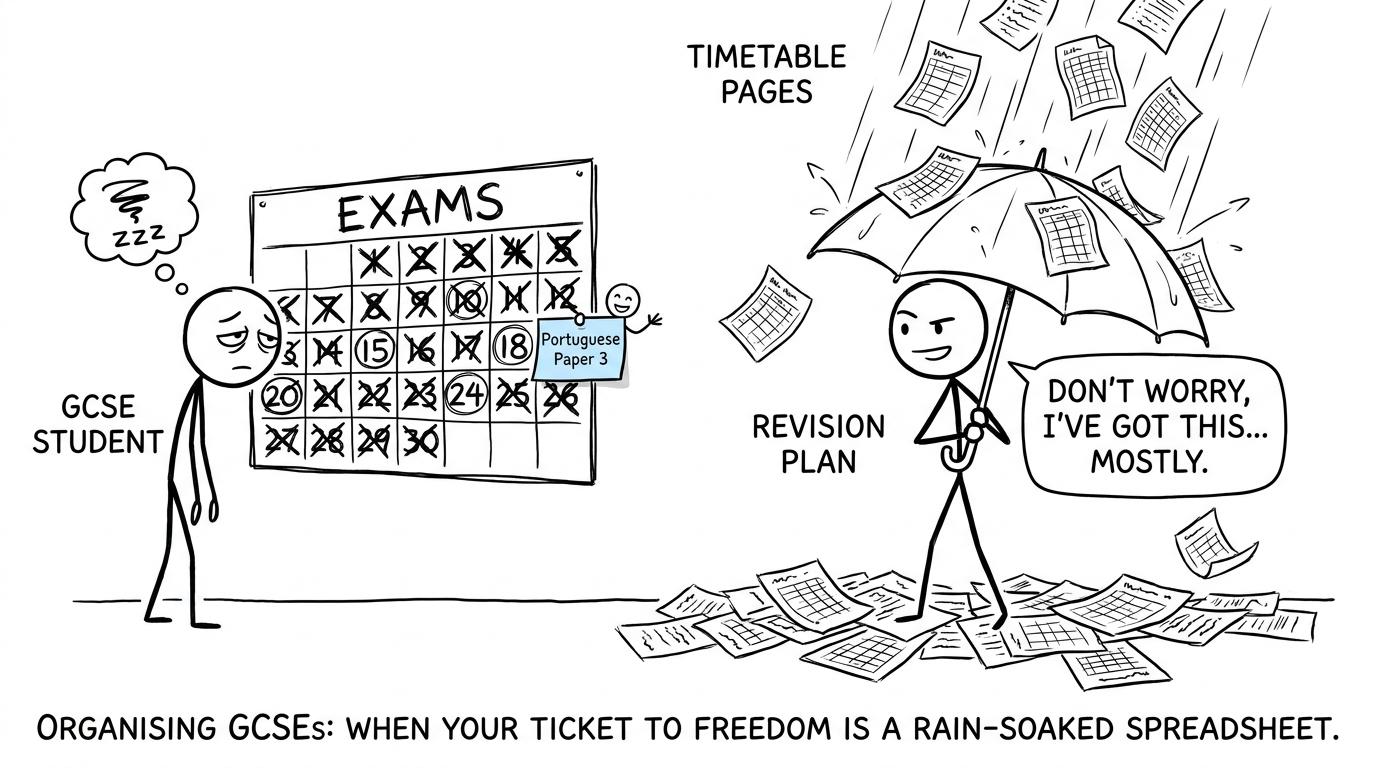 A student sheltering beneath a revision plan while timetable pages fall around them
Why 2 June needed careful planning
Portuguese Paper 3 did not sit alone in the timetable. Pearson scheduled both Portuguese Paper 1 and Paper 3 in the Tuesday afternoon session:
- Paper 1: Listening and Understanding in Portuguese
- Paper 3: Reading and Understanding in Portuguese
Pearson's timetable instructions state that candidates with more than one examination in a session should take them consecutively. A supervised break may be provided between consecutive examinations. That means you could not assume that your afternoon would involve only the advertised Paper 3 duration.
The listening paper lasted 353535 minutes at Foundation tier and 454545 minutes at Higher tier. Combined with the reading paper, the examination time was therefore substantial, even before a supervised break, administration and the checking of candidate details.
Your centre might also adjust the exact start arrangements within the permitted examination rules. Follow the arrival time printed on your school timetable rather than working backwards from Pearson's published afternoon starting time.
The maths exam the following morning
For many GCSE students, the calendar became even tighter because Wednesday 3 June 2026 was a major GCSE maths examination morning. AQA and Pearson Edexcel scheduled Maths Paper 2 then, while OCR scheduled its second Foundation paper and fifth Higher paper.
So the sensible plan was not to finish Portuguese on Tuesday afternoon and begin an exhausting maths revision session that evening. The better approach was to complete the main maths preparation earlier, leaving Tuesday evening for a short review, packing equipment and sleeping properly.
MathsGenie's GCSE Maths Revision hub lets you choose your exam board and move between revision lessons, exam-style questions and papers. If you take Edexcel, the Edexcel GCSE Maths revision page brings Foundation and Higher resources together in one place.
What Portuguese Paper 3 assesses
Paper 3 tests whether you can understand written Portuguese across the specification's themes and topics. According to Pearson's specification, the paper contains 101010 questions divided across three sections.
You may encounter passages adapted from different types of source, including factual writing and literary material. The questions include instructions and responses in both English and Portuguese. The final section requires translation from Portuguese into English.
This matters because reading revision is not simply vocabulary memorisation. You need to practise:
- identifying the main message and supporting detail;
- recognising opinions, attitudes and changes of viewpoint;
- using context to interpret unfamiliar words;
- noticing negatives, tense and time references;
- responding in the language requested;
- producing accurate, natural English in the translation.
Every question must be attempted. If one phrase is unfamiliar, use the rest of the sentence and passage rather than allowing a single word to stop your progress.
What to have ready before the exam
A calm examination morning usually begins the night before. The goal is not to carry everything you own. It is to remove small uncertainties before they have a chance to become distractions.
Your confirmed timetable details
Have your centre-issued timetable ready and check:
- the date and arrival time;
- the examination room;
- whether you are entered for Foundation or Higher tier;
- your candidate and centre numbers;
- the arrangements for Paper 1 and Paper 3;
- any approved access arrangements.
If anything looks inconsistent, ask your examinations officer or teacher. Do not try to resolve a tier or timetable concern through guesswork.
Suitable writing equipment
Pearson's sample assessment instructions specify black ink or a black ball-point pen. Take at least two reliable black pens in a clear pencil case, following your centre's rules.
You should also have any identification or candidate card required by your school. If water is permitted, follow your centre's instructions about transparent bottles and labels.
You do not need a calculator for Portuguese reading. More importantly, you must not use a dictionary. Mobile phones, watches and other unauthorised devices should be left where your centre tells you to leave them, rather than carried to the desk.
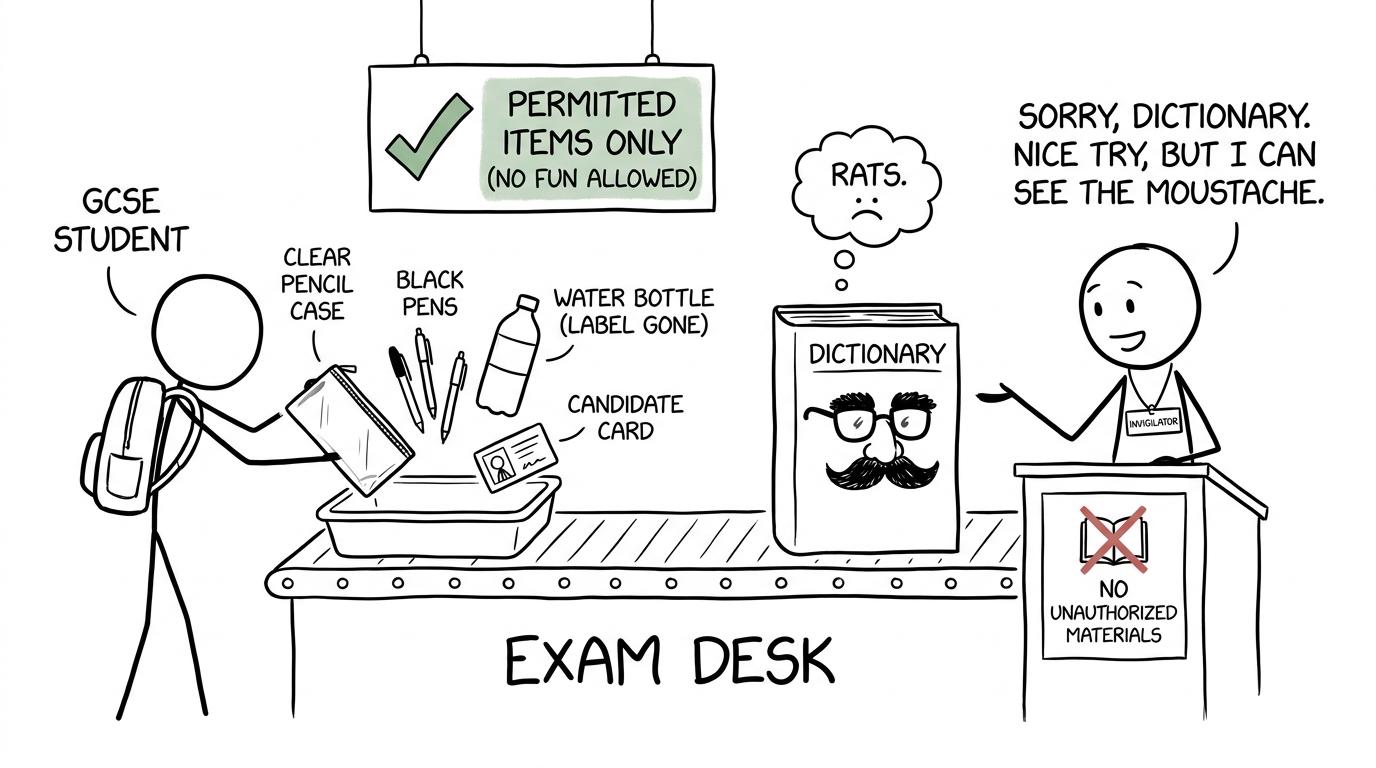 A dictionary in disguise being refused entry at an exam equipment checkpoint
A reading strategy you have already practised
Exam day is too late to invent a new system. Before 2 June, decide how you will handle difficult vocabulary, short-answer questions and translation.
A dependable approach is to read the question carefully, identify exactly what information is required and then return to the relevant part of the passage. Pay attention to the language in which you must answer. An accurate idea written in the wrong language may not satisfy the instruction.
For translation, aim to communicate the full meaning in clear English. Do not leave a gap merely because one word is uncertain. Use context, grammar and the surrounding sentence to produce the most plausible complete meaning.
How to balance Portuguese with GCSE maths revision
When two important subjects sit close together, revision can become a contest for attention. The answer is not to choose one and neglect the other. It is to separate the jobs.
Before Tuesday, complete at least one timed maths paper or substantial timed section. Mark it and reduce the result to a short list of specific weaknesses. MathsGenie's guide to using Edexcel GCSE Maths past papers properly explains how to turn lost marks into targeted practice instead of simply collecting paper scores.
Then divide the final preparation:
- Portuguese: timed reading, vocabulary retrieval and translation practice;
- Maths: short review of known weaknesses, formula recall and calculator preparation where relevant;
- Tuesday evening: light review only, followed by packing and rest.
If a full maths paper feels too demanding before a long language examination, use shorter activities from the revision hub. Mini tests and topic questions can keep methods active without consuming the whole evening.
The GCSE predicted papers can provide fresh maths questions, but they should complement rather than replace past papers. The aim is to discover what still needs attention while there is time to fix it.
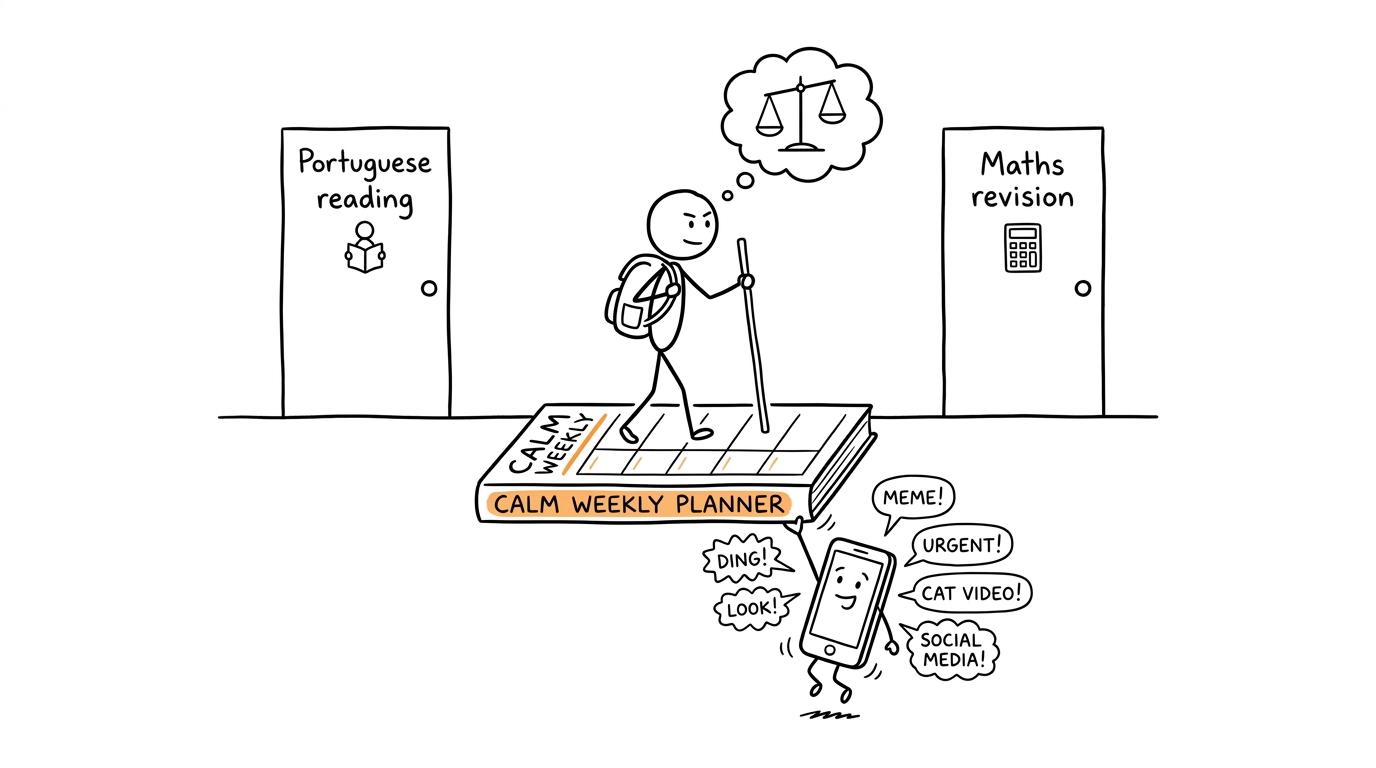 A student using a weekly planner as a bridge between Portuguese and maths revision
The final 24-hour plan
The day before the examination should make life simpler, not noisier.
Complete one short Portuguese reading or translation activity, then review errors rather than starting several new resources. Confirm transport, arrival time and the arrangements for the two Portuguese papers. Pack your black pens and permitted equipment.
For maths, revise only the topics already identified as priorities. The Maths night-before revision plan is useful when you need a focused routine without attempting to relearn the entire specification.
If you are still deciding how to phase paper practice, read when to start GCSE past papers. Past papers are most valuable when you leave enough time to mark them, diagnose mistakes and revisit the relevant lesson.
Finally, keep Wednesday 24 June 2026 available if instructed. Ofqual identified this as the national contingency day for the Summer 2026 examination series. It was reserved for examinations moved because of national or significant local disruption, not for individually missed papers.
Common mistakes to avoid
Confusing Portuguese Paper 3 with maths Paper 3
They are entirely different examinations. Portuguese Paper 3 was on Tuesday 2 June in the afternoon. The main AQA and Edexcel GCSE Maths Paper 3 examinations were scheduled for Wednesday 10 June in the morning.
Forgetting about Portuguese Paper 1
Paper 1 and Paper 3 shared the same afternoon session. Plan for both papers and follow your centre's instructions about supervision and breaks.
Revising for the wrong tier
Foundation and Higher Paper 3 have different codes and durations. Check your entry rather than selecting practice materials based only on difficulty.
Taking a dictionary into the examination
Dictionaries are not permitted. Build the habit of inferring meaning from context during timed practice.
Leaving maths preparation until Tuesday evening
For many students, a maths paper followed the next morning. Move demanding maths practice earlier and keep the final evening short and deliberate.
Treating the date as the whole plan
Knowing the date prevents one mistake. Knowing the paper format, arrival arrangements, permitted equipment and next day's commitments prevents several more.
Turn the timetable into a revision plan
A timetable date is only a fixed square on a calendar. What matters is what you place around it.
For GCSE Portuguese Paper 3, that meant preparing for reading and translation, remembering that Paper 1 shared the afternoon, and protecting enough energy for the maths examination the following morning. Good planning rarely feels dramatic. It simply removes decisions from the moment when you are least able to make them calmly.
Use MathsGenie as your free maths revision base. Start with the GCSE Maths Revision hub, rebuild weak topics through revision lessons and practice questions, then test your progress with past papers, mark schemes, video solutions, mini tests and predicted papers. One well-reviewed paper is worth more than several rushed ones. Choose the next useful task and begin there.