GCSE Portuguese Paper 2: What to Actually Expect
GCSE Portuguese Paper 2 explained: timings, role play, picture task, conversation, mark allocation and practical revision advice for each tier.
The strange thing about a speaking exam is that the shortest paper can feel the longest. A pause of three seconds feels enormous. A forgotten word suddenly seems more important than every sentence you have already said correctly.
But GCSE Portuguese Paper 2 is not a test of whether you can speak without pausing. It is the speaking assessment for Pearson Edexcel GCSE Portuguese, worth 25%25\%25% of the qualification. You complete three tasks: a role play, a picture-based task and a conversation. Foundation lasts 777-999 minutes, while Higher lasts 101010-121212 minutes, with 121212 minutes of supervised preparation at both tiers.
The useful question is not, “How do I sound completely fluent?” It is, “What does each task reward, and how can I make that visible?”
GCSE Portuguese Paper 2 at a glance
The current Pearson Edexcel specification gives the paper 707070 marks. It is conducted by a teacher at your centre, recorded and externally assessed by Pearson. Your school will tell you the exact date and arrangements.
| Part | Foundation guidance | Higher guidance | Marks |
|---|---|---|---|
| Preparation time | 121212 minutes | 121212 minutes | Not separately marked |
| Role play | 111-1.51.51.5 minutes | 222-2.52.52.5 minutes | 101010 |
| Picture-based task | 2.52.52.5-333 minutes | 333-3.53.53.5 minutes | 242424 |
| Conversation | 3.53.53.5-4.54.54.5 minutes | 555-666 minutes | 363636 |
| Total speaking time | 777-999 minutes | 101010-121212 minutes | 707070 |
The three sections do different jobs:
- Role play: communicate specific information clearly and appropriately.
- Picture-based task: describe, explain and respond to questions connected with an image and its theme.
- Conversation: develop answers, exchange opinions and respond spontaneously across two themes.
Paper 2 draws on vocabulary and structures from across the specification. There is no dependable “Paper 2 vocabulary list” that replaces learning the course themes.
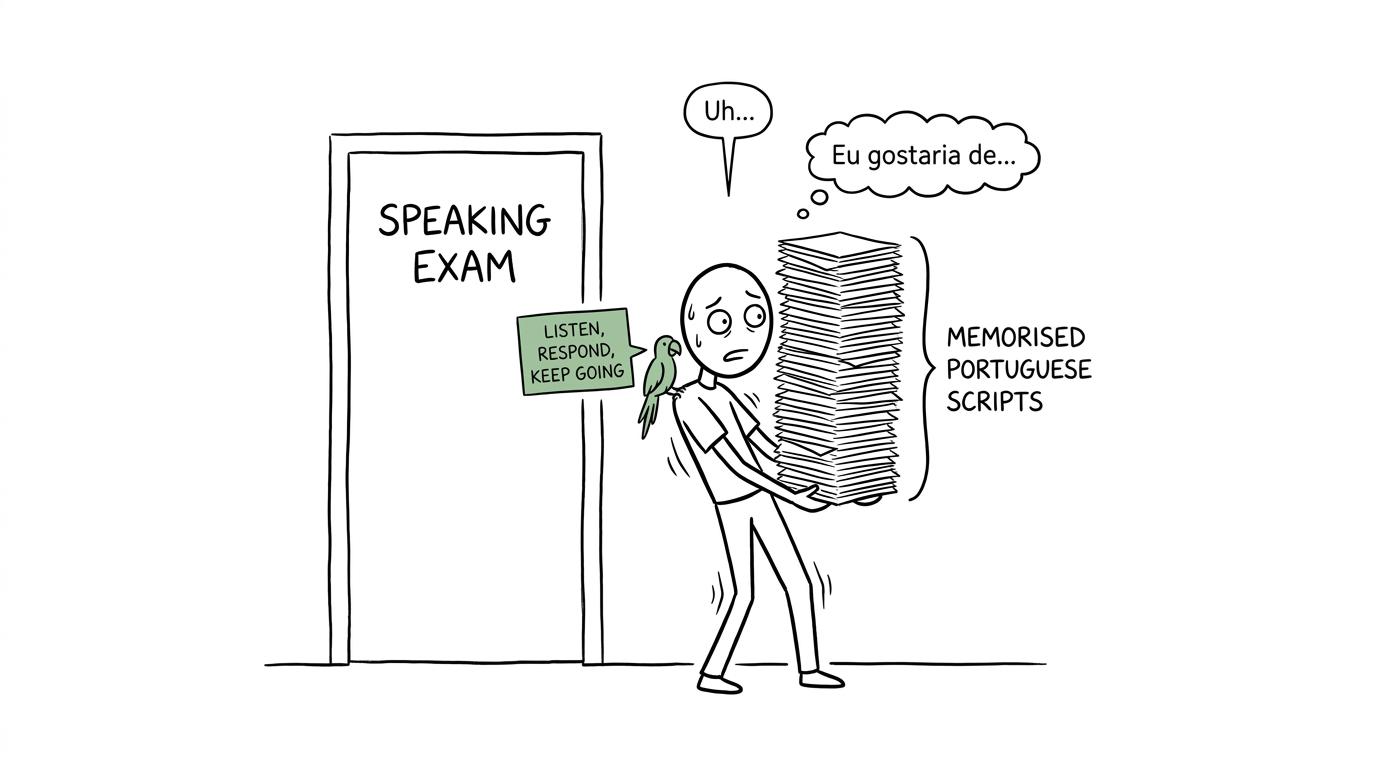 A nervous student abandons an enormous memorised script and follows a parrot's advice to listen, respond and keep going
What is different about Paper 2?
Listening, reading and writing papers give you material that stays on the page. Speaking is less stable. You must process a prompt, retrieve language and communicate in real time.
That changes what successful revision looks like.
A memorised paragraph may contain impressive language, but it is only useful when it answers the question asked. Paper 2 particularly rewards:
- relevant communication;
- interaction with the examiner;
- spontaneous responses;
- opinions supported with reasons;
- accurate vocabulary and grammar;
- the ability to narrate or refer to different time frames where appropriate;
- strategies that keep communication moving when a word disappears.
In other words, the paper favours flexible language over a perfect speech delivered regardless of the prompt. This is the same reason active practice works better than passive rereading in maths. The MathsGenie guide to efficient GCSE revision recommends learning, attempting, marking and correcting. For Portuguese speaking, the equivalent is prepare, speak, listen back and improve.
What happens during the preparation time?
You receive 121212 minutes of supervised preparation for the role play and picture-based task. The conversation is not prepared during this period.
Pearson’s sample assessment instructions state that dictionaries and other resources are not allowed. Candidates may make notes on no more than one side of A4 paper, but must not write on the stimulus cards. Your centre will manage the secure materials and explain exactly what you may take into the assessment.
Use the preparation time to create prompts, not a script. A practical checklist is:
- identify every role-play instruction;
- notice where you must ask a question;
- prepare a short response for each visible prompt;
- list useful picture vocabulary;
- note an opinion and a reason;
- prepare links to past, present or future ideas where relevant;
- leave enough space to read your notes quickly.
Full sentences covering the page can become a trap. Under pressure, you start searching for the sentence you planned rather than listening to the sentence being spoken to you.
What to expect from the role play
The role play is the shortest task and is worth 101010 marks. Its purpose is practical communication within a stated situation. Your candidate card gives instructions in English, and the interaction takes place in Portuguese.
The prompts are deliberately specific. You may need to provide information, express a preference, ask a question or respond to an unexpected prompt. Each required utterance matters, so directness is valuable.
This is not the moment to force in every sophisticated phrase you know. If the prompt asks when you want to travel, the examiner needs an identifiable time. If it asks you to request information, your response must function as a question.
The best preparation is repeated short practice with varied situations. Ask a teacher or partner to change one detail each time so that you cannot survive by reciting the same exchange.
What to expect from the picture-based task
The picture-based task carries 242424 marks. You respond to a picture stimulus and related questions connected with one of the specification themes.
A strong response moves beyond naming visible objects. You may be asked to describe what is happening, infer how somebody feels, give an opinion, explain a reason or connect the theme to your own experiences.
Marks are available for communication and content, as well as linguistic knowledge and accuracy. That means two things must happen together: the examiner should understand your message, and your language should show suitable control and range.
During preparation, think in layers:
- Observation: who, where and what can you see?
- Action: what are people doing?
- Interpretation: what might they be feeling, and why?
- Theme: how does the scene connect to school, travel, identity, work or another course area?
- Personal response: what do you think about the wider issue?
You are not being assessed on discovering a hidden “correct” interpretation of the image. The image is a doorway into communication.
What to expect from the conversation
The conversation is worth 363636 marks, more than half of the marks available on Paper 2. It covers two themes. One is chosen by the student in advance; the second is allocated according to Pearson’s assessment arrangements.
This section gives you the greatest opportunity to demonstrate developed language. It also places the greatest emphasis on interaction and spontaneity. The assessment considers communication and content, linguistic knowledge and accuracy, and your ability to engage naturally with questions.
Developed answers are useful, but “developed” does not mean endlessly long. A reliable answer usually has a clear response, a reason and one relevant extension. You might add a comparison, a past experience, a future intention or a contrasting view.
Listen to the tense and question word before deciding what to say. An elegant answer about the wrong time frame is still an answer to the wrong question.
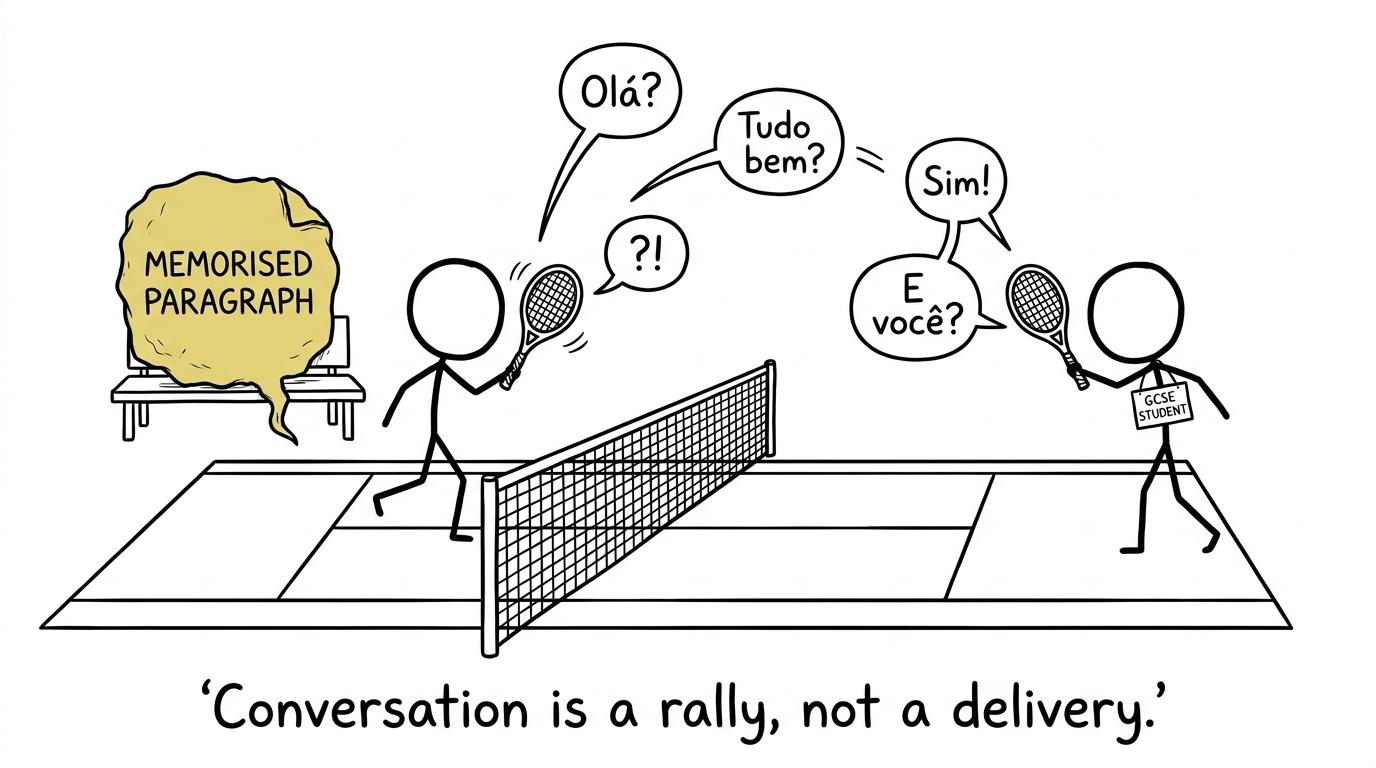 A student returns speech bubbles in a conversational tennis rally while a memorised paragraph waits on the bench
How Foundation and Higher differ
Both tiers contain the same three task types and carry 707070 marks. Higher simply gives the interaction more room to develop: its recommended role-play and picture-task timings are longer, and its conversation lasts 555-666 minutes rather than 3.53.53.5-4.54.54.5 minutes.
The linguistic demand also reflects the tier. At Higher, students should be ready to handle less predictable questions, communicate in greater detail and show broader control of vocabulary and structures. At Foundation, clear communication remains central; short, accurate answers can be more effective than ambitious language that obscures the meaning.
GCSE Portuguese uses one tier of entry across all four papers, so students do not mix Foundation and Higher components. Confirm your entry with your teacher rather than assuming it from the difficulty of classroom practice.
A practical revision method
Speaking improves through retrieval. Looking at vocabulary can create familiarity, but familiarity is not the same as being able to produce it when someone is waiting for your answer.
Build practice around short, repeatable sessions:
- Record a response without notes.
- Listen once for whether you answered the question.
- Listen again for tense, agreement and pronunciation.
- Correct only the most important weaknesses.
- Repeat the response with one changed detail.
- Practise an unexpected follow-up question.
Keep a compact record of recurring errors. This resembles the correction process explained in MathsGenie’s guide to using mark schemes: identify the first point where marks are being lost, fix it and retest it later.
If you are balancing Portuguese with maths, avoid letting one speaking session consume an entire evening. A focused oral drill can sit alongside an Edexcel GCSE Maths mini test. Short, honest practice is easier to repeat than a heroic revision session followed by several days of avoidance.
Common mistakes in GCSE Portuguese Paper 2
Memorising answers instead of learning building blocks
Memorised material can support confidence, but it becomes fragile when the wording changes. Learn reusable verbs, opinion phrases, connectives and repair strategies so you can adapt.
Missing part of a role-play instruction
A fluent response cannot earn communication marks for information it never gives. During preparation, check every bullet and mark where you need to ask a question.
Describing only what is visible
In the picture task, move from observation towards interpretation and opinion. Give reasons where the question allows them.
Giving one-sentence conversation answers
Repeatedly stopping after one brief statement limits the language and interaction you can demonstrate. Extend naturally, but do not continue so long that you stop responding to the examiner.
Treating a pause as a disaster
A pause is recoverable. Use a simple phrase to gain thinking time, rephrase with vocabulary you do know or correct yourself and continue. Communication matters more than pretending the mistake never happened.
Ignoring the question word or time frame
Listen for whether you are being asked who, where, when, why or what you think. Then check whether the question points to the past, present or future.
Revising passively
Reading model answers feels comfortable because nothing can go wrong. Unfortunately, speaking practice must include moments when words do go wrong. Those moments show you what to repair.
Go into Paper 2 knowing its shape
Uncertainty makes this assessment feel larger than it is. Once you know the sequence, the job becomes clearer: communicate precisely in the role play, develop the picture into meaningful language, then sustain a responsive conversation across two themes.
Your Portuguese teacher and Pearson materials should remain your source for language-specific assessment practice. For the maths side of your GCSE timetable, use MathsGenie’s free GCSE and A Level revision resources to keep the rest of your revision structured. You can also follow the realistic independent GCSE maths plan or use the GCSE maths night-before checklist when exams are close.
Start with revision lessons, move into practice questions, check mark schemes and video solutions, then test yourself with mini tests, past papers and predicted papers. Paper 2 rewards the same quiet habit that improves maths: do the real task, notice what failed, and return with a better response.