

GCSE Physics Resit: Your Results Day Revision Plan
GCSE physics resit advice with a clear post-results revision plan, weekly milestones, exam practice, maths skills and calm preparation for your retake.
Results Day can make one grade feel larger than everything around it. Yet a disappointing Physics result is information, not a verdict. If you are planning a GCSE physics resit, your first steps are to confirm the qualification you need to retake, identify where you lost marks and build a revision routine around questions rather than rereading.
Unlike GCSE English Language and Maths, Physics is not normally available in the November series. Most students resitting GCSE Physics therefore take the qualification in the following summer. Confirm the available series, entry arrangements and deadline with your school, college or approved examination centre.
Your GCSE physics resit checklist
Before serious revision begins, establish the facts:
- Confirm whether you took separate GCSE Physics or Combined Science.
- Check your exam board: AQA, Edexcel, OCR or Eduqas.
- Ask whether you must repeat every relevant paper or assessment component.
- Confirm your examination centre, entry deadline and any fees.
- Obtain the correct specification and equation sheet for your exam year.
- Complete a short diagnostic set and create an error log.
- Schedule regular topic practice, maths repair and timed papers.
If you originally took Combined Science, do not assume you can simply retake one Physics paper. Your centre must explain which qualification and components need entering.
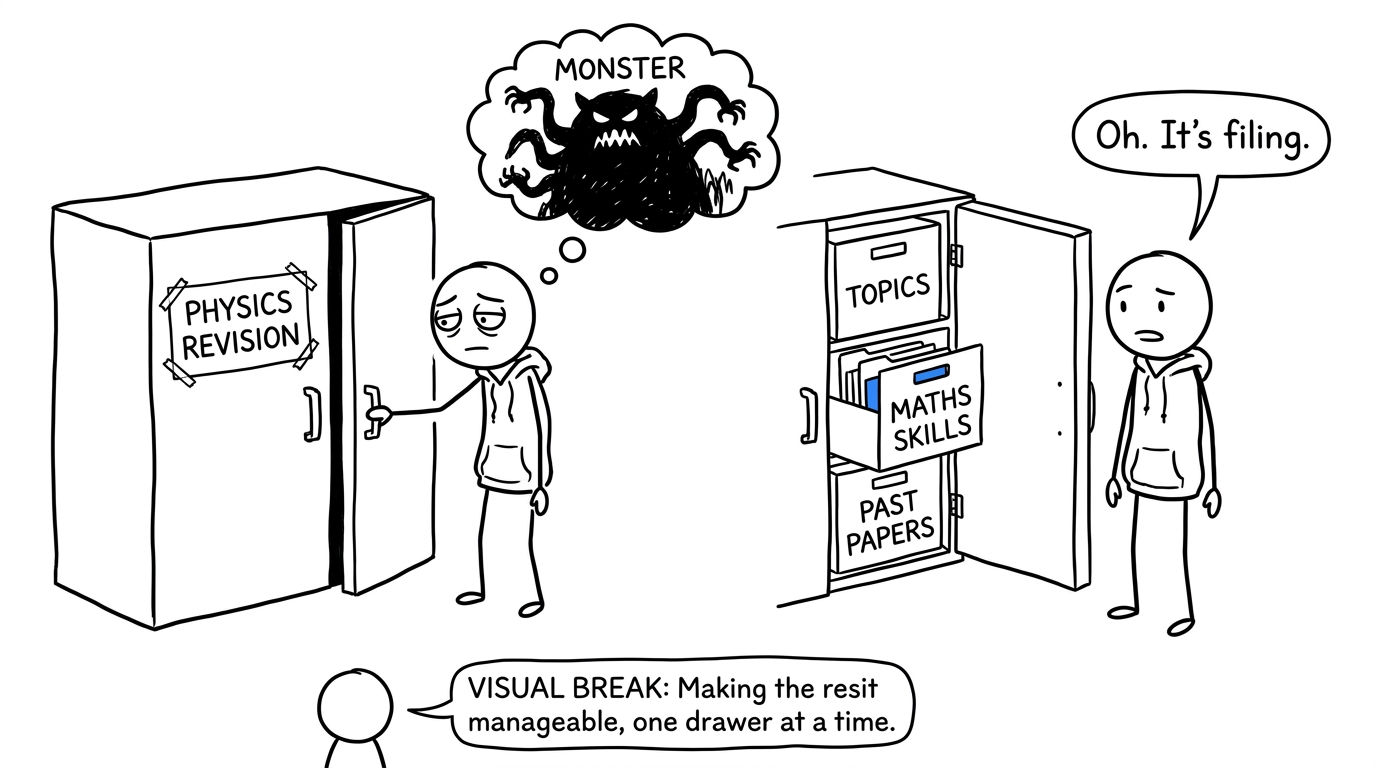 A student discovers that Physics revision is really three manageable filing drawers
Milestone one: diagnose the old result
The grade tells you the outcome. It does not tell you the cause.
Begin with a short, closed-book section from your exam board. AQA students can use the AQA GCSE Physics past papers, then mark the attempt strictly. For every lost mark, classify the problem as:
- Physics knowledge: you did not understand or recall the concept.
- Maths method: you struggled with algebra, graphs, units or powers of ten.
- Exam technique: you misread a command word, omitted working or gave an imprecise explanation.
The guide to finding your weakest Physics topics provides a practical way to build this diagnosis. Keep the resulting error log short: topic, mistake, reason and next action.
Your first milestone is reached when you can name three specific weaknesses. “Electricity” is too broad. “Choosing the correct relationship in circuit calculations” is useful.
Milestone two: rebuild topics and maths together
For the next phase, divide each week between Physics understanding and the maths that supports it. A productive session might contain a short revision lesson, several targeted questions, immediate marking and one reattempt.
Use the AQA GCSE Physics revision guides if they match your specification, or the Edexcel GCSE Physics worksheets for Edexcel topic practice. Staying with the correct board matters because specifications, paper structures and accepted terminology can differ.
Physics calculations repeatedly depend on a small group of mathematical skills:
- rearranging formulae;
- converting units;
- standard form and powers of ten;
- ratios and proportional reasoning;
- gradients and areas on graphs;
- rounding and significant figures.
If rearranging is costing marks, use the changing the subject of a formula revision resources. For very large or small quantities, strengthen the method through GCSE standard form practice.
For exams in 2026 and 2027, students are provided with Physics equation sheets. That removes some memory pressure, but it does not remove the need to recognise the correct relationship, understand each symbol, rearrange accurately and use consistent units. Practise with the sheet intended for your board and exam year from the beginning.
Milestone three: turn notes into retrieval
Resitting GCSE Physics does not require rewriting the same folder more neatly. It requires retrieving ideas without support.
Convert notes into short questions covering definitions, relationships, practical methods and explanations. Answer them from memory, check immediately and revisit missed prompts later. The MathsGenie guide to turning Physics notes into active recall explains how to make prompts resemble the demands of a mark scheme.
By this milestone, you should be able to explain core ideas aloud, select equations without being directed and describe required practicals with attention to variables, measurements, safety and evaluation.
Milestone four: move from topics to timed papers
Topic worksheets build control. Past papers build performance.
Begin with timed sections, then progress to complete papers under realistic conditions. Use the routine explained in how to use AQA Physics past papers properly: attempt, mark, diagnose, fix and reattempt.
Record more than a total mark. Track marks by topic and mistake type. A rising score is encouraging, but a shrinking list of repeated errors is even more useful.
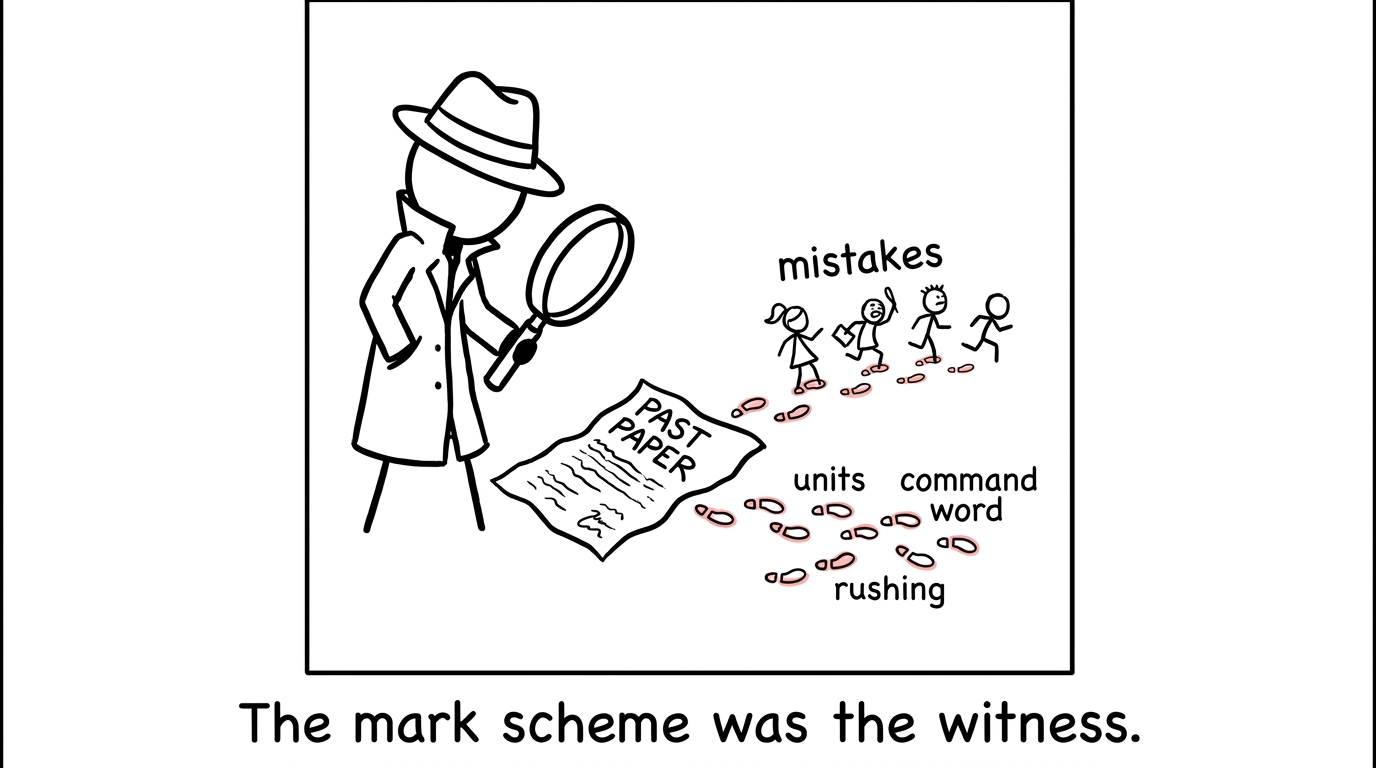 A student detective follows the footprints of units, command words and rushing
Milestone five: prepare for the final month
In the final month, shift most revision towards mixed and timed practice. Keep short topic sessions for weaknesses that still appear in your error log.
Each week should include:
- at least one substantial timed paper or paper section;
- marking with the official mark scheme;
- targeted repair of recurring gaps;
- practice using the current equation sheet;
- a check of equipment, dates and examination arrangements.
Predicted papers and mini tests can add variety, but official past papers remain the clearest guide to genuine question style. Avoid using every recent paper too early; save some unseen material for final timed practice.
Common mistakes when resitting GCSE Physics
Repeating the previous revision method: more hours will not help if those hours are spent passively reading.
Using the wrong exam board: always match questions and revision resources to your specification.
Ignoring the maths: a Physics knowledge gap and an algebra gap require different fixes.
Looking at the mark scheme too early: attempt questions closed-book before checking support.
Recording only scores: write down why each mark was lost and what you will practise next.
Assuming the equation sheet does the thinking: familiarity with a formula is not the same as knowing when and how to use it.
Make the resit a different attempt
A resit becomes valuable when it is not simply a repeat. Treat the old result as your first diagnostic, organise the months ahead into clear milestones and let each paper tell you what to do next.
Start today with MathsGenie’s free GCSE Physics past papers and Physics worksheets. Combine them with revision lessons, practice questions, mark schemes, video solutions, mini tests and predicted papers. The aim is not to feel confident before practising. It is to practise carefully enough that confidence eventually has evidence behind it.











