

GCSE Physics Remark: Process and When to Request One
GCSE physics remark guidance: learn how reviews work, what can change, key 2026 deadlines and when appealing your Physics grade makes sense.
Results day can turn a single mark into the most important mark in the world. If your Physics result is just below the grade you expected, a GCSE physics remark may be worth considering, but only when there is credible evidence of a marking error. The official service is called a review of marking, not a fresh re-mark. Your school requests it, your mark can rise, fall or stay unchanged, and the decision should usually be made after checking your grade boundary and marked script.
Here is the calm version of what to do next.
GCSE physics remark decision checklist
Before requesting anything, ask:
- Have you confirmed whether the result is separate Physics or Combined Science?
- How many marks are you below the next overall grade boundary?
- Can your school obtain and inspect the marked paper?
- Has a Physics teacher identified a possible marking error?
- Which paper or component contains the concern?
- Would a lower mark create a genuine risk?
- What are your school’s deadline and fee arrangements?
- Does the grade affect a sixth-form course or another progression decision?
Being disappointed is understandable, but it is not evidence that the marking was wrong. A close boundary makes a review more relevant; a teacher-supported concern makes it more credible.
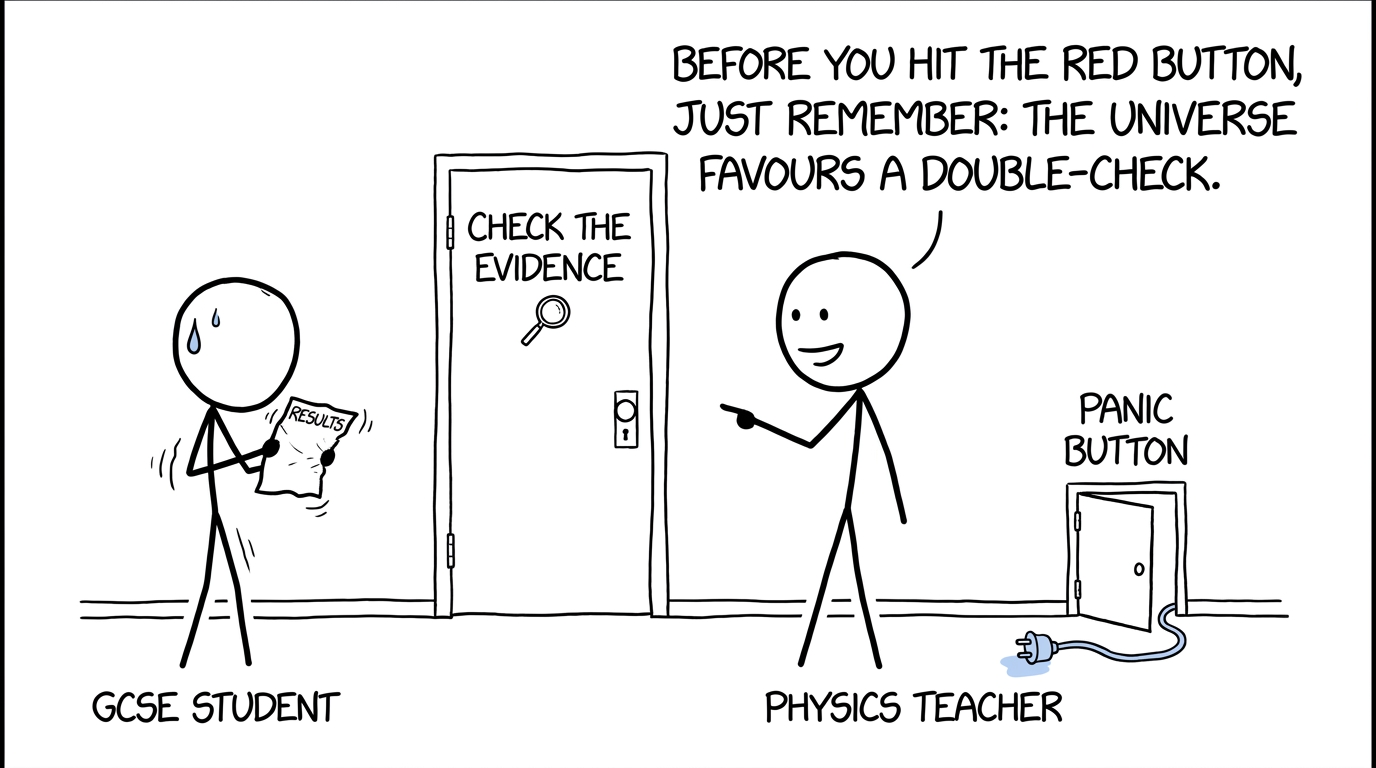 A student choosing between checking evidence and pressing an unplugged panic button
How the GCSE physics re-mark process actually works
Check the qualification and boundary
Start with your results slip. Confirm the exam board, specification, tier where applicable, component marks and whether you took separate Physics or Combined Science. Physics papers within Combined Science contribute to the combined qualification, so improving one paper does not automatically change the final grade pair.
Next, use the GCSE grade boundaries guide and select the correct board and examination series. Do not compare your result with a previous year because boundaries can change between series.
Your distance from the next boundary can be expressed as:
marks required=next grade boundary−current total mark\text{marks required}=\text{next grade boundary}-\text{current total mark}marks required=next grade boundary−current total markThis tells you how much movement is needed, not how likely that movement is. Edexcel students can also inspect the paper totals through the GCSE Physics grade calculator.
Ask for access to the marked script
Speak to your exams officer promptly. Your school or college can request access to marked scripts, subject to the relevant board’s arrangements and deadlines. Candidate permission is required.
A Physics teacher can then compare your responses with the mark scheme. They might check whether:
- valid working in a calculation was overlooked;
- error-carried-forward marks were applied correctly;
- a graph, practical method or extended response received reasonable credit;
- every page and question was marked;
- marks were transferred and totalled correctly.
Physics contains objective calculations as well as responses requiring examiner judgement. A different teacher preferring your wording is not enough by itself. The question is whether the original mark was unreasonable under the mark scheme.
Choose the correct service
A clerical re-check checks administrative matters such as whether every response was marked and whether marks were recorded and totalled correctly.
A review of marking includes clerical checks and asks a reviewer to examine the original marking for errors. It is not a complete second attempt at marking the paper from scratch.
Reviews normally apply to individual papers or components. Ask your teacher which paper contains the strongest evidence rather than automatically reviewing every Physics paper. Fees are set by exam boards and your school may have its own payment policy, so obtain the current details from the exams officer.
Give consent and let the school submit the request
Schools and colleges normally submit review requests to the exam board. Written candidate consent is necessary because the mark and final grade can go down as well as up. Private candidates should contact their entering centre or exam board for the route that applies to them.
For the June 2026 series, GCSE results are released to candidates on 20 August 2026, and JCQ’s common deadline for standard reviews of marking is 24 September 2026. Your school may impose a substantially earlier internal deadline, so do not wait.
Read the outcome carefully
The reviewed mark may rise, remain unchanged or fall. Even if the paper mark changes, the overall subject grade may stay the same because the new total has not crossed a boundary.
If concerns remain, appealing a GCSE Physics grade is a separate later stage. An appeal generally challenges whether the review or awarding-body procedures were applied properly; it is not simply another review because you dislike the outcome. Discuss the permitted grounds, deadline, evidence and financial risk with your school.
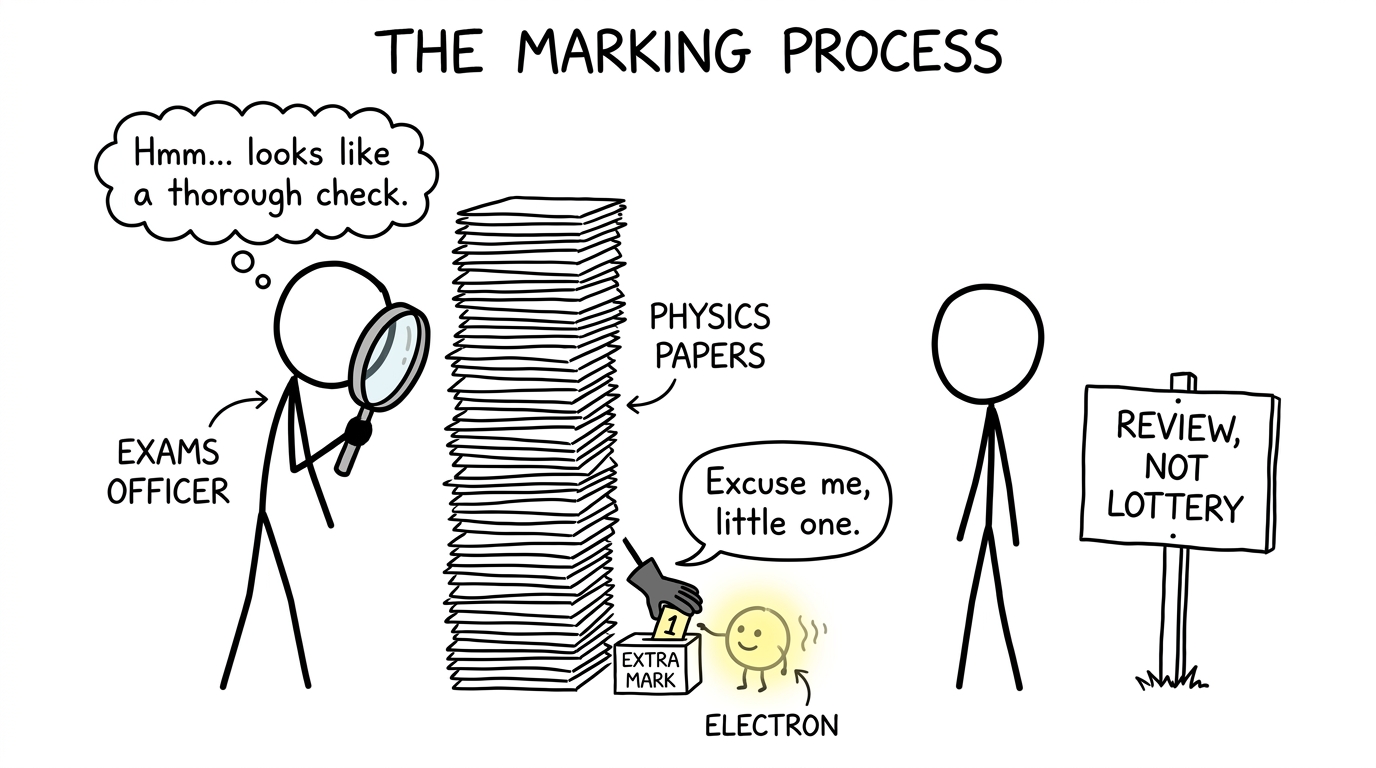 An exams officer reviewing papers while an electron tries to sneak in an extra mark
When requesting a review makes sense
A review is most defensible when you are close to an important boundary and a qualified teacher has found a specific response that may have been marked incorrectly. It may also deserve urgent discussion when the grade affects entry to A Level Physics, Maths or another course.
Be more cautious when the hoped-for increase is large, no marking concern has been identified, or a reduction could move you below another boundary. Predictions, mock grades and how the examination felt can begin the conversation, but none proves a marking error.
Common mistakes to avoid
- Calling it a guaranteed re-mark rather than a review of existing marking.
- Looking at the wrong board, series, tier or qualification boundary.
- Assuming a changed paper mark must change the overall grade.
- Requesting every component without first inspecting the evidence.
- Forgetting that marks and grades can decrease.
- Missing the school’s internal deadline while focusing on the final JCQ date.
- Treating an appeal as the first stage instead of following a review outcome.
Turn the outcome into a useful next step
A result can be reviewed, but the revision habits behind future results can still be improved. Explore the GCSE Physics revision hub for lessons, practice questions, past papers, mark schemes and revision guides. If calculations were the weak point, strengthen the underlying skills through GCSE Maths revision.
You can also learn how to find weak Physics topics, use AQA Physics past papers effectively, or prepare with AQA GCSE Physics predicted papers.
Start by checking the official marks on MathsGenie’s GCSE grade boundaries pages. Then take your script, evidence and questions to your exams officer. A good decision is not driven by panic or hope alone. It is built from the boundary, the marked paper and a teacher’s professional judgement.











