GCSE Physics OCR Grade Boundaries Explained
GCSE physics OCR grade boundaries explained for results day, with 2025 Gateway and Twenty First Century tables, tier rules, marks and clear next steps.
Results day has a peculiar way of making one number feel larger than it is. You see your grade first, but the mark beneath it often tells the more useful story. GCSE physics OCR grade boundaries show the minimum total mark required for each grade. They are set after marking is nearly complete, so the official summer 2026 boundaries will not be known before GCSE results day on Thursday 20 August 2026.
The latest confirmed comparison is therefore June 2025. This guide explains those boundaries, the difference between OCR Gateway and Twenty First Century Physics, and what to do when your result arrives.
GCSE physics results day checklist
Before interpreting any boundary table, check four details:
- your specification code: J249 or J259;
- your tier: foundation or higher;
- your total raw mark across both papers;
- the boundary document for the correct exam series.
Then remember the central rule: a boundary is the minimum mark for a grade. If a grade 777 boundary is 127127127, a total of 127127127 reaches that grade. You do not need 128128128.
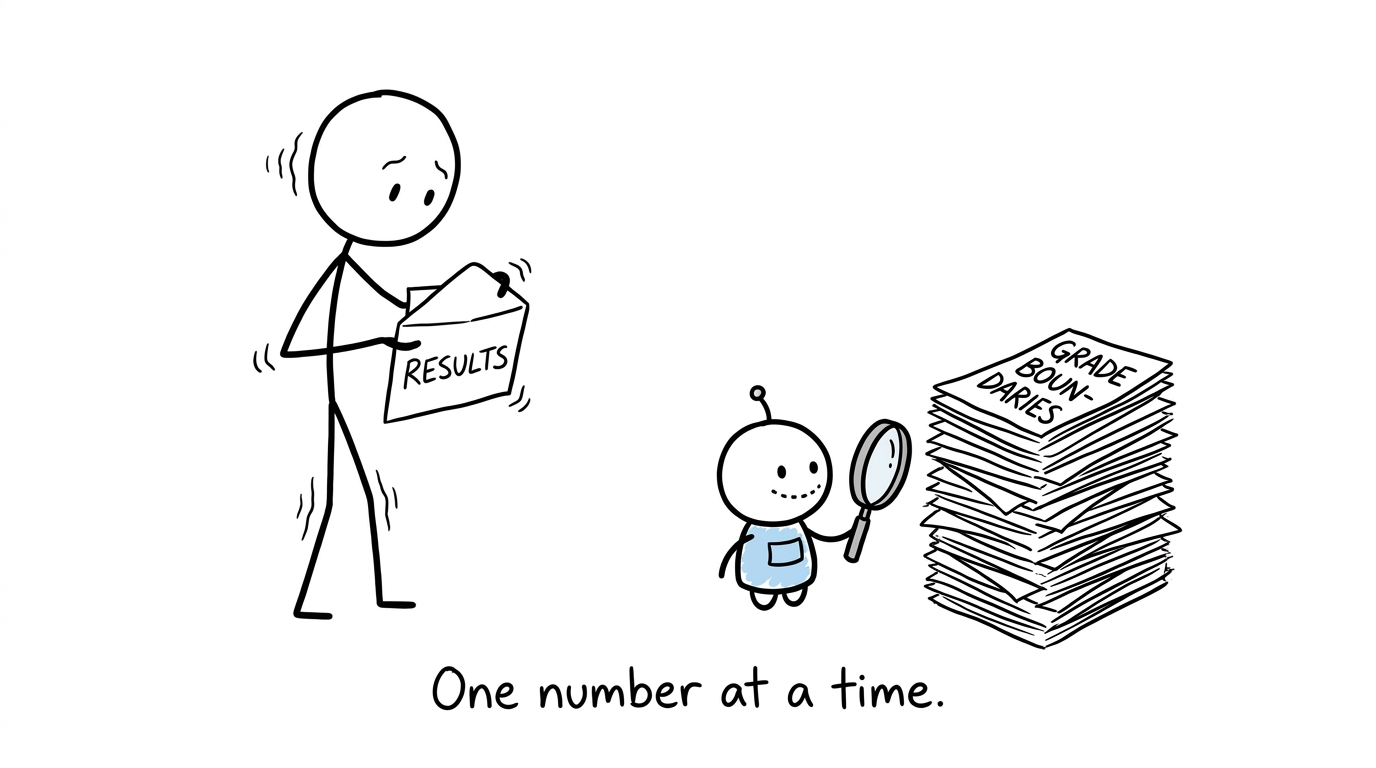 A student and a robot calmly inspect a GCSE results envelope
Which OCR Physics course did you take?
OCR offers two separate GCSE Physics specifications:
- Physics A: Gateway Science (J249)
- Physics B: Twenty First Century Science (J259)
Both qualifications have two written papers for each tier. Every paper is worth 909090 marks, lasts one hour and 454545 minutes, and contributes 50%50\%50% of the qualification. Your overall result is therefore based on a maximum of:
90+90=180 90+90=180 90+90=180Foundation tier assesses grades 111 to 555. Higher tier assesses grades 444 to 999, although OCR can award an allowed grade 333 when a higher-tier mark falls narrowly below the grade 444 boundary.
Do not assume that boundaries for J249 apply to J259. The papers and qualification boundaries are separate. If you are unsure, look for the code on your results information or ask your school.
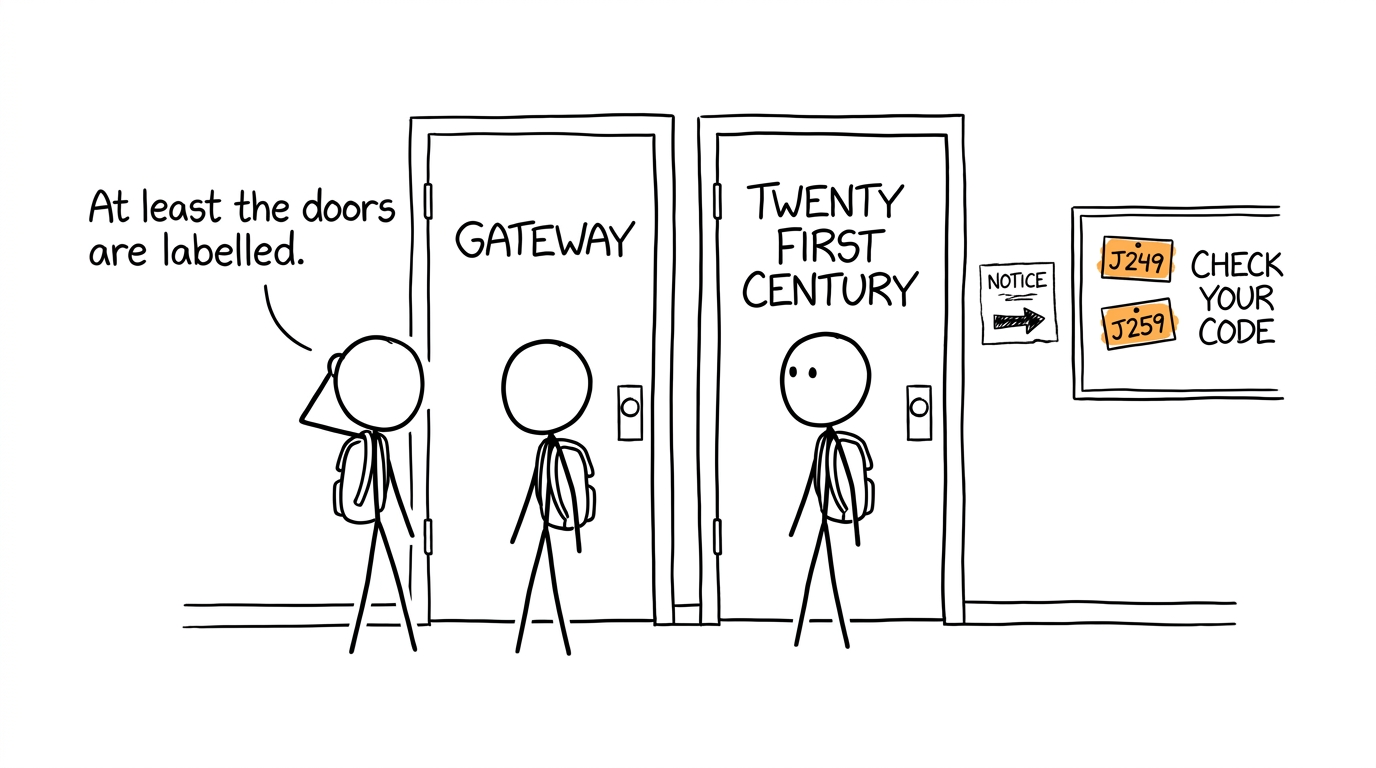 Two students choose between clearly labelled OCR Physics specifications
OCR Physics grade boundaries for June 2025
These are the confirmed June 2025 overall qualification boundaries. They provide useful context, but they do not predict the 2026 boundaries.
Physics A: Gateway Science J249
| Tier | Maximum mark | Grade 999 | Grade 888 | Grade 777 | Grade 666 | Grade 555 | Grade 444 | Grade 333 | Grade 222 | Grade 111 |
|---|---|---|---|---|---|---|---|---|---|---|
| Foundation | 180180180 | N/A | N/A | N/A | N/A | 114114114 | 101101101 | 777777 | 545454 | 313131 |
| Higher | 180180180 | 150150150 | 138138138 | 127127127 | 109109109 | 929292 | 757575 | 666666 | N/A | N/A |
For specification-matched support, open the OCR GCSE Physics revision guides. You can also target calculation-heavy areas through the Motion revision guide and Work done revision guide.
Physics B: Twenty First Century Science J259
| Tier | Maximum mark | Grade 999 | Grade 888 | Grade 777 | Grade 666 | Grade 555 | Grade 444 | Grade 333 | Grade 222 | Grade 111 |
|---|---|---|---|---|---|---|---|---|---|---|
| Foundation | 180180180 | N/A | N/A | N/A | N/A | 121121121 | 108108108 | 858585 | 626262 | 404040 |
| Higher | 180180180 | 147147147 | 135135135 | 123123123 | 106106106 | 909090 | 747474 | 666666 | N/A | N/A |
Students following J259 should use the dedicated OCR Twenty First Century Physics hub, rather than assuming every Gateway resource follows the same course structure.
Why OCR grade boundaries change
Grade boundaries are not pass percentages fixed before the exams. Exam boards set them when marking is nearly complete, using statistical evidence alongside senior examiners’ reviews of work around possible boundaries.
Papers cannot be identical in difficulty each year. If a paper proves more demanding, a comparable standard of work may produce a lower raw mark, so boundaries can fall. If it is less demanding, boundaries can rise. A higher boundary does not automatically mean that the qualification has become harder to achieve.
This is why predicted boundaries circulating before results day are unofficial. Previous boundaries can help you understand a past-paper score, but they cannot confirm a future grade.
How to read your result calmly
Start with the overall boundary, not a boundary shown beside an individual paper. OCR publishes component boundaries to illustrate performance, but your GCSE grade comes from the combined qualification total.
If your mark is close to the next boundary, speak to your physics teacher or exams officer. They can inspect the available information and discuss access to your script or a review of marking. A review checks whether the mark scheme was applied correctly; it is not a fresh attempt at the paper, and marks can sometimes go down as well as up.
If the result means changing a sixth-form or college plan, contact the institution promptly. A near-boundary result is information requiring a decision, not a judgement about your ability.
Common mistakes when checking OCR boundaries
Using the wrong specification
J249 Gateway and J259 Twenty First Century have different papers and boundaries. Check the code before comparing marks.
Looking at one paper in isolation
The final qualification uses both equally weighted papers. Add the raw marks and compare the total with the overall row.
Treating the 2025 table as a 2026 prediction
Official summer 2026 boundaries will only be available once awarding is complete. Past figures are context, not promises.
Comparing OCR directly with another board
AQA, Edexcel, OCR and Eduqas use different papers and total marks. A lower numerical boundary does not make one board easier.
Ignoring the maths behind lost marks
Physics calculations reward accurate substitution, rearranging, graph work, standard form and units. Use OCR GCSE Physics past papers with their mark schemes, then repair recurring mathematical weaknesses through the GCSE Maths revision hub.
Turn the boundary into a better revision plan
A boundary tells you where a grade began. It does not tell you why marks were lost. That requires returning to the paper and classifying each error as knowledge, calculation, practical method or exam technique.
MathsGenie makes that next step concrete. Read the board-matched revision guides, complete practice questions, and use past papers under timed conditions. Mark every attempt carefully rather than simply recording a score. The guide on using OCR Physics past papers properly provides a clear attempt, mark and repair routine, while the MathsGenie revision planner can organise revision lessons, mini tests and follow-up practice.
On GCSE physics results day, begin with the correct code, tier and overall mark. Then take the next useful action. Whether you are checking a near-boundary result or preparing for another exam series, MathsGenie gives you free OCR revision guides, practice questions, past papers, predicted papers, mark schemes and video solutions to turn one result into a stronger plan.