GCSE Physics Lower Grade Than Expected: Next Steps
GCSE physics lower grade than expected? Check your marks, consider a review, protect your college place and make a focused plan for a summer resit.
Opening a results slip can feel strangely final. Months of revision have been compressed into one number, and it is lower than the number you had pictured. If you received a GCSE physics lower grade than expected, your first steps are practical: check how close you were to the next boundary, speak to your school or college, protect your next-stage place and decide whether a review or resit is genuinely worthwhile.
A disappointing result deserves attention, but not panic. The grade is evidence about one set of assessments. It is not a permanent judgement on your ability in Physics, maths or anything else.
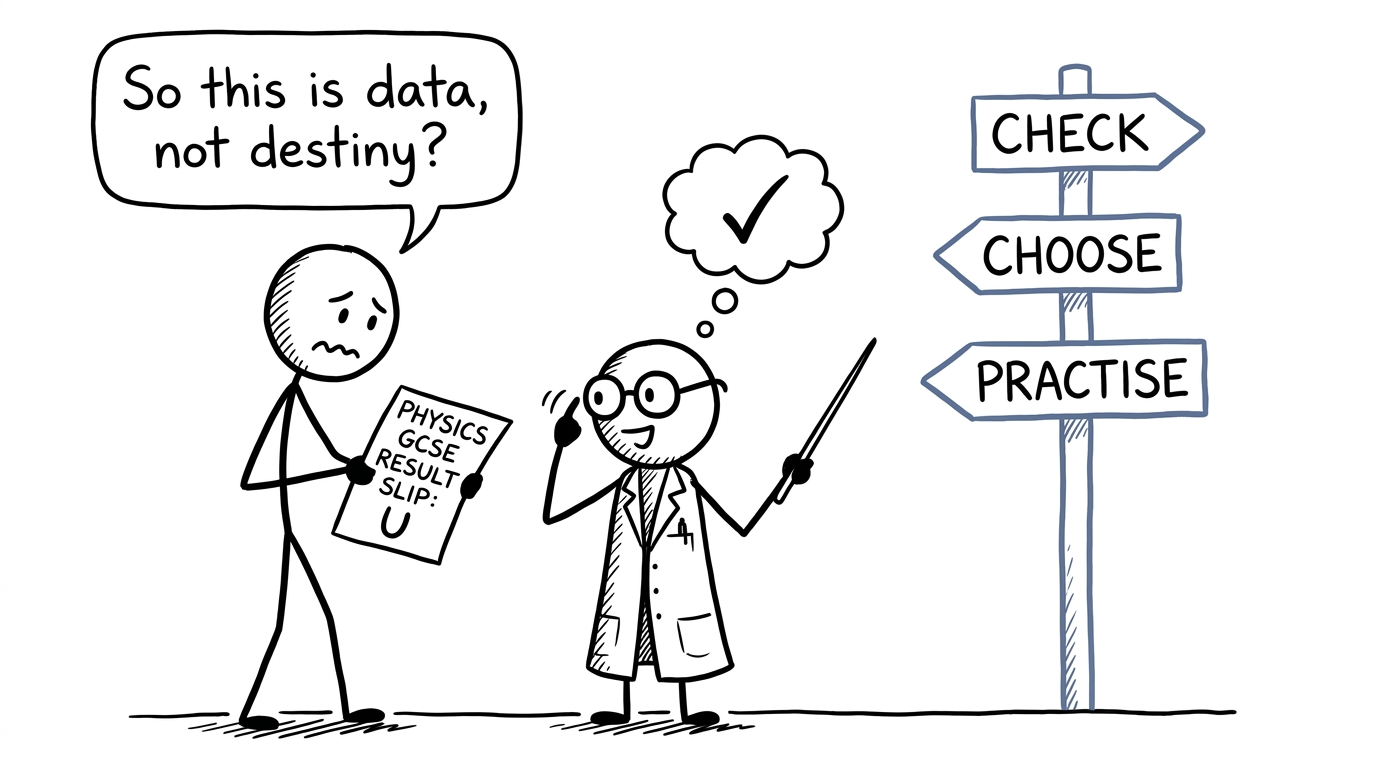 A student discovers that a result can become useful data rather than destiny
Your GCSE Physics results-day checklist
Before making a decision, work through these actions:
- Check your component marks and the published grade boundaries.
- Ask a Physics teacher whether your marks look unusual.
- Request access to your marked scripts if appropriate.
- Contact your intended sixth form or college immediately.
- Compare the risks and benefits of a review of marking.
- Confirm whether you can resit and where the entry would be made.
- Identify whether knowledge, maths or exam technique caused the lost marks.
These GCSE Physics next steps turn an emotional moment into a manageable decision.
Check the result before reacting to it
Your overall grade does not show where the problem occurred. Ask your exams officer or teacher for your marks on each paper and compare the total with the relevant grade boundaries for your exam board and tier.
Use the correct qualification. Separate GCSE Physics and Combined Science are not interchangeable, while AQA, Edexcel, OCR and Eduqas use different papers, specifications and boundaries. Boundaries can also change between exam series because they reflect the difficulty of that particular assessment.
Being close to a boundary does not automatically mean the marking is wrong. It simply tells you whether a small mark change could affect the grade. A teacher can help judge whether the script contains a plausible marking error or whether the awarded marks match the mark scheme.
Ask for access to your exam scripts
Schools and colleges can use exam-board access-to-scripts services to obtain marked GCSE papers. Looking at the script before requesting a review can make the decision far more informed.
Ask your teacher to look for:
- an unanswered page that you remember completing;
- a possible error in the total;
- a response that appears inconsistent with the mark scheme;
- repeated losses caused by missing units or unclear working;
- longer answers where key scientific statements were not credited.
Most students make post-results requests through their centre, and your written consent is normally required. Private candidates may be able to approach the exam board or the centre through which they entered.
Do this promptly. For the summer 202620262026 series, the JCQ deadline for reviews of marking is 242424 September 202620262026, but your school may set an earlier internal deadline so it has time to process requests.
Decide whether to request a review of marking
A review of marking checks whether the original mark scheme was applied correctly. It is not simply a fresh attempt to find extra marks.
Your mark can rise, remain unchanged or fall. Your school needs your permission because a lower mark could potentially produce a lower grade. Exam boards may charge a fee, although centres sometimes have their own payment policies.
A review may be reasonable when:
- you are close to the next grade boundary;
- a teacher has inspected the script and identified a credible concern;
- the grade affects a confirmed progression requirement;
- your performance differs sharply across papers without an obvious explanation.
A grade boundary itself cannot be appealed. If concerns remain after a review, your school can explain the formal appeal process and its deadlines.
Protect your sixth-form or college place
If Physics is part of an entry requirement, contact the sixth form, college or training provider on results day. Do not assume that one missed grade has automatically ended your application.
Explain the confirmed result, whether a review is being considered and your grades in related subjects. Each institution sets its own entry requirements, particularly for A Level Physics, so only that institution can tell you whether it will accept the result, offer another course or wait for a review outcome.
This conversation matters more than trying to predict the answer alone.
Consider a GCSE Physics resit
GCSE Physics is generally resat in the next summer exam series, not in November. The November GCSE series is available for English Language and maths under specified age rules, while most other GCSE subjects are examined in May and June.
Ofqual’s guidance says GCSE resit students normally need to take all exam components again. If your result came from Combined Science, ask your centre exactly how the entry works rather than assuming you can retake only the Physics papers.
Your former school may not offer the resit. Ask a school, further education college or approved private exam centre about availability, exam board, specification, tier, entry deadlines and fees before committing.
Start your preparation from the GCSE Physics revision hub, where you can choose the correct exam board and find free lessons, questions, revision guides and papers. AQA students can go directly to the AQA GCSE Physics past papers, while Edexcel students can rebuild topic knowledge using the Edexcel GCSE Physics revision guides. OCR Twenty First Century students should use the matching OCR Twenty First Century Physics resources.
Build a resit plan from the marks you lost
A resit only helps if the preparation changes. Divide mistakes into three groups: Physics knowledge, mathematical method and exam technique.
The guide to finding weak Physics topics explains how to diagnose gaps from timed questions. For forgotten facts and definitions, use the Physics active recall strategy. Then return to exam questions and mark them honestly.
Physics calculations often expose weaknesses in rearranging formulae, proportional reasoning, graphs, standard form and unit conversion. Strengthen those foundations through the GCSE Maths revision hub rather than repeatedly losing the same calculation marks.
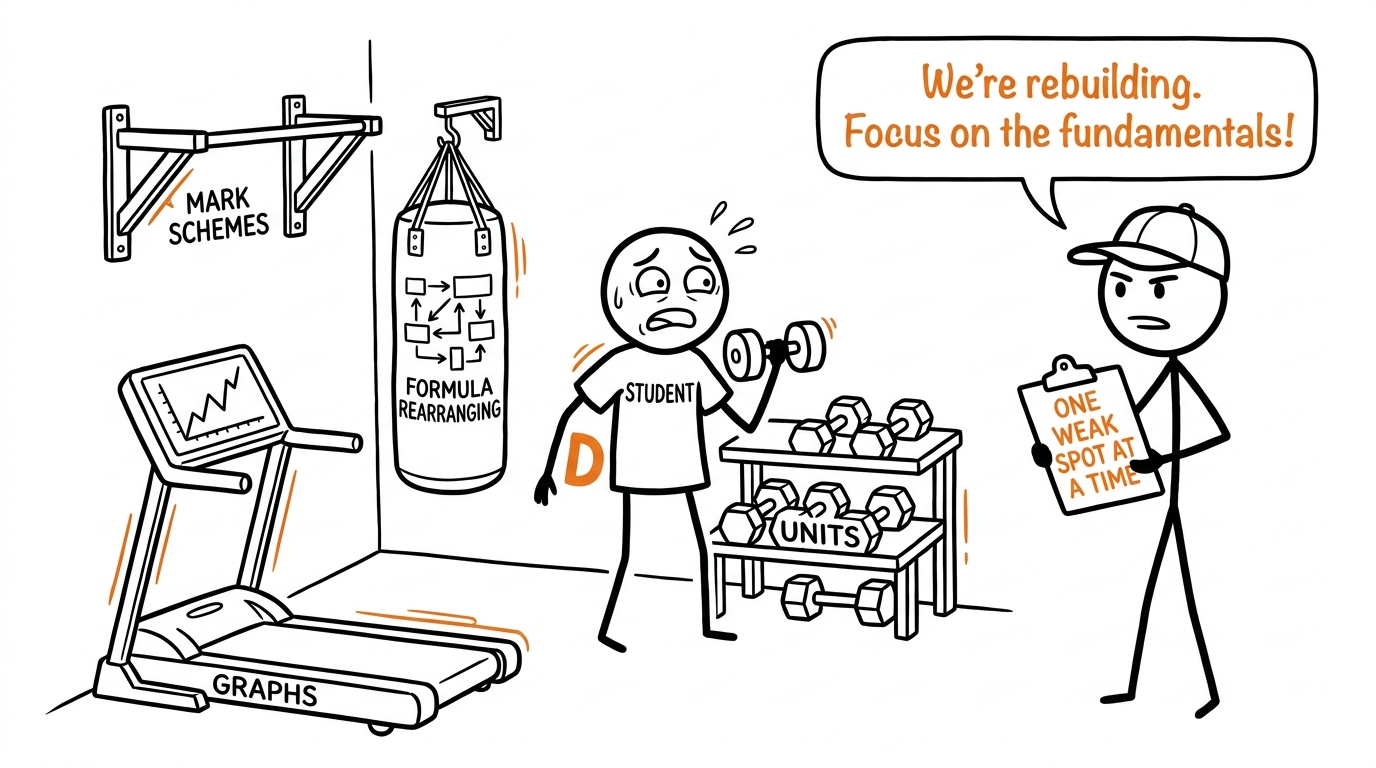 A student trains one Physics weakness at a time in an exam-skills gym
A useful weekly cycle is simple: revise one weak topic, answer targeted questions, check the mark scheme, record the precise error and retest it later. Near the exam, add full papers and GCSE predicted papers to develop timing and stamina.
Common mistakes after a disappointing Physics result
Requesting a review without seeing the evidence: Being disappointed is understandable, but a teacher’s inspection of the script should guide the decision.
Waiting too long: Post-results services and exam entries have deadlines. Speak to your centre immediately.
Assuming a resit is available in November: GCSE Physics is normally available in the summer series.
Revising everything equally: Your script and past-paper errors should identify the topics and skills that need the most attention.
Ignoring the maths: Correct Physics knowledge can still lose marks through poor rearranging, conversions, graphs or missing units.
Turn the result into a clear next move
A GCSE Physics disappointing result may change the route, but it does not remove the destination. Check the marks, seek informed advice, contact your next provider and choose between accepting the grade, requesting a review or preparing for a resit.
If a resit is your best option, begin with MathsGenie’s free GCSE Physics resources. Use revision lessons to rebuild understanding, practice questions to close specific gaps, mark schemes and video solutions to improve your answers, then past papers, mini tests and predicted papers to make exam conditions familiar. Start with the GCSE Physics revision and resit resources and make the next result the product of a better process.