

GCSE Physics Grade Boundaries: 2026 Results Day
GCSE physics grade boundaries explained for 2026 results day. Learn how marks become grades, how tiers work, and what to do near a boundary after results.
The envelope, email or results portal gives you a grade. What it rarely gives you is the story behind it. On GCSE physics results day, a difference of one raw mark can sometimes separate two grades, while the boundary itself may look quite different from last year's.
The essential answer is simple: GCSE physics grade boundaries are the minimum total marks needed for each grade. Exam boards set them after the papers have been sat and marked, then publish them on results day. They are not fixed percentages, and the official physics grade boundaries 2026 cannot be known reliably in advance.
As confirmed in Ofqual's current guidance, GCSE results day in England is Thursday 20 August 2026.
Your results day checklist
Before comparing your result with a boundary table, check:
- whether you took separate GCSE Physics or Combined Science;
- your exam board: AQA, Pearson Edexcel, OCR or Eduqas;
- whether you sat foundation or higher tier;
- your qualification's total raw mark;
- whether the table shows an overall subject boundary or a notional paper boundary;
- how many marks, if any, separate you from the next grade.
You can find board-specific resources through the GCSE Physics revision hub, including revision guides, questions, past papers and mark schemes.
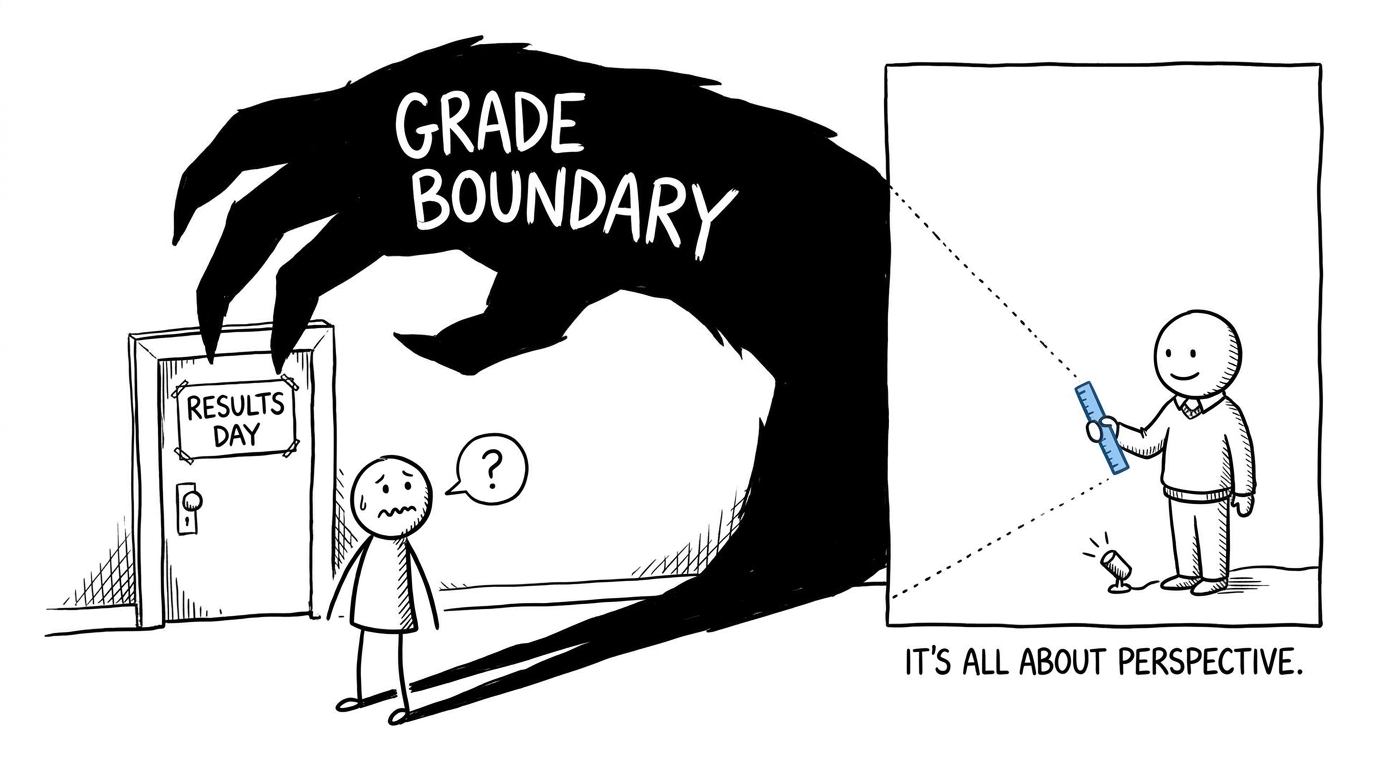 A nervous student discovers that the frightening grade-boundary shadow comes from a small ruler
How GCSE Physics grade boundaries work
A grade boundary is the lowest mark that earns a particular grade. If the grade 7 boundary were 126126126 marks, for instance, then 126126126 would earn grade 7, while 125125125 would fall into the grade below unless another adjustment applied.
Boundaries move because exam papers cannot be made identical in difficulty every year. If a paper proves more demanding, boundaries may be lower. If it proves less demanding, they may be higher. This adjustment is intended to preserve the standard represented by a grade rather than reward or punish the year in which you sat the exam.
Exam boards use evidence about how the papers performed, comparisons with previous cohorts and expert review of work around possible boundaries. There is no simple rule such as “grade 7 is always 70%70\%70%”. Nor is there a fixed quota limiting how many students can receive each grade.
For example, AQA GCSE Physics consists of two equally weighted papers, each worth 100100100 marks, producing a total of 200200200 marks. Other boards can use different totals, so never compare raw marks across exam boards without checking the correct document.
Worked boundary example
Consider a hypothetical higher-tier Physics qualification worth 200200200 marks. These are illustrative boundaries, not the official 2026 figures:
| Grade | Minimum mark |
|---|---|
| 9 | 154154154 |
| 8 | 139139139 |
| 7 | 125125125 |
| 6 | 106106106 |
| 5 | 878787 |
| 4 | 696969 |
Suppose a student receives 124124124 marks. Their percentage is:
124200×100=62%\frac{124}{200}\times 100=62\%200124×100=62%However, the percentage does not decide the grade independently. Comparing the raw mark with the hypothetical table, 124124124 is below the grade 7 boundary of 125125125 but above the grade 6 boundary of 106106106. The student therefore receives grade 6 and is one raw mark below grade 7.
This is why the correct question is not simply, “What percentage did I get?” It is, “Where does my total raw mark sit in my board's official boundary table?”
Separate Physics and Combined Science are different
If you took separate GCSE Physics, you receive one Physics grade based on the marks for that qualification.
If you took Combined Science, you receive a double grade, such as 7-6 or 5-5. Your Physics papers contribute to an overall Combined Science result alongside Biology and Chemistry. You do not normally receive an independent GCSE Physics grade from the Physics component alone.
That distinction matters when searching for boundaries. A separate-science Physics table cannot be used to calculate a Combined Science grade.
Foundation and higher tiers also have different available grade ranges. In England, foundation tier offers grades 1 to 5. Higher tier principally offers grades 4 to 9, with a narrow grade 3 safety net for students who just miss grade 4. A grade 4 or 5 represents the same standard whichever tier produced it.
When will physics grade boundaries 2026 be available?
Official summer 2026 boundaries are published on results day, not during the revision period and not immediately after the final paper. As of 30 July 2026, students should treat online predictions as estimates rather than confirmed figures.
This matters because memories of an exam are unreliable evidence. A paper that felt difficult to you may also have felt difficult nationally, or it may have tested one of your weaker areas particularly heavily. The boundary-setting process uses marked scripts and wider performance evidence rather than reactions on social media.
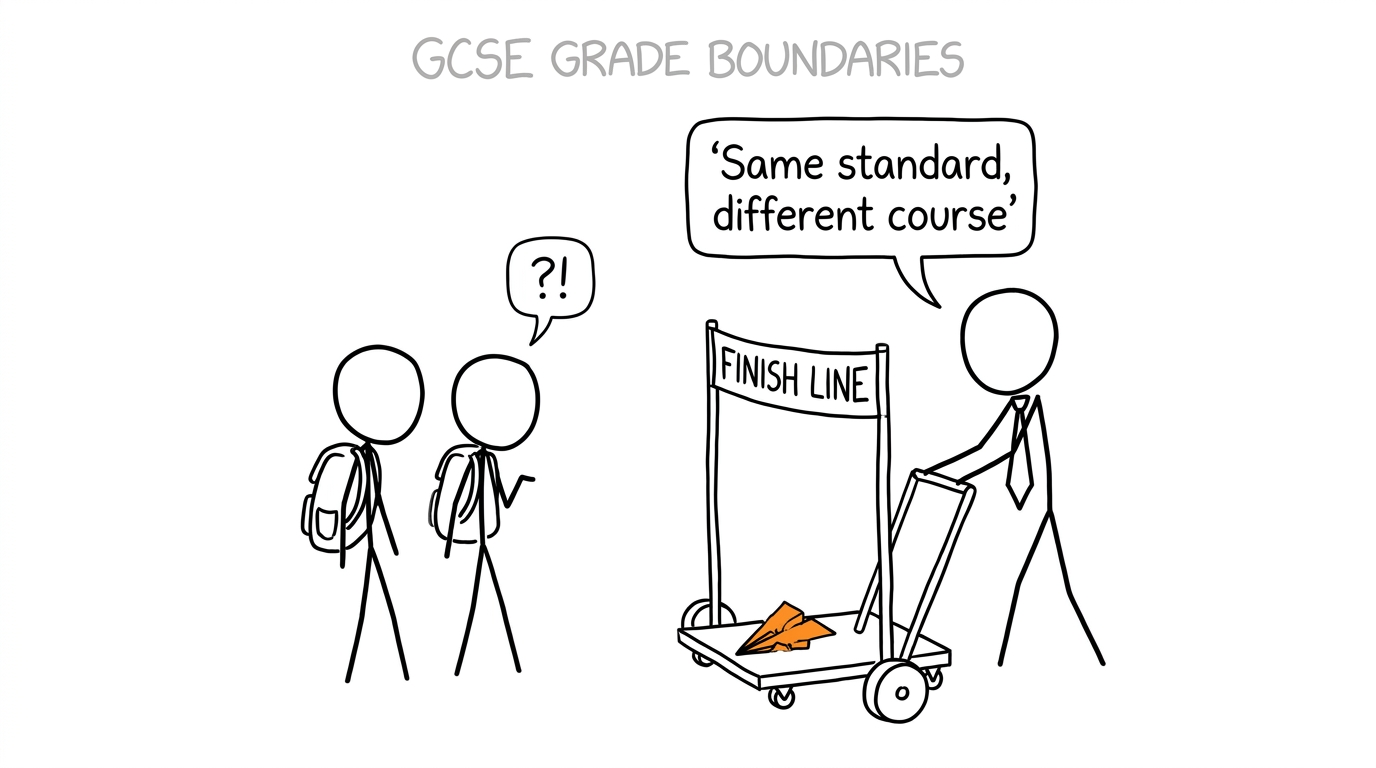 Students watch an examiner adjust a movable finish line to preserve the same standard
What to do when you receive your result
First, pause. A grade matters, but it is not improved by reading the wrong boundary document in a hurry.
Ask your school or exams officer for your component marks or raw mark if they are not shown on your results slip. Then locate the official table for your board, qualification and tier. Check how far your total is from the next boundary.
If the result is below what you expected, speak to your school before requesting a review of marking. A review checks whether the mark scheme was applied correctly; it is not an automatic search for extra marks, and marks can stay the same, rise or fall. Your school can explain deadlines, fees, access to scripts and whether the evidence supports a review.
Common mistakes when reading Physics boundaries
Using predicted boundaries as confirmed figures
Predictions can support planning before results day, but they cannot reveal the official outcome. Boundaries require evidence from completed marking.
Comparing different boards
A mark from AQA cannot be placed directly into an Edexcel, OCR or Eduqas table. Paper structures and maximum marks differ.
Looking at one paper in isolation
Your final grade is normally determined from the total qualification mark. Notional component boundaries may illustrate performance on individual papers, but they do not necessarily determine the certificate grade.
Confusing Combined Science with separate Physics
Combined Science uses an overall double-grade system. Select the qualification you actually entered, not simply the table containing the word “Physics”.
Assuming one mark below means an automatic review
Closeness is useful information, but it does not prove a marking error. Discuss the script and post-results options with your school.
Turn results into a better next step
A boundary explains where your mark landed. It does not explain every mark you lost. That requires a calmer kind of investigation: looking at topics, calculations, command words and exam technique.
MathsGenie makes that process practical. Start with the AQA GCSE Physics revision guides or Edexcel GCSE Physics revision guides, and use the OCR Twenty First Century Physics resources where appropriate. You can also learn how to use Physics mark schemes effectively and turn your notes into active-recall Physics practice.
Physics calculations often reveal underlying maths gaps. The GCSE Maths revision hub and GCSE predicted papers provide revision lessons, practice questions, mini tests, past papers, mark schemes and video solutions to help close them.
Check your official boundary carefully, ask for guidance if your result is close, then choose the next useful action. A boundary is a line in a table. Your progress continues beyond it.











