GCSE: Use Mark Schemes to Improve in Physics
GCSE mark schemes can boost Physics marks fast. Learn how to spot method marks, units and exam wording, with worked maths examples and routines.

GCSE Physics revision can feel unfair for a simple reason: you know more than you’re getting credit for. You write something sensible, you turn the page, and somehow you lose marks you thought were yours. The quickest way to fix that is not another hour of rereading notes; it’s learning to think like the mark scheme. Once you use mark schemes properly, GCSE Physics becomes less of a mystery and more of a pattern: method marks, key phrases, units, and rounding rules repeating like familiar footsteps.
And because GCSE Physics is quietly a maths paper wearing a lab coat, the same approach also strengthens your GCSE maths: you start writing solutions that are easy to award marks to.
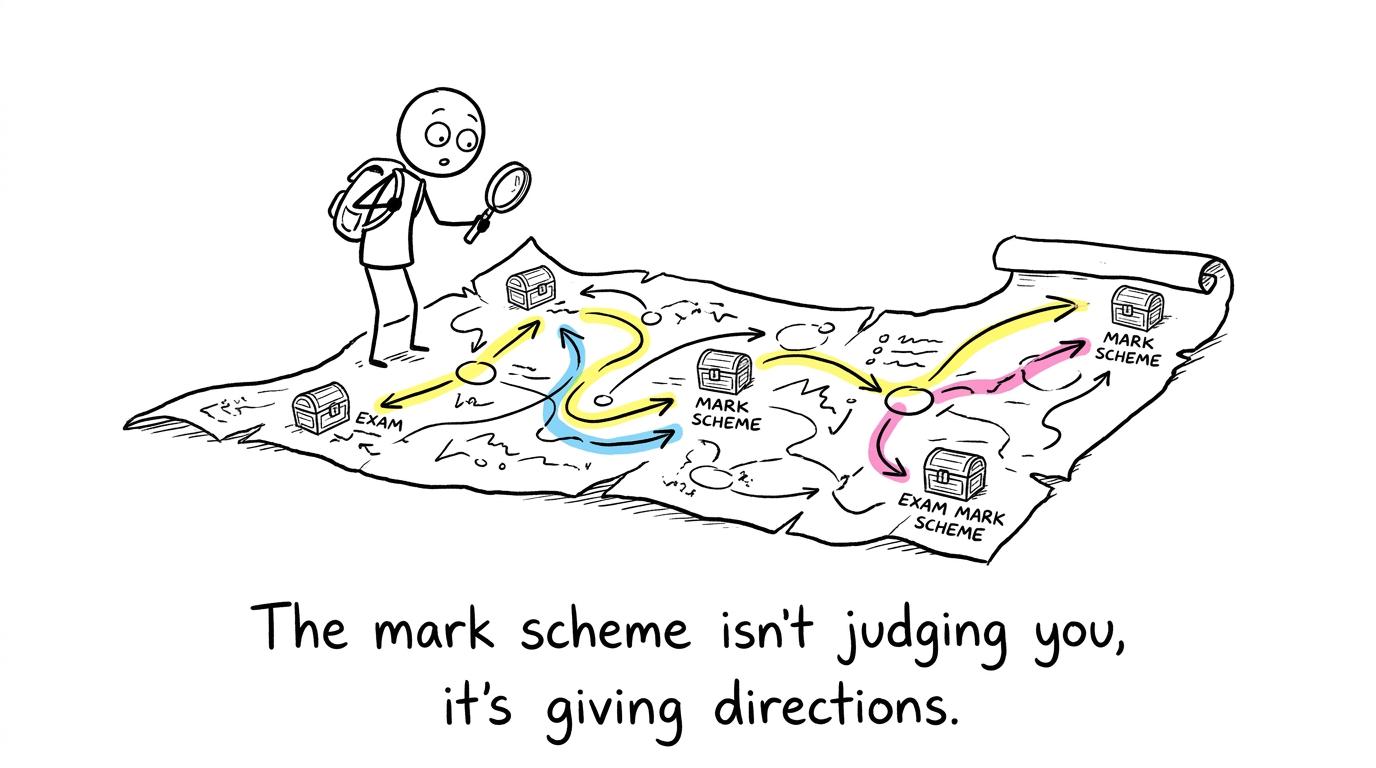 A student stares at a huge mark scheme like a treasure map
A quick checklist for using mark schemes well
Use this every time you review an answer, whether it’s AQA, Edexcel, OCR or Eduqas:
- Find the mark breakdown: how many marks are for method vs accuracy vs communication.
- Underline the command word (state, describe, explain, calculate).
- Identify the minimum evidence needed for each mark.
- Look for follow-through marks: you might still earn marks after a mistake.
- Check units, significant figures, and whether the question expects standard form.
- Rewrite your answer in a “mark-scheme-friendly” way, then practise that style on the next question.
On YesGenie you can build this habit quickly by using real mark schemes alongside practice: GCSE Past papers and the wider Resources section are ideal for structured practice.
Why mark schemes are a shortcut in GCSE Physics (and maths)
A mark scheme is not just an answer key. It’s a description of what an examiner is allowed to reward. That matters because in GCSE Physics you’re often assessed on:
- Physics knowledge (facts, definitions, ideas)
- Application (using the right equation, choosing the right approach)
- Maths (substitution, rearranging, units, standard form, gradients)
- Communication (clear reasoning, correct terms)
If you only compare your final answer to the “correct” final answer, you miss the real game: most of the marks are usually hidden in the structure.
A simple example: if a question is worth 4 marks, it rarely means “one perfect sentence”. It often means “four small, checkable pieces of evidence”. Mark schemes teach you what those pieces look like.
How to read a mark scheme like an examiner
Spot the marks that are “easy to award”
Most schemes reward answers that are:
- Broken into steps
- Labelled
- Using correct units
- Explicit about substitutions
That’s why in maths, showing the substitution line can rescue you even if you slip at the end. On YesGenie, this is especially clear when you watch Paper 1 video solutions and compare them to the mark scheme style.
Learn the “mark scheme language”
Mark schemes tend to use a small set of recurring ideas:
- Method marks (you used the right equation or process)
- Accuracy marks (your final value is correct, usually dependent on method)
- Communication marks (units, explanation quality, correct terminology)
- Follow through (you can carry a wrong number forward and still get later marks)
Even if your GCSE Physics mark scheme doesn’t label marks as M1M1M1 and A1A1A1, the logic is often the same.
Worked example: using a mark scheme to gain method marks
A classic GCSE Physics calculation might be:
A force of 12 N12\,\text{N}12N accelerates a mass of 3 kg3\,\text{kg}3kg. Calculate the acceleration.
A mark scheme-friendly solution looks like this:
F=ma F = ma F=ma a=Fm a = \frac{F}{m} a=mF a=123=4 a = \frac{12}{3} = 4 a=312=4So a=4 m s−2a = 4\,\text{m s}^{-2}a=4m s−2.
Why this earns marks even under pressure:
- You’ve stated the correct equation (F=maF=maF=ma).
- You’ve rearranged correctly.
- You’ve substituted clearly.
- You’ve included units.
If you wrote only “444” you might still get the accuracy mark, but you make it harder for an examiner to reward method if something goes wrong.
To practise this kind of “show-your-working” fluency for GCSE maths too, use topic-based practice from your board page, for example GCSE Maths OCR.
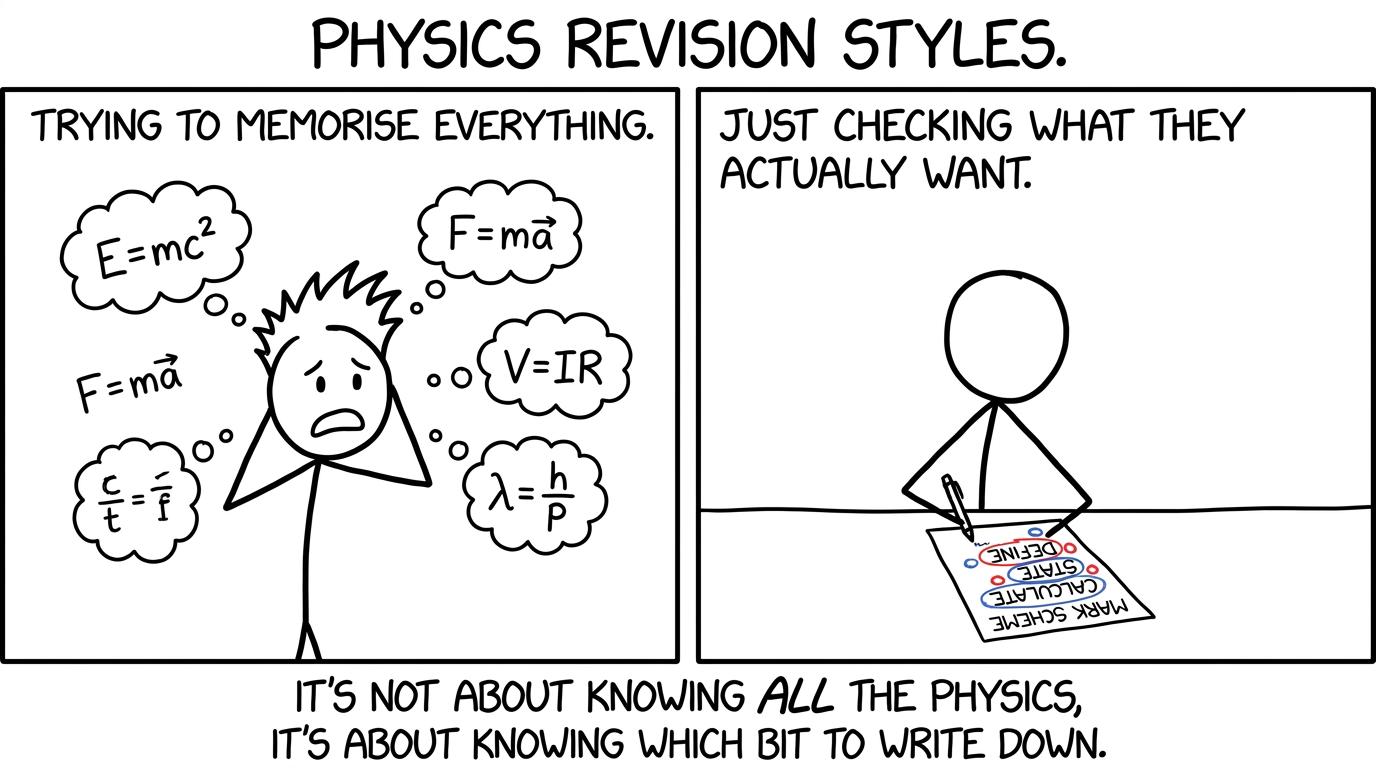 Two students: one memorises formulas, one circles command words
Worked example: units and standard form (where marks quietly disappear)
Suppose a GCSE Physics question says:
The current is 0.25 A0.25\,\text{A}0.25A and the resistance is 48 Ω48\,\Omega48Ω. Calculate the potential difference.
A clear answer:
V=IR V = IR V=IR V=0.25×48=12 V = 0.25 \times 48 = 12 V=0.25×48=12So V=12 VV = 12\,\text{V}V=12V.
Now imagine the question continues:
The device transfers 3.6×10⁴ J3.6\times 10^4\,\text{J}3.6×10⁴J of energy in 30 min30\,\text{min}30min. Calculate the power.
Mark-scheme-friendly steps:
Convert time:
30 min=30×60=1800 s 30\,\text{min} = 30 \times 60 = 1800\,\text{s} 30min=30×60=1800sUse P=EtP = \frac{E}{t}P=tE:
P=3.6×1041800=360001800=20 P = \frac{3.6\times 10^4}{1800} = \frac{36000}{1800} = 20 P=18003.6×104=180036000=20So P=20 WP = 20\,\text{W}P=20W.
This is where mark schemes teach you to slow down in the right places. GCSE papers love unit conversions because they separate “I recognise the topic” from “I can execute under exam conditions”.
Turning a mark scheme into a revision routine
Do “two-pass marking”
Pass 1: mark strictly.
- Use the mark scheme.
- Don’t negotiate with it.
- Write the total in the margin.
Pass 2: extract patterns.
- Where did marks go: equation choice, rearranging, substitution, units, explanation wording?
- Write one sentence: “Next time I will…”
Then immediately do one more similar question while the lesson is fresh. This is where YesGenie’s structure helps: go from a past paper question to topic practice, then back again.
Build a personal “mark scheme dictionary”
Keep a short list of phrases that repeatedly earn marks in GCSE Physics:
- “Because…” with a cause-and-effect link
- “The resultant force is…”
- “Energy is transferred from… to…”
- “The gradient represents…”
- “Increased temperature increases resistance because…”
This matters because GCSE mark schemes reward specificity. Vague answers often feel right but score zero.
Use maths mark schemes to train the same habit
Even though this post is about GCSE Physics, you’ll level up faster if you practise mark-scheme thinking in maths too, because the feedback is cleaner and more frequent.
Start with a full paper and look at the scheme immediately after you attempt each question set. YesGenie makes that easy because the mark scheme is built into each paper view, for example: Paper 2 mark scheme (Edexcel GCSE Maths).
If you also revise older spec content (useful for extra practice), you can use: Edexcel GCSE Old Maths Revision.
Common mistakes when using mark schemes
- Only checking the final answer. In GCSE Physics, most improvement comes from learning what earns method marks and communication marks.
- Copying the mark scheme without understanding it. The goal is not to memorise solutions; it’s to learn the smallest set of steps that consistently earns marks.
- Ignoring units and significant figures. A correct number with missing units can lose marks, and inconsistent rounding can cost you accuracy marks.
- Not matching the command word. “State” is usually a short fact; “explain” needs linked reasoning; “calculate” needs working.
- Not using follow-through. If you get an early value wrong, still continue using it. Mark schemes often allow follow-through marks for correct method.
- Studying mark schemes passively. Improvement comes from active marking and rewriting: attempt, mark, fix, reattempt.
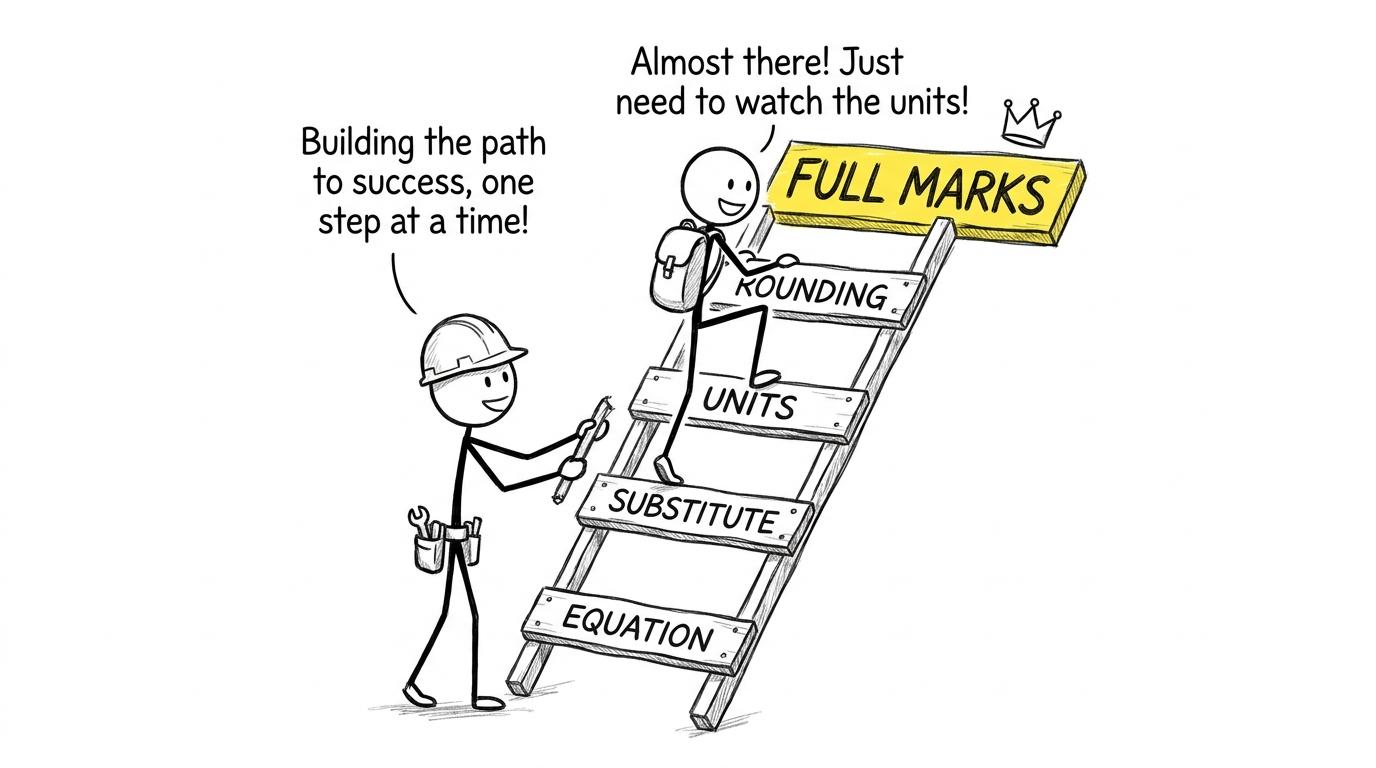 A stick figure climbs a 'method marks' ladder to full marks
Bringing it together: make the mark scheme your training partner
The students who improve fastest at GCSE Physics aren’t necessarily the ones who “know the most”. They’re the ones who learn what gets rewarded, and then practise writing answers that make those marks easy to give. A mark scheme is basically a map of how to turn your understanding into marks under timed conditions.
If you want a simple plan: do a past paper, mark it, extract three recurring mark-scheme patterns, then practise those patterns on fresh questions the same day. Use YesGenie as the system around that habit: revision lessons when a topic is shaky, practice questions when you need repetitions, and past papers and predicted papers when you need realism.
Start here and keep it consistent: GCSE Past papers, the wider Resources, and board-specific pages like GCSE Maths OCR. Your next set of GCSE papers won’t feel easier because the content changed; it’ll feel easier because you finally learned how marks are actually awarded.