GCSE Physics Grade Boundaries History and Trends
GCSE physics grade boundaries history explained: compare AQA and Edexcel trends from 2018 to 2025, then use past papers sensibly for better mocks.
A past paper can feel reassuring until you ask the awkward question: what grade was that mark actually worth? The short answer is that boundaries move each year. This GCSE physics grade boundaries history shows that recent thresholds have generally risen from their early reformed-GCSE levels, but not in a straight or predictable line.
The table below compares AQA and Pearson Edexcel separate GCSE Physics Higher tier boundaries. It is useful historical evidence, not a forecast. Your safest target is still the highest raw mark you can earn.
What to know before comparing boundaries
- Grade boundaries are the minimum raw marks needed for each grade.
- Exam boards set them after papers have been marked and the evidence has been reviewed.
- Boundaries can rise when a paper is more accessible and fall when it is more demanding.
- Different specifications cannot be compared using percentages alone.
- There were no summer GCSE exam boundaries in 202020202020 or 202120212021 because summer exams were cancelled.
- The exceptional grading arrangements used around the pandemic make some series less suitable for predicting future grades.
Students can explore the correct specification through the GCSE Physics revision hub, which separates resources by exam board.
Past GCSE Physics grade boundaries by year
The figures below are overall raw-mark boundaries out of 200200200 for AQA Physics 846384638463 and Pearson Edexcel Physics 1PH01PH01PH0, Higher tier. They cover separate Physics rather than Combined Science and were checked against the exam boards' published boundary documents.
| Summer series | AQA grade 999 | AQA grade 777 | AQA grade 444 | Edexcel grade 999 | Edexcel grade 777 | Edexcel grade 444 |
|---|---|---|---|---|---|---|
| 201820182018 | 135135135 | 103103103 | 515151 | 153153153 | 115115115 | 515151 |
| 201920192019 | 143143143 | 108108108 | 515151 | 154154154 | 121121121 | 535353 |
| 202020202020 | No summer exams | No summer exams | No summer exams | No summer exams | No summer exams | No summer exams |
| 202120212021 | No summer exams | No summer exams | No summer exams | No summer exams | No summer exams | No summer exams |
| 202220222022 | 150150150 | 119119119 | 565656 | 156156156 | 121121121 | 575757 |
| 202320232023 | 147147147 | 120120120 | 676767 | 163163163 | 131131131 | 737373 |
| 202420242024 | 151151151 | 122122122 | 676767 | 161161161 | 131131131 | 666666 |
| 202520252025 | 152152152 | 126126126 | 707070 | 161161161 | 130130130 | 717171 |
These are qualification-level boundaries, meaning marks from both papers are combined. Notional boundaries for individual papers are not separate grades.
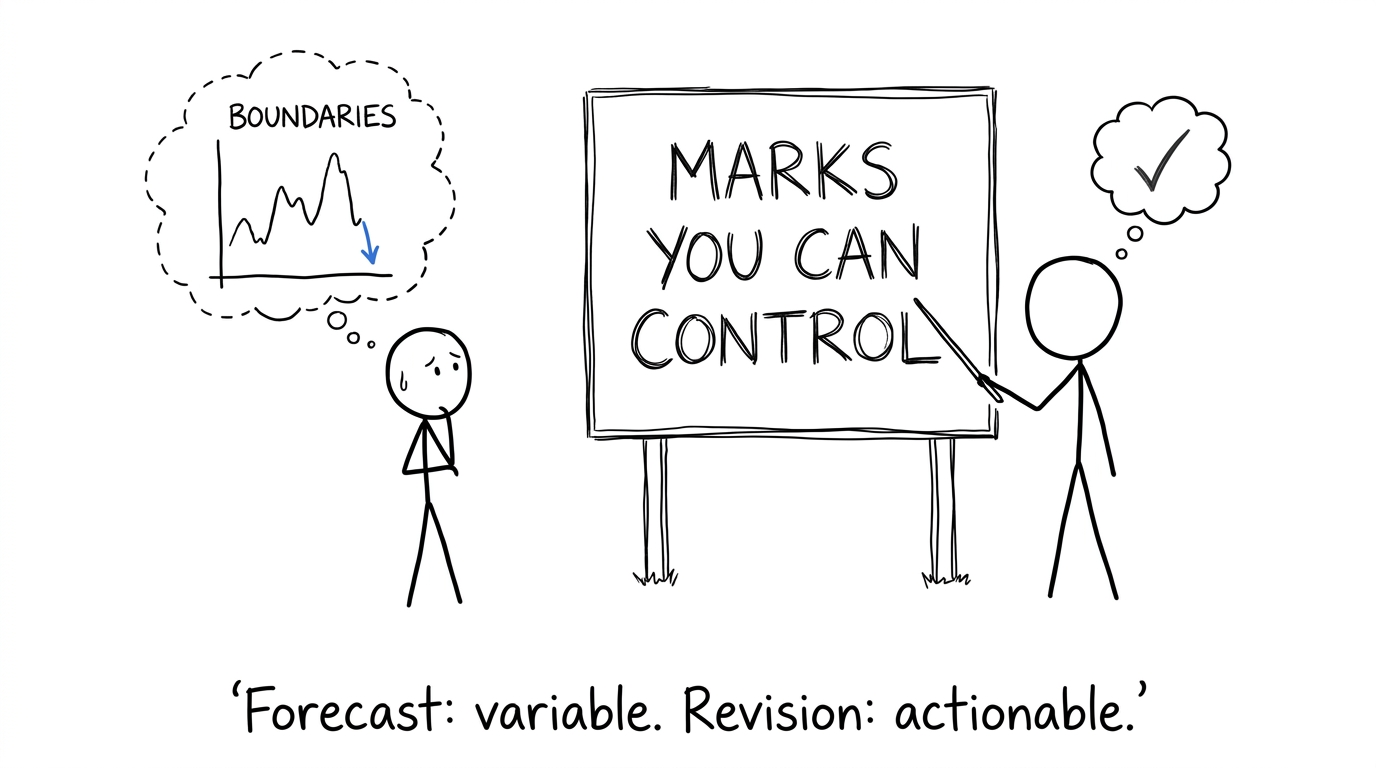 Student choosing between boundary forecasting and controllable marks
What changed from year to year?
The first reformed papers
In 201820182018, both specifications were relatively new. AQA's grade 999 boundary was notably lower than its later thresholds, while Edexcel began at a higher level. That difference does not prove that one board was easier. The papers, question structures and cohorts were different.
By 201920192019, AQA boundaries had risen at grades 999 and 777. Edexcel's grade 999 boundary barely changed, although the grade 777 threshold increased.
The missing summer series
There are no standard summer boundaries for 202020202020 or 202120212021. Grades were awarded without the usual summer examinations, so placing invented values into a trend line would be misleading.
Some autumn examinations did take place, but Ofqual has advised schools to treat pandemic-era boundaries cautiously when estimating current performance. For practical revision, pre-pandemic papers and papers from 202320232023 onwards provide a clearer comparison of normal grading standards.
The transition in grading
Summer 202220222022 marked the return of national examinations, but grading was deliberately more generous than normal pre-pandemic grading. It was a transition year rather than a clean continuation of 201920192019.
In 202320232023, grading returned broadly to pre-pandemic standards. Yet raw boundaries did not simply return to their old numbers. AQA's grade 999 threshold fell slightly from 202220222022, while its grade 444 boundary rose. Edexcel's thresholds rose more sharply, particularly at grades 999, 777 and 444.
Recent boundaries
Across 202420242024 and 202520252025, AQA Higher boundaries increased overall. Edexcel's grade 999 boundary remained at 161161161, while other thresholds moved in both directions.
The important pattern is not that every boundary rises. It is that GCSE physics grade boundary trends respond to each specific examination series. A boundary is an adjustment mechanism, not a fixed pass mark.
What the trends mean for revision
Do not choose a comfortable historical boundary and treat it as a promise. Instead, mark the exact paper using its mark scheme and use that year's official boundary for context.
A sensible routine is:
- complete both papers from the same year, board and tier;
- add the raw marks before estimating a qualification grade;
- record lost marks as physics knowledge, maths method or exam technique;
- repair the weakness with focused questions;
- repeat using another examination series.
For AQA students, start with AQA GCSE Physics past papers and follow the process in how to use AQA Physics papers properly. OCR students can use the corresponding guide to practising OCR Physics past papers.
Physics also exposes small maths weaknesses quickly. Rearranging equations, reading graphs, using standard form and converting units can decide several marks across a paper. Use the GCSE Maths revision hub or practise changing the subject of a formula when your error log reveals a calculation gap.
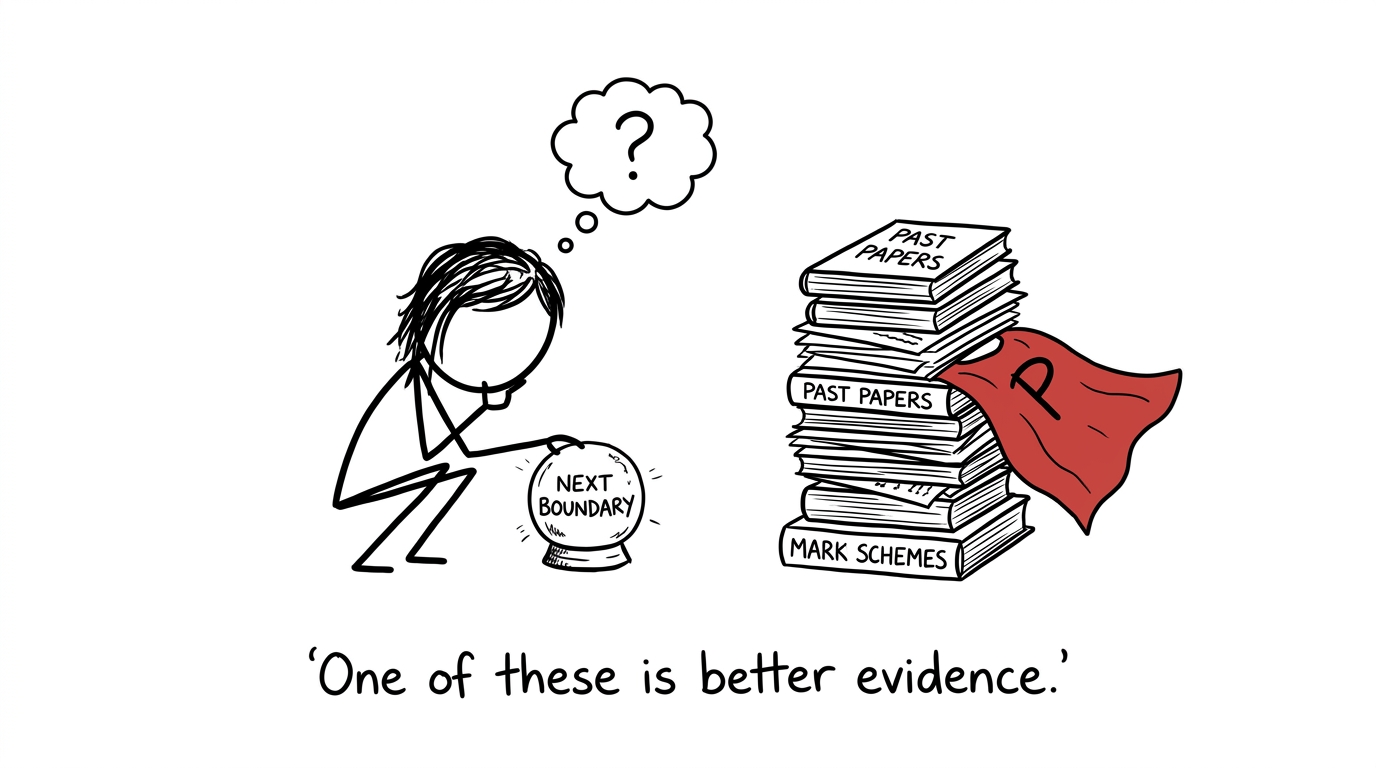 Crystal ball competing with past papers and mark schemes
Common mistakes when analysing grade boundaries
Comparing different qualifications
Separate Physics, Combined Science and International GCSE are different qualifications. Their totals and grading structures are not interchangeable.
Mixing tiers or exam boards
AQA Foundation cannot be compared directly with Edexcel Higher. Foundation tier also has a maximum available grade of 555, so always check the tier printed on the paper.
Using one paper's mark as a final grade
GCSE Physics grades are based on the combined qualification mark. A paper-level threshold may be notional and should not be treated as an awarded grade.
Predicting the next boundary from a straight line
Past GCSE Physics grade boundaries fluctuate because papers and student performance change. No historical average can confirm the next boundary before marking has taken place.
Focusing on the boundary instead of mistakes
A boundary explains a past result. It does not improve the next one. The useful question is not, "Will the boundary fall?" but, "Which lost marks can I recover?" The guide to finding weak Physics topics quickly turns that question into a practical revision plan.
Turn boundary history into better preparation
The history offers perspective: thresholds move, exceptional years need context, and no single percentage guarantees a grade across every board and series. What remains stable is the value of accurate practice.
Choose your board on MathsGenie, complete a paper under timed conditions, mark it honestly and repair the first recurring weakness. Then return to the MathsGenie GCSE Physics past-paper collection for another attempt. Revision lessons, practice questions, mark schemes, video solutions, mini tests and GCSE predicted papers can support the same cycle, but your goal stays simple: build marks rather than guess boundaries.