GCSE Maths Numeracy Grade 9 Rate: Latest Data
GCSE maths numeracy grade 9 rate explained with 2025 data, recent trends, GCSE comparisons and practical revision advice for top grades in Wales.
A top grade can feel like a verdict delivered from somewhere far away. You see a boundary, hear that only a small proportion of candidates reach it, and wonder whether the target is realistic.
The latest GCSE maths numeracy grade 9 rate needs one important clarification: WJEC GCSE Mathematics and Numeracy in Wales was graded from A* to G, not from 999 to 111. Its closest top-grade measure is therefore the A* rate. In summer 2025, WJEC reported that 5.8%5.8\%5.8% of Mathematics Numeracy candidates achieved A*. That was about one candidate in every 171717.
The figure is useful, but it is not a prediction of your result. It describes a cohort. Your result will depend on the specification you are taking, your tier, the marks you earn and how effectively you prepare.
The quick answer
Here is the essential picture:
- In summer 2025, 5.8%5.8\%5.8% of WJEC GCSE Mathematics Numeracy candidates achieved A*.
- There were 23,77723{,}77723,777 candidates in WJEC's final results data, so the published rounded percentage represents approximately 1,3791{,}3791,379 A* results.
- In summer 2024, the A* rate was 5.1%5.1\%5.1% from 25,36625{,}36625,366 candidates.
- The separate WJEC GCSE Mathematics A* rate was 6.4%6.4\%6.4% in 2025.
- Among the relatively small number of Mathematics Numeracy entries reported on the 999 to 111 scale in JCQ's Wales data for 161616-year-olds, 4.6%4.6\%4.6% received grade 999 in 2025.
- Wales is now moving to the new GCSE Mathematics and Numeracy Double Award, so students must check which specification and grading system applies to them.
For course-specific preparation, begin with the WJEC GCSE Maths Numeracy revision hub, where MathsGenie brings the relevant lessons, questions and paper resources together.
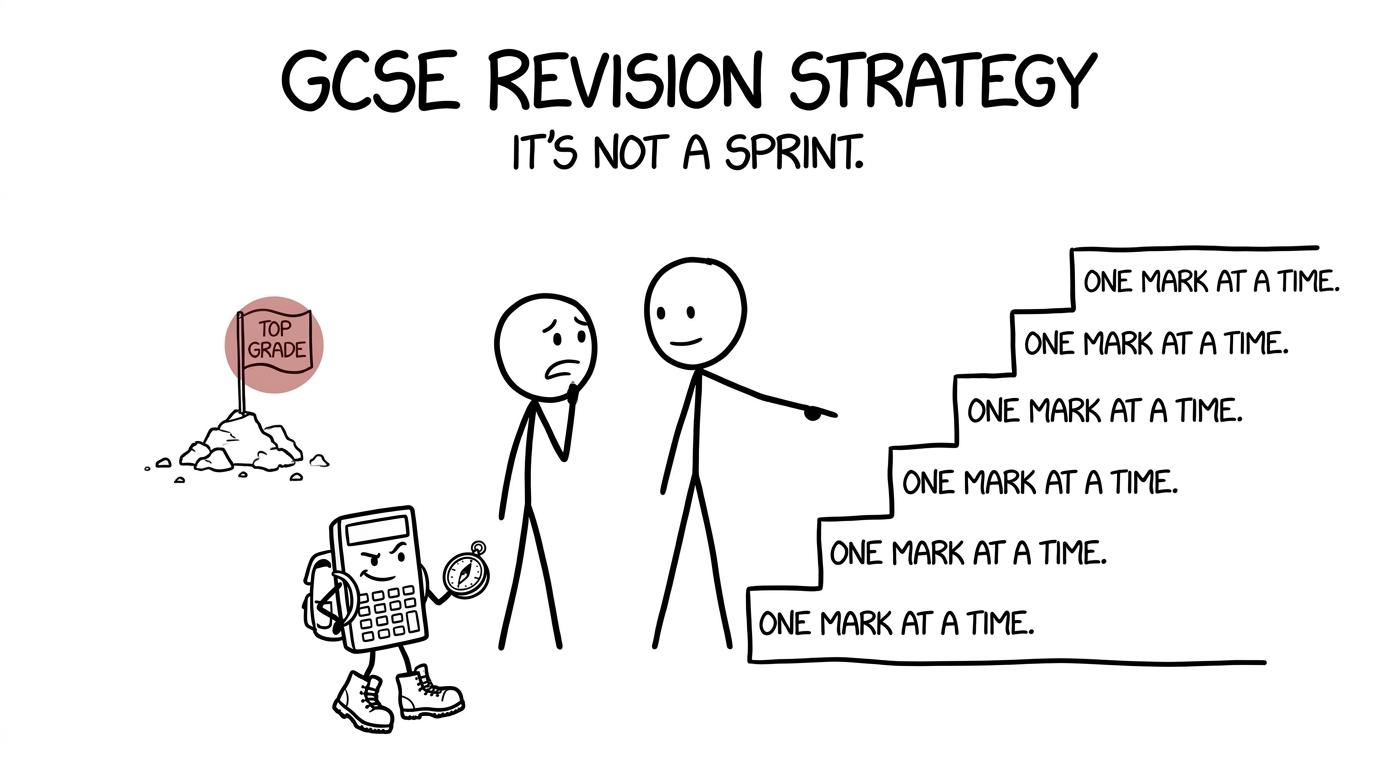 A student climbing towards a top grade one mark at a time
Is there actually a grade 9 in GCSE Maths Numeracy?
For the established WJEC GCSE Mathematics and Numeracy qualification, the precise answer is no. Results are reported from A* to G, with A* as the highest grade. Under that specification, students take both units at the same tier:
- Higher tier offers grades A* to C.
- Intermediate tier offers grades B to E.
- Foundation tier offers grades D to G.
Consequently, only higher-tier candidates can achieve A*. A statistic calculated across all candidates includes students entered at tiers where A* is unavailable. It is not the percentage of higher-tier candidates who achieved the top grade.
JCQ sometimes presents Welsh results alongside qualifications using the 999 to 111 scale. It also reports a small number of Welsh entries under the main 999 to 111 grade set. These tables are useful for national analysis, but they do not change the grade printed on a standard WJEC Mathematics Numeracy result.
There is no exact rule saying A* equals grade 999. An A* is the highest grade in the Welsh scale, while England's 999 to 111 system divides the upper range differently. Treat A* and grade 999 as comparable ideas, top attainment, rather than interchangeable grades.
The latest GCSE Maths Numeracy top-grade rates
The latest complete summer results available before summer 2026 results day are from 2025.
| Summer series | Qualification | Candidates | Highest grade | Top-grade rate |
|---|---|---|---|---|
| 2025 | WJEC Mathematics Numeracy | 23,77723{,}77723,777 | A* | 5.8%5.8\%5.8% |
| 2024 | WJEC Mathematics Numeracy | 25,36625{,}36625,366 | A* | 5.1%5.1\%5.1% |
| 2025 | WJEC Mathematics | 36,53136{,}53136,531 | A* | 6.4%6.4\%6.4% |
| 2024 | WJEC Mathematics | 36,81536{,}81536,815 | A* | 6.2%6.2\%6.2% |
These are WJEC's final results statistics for all candidates in the relevant summer series. Because the published percentages are rounded, any candidate total calculated from them is approximate.
The Numeracy A* rate rose by 0.70.70.7 percentage points between 2024 and 2025. In relative terms, that is an increase of approximately
5.8−5.15.1×100%≈13.7%.\frac{5.8-5.1}{5.1}\times 100\% \approx 13.7\%.5.15.8−5.1×100%≈13.7%.That does not mean the examination suddenly became 13.7%13.7\%13.7% easier. Grade outcomes can move because of cohort composition, tier entry, candidate performance and the awarding process. A single annual change is not enough to establish a lasting trend.
How does the rate compare with other GCSEs?
Comparisons require care because subjects attract different groups of candidates. Separate sciences, for example, can have high top-grade rates partly because their entry populations differ from those taking large compulsory subjects.
In 2025, the WJEC Mathematics Numeracy A* rate of 5.8%5.8\%5.8% was slightly below the separate WJEC Mathematics A* rate of 6.4%6.4\%6.4%. Across all GCSE results in England, approximately 5.2%5.2\%5.2% of grades awarded in 2025 were grade 999. For 161616-year-old GCSE Mathematics candidates in England, the grade 999 rate was about 4.1%4.1\%4.1%.
Those figures provide context, not direct equivalence. They involve different grading structures, specifications and candidate populations.
Broader top-grade bands tell a similar story. In Wales during 2025, 19.5%19.5\%19.5% of GCSE results were awarded at A*/999 to A/777. For Mathematics Numeracy, the corresponding A*/999 to A/777 measure was 13.6%13.6\%13.6%. The separate sciences had much higher proportions in that band, but their entry patterns were more selective.
The sensible conclusion is not that one subject is inherently harder. It is that a raw percentage never tells the whole story. Exam entry and grading context matter.
What is changing for students in Wales?
Students taught from September 2025 are moving to the new WJEC GCSE Mathematics and Numeracy Double Award. It replaces the two separate qualifications with one course worth two GCSEs.
The new qualification has:
- three assessed units;
- higher and foundation tiers rather than the previous three-tier structure;
- grades from AA to GG;
- a top overall grade of AA;
- mixed-tier entry available across units.
Units 111 and 222 were first available in summer 2026, while Unit 333 and the first complete Double Award are available in November 2026. Therefore, as of August 2026, there is no historical AA rate for the completed new qualification.
This distinction matters. A student preparing for the new Double Award should not use the old 5.8%5.8\%5.8% A* rate as though it were a forecast for AA. Ask your school which specification and units you are taking, then revise from matching materials.
What the percentage means for your own target
Suppose 5.8%5.8\%5.8% of candidates receive A*. That can sound discouraging because it frames success as scarcity. Yet exams are not lotteries in which only one person in every classroom is allowed to win.
Grade boundaries are applied to marks after awarding bodies review the examination and candidate performance. You are not trying to defeat a fixed number of classmates. You are trying to demonstrate top-grade knowledge, reasoning and accuracy against the required standard.
The practical questions are therefore more useful than the national percentage:
- Are you entered for a tier that permits the top grade?
- Can you complete unfamiliar, multi-stage questions without relying on prompts?
- Do you interpret tables, graphs, rates and financial contexts carefully?
- Are your units, rounding and conclusions consistently correct?
- Can you maintain that standard under timed conditions?
Use the WJEC Maths Numeracy past papers to replace guesswork with evidence. Complete a paper under the correct conditions, mark it and identify exactly where marks were lost.
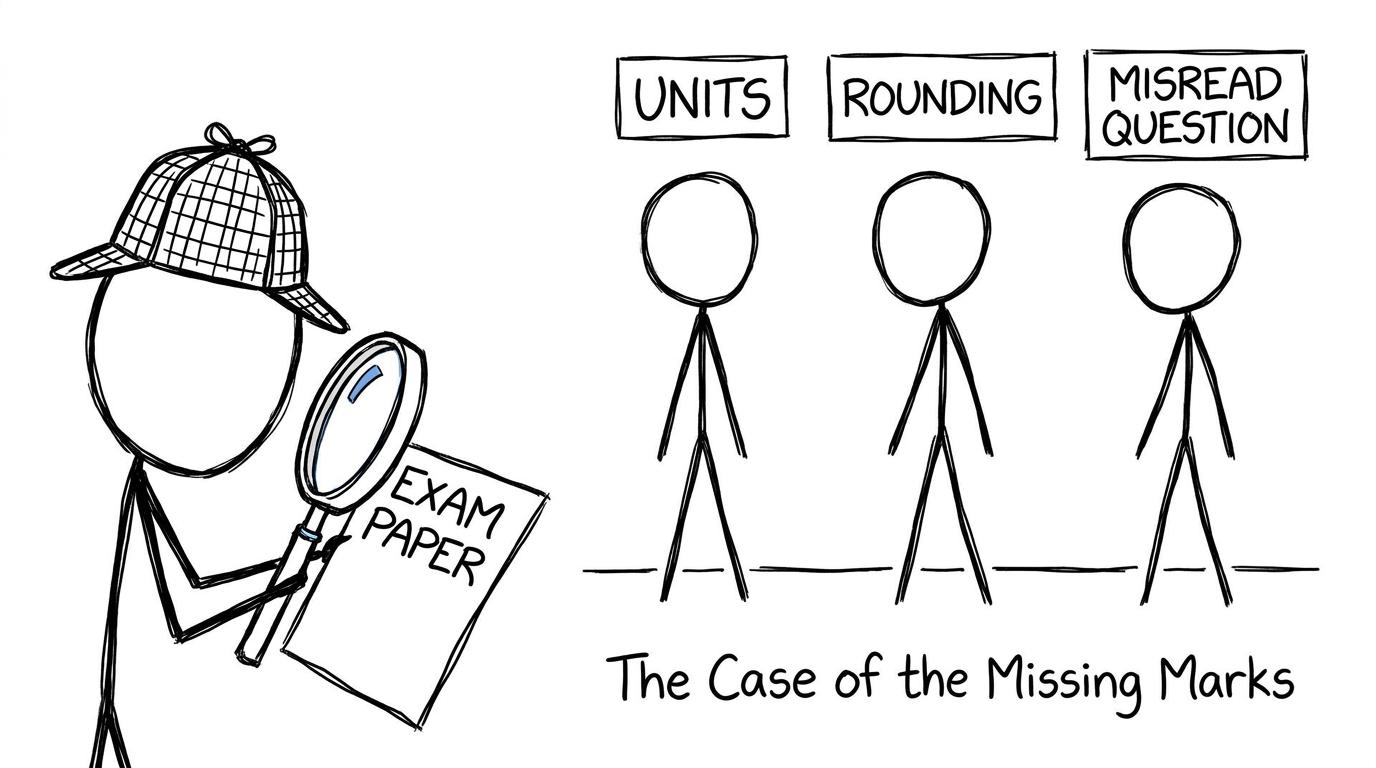 A detective investigates the case of the missing exam marks
How to revise towards the highest grade
Diagnose before you revise
Begin with a timed paper or substantial paper section. Your total matters, but the pattern underneath it matters more. Separate lost marks into four groups:
- missing mathematical knowledge;
- failure to recognise the required method;
- accuracy errors;
- exam technique, including timing or misreading.
MathsGenie's wider GCSE maths revision hub lets you choose resources by exam board, while the free revision resources collection includes practice papers, tests and predicted papers.
Build a mark-repair cycle
For each weak area, follow a short cycle:
- review the relevant revision lesson;
- complete focused practice questions;
- check the mark scheme or video solution;
- record one specific correction;
- retest the same skill later;
- return to mixed paper practice.
A revision session should produce evidence of improvement, not merely time spent. The 20-minute GCSE maths revision routine is useful when school days are busy, while the one-month GCSE maths revision plan provides a longer structure.
Learn to interpret context
Numeracy questions often place familiar mathematics inside realistic information. The difficulty may be deciding which values matter, what units are being used and whether the final answer is reasonable.
Practise identifying the task before calculating. Underline command words, label quantities and return to the context after obtaining an answer. A correct calculation with an unsuitable conclusion can still lose marks.
Use papers as feedback, not theatre
Sitting paper after paper without repairing mistakes creates the feeling of revision without much improvement. A paper becomes valuable when it changes your next session.
Use official past papers first, then bring in predicted papers and mini tests for additional practice. The guide to when to start GCSE past papers explains how to progress from short sections to complete timed papers.
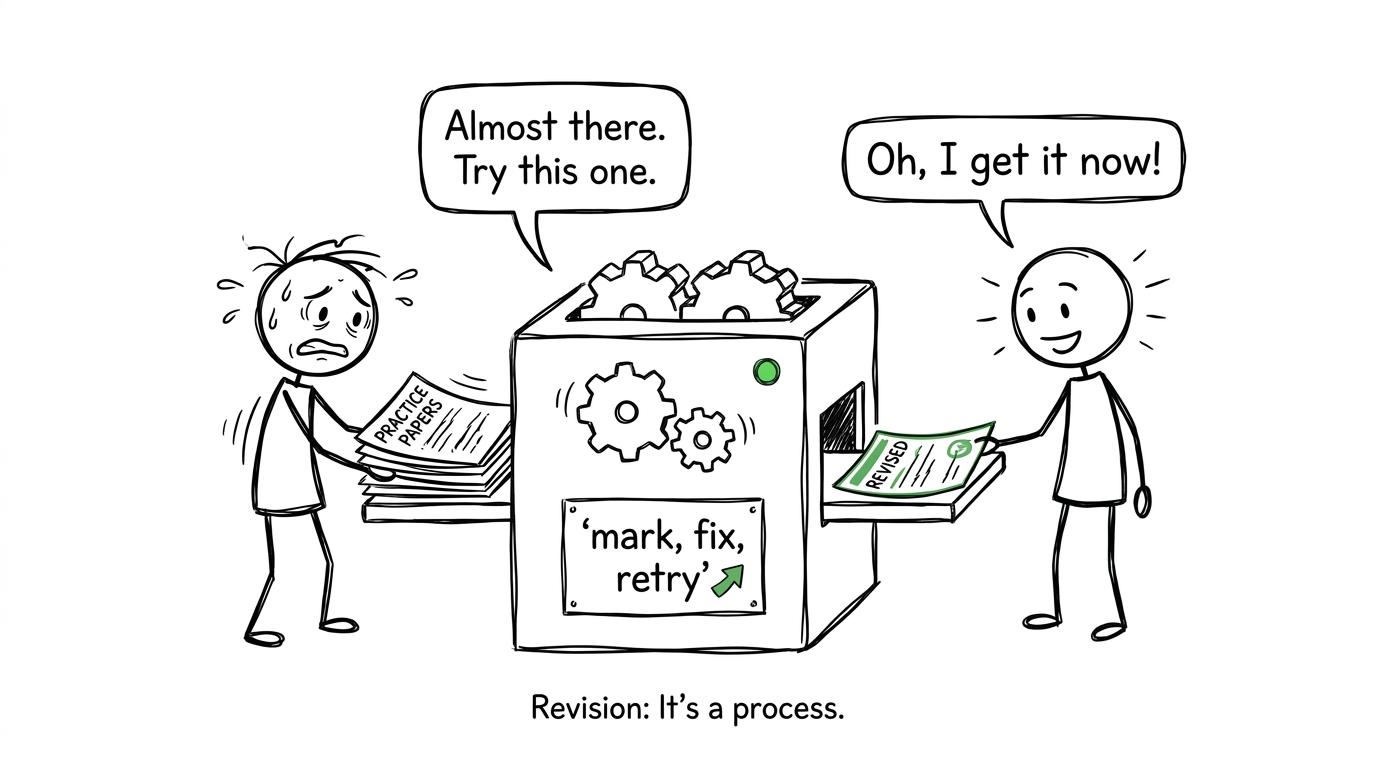 A revision machine returns a calmer student after marking and retrying
Common mistakes when interpreting the grade 9 rate
Treating A* and grade 9 as identical
Both are top grades, but they belong to different grading systems. Use the published grade for your qualification rather than casually converting between them.
Ignoring tier restrictions
Under the established WJEC Mathematics Numeracy specification, A* is available only at higher tier. The overall A* percentage includes candidates from intermediate and foundation tiers, so it is not a higher-tier success rate.
Comparing subjects without considering entry patterns
A subject taken by nearly everyone cannot be compared fairly with one chosen by a smaller, academically selective group using percentages alone.
Assuming last year's boundary is this year's boundary
Grade boundaries can change between exam series. Use old boundaries to assess practice, not to predict exactly how many marks will secure a future grade.
Chasing the hardest questions too early
Top grades are built from reliable marks across the whole paper. Secure routine percentage, ratio, data, measure and interpretation questions before devoting all your time to the final questions.
Turn the statistic into a revision decision
The latest complete data says that 5.8%5.8\%5.8% of WJEC Mathematics Numeracy candidates achieved A* in summer 2025, compared with 5.1%5.1\%5.1% in 2024. That makes the top grade uncommon, but it does not make it mysterious.
The more important question is what your latest paper reveals. Choose a matching paper from the MathsGenie WJEC Numeracy collection, complete it honestly and use the mark scheme to create a short list of repairs. Then combine revision lessons, practice questions, mini tests and video solutions before returning to past papers and predicted papers.
National rates describe what happened last year. Focused revision decides what you do next.