GCSE Maths Numeracy Early Entry: Is It Worth It?
GCSE maths numeracy early entry: weigh readiness, tier choice, stress and future plans before deciding whether sitting a year early is right for you.
The appealing part of finishing an exam early is easy to see. One qualification completed. One less subject competing for attention in Year 11. Perhaps even a little more room to breathe.
But GCSE maths numeracy early entry is a good idea only when you are genuinely ready to achieve a result that reflects your ability. It should not be based simply on being ahead of schedule. Before agreeing, check which qualification and units your school means, whether you have covered the full assessed content, how reliably you perform in unseen papers and what will happen after the early examination.
That distinction matters because mathematics qualifications in Wales have recently changed. The decision is no longer quite the same as it was for previous year groups.
The short answer: should you take it early?
Early entry may make sense if:
- your class has completed all content assessed in the relevant unit;
- your recent unseen papers show consistently secure performance;
- your proposed tier gives access to an appropriate grade range;
- preparing will not damage progress in other subjects;
- your teacher has a clear plan for later units and any permitted resit;
- you can handle examination pressure without rushing the course.
Waiting is usually wiser if important topics remain unfamiliar, your marks vary sharply between papers, or the decision relies mainly on the hope that you can “get it out of the way”.
The date of an examination does not improve the grade. Readiness does.
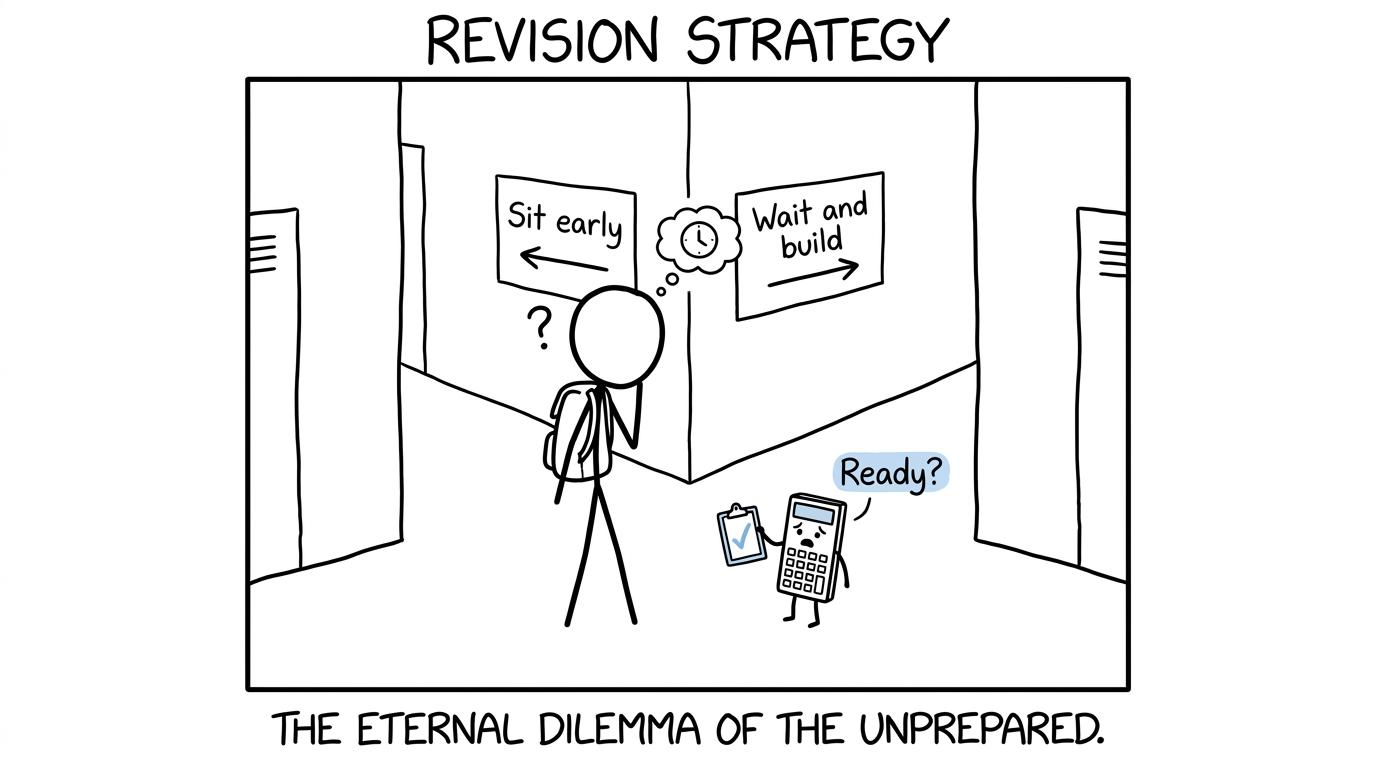 A student choosing between sitting early and waiting to build readiness
First, confirm which Welsh maths qualification you take
“GCSE Maths Numeracy” usually refers to qualifications taken in Wales through WJEC. It is not the standard name for the GCSE maths qualifications offered by Edexcel, AQA, OCR or Eduqas in England.
The legacy system contained separate GCSE Mathematics and GCSE Mathematics and Numeracy qualifications. However, learners beginning Year 10 from September 2025 follow the new GCSE Mathematics and Numeracy (Double Award). WJEC states that Year 10 learners must not be entered for the old qualifications.
The new double award is unitised and contains:
- Unit 1: Financial Mathematics and Other Applications of Numeracy, worth 30%30\%30%;
- Unit 2: Non-calculator Mathematics, worth 30%30\%30%;
- Unit 3: Calculator Mathematics, worth 40%40\%40%.
Units 1 and 2 first became available in summer 2026. Unit 3 is first available in November 2026, when the complete double award can first be awarded. After that, the units are scheduled for November and summer series.
This means “taking numeracy early” may now refer to sitting one or more units before the summer of Year 11, rather than completing the old separate Mathematics and Numeracy GCSE. Ask your teacher for the qualification title, unit, tier and examination series before making a decision.
Students following the retiring specification can use the WJEC GCSE Maths Numeracy past papers, but current Year 10 learners must prepare from materials matching the new double-award specification.
Why early entry can be a sensible decision
It can reduce the Year 11 examination load
Completing an appropriate unit earlier can spread assessment across the course. Instead of placing every major examination into one crowded summer, you deal with part of the qualification while its content is fresh.
That can be useful when the saved time has a purpose. You might strengthen later mathematics, repair weaknesses elsewhere or prepare more carefully for Year 11 papers. Early entry creates capacity only if your school protects and uses that capacity well.
It can provide honest evidence of performance
Mocks are valuable, but a real examination requires you to manage unfamiliar wording, timing and pressure. An early unit can reveal whether your mathematical methods remain dependable under formal conditions.
The useful lesson is not merely the resulting mark. It is the pattern underneath it: misread contexts, weak arithmetic, premature rounding, missing units or difficulty deciding which method a question requires.
MathsGenie's GCSE maths revision hub helps you move from topic lessons to practice questions, mini tests and paper-based revision rather than relying on memory alone.
It may suit students who are already consistently ready
Some students complete the relevant curriculum early and repeatedly demonstrate secure understanding. Making such a student wait does not automatically produce a better outcome.
Yet speed should never be confused with depth. A student ready for early entry can explain methods, apply them in unfamiliar contexts and maintain accuracy across a complete paper. Finishing textbook exercises quickly is not the same test.
Why waiting may produce a better result
Another year can turn fragile knowledge into fluency
Many mistakes disappear slowly. Percentages become easier after they appear in finance, compound change and reverse-percentage questions. Ratio becomes more secure when it connects with scale, rates and probability.
Extra time allows these links to develop. That matters particularly in numeracy questions, where the challenge often lies in interpreting a real-world situation rather than spotting a topic label.
If your foundations need strengthening, follow a deliberate sequence such as the best order for learning GCSE maths topics. Coverage first, then depth, then mixed-paper performance.
Early preparation can compete with other GCSEs
Revision time always has an opportunity cost. Several weeks spent forcing an early maths entry may remove time from English, science, Welsh or option subjects.
Ask a practical question: if the examination were delayed, where would those hours go? If the answer is “towards mastering the same mathematics more securely”, waiting may help. If the answer is “the class would repeat work already mastered while other subjects become crowded”, early entry may be reasonable.
A disappointing result can change confidence
An early result is information, not a verdict. Even so, sitting before you are ready can create avoidable anxiety. Students sometimes respond to one poor paper by deciding they are “bad at maths”, when the real problem was incomplete coverage or insufficient examination practice.
A better decision protects both attainment and confidence. Confidence should come from evidence: completed papers, careful marking and successful retesting.
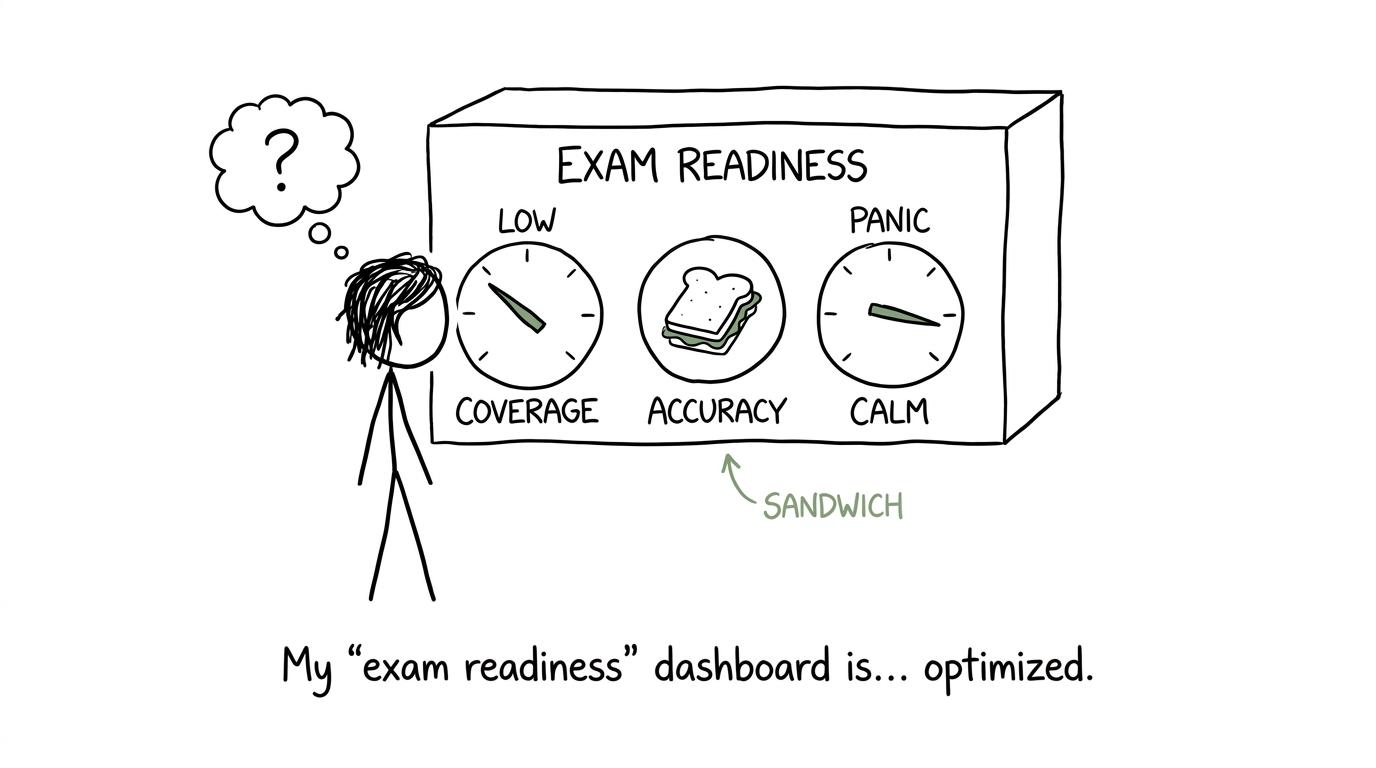 A slightly unreliable dashboard attempting to measure exam readiness
How to judge whether you are ready
Use several unseen assessments
One excellent mock can be encouraging without being conclusive. Look for a stable pattern across several unseen papers or unit-style assessments completed under the correct calculator and timing conditions.
When marking, separate lost marks into four groups:
- knowledge: the method was unknown;
- application: the method was known but not recognised;
- accuracy: arithmetic, signs, rounding or units failed;
- technique: working was unclear, time ran out or the question was misread.
The total mark tells you where you finished. These categories tell you what must change.
The guidance on when to start GCSE past papers explains how to progress from short diagnostic work to timed papers. Use past papers from a different specification cautiously: they can strengthen shared skills, but they cannot perfectly reproduce the new WJEC unit structure.
Check your tier carefully
The new double award has foundation and higher tiers. WJEC specifies grades CCC to GGG for foundation and A∗A^*A∗ to DDD for higher. Students may be entered at different tiers across different units.
That flexibility makes the decision more individual, but tier choice should come from sustained evidence. Ask which tier your school proposes, which grades it permits and why your recent work supports that choice. Do not assume that “early” must also mean “higher”.
Understand the resit rules before entering
Under the WJEC specification, a pre-16 candidate may resit an individual unit once. The better uniform mark score is normally used in the overall result, subject to the qualification's terminal rule. At least 30%30\%30% of the assessment must contribute at the point when the qualification is completed.
These rules make a later attempt possible, but a resit should be a safety net rather than the whole strategy. Your school is responsible for entries, so ask it to explain how an early unit, any resit and final certification would fit together in your case.
Consider what happens after the examination
The best early-entry plans include the next chapter. Will you continue practising core skills? Begin preparation for later units? Move towards Level 2 Additional Mathematics when appropriate? Or simply stop doing maths for months?
Long gaps can weaken fluency. This matters if you may later take A Level maths, where secure algebra, graphs, number and problem-solving habits are more valuable than the fact that an earlier examination was completed quickly.
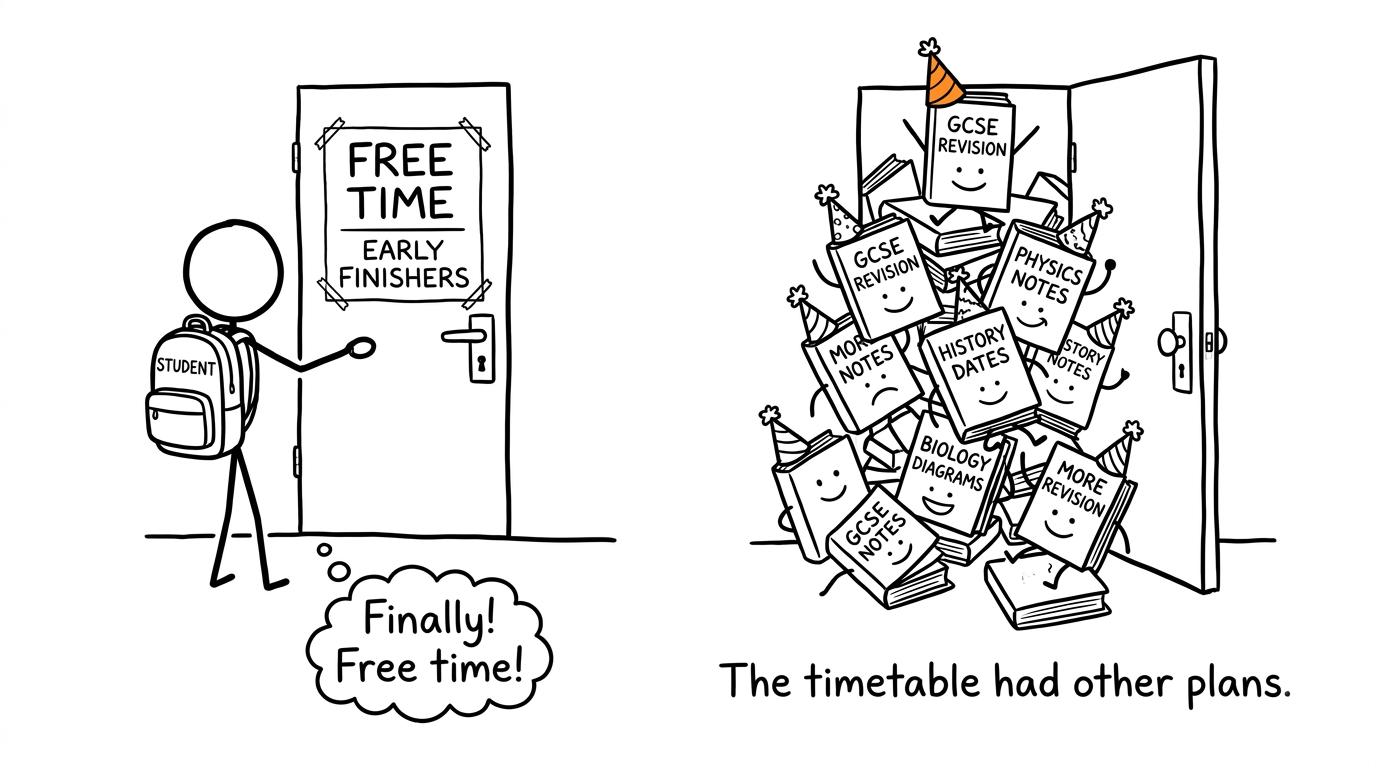 A student discovering that finishing one exam does not empty the revision timetable
A calm revision plan before agreeing
Spend a few weeks gathering evidence rather than arguing from instinct:
- confirm the exact WJEC unit, tier and series;
- list every assessed topic and label it secure, developing or not yet covered;
- complete short mixed tests without notes;
- sit an unseen assessment in formal conditions;
- mark it and create a specific correction list;
- use revision lessons and questions to repair each gap;
- retest those skills several days later;
- discuss the evidence with your teacher and parent or carer.
MathsGenie's active recall guide for GCSE maths can help turn notes into usable knowledge. For a short structured run-up, adapt the GCSE one-week revision plan, while making sure every resource matches your assessed content.
Common mistakes when deciding on early entry
Treating the earliest date as the best date. Earlier is useful only when it supports your strongest reasonable outcome.
Using classroom confidence as the only evidence. Familiar exercises feel different from unseen, contextual examination questions.
Ignoring the specification change. Legacy Mathematics and Numeracy papers remain useful for selected skills, but current learners must know which new double-award unit they are preparing for.
Choosing a tier for prestige. The right tier is the one that gives a realistic route to your best result.
Assuming a resit removes all risk. Resits involve rules, another period of preparation and additional pressure. Confirm the arrangements before the first entry.
Stopping maths afterwards. Skills fade when they are left unused, especially before later units or A Level study.
Counting papers without reviewing them. Five rushed papers teach less than one paper that is marked, analysed and followed by targeted practice. The GCSE maths resit revision process offers a useful learn, practise, mark, fix and retest cycle even if you are not resitting.
Make the decision from evidence, not urgency
Taking GCSE Mathematics and Numeracy units a year early can be sensible. It can spread the examination load and create space later. But the benefit comes from being ready, not from being young when the paper is sat.
Confirm the current qualification, examine your performance across several assessments and ask what the early entry changes afterwards. If the evidence is strong and the plan is clear, early entry may fit. If important knowledge remains fragile, another year is not lost time; it is time that can become marks.
Start at the MathsGenie GCSE maths revision hub. Use free revision lessons and practice questions to build the methods, mini tests to check recall, and relevant past papers, predicted papers, mark schemes and video solutions to test performance. Then take that evidence to your teacher and make the decision calmly.