GCSE Maths Grade 5 Meaning: A Strong Pass
GCSE maths grade 5 meaning explained: discover what a strong pass shows, how it compares with old grades and how to plan revision for your next goal.
There is a peculiar moment on results day when years of lessons, homework and exams are compressed into one number. If that number is 555, what does it really say about you?
The short answer to the GCSE maths grade 5 meaning is this: in England, grade 555 is officially described as a strong pass. It is above grade 444, the standard-pass threshold, and broadly sits between the old grades C and B. It shows that you demonstrated a secure understanding of a substantial range of GCSE maths, although it does not mean that every topic was mastered.
More importantly, grade 555 is a result, not a ceiling. It tells you where your performance landed in one exam series. It does not define how far you can progress.
Grade 5 at a glance
Here is the practical picture:
- Grade 555 is officially called a strong pass.
- Grade 444 is the standard pass.
- Grade 555 is broadly comparable with the upper part of the old grade C and the lower part of grade B.
- It can be achieved on either foundation or higher tier.
- Foundation tier awards grades 111 to 555, so grade 555 is its highest available grade.
- Higher tier mainly awards grades 444 to 999, with a restricted grade 333 available below the grade 444 boundary.
- A foundation grade 555 has the same value as a higher grade 555.
- The number of marks needed changes between exam boards and exam series.
- Course, college and apprenticeship entry requirements must be checked individually.
If you are still preparing for your exams, the GCSE Maths revision hub lets you select your exam board and find free lessons, questions, worksheets and papers.
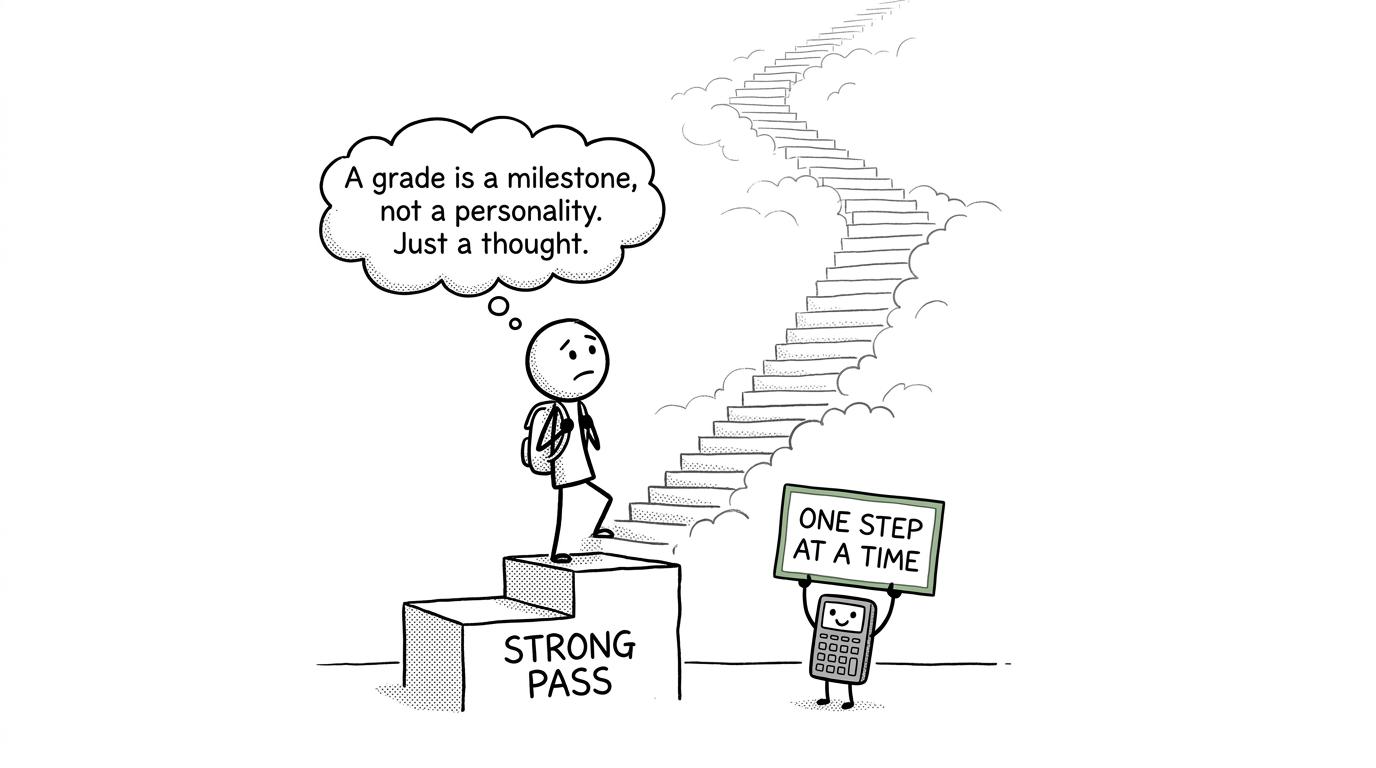 A student discovers that a strong pass is one milestone on a longer staircase
What ability does a grade 5 represent?
A grade cannot provide a perfect inventory of what a student knows. GCSE maths covers number, algebra, ratio and proportion, geometry, probability and statistics. Your final grade reflects your total performance across the qualification rather than separate passes in each area.
Nevertheless, grade 555 normally indicates that you can use familiar methods reliably and apply them in questions requiring some interpretation. Depending on the specification and tier, this may include working confidently with fractions and percentages, solving equations, using ratio, interpreting graphs, applying geometrical facts and reasoning with probability or data.
The important word is apply. Questions around this level do not always announce the method. You may need to identify relevant information, choose an approach, carry out several connected steps and communicate enough working to earn method marks.
That does not mean a grade 555 student answers every grade 555 question correctly. Grades are awarded from a total mark across the papers. One student might be stronger in algebra and weaker in geometry; another might have the reverse profile. Both could finish with the same grade.
The GCSE Maths topics by exam board and tier guide is useful here. It helps you see the breadth of the course rather than treating grade 555 as a small collection of isolated topics.
How grade 5 compares with the old letter grades
The numerical scale is not a simple renaming of the former A* to G scale. Official comparisons anchor the bottom of grade 777 to the bottom of the old grade A, the bottom of grade 444 to the bottom of grade C, and the bottom of grade 111 to the bottom of grade G.
Grade 555 lies between those fixed comparison points. When the reformed system was designed, it was positioned across the upper part of the old C range and the lower part of the old B range. It is therefore commonly described as broadly equivalent to a high C or low B.
| Current grade | Broad interpretation | Important qualification |
|---|---|---|
| 777 | Comparable at its lower boundary with the old grade A | Grades 777, 888 and 999 provide greater differentiation at the top |
| 555 | Strong pass; broadly a high C or low B | There is no exact one-to-one letter conversion |
| 444 | Standard pass; comparable at its lower boundary with the old grade C | This is the key pass threshold for many purposes |
| 111 | Comparable at its lower boundary with the old grade G | It is the lowest numbered GCSE grade |
So it is reasonable to explain grade 555 as stronger than the old minimum C threshold. It is not accurate to claim that every grade 555 is exactly a B. The old and new systems divide attainment differently.
For a closer look at the threshold below it, read what a grade 4 GCSE pass means.
Is grade 5 a good GCSE maths grade?
Yes. A grade 555 is a solid result that exceeds the standard-pass threshold. It shows meaningful mathematical competence across a demanding Level 222 qualification.
Its practical value, however, depends on what you want to do next. A college course, apprenticeship or sixth form may set its own entry criteria. Some routes accept grade 444 in maths, some request grade 555, and mathematically demanding courses may require a higher grade. Entry requirements can also change, so check the current published conditions for each destination rather than relying on a general rule.
Grade 555 should therefore be read in two ways:
- As an achievement: you earned a strong pass.
- As information: compare it with the requirement for your next course.
If you hope to take A Level Maths, do not assume that the phrase “strong pass” automatically meets the entry requirement. Schools and colleges commonly set a higher mathematics threshold because A Level work develops algebra, functions, trigonometry and mathematical reasoning rapidly. Check the exact requirement with the institution concerned.
Does foundation or higher tier change its value?
No. A grade 555 achieved through foundation tier is the same qualification grade as a 555 achieved through higher tier. The certificate does not show the tier, and exam boards are required to maintain a comparable standard at the overlapping grades.
The experience of earning it can feel different, though. Foundation papers contain more questions aimed across grades 111 to 555, and grade 555 is the highest available outcome. Higher papers contain more advanced material because they provide access to grades 444 to 999. A student can therefore need a very different raw mark on each tier while still meeting the same grade standard.
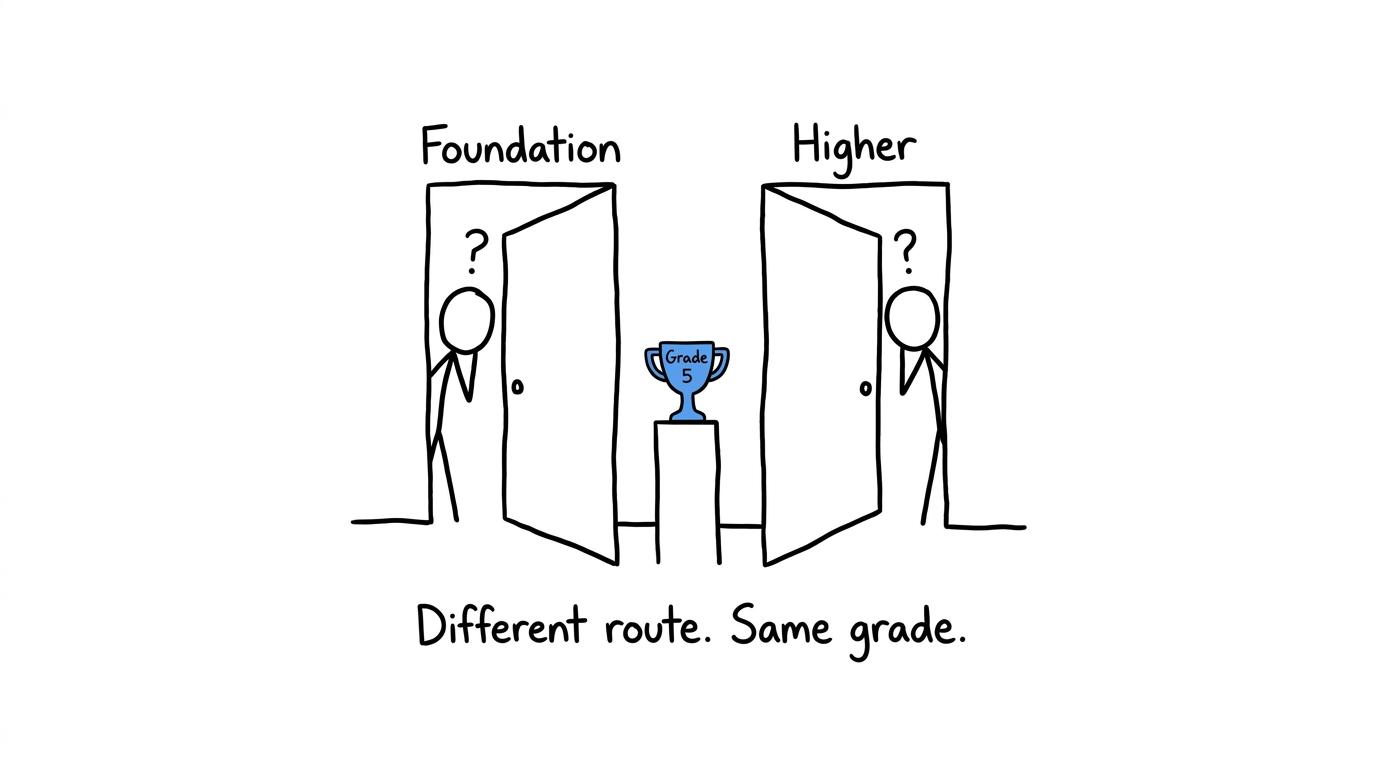 Students take different tier routes towards the same grade 5
Tier decisions should be based on the paper that gives you the best opportunity to demonstrate your knowledge, not on the idea that higher tier automatically looks better. Speak to your teacher if you are uncertain about your entry.
Why there is no fixed grade 5 pass mark
A common question is, “What percentage do I need for grade 555?” There is no permanent national percentage.
Grade boundaries are set after the papers have been taken and marked. Awarding organisations consider evidence about the demand of the papers and student performance. If one series is more demanding than another, boundaries can move so that the expected grade standard remains comparable.
The raw marks also differ by exam board, tier and series. Edexcel, AQA, OCR and Eduqas follow the national subject content, but their papers are not identical. Comparing a mark from one board with a boundary from another can therefore be misleading.
Use previous boundaries as context, not as a promise. The GCSE Maths grade-boundary history shows why movement between years matters.
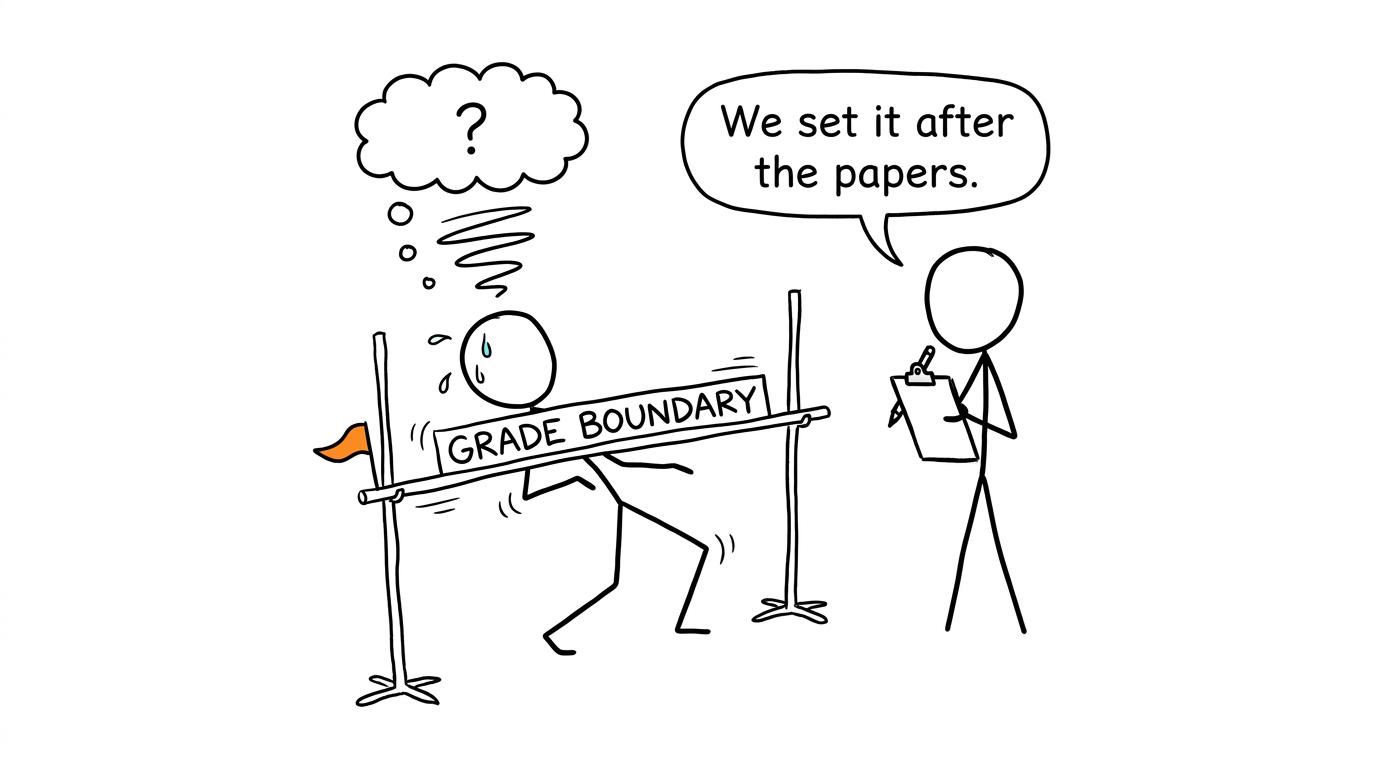 A student discovers that the grade-boundary bar moves between exam series
A safer revision target is consistent performance across several unseen papers. Give yourself a buffer above previous boundaries rather than aiming for the smallest mark that happened to earn grade 555 in one year.
How to turn a grade 5 target into a revision plan
“Revise for grade 555” is too vague to guide an evening. A useful plan converts the grade into skills, questions and feedback.
Diagnose before revising
Complete a paper that matches your board and tier under timed conditions. Mark it carefully and classify each lost mark:
- missing knowledge;
- incorrect method;
- arithmetic or algebra error;
- weak mathematical communication;
- poor time management.
A paper should tell you what to revise next. The guide to using GCSE past papers properly explains how to turn marking into improvement rather than simply collecting scores.
Repair one weakness at a time
Choose a repeated weakness, revisit the revision lesson, then answer targeted practice questions without copying the method. Edexcel students can organise this through the Edexcel GCSE Maths revision resources, while students following AQA, OCR or Eduqas can select their board from the main GCSE hub.
Grade 555 material often connects familiar skills. For example, students may need secure linear algebra, proportional reasoning and compound measures. MathsGenie provides focused resources such as simultaneous equations revision and speed and density revision. Use resources matching your own specification.
Retest under exam conditions
After repairing weak topics, use a mini test or a fresh paper. Later in your revision, Edexcel predicted papers can provide additional exam-style rehearsal. Predicted papers should supplement official past papers, not replace them.
The cycle is simple: learn, practise, mark, fix and retest. Progress usually looks less dramatic than motivation posters suggest. It is often just the same mistake appearing less frequently.
Common mistakes when interpreting grade 5
Calling it the minimum pass
Grade 555 is the strong pass. Grade 444 is the standard pass and is the key threshold for post-16 maths continuation requirements in England.
Treating it as exactly equivalent to grade B
Grade 555 overlaps the old high-C and low-B territory. The scales do not convert perfectly grade by grade.
Assuming foundation grade 5 is worth less
It is not. Grade 555 has the same value on both tiers. Foundation simply limits the highest available grade to 555.
Predicting a grade from one percentage
Boundaries vary by board, tier and exam series. One paper can also flatter or understate your usual performance. Look for a pattern across several papers.
Believing the grade describes every skill
A final grade is an aggregate result. Use your marked papers to identify the particular topics and habits behind it.
Your grade is a checkpoint, not a verdict
The clearest GCSE maths grade 555 meaning is “strong pass”. It represents performance above the standard-pass threshold and broadly bridges the old high-C and low-B range. It can open useful routes, although every next step has its own entry requirements.
If grade 555 is your target, make it practical. Start at the MathsGenie GCSE Maths revision hub, choose your board and tier, and use free revision lessons, practice questions and mini tests to strengthen individual topics. Then move into past papers, mark schemes, video solutions and predicted papers.
The number matters. But what matters more during revision is the next mark you learn how to earn.