Simultaneous Equations
x

Revision notes for Edexcel GCSE Maths Simultaneous Equations. Open the guide for explanations and worked examples. Written against the Edexcel GCSE Maths (1MA1) specification, so the content matches what's examinable rather than general Maths background.

Simultaneous Equations

What you'll learn

  • What a simultaneous equation is and what a solution means.
  • How to solve two linear equations by eliminating one variable.
  • How to deal with equations that need rearranging first.
  • How to turn short word problems into simultaneous equations.

The basic idea

You already know how to solve one equation with one unknown, such as x+4=11x+4=11x+4=11.

In this topic, you usually have two unknowns, often called xxx and yyy, and two equations. Your job is to find the one pair of values that makes both equations true at the same time.

Definition

Simultaneous equations

Simultaneous equations are two or more equations that must be true at the same time.
A solution is the value of each variable, usually written like x=3, y=2x=3,\ y=2x=3, y=2.

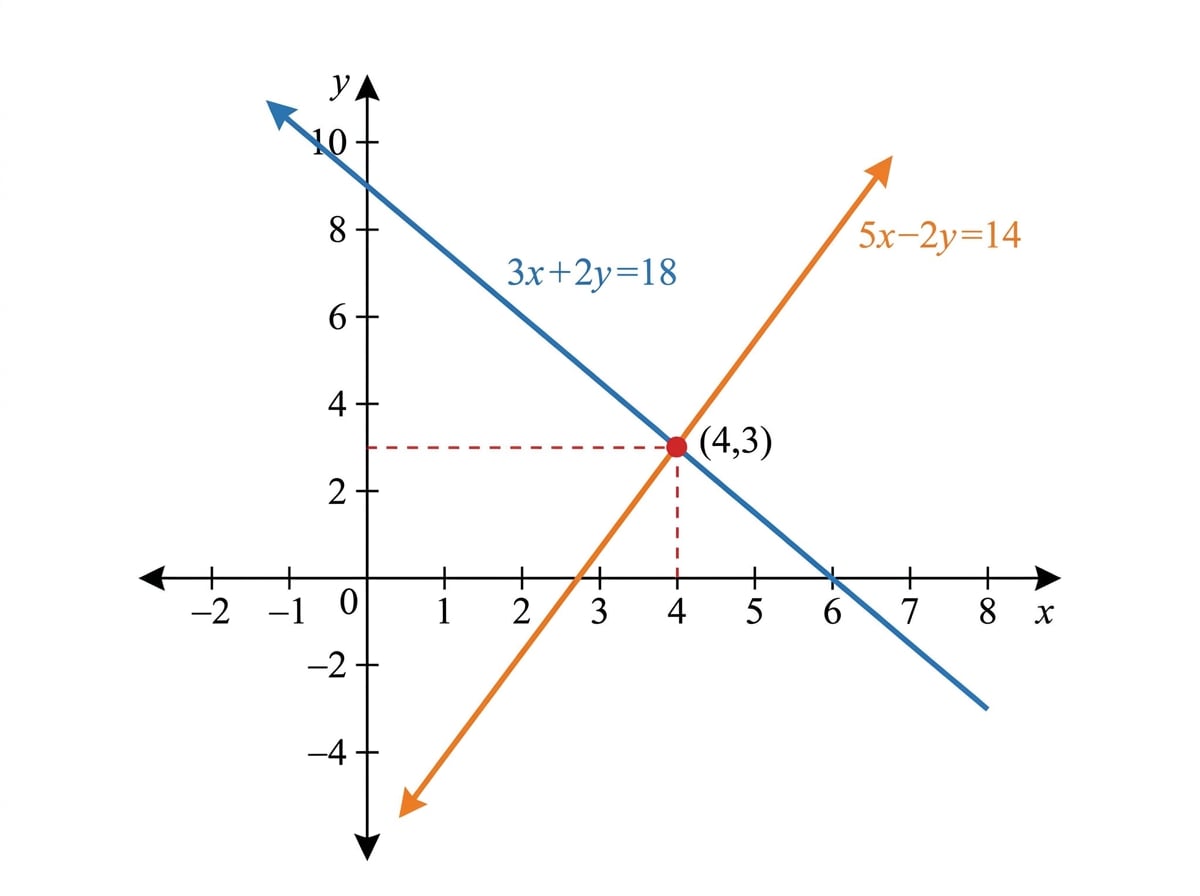
A simultaneous-equations solution is the point where both line graphs meet.

Checking a possible solution

Before solving, it helps to understand what a correct answer looks like.

Example

Checking whether a pair of values works

Check whether x=4, y=1x=4,\ y=1x=4, y=1 solves these equations:

The pair x = 4, y = 1 works because the point lies on both lines.

2x+3y=115x−y=19\begin{aligned} 2x+3y&=11 \\ 5x-y&=19 \end{aligned}2x+3y5x−y​=11=19​
  1. Substitute x=4x=4x=4 and y=1y=1y=1 into the first equation:

    2(4)+3(1)=8+3=112(4)+3(1)=8+3=112(4)+3(1)=8+3=11
  2. The first equation works.

  3. Substitute x=4x=4x=4 and y=1y=1y=1 into the second equation:

    5(4)−1=20−1=195(4)-1=20-1=195(4)−1=20−1=19
  4. The second equation works, so x=4, y=1x=4,\ y=1x=4, y=1 is the solution.

Tip

Always check both equations

A pair of values must work in both equations, not just one. If it only works in one, it is not the solution.

Elimination: getting rid of one variable

The main Grade 5 method is called elimination.

Definition

Elimination

Elimination means adding or subtracting the two equations so that one variable disappears, leaving one equation with one unknown.

Elimination combines two equations so one variable cancels out.

The goal is to make either the xxx terms or the yyy terms cancel out.

Key Idea

The big idea

If the coefficients are the same size but opposite signs, add the equations.

Opposite signs cancel when the equations are added. If the coefficients are the same size and the same sign, subtract the equations.

Same signs cancel when one equation is subtracted from the other.

Definition

Coefficient

A coefficient is the number multiplying a variable.
For example, in 4x−3y=104x-3y=104x−3y=10, the coefficient of xxx is 4 and the coefficient of yyy is -3.

When the signs are opposite: add

Look for terms like +2y+2y+2y and −2y-2y−2y. These cancel when you add.

Example

Solving by adding the equations

Solve:

In this example, the +2y and −2y terms cancel when the equations are added.

3x+2y=185x−2y=14\begin{aligned} 3x+2y&=18 \\ 5x-2y&=14 \end{aligned}3x+2y5x−2y​=18=14​
  1. The yyy terms are +2y+2y+2y and −2y-2y−2y, so they will cancel if we add the equations.

  2. Add the left sides and add the right sides:

    3x+2y+5x−2y=18+148x=32\begin{aligned} 3x+2y+5x-2y&=18+14 \\ 8x&=32 \end{aligned}3x+2y+5x−2y8x​=18+14=32​
  3. Solve for xxx:

    x=4x=4x=4
  4. Substitute x=4x=4x=4 into one of the original equations:

    3(4)+2y=183(4)+2y=183(4)+2y=18
  5. Solve for yyy:

    12+2y=182y=6y=3\begin{aligned} 12+2y&=18 \\ 2y&=6 \\ y&=3 \end{aligned}12+2y2yy​=18=6=3​
  6. Write the final answer:

    x=4,y=3x=4,\quad y=3x=4,y=3

When the signs are the same: subtract

If both matching terms are positive, or both are negative, subtract one equation from the other.

Example

Solving by subtracting the equations

Solve:

4x+3y=22x+3y=10\begin{aligned} 4x+3y&=22 \\ x+3y&=10 \end{aligned}4x+3yx+3y​=22=10​
  1. The yyy terms are both +3y+3y+3y, so subtract the second equation from the first.

  2. Subtract the left sides and subtract the right sides:

    (4x+3y)−(x+3y)=22−103x=12\begin{aligned} (4x+3y)-(x+3y)&=22-10 \\ 3x&=12 \end{aligned}(4x+3y)−(x+3y)3x​=22−10=12​
  3. Solve for xxx:

    x=4x=4x=4
  4. Substitute x=4x=4x=4 into the simpler original equation:

    4+3y=104+3y=104+3y=10
  5. Solve for yyy:

    3y=6y=2\begin{aligned} 3y&=6 \\ y&=2 \end{aligned}3yy​=6=2​
  6. Write the final answer:

    x=4,y=2x=4,\quad y=2x=4,y=2
Common Mistake

Subtracting only part of the equation

If you subtract equations, subtract every term on the left and the right. For example, subtracting x+3y=10x+3y=10x+3y=10 from 4x+3y=224x+3y=224x+3y=22 gives 3x=123x=123x=12, not 3x=223x=223x=22.

If nothing cancels yet: multiply first

Sometimes the coefficients do not match. You can multiply one or both whole equations to make a matching coefficient.

Multiplying a whole equation can create matching coefficients ready for elimination.

Key Idea

Make a match first

Before adding or subtracting, choose a variable and make its coefficients the same size.

Example

Multiplying one equation first

Solve:

2x+y=115x+2y=26\begin{aligned} 2x+y&=11 \\ 5x+2y&=26 \end{aligned}2x+y5x+2y​=11=26​
  1. The first equation has yyy, and the second has 2y2y2y. Multiply the first equation by 2.

    2(2x+y)=2(11)2(2x+y)=2(11)2(2x+y)=2(11)
  2. This gives a new equivalent equation:

    4x+2y=224x+2y=224x+2y=22
  3. Now compare it with the second equation:

    4x+2y=225x+2y=26\begin{aligned} 4x+2y&=22 \\ 5x+2y&=26 \end{aligned}4x+2y5x+2y​=22=26​
  4. The 2y2y2y terms are the same sign, so subtract the first new equation from the second.

    (5x+2y)−(4x+2y)=26−22x=4\begin{aligned} (5x+2y)-(4x+2y)&=26-22 \\ x&=4 \end{aligned}(5x+2y)−(4x+2y)x​=26−22=4​
  5. Substitute x=4x=4x=4 into 2x+y=112x+y=112x+y=11:

    2(4)+y=112(4)+y=112(4)+y=11
  6. Solve for yyy:

    8+y=11y=3\begin{aligned} 8+y&=11 \\ y&=3 \end{aligned}8+yy​=11=3​
  7. Write the answer:

    x=4,y=3x=4,\quad y=3x=4,y=3
Common Mistake

Multiply the whole equation

If you multiply an equation by 2, every term must be multiplied by 2. For example, 2x+y=112x+y=112x+y=11 becomes 4x+2y=224x+2y=224x+2y=22, not 4x+2y=114x+2y=114x+2y=11.

Rearranging first

Some equations are not written neatly as “xxx terms, yyy terms, equals number”. Rearrange them first.

Definition

Standard form

For GCSE simultaneous equations, a useful form is ax+by=cax+by=cax+by=c, where the xxx and yyy terms are on the left and the number is on the right.

Example

Rearranging before solving

Solve:

3x=12+yx+4y=19\begin{aligned} 3x&=12+y \\ x+4y&=19 \end{aligned}3xx+4y​=12+y=19​
  1. Rearrange the first equation by subtracting yyy from both sides:

    3x−y=123x-y=123x−y=12
  2. The equations are now:

    3x−y=12x+4y=19\begin{aligned} 3x-y&=12 \\ x+4y&=19 \end{aligned}3x−yx+4y​=12=19​
  3. Multiply the first equation by 4 so the yyy terms can cancel:

    12x−4y=4812x-4y=4812x−4y=48
  4. Add this to the second equation:

    12x−4y+x+4y=48+1913x=67\begin{aligned} 12x-4y+x+4y&=48+19 \\ 13x&=67 \end{aligned}12x−4y+x+4y13x​=48+19=67​
  5. Solve for xxx:

    x=6713x=\frac{67}{13}x=1367​
  6. Substitute x=6713x=\frac{67}{13}x=1367​ into x+4y=19x+4y=19x+4y=19:

    6713+4y=19\frac{67}{13}+4y=191367​+4y=19
  7. Solve for yyy:

    4y=19−67134y=18013y=4513\begin{aligned} 4y&=19-\frac{67}{13} \\ 4y&=\frac{180}{13} \\ y&=\frac{45}{13} \end{aligned}4y4yy​=19−1367​=13180​=1345​​
  8. Write the answer:

    x=6713,y=4513x=\frac{67}{13},\quad y=\frac{45}{13}x=1367​,y=1345​
Tip

Fractions can be correct

Not every simultaneous equations answer is a whole number. If you get fractions, keep going carefully and check by substitution if you are unsure.

Word problems

For word problems, the hardest part is often setting up the equations.

Choose letters for the unknowns, then translate each sentence into an equation.

Example

Prices in a shop

Two sandwiches and three drinks cost £14.70.

A word problem can be modelled by turning each shopping basket into an equation. One sandwich and two drinks cost £8.70.
Find the price of one sandwich and one drink.

  1. Let sss be the price of one sandwich in pounds, and let ddd be the price of one drink in pounds.

  2. Write two equations:

    2s+3d=14.70s+2d=8.70\begin{aligned} 2s+3d&=14.70 \\ s+2d&=8.70 \end{aligned}2s+3ds+2d​=14.70=8.70​
  3. Multiply the second equation by 2:

    2s+4d=17.402s+4d=17.402s+4d=17.40
  4. Subtract the first equation from this new equation:

    (2s+4d)−(2s+3d)=17.40−14.70d=2.70\begin{aligned} (2s+4d)-(2s+3d)&=17.40-14.70 \\ d&=2.70 \end{aligned}(2s+4d)−(2s+3d)d​=17.40−14.70=2.70​
  5. Substitute d=2.70d=2.70d=2.70 into s+2d=8.70s+2d=8.70s+2d=8.70:

    s+2(2.70)=8.70s+2(2.70)=8.70s+2(2.70)=8.70
  6. Solve for sss:

    s+5.40=8.70s=3.30\begin{aligned} s+5.40&=8.70 \\ s&=3.30 \end{aligned}s+5.40s​=8.70=3.30​
  7. Give the answer in words: one sandwich costs £3.30 and one drink costs £2.70.

Common Mistake

Forgetting what the letters mean

If sss means one sandwich, then 2s2s2s means two sandwiches. Do not swap the meanings halfway through the question.

Checking your answer

A quick check can save marks.

Substitute your values into both original equations. If both sides match in both equations, your answer is correct.

Example

Checking a final answer

Check x=2, y=5x=2,\ y=5x=2, y=5 for these equations:

4x+y=133x+2y=16\begin{aligned} 4x+y&=13 \\ 3x+2y&=16 \end{aligned}4x+y3x+2y​=13=16​
  1. Check the first equation:

    4(2)+5=8+5=134(2)+5=8+5=134(2)+5=8+5=13
  2. Check the second equation:

    3(2)+2(5)=6+10=163(2)+2(5)=6+10=163(2)+2(5)=6+10=16
  3. Both equations work, so the solution is correct.

Exam technique

In the exam

  1. Number the equations, choose a variable to eliminate, and look for matching coefficients.

  2. If coefficients do not match, multiply a whole equation first.

  3. Substitute your first answer into an original equation, then check both original equations if you have time.

Self review

Check yourself

  • Can you explain when to add equations and when to subtract them?

  • Can you multiply a whole equation correctly before eliminating?

  • Can you turn a word problem with two unknowns into two equations?

Recap questions

Test yourself with 5 quick questions on this guide. Answer them all correctly to complete it.

You've reached the end

Test yourself on this topic, or move on to the next guide.

Practice questionsTake a quick quiz on this topicFlashcardsSelf-test with active recall
Solving Simultaneous Equations GraphicallyUp next

How was this guide?

Simultaneous Equations Revision Guide

  1. GCSE
  2. /Maths
  3. /Simultaneous Equations