GCSE Japanese Grade and Sixth Form Entry
GCSE Japanese grade and sixth form entry: learn how colleges weigh it, when it counts, and why maths, English and chosen subjects usually matter more.
A results sheet can make every grade look equally important. Admissions decisions rarely work that way.
If you searched for gcse japanese grade sixth form entry, the short answer is reassuring: most sixth forms and colleges will not treat your Japanese result as a decisive grade unless it is needed for your chosen course or included in their overall GCSE requirement. It may strengthen your total GCSE profile, but maths, English and subjects related to your intended A Levels usually carry more weight.
There is an important complication. Each institution publishes its own admissions policy. Some count any recognised GCSE towards the required total; others specify which subjects count or place restrictions on community language qualifications. You must therefore check the exact rules for every place to which you apply.
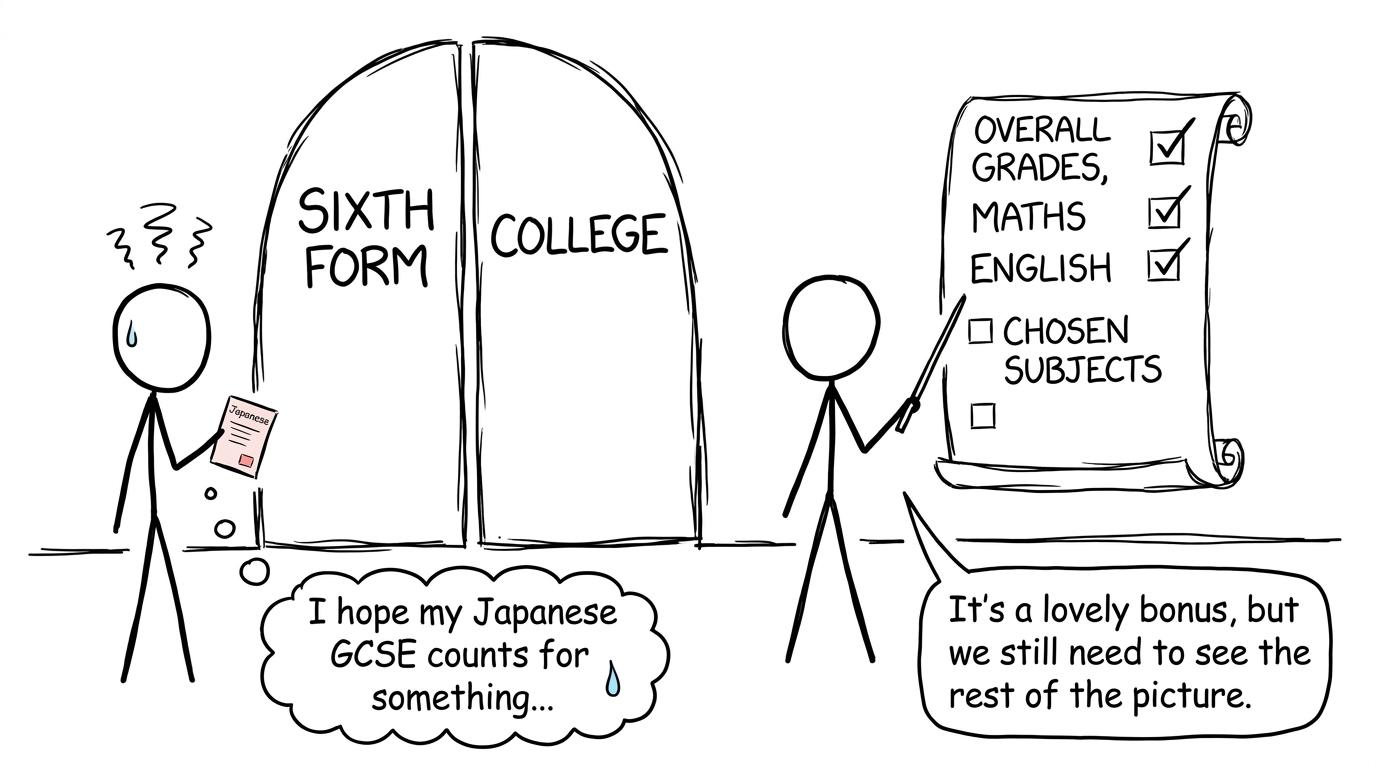 A student discovers that one GCSE grade is only part of a much larger admissions checklist
The quick admissions checklist
Before worrying about one Japanese grade, check these questions in order:
- Does the sixth form require a particular number of GCSEs at grades 999 to 444, 999 to 555 or 999 to 666?
- Does GCSE Japanese count among those qualifications?
- What grades are required in maths and English?
- Are there separate requirements for your chosen A Levels or Level 333 courses?
- Are community language GCSEs, privately entered qualifications or qualifications completed outside school treated differently?
- Is the course oversubscribed, making stronger grades more useful even above the published minimum?
- Are your predicted grades high enough for a conditional offer?
The prospectus gives you a useful summary, but the admissions policy and subject entry requirements provide the detail. If Japanese is not mentioned clearly, ask the admissions team in writing rather than relying on assumptions.
How much does a GCSE Japanese grade actually matter?
In most applications, its importance falls into one of four categories.
It may count towards your overall GCSE total
Many sixth forms set a general threshold, such as five GCSEs at a specified grade, often including maths and English. Where the policy accepts recognised GCSE subjects without naming a restricted list, Japanese may count as one of those qualifications.
That means a strong Japanese result can be useful. If you need five grades at 555 or above, for example, Japanese could contribute to that total if the institution accepts it. It is not necessarily given special weight, but it is not automatically ignored either.
Pearson Edexcel GCSE Japanese is a graded 999 111 GCSE covering listening, speaking, reading and writing. Nevertheless, recognition of the qualification does not force every sixth form to include it in its particular admissions calculation.
It matters more when it is relevant to your course
A Japanese grade becomes more significant if you want to continue with Japanese or another closely related language pathway. An institution offering A Level Japanese may require a particular GCSE Japanese grade, just as sixth forms commonly set subject-specific thresholds for French, Spanish or German.
If Japanese is not offered at A Level, the grade might still demonstrate language ability, persistence and communication skills. Those qualities can support your wider profile, but they do not normally replace a required grade in another subject.
A grade 888 in Japanese, for instance, would not usually compensate for missing a compulsory GCSE maths threshold for A Level Mathematics. Admissions teams work from published criteria, not from a simple average in which every grade is interchangeable.
It may receive little direct weight
If you are applying for Mathematics, Physics or Chemistry, selectors are more likely to focus on your results in maths and science. For English Literature, the English grades matter more. For History, a sixth form may ask for History or another essay-based subject.
Japanese remains part of your academic record, but it may sit in the background rather than drive the decision. That is not a judgement on the difficulty or value of the subject. It simply reflects the question an admissions team is trying to answer: are you prepared for this particular course?
Occasionally, it may not count towards the threshold
Some published sixth-form policies restrict the subjects used to calculate entry eligibility. A small number also state that certain community languages, qualifications not taught in school or privately completed GCSEs will not count towards the minimum.
Policies differ sharply here. Do not assume that a rule used by one selective sixth form applies to every college. Equally, do not assume that being awarded a GCSE guarantees it will be included in every institution's entry calculation.
Why your GCSE maths grade often carries more weight
For students planning post-161616 education, maths occupies a different position from most optional GCSEs.
Current Department for Education funding rules in England require students on relevant 161616 to 191919 programmes who have not achieved grade 444 or above in GCSE maths to continue studying an approved maths qualification. A college may still offer suitable routes to a student below grade 444, but continued maths study will normally become part of the programme.
Sixth forms also set their own higher thresholds. Published entry requirements commonly ask for maths and English at grade 444 or 555 for general A Level study. Individual courses can demand more. A Level Mathematics may require a GCSE maths grade of 666 or 777, while some Further Mathematics courses ask for 777 or 888. Exact requirements vary, so your chosen institution's policy remains decisive.
This creates a practical priority. If revision time is limited and your Japanese result is secure but your maths grade is close to an entry boundary, improving maths may protect more future options.
Start by identifying your board and tier through the GCSE Maths revision hub. If the syllabus feels difficult to organise, the complete GCSE Maths topic list by board and tier gives you a clear map for Edexcel, AQA, OCR and Eduqas.
 A student juggles several GCSE subjects while an admissions officer waits for the relevant grades
How admissions teams are likely to read your results
Admissions decisions often involve several layers rather than one dramatic judgement about a single grade.
First comes the general entry requirement. You may need a stated number of GCSEs within a particular grade range.
Next come the subject-specific requirements. These determine whether you can begin each chosen A Level or vocational course. A student may meet the general threshold but be unable to take one preferred subject because the relevant GCSE grade is too low.
The institution may then consider capacity and oversubscription rules. Meeting a minimum requirement does not always guarantee a place when applications exceed available spaces. The published admissions arrangements should explain how places are allocated.
Finally, staff may discuss whether your proposed combination is realistic. This is where your wider grade profile can provide context. Japanese may support that profile, particularly when it is one of your stronger academic subjects, but it normally remains secondary to mandatory and course-related results.
What to do if your Japanese grade is lower than expected
Do not begin by assuming your sixth-form plans are over. Take a calmer sequence of actions:
- Read the general entry requirements.
- Check whether Japanese is included in the qualifying GCSE count.
- Check every chosen course separately.
- Compare your remaining grades with the threshold.
- Contact admissions if the wording is unclear.
- Prepare a realistic alternative course combination before results day.
If Japanese is not required and your overall profile still meets the rules, a lower grade may have little practical effect. If it causes you to miss the required number of qualifying GCSEs, speak to the institution promptly. It may have alternative Level 222 or Level 333 pathways, but no student should assume that discretion will override a published condition.
The same principle applies to predicted grades. They may influence conditional offers and course discussions, while final enrolment normally depends on achieved results and the institution's policy.
Make revision match the entry requirements
Good revision is partly an exercise in allocation. Every subject deserves honest effort, but not every missing mark has the same consequence for your next step.
Write down the minimum grades for your preferred course, then identify where your current predictions sit closest to a boundary. Your revision planner should give extra attention to subjects that are both uncertain and essential.
For maths, use the best order for learning GCSE Maths topics to rebuild gaps logically. If you are hovering around the standard pass, follow the focused advice in GCSE Maths revision when you are stuck at a pass grade.
Once the methods are secure, move from topic questions to timed assessment. The guide to using GCSE past papers properly explains the useful cycle: complete a paper, mark it carefully, fix the weak topics and test them again. Nearer the examination, GCSE predicted papers can provide a realistic rehearsal.
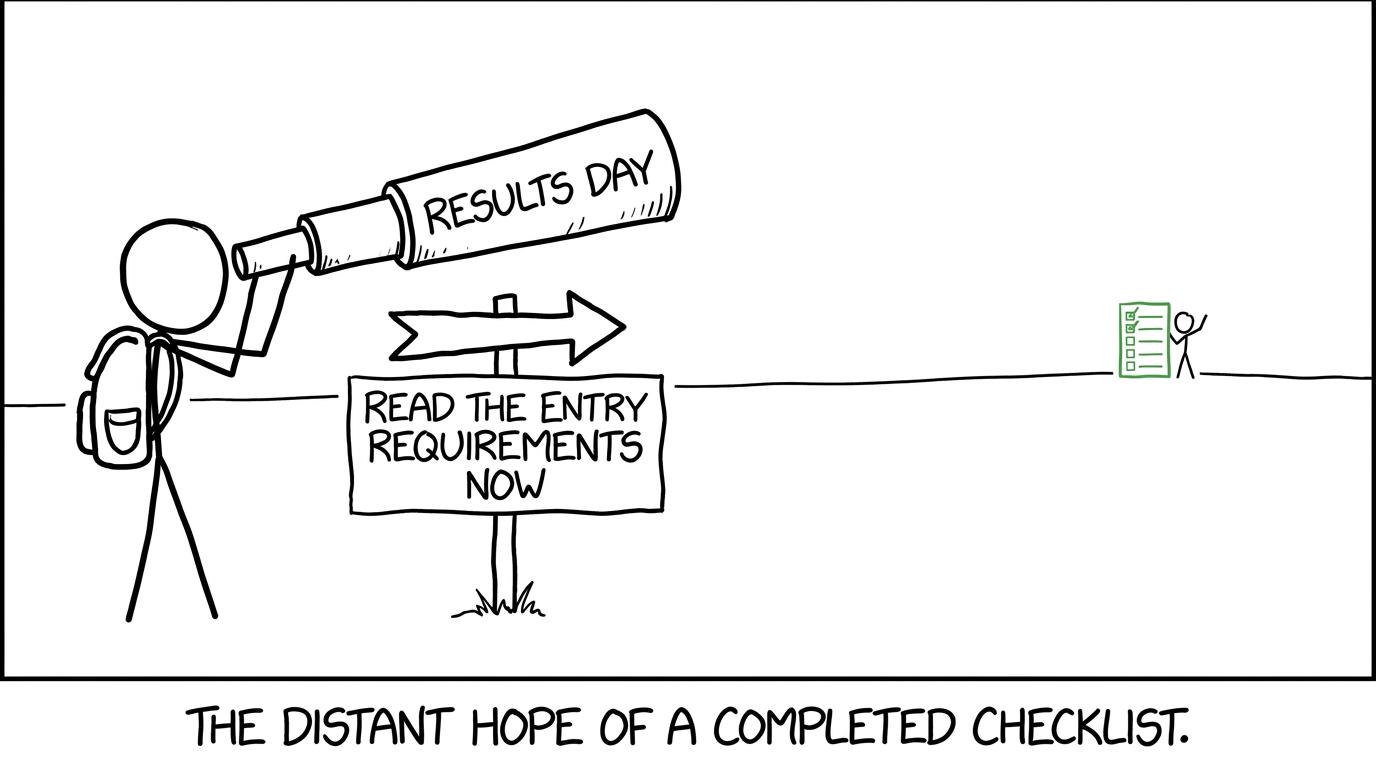 A student looks towards results day while the entry requirements sit helpfully beside them
Common mistakes when judging the importance of Japanese
Assuming every GCSE is weighted equally
Admissions policies usually combine overall thresholds with subject-specific requirements. A grade in Japanese may count towards the total without carrying the same importance as maths for A Level Mathematics.
Treating one sixth form's rules as universal
There is no single entry formula used by every UK sixth form and college. Requirements can differ by institution, programme and year of entry.
Reading only the headline requirement
Meeting the general condition does not prove that you meet the requirement for each chosen subject. Always open the individual course pages.
Assuming Japanese will automatically count
A recognised GCSE may still be excluded from a particular institution's admissions calculation. Check for rules concerning accepted subject lists, community languages and qualifications taken outside school.
Neglecting maths because another grade is strong
A high Japanese grade cannot normally substitute for a compulsory maths grade. If maths is the result placing your course at risk, direct revision time towards that requirement while continuing sensible preparation elsewhere.
Your grade matters, but its context matters more
Your GCSE Japanese grade is neither meaningless nor usually decisive. For many applicants, it is one useful part of the overall GCSE total. It matters substantially more when Japanese is relevant to the proposed course, and less when the institution is primarily checking maths, English or another subject-specific result.
The most valuable step is simple: read the current admissions policy for every sixth form or college on your list. Then revise according to the grades that genuinely control your options.
MathsGenie can help you protect one of the grades most frequently named in post-161616 requirements. Begin with the free GCSE Maths revision resources, use revision lessons and practice questions to repair weak topics, and then test your progress with mini tests, past papers, predicted papers, mark schemes and video solutions. The uncertainty becomes smaller once the plan becomes specific.