GCSE ICT Flashcards Quizlet: Best Decks and Sets
GCSE ICT flashcards Quizlet guide: find accurate, specification-matched decks, avoid weak sets, and build effective cards quickly for focused exam revision.

The difficult part of flashcard revision is not finding cards. It is deciding which cards deserve your trust.
Search for GCSE ICT flashcards Quizlet and you will encounter large collections covering networks, databases, cyber security, hardware and legislation. Some are useful. Others mix exam boards, use outdated terminology or give answers so vague that they would struggle to earn marks.
The best choice is a deck matched to your exact qualification and specification, checked against lessons or official materials, and divided into manageable topics. Teacher-provided sets are usually the safest starting point. Carefully checked topic decks can then fill gaps, while a small personal deck should record the facts and distinctions you keep forgetting.
The quick flashcard checklist
Before using any ICT or computing deck, ask:
- Does it name the qualification and exam board?
- Does it match the specification being taught to your cohort?
- Is it organised by topic rather than presented as one enormous set?
- Do the answers use precise technical vocabulary?
- Are cards short enough to test one idea at a time?
- Does the deck include applications and comparisons, not only definitions?
- Can you confirm uncertain answers using a trusted lesson or specification?
- Will you combine recall with exam questions?
If a deck fails the first two checks, do not spend an evening trying to repair it. Revision time is scarce. Accuracy comes first.
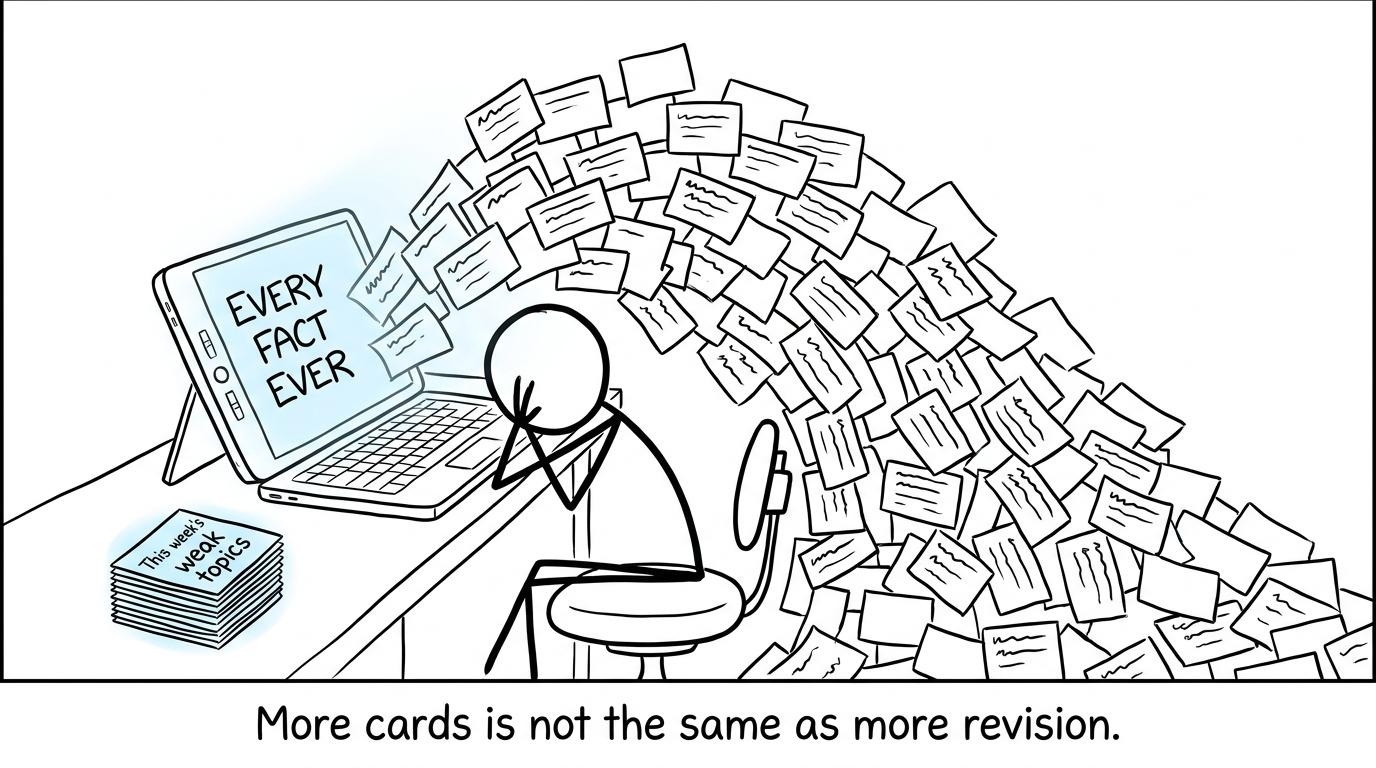 A student discovers that a gigantic flashcard deck is not automatically a useful one
First, check whether your course is really GCSE ICT
Students and schools sometimes use “ICT” as a broad label for several different qualifications. That creates a problem when searching for shared flashcards.
Depending on where you study and the course selected by your school, your qualification may be GCSE Computer Science, GCSE Digital Technology or a vocational digital information technology course. AQA, OCR, Pearson Edexcel, Eduqas and WJEC do not all package digital subjects in the same way.
Current GCSE Computer Science content commonly includes algorithms, programming, data representation, computer systems, networks, cyber security and the impacts of digital technology. However, the exact wording, assessment structure and required depth vary. Specifications can also change between cohorts. For example, AQA distinguishes between the content used for students examined in 202620262026 and its updated specification for first examinations in 202720272027.
Look at your timetable, exercise book or school revision list and write down:
- the full qualification title;
- the awarding body;
- the specification code, if available;
- your examination year;
- the components or units you will complete.
Only then should you choose a deck. A polished OCR Computer Science set is not automatically suitable for a learner taking Digital Technology or a Pearson vocational qualification.
Which GCSE ICT flashcard decks are worth using?
A public deck is worth using when its scope is narrow, its source is clear and its language matches your course. The creator’s confidence, number of cards or apparent popularity cannot prove accuracy.
Teacher-provided specification decks
Start with sets supplied or approved by your teacher. Your teacher knows the qualification, the order in which content has been taught and any terminology expected by the exam board.
These decks are especially useful for unit vocabulary, hardware functions, network concepts, threats, protective measures, database terminology and legal or ethical issues. Still report suspected errors. A shared classroom resource can contain an accidental typo like any other document.
Exam-board-specific topic decks
The next-best option is a public set whose title identifies the board, specification and topic. Search narrowly rather than typing only “GCSE ICT”. Useful searches follow patterns such as:
- OCR J277 systems architecture;
- AQA 8525 cyber security;
- Edexcel GCSE Computer Science networks;
- Eduqas Computer Science data representation;
- WJEC Digital Technology data and digital systems.
Choose several smaller sets over a single “complete course” deck. A focused network-security set is easier to inspect, test and update than hundreds of disconnected cards.
Decks for precise factual recall
Flashcards are strongest when a prompt has a concise, checkable answer. Good candidates include:
- technical definitions;
- functions of hardware and software;
- network types and protocols required by your specification;
- cyber threats and appropriate protections;
- units of data and representation facts;
- database fields, records, keys and validation;
- legal, ethical, environmental and privacy concepts.
The government’s GCSE Computer Science subject content also expects application, problem solving, programming and evaluation. Those skills cannot be reduced to memorising vocabulary. A card can remind you what decomposition means, but an unfamiliar problem must test whether you can use it.
Personal mistake decks
The most valuable deck is often the smallest: a collection built from your own errors.
When an exam question exposes confusion between validation and verification, primary and secondary storage, or authentication and authorisation, create one card that separates the ideas. Personal cards are efficient because they target evidence rather than anxiety.
This mirrors the approach used in MathsGenie’s guide to finding weak GCSE topics: diagnose a gap, repair it and re-test it. The subject may differ, but the revision logic remains sound.
How to judge a Quizlet set before learning it
Quizlet sets are generally created by users, so treat them as editable revision aids rather than mark schemes. Inspect a sample before committing.
Check coverage against your specification
Open the topic list for your course and compare it with the deck. Missing sections matter, but extra material matters too. Irrelevant cards consume time and can blur the vocabulary used by your own board.
A deck does not need to cover everything. It does need to state honestly what it covers.
Inspect technical distinctions
Weak cards often turn two different ideas into synonyms. Check especially carefully where terms sound related. Security, networking, database and data-representation vocabulary rewards precision.
Answers should explain the defining feature, not merely restate the term. A circular card such as “utility software is useful software” gives the illusion of progress without supplying usable knowledge.
Look for meaningful prompts
A good deck contains a mixture of prompts:
- “What is...?” for definitions;
- “What is the purpose of...?” for functions;
- “How does... reduce this risk?” for causal understanding;
- “What is the difference between...?” for distinctions;
- “Which concept applies in this situation?” for application.
Avoid cards with several unrelated questions on one side. If you remember three parts but forget the fourth, it becomes difficult to judge the card honestly.
Check dates and legal references
Technology changes, and shared sets can remain online long after a course has changed. Be particularly cautious with legislation, specification numbers, named protocols and assessment details. If a card makes a time-sensitive claim, confirm it through your teacher or current course materials.
How to build your own GCSE ICT deck quickly
Making cards should not become a beautifully colour-coded form of avoidance. The goal is a usable deck, not a design project.
Build from the specification headings
Create separate folders or sets for the major units in your course. Within each unit, turn only essential knowledge into cards. One prompt should test one retrievable idea.
Begin with teacher checklists, corrected assessments and lesson summaries. Do not copy whole textbook paragraphs. Compress the idea into a question and an answer you could reproduce under examination pressure.
Use a fast three-pass method
First pass: essential terms. Add the definitions, functions and distinctions you must recall.
Second pass: misconceptions. Add cards for mistakes from mini tests, homework and past-paper questions.
Third pass: application. Add short scenarios asking which concept, risk or solution applies. Keep these concise; full exam practice belongs outside the deck.
Aim for a small topic set that can be tested repeatedly. Add cards when evidence reveals a gap rather than trying to predict every possible question in advance.
Write answers that can be marked
Each answer should contain the minimum technical detail needed to distinguish it from a nearby idea. If your answer could describe several terms, it is too vague.
Tags can identify:
- secure knowledge;
- uncertain knowledge;
- frequent mistakes;
- content needing teacher confirmation.
This gives each session a purpose. It also prevents familiar cards from hiding the difficult ones.
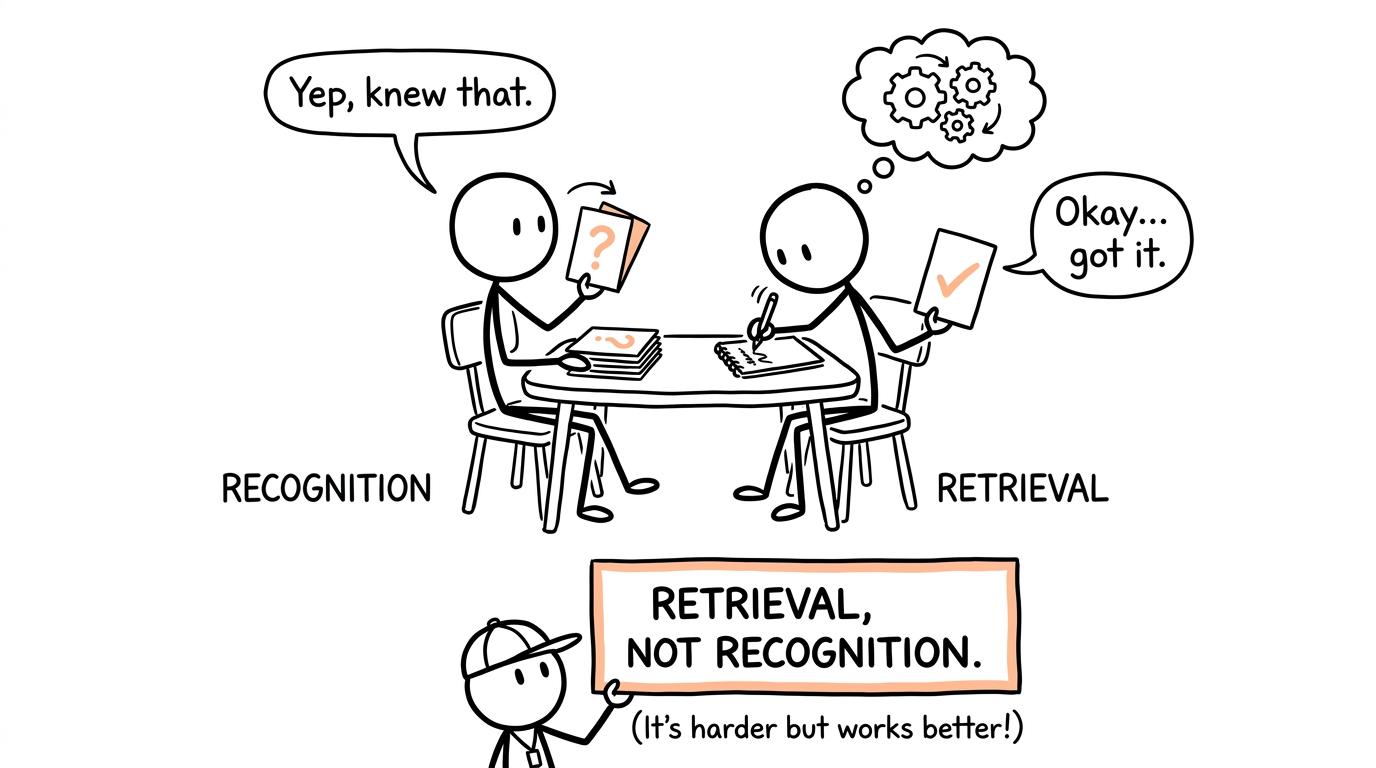 Two students discover the difference between recognising and retrieving an answer
How to use flashcards so they improve recall
Research on retrieval practice consistently supports trying to recall information rather than merely rereading it. Spacing revision across different sessions is also more useful for durable memory than compressing every repetition into one sitting.
But possession of flashcards is not retrieval practice. You must attempt the answer before revealing it.
Use this routine:
- read the prompt without viewing the answer;
- say or write a complete response;
- reveal the card and compare precisely;
- correct missing technical vocabulary;
- keep uncertain cards active;
- shuffle the order on the next attempt;
- return to the topic after a gap.
The same principle appears in MathsGenie’s twenty-minute GCSE revision routine: recall should lead into questions and immediate review, not consume the whole session.
For maths revision, flashcards are useful for formulae, vocabulary and conditions, but they cannot replace problem solving. Use GCSE maths topics by board and tier to identify content, then complete questions. If statistics or data handling overlaps with your digital course, the Edexcel GCSE Statistics revision hub provides lessons, questions and papers.
Turn remembered facts into examination marks
A remembered definition is raw material. Examinations often require you to apply it, compare alternatives, justify a choice or evaluate an impact.
After a flashcard session, complete a small group of relevant exam-style questions. Mark them carefully and create new cards only for genuine knowledge gaps. If the problem was weak interpretation or poor explanation, practise that question type instead.
This is the same feedback loop explained in MathsGenie’s efficient GCSE maths revision guide: learn, practise, mark and fix. For maths, move from recall into AQA GCSE probability questions, topic practice or full papers rather than assuming that remembered facts guarantee marks.
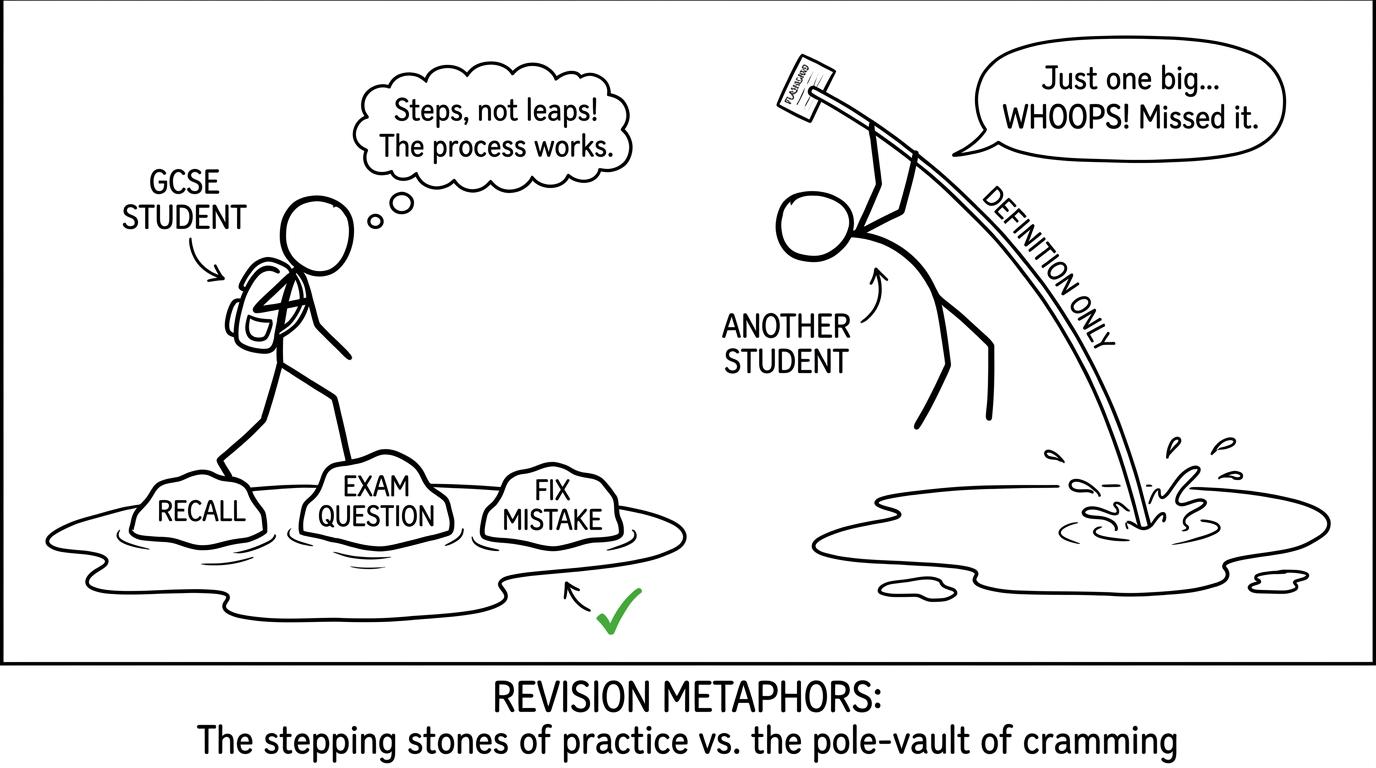 A student crosses from recall to exam performance using practice and correction
Common mistakes with ICT and computing flashcards
Choosing by size or popularity
A large, popular deck may still contain irrelevant or inaccurate material. Specification match matters more than card count.
Mixing qualifications
GCSE ICT, Computer Science, Digital Technology and vocational digital courses are not interchangeable labels. Confirm your exact course before searching.
Flipping too quickly
Seeing an answer and thinking “I knew that” tests recognition. Pause and produce the answer first.
Memorising without applying
Definitions alone do not prepare you for scenario, comparison, programming or evaluation questions. Follow cards with exam practice.
Copying notes word for word
Long cards are difficult to test. Split them into focused prompts and use precise answers.
Ignoring errors in shared sets
Public cards are not official mark schemes. Check suspicious claims and correct your copy immediately.
Revising only comfortable cards
Easy cards feel productive because they move quickly. Spend more time on uncertain cards and weaknesses exposed by assessment.
Build a revision system, not a card collection
The best GCSE ICT flashcards and Quizlet sets are not necessarily the most polished. They are the ones that match your qualification, make you retrieve precise knowledge and lead you back to examination questions.
Use an approved board-specific deck for coverage, smaller topic sets for weak areas and a personal mistake deck for the facts that repeatedly cost you marks. Then stop flipping cards and start applying what you remember.
For your maths exams, make MathsGenie the practical half of that system. Use free revision lessons and practice questions to rebuild methods, mark schemes and video solutions to understand lost marks, and past papers to develop timing. When the examination approaches, add GCSE predicted papers and use the guidance on when to start GCSE past papers.
Flashcards help knowledge become available. Deliberate practice teaches you what to do with it.