GCSE History: How Many Practice Papers Should You Do?
GCSE history how many practice papers? Aim for 4-6 full timed sittings, with careful marking, targeted revision and clear signs for when to stop.

There is a moment in GCSE revision when doing more begins to feel like the only safe answer. Another paper. Another timer. Another evening spent writing at speed.
But if you are searching gcse history how many practice papers, the realistic answer is simpler: aim for 444 to 666 full timed paper sittings before your exams, covering every component in your specification at least once. If time is limited, complete at least 222 carefully chosen full papers. If you have started early and review each attempt properly, 666 to 888 may be useful.
Beyond that, more full papers often stop helping when they merely reproduce the same mistakes. The paper is the test. The improvement usually happens afterwards.
The short answer: aim for 444 to 666 timed sittings
A sensible target for most GCSE History students is:
- Minimum useful target: 222 complete timed sittings
- Realistic target: 444 to 666 complete timed sittings
- Higher-volume target: 666 to 888, provided every paper is marked and reviewed
- Usually unnecessary: more than 888 full sittings if they crowd out content revision, sleep or other subjects
Here, one sitting means one complete exam component under the correct time limit, not an entire qualification completed in a single day.
Your exam board matters. AQA GCSE History has two written papers, while Edexcel uses three. OCR and Eduqas have their own component structures, topic combinations and timings. Check the current specification or guidance supplied by your school before planning your practice. In particular, do not assume that an older paper always has the same timing or question structure as your current exam.
There is no official exam-board rule stating that every student needs an exact number of practice papers. The 444 to 666 recommendation is a practical revision target, not a scientific threshold. Research on retrieval practice supports testing yourself rather than relying only on rereading, but the benefit depends heavily on what you do with the information the test reveals.
Your timed-paper checklist
Before adding another full paper to your timetable, check that your plan includes all of the following:
- every exam component practised at least once
- current timings and question formats for your board
- a quiet sitting without notes or phone interruptions
- strict marking with the official mark scheme where available
- examiner reports or teacher feedback for longer answers
- a record of lost marks and unfinished questions
- targeted revision before the next full attempt
- shorter timed questions between full sittings
This is similar to effective maths revision. A paper exposes the gap; focused practice closes it. MathsGenie's guide to starting GCSE past papers at the right time explains the same diagnose, repair and retest cycle for maths.
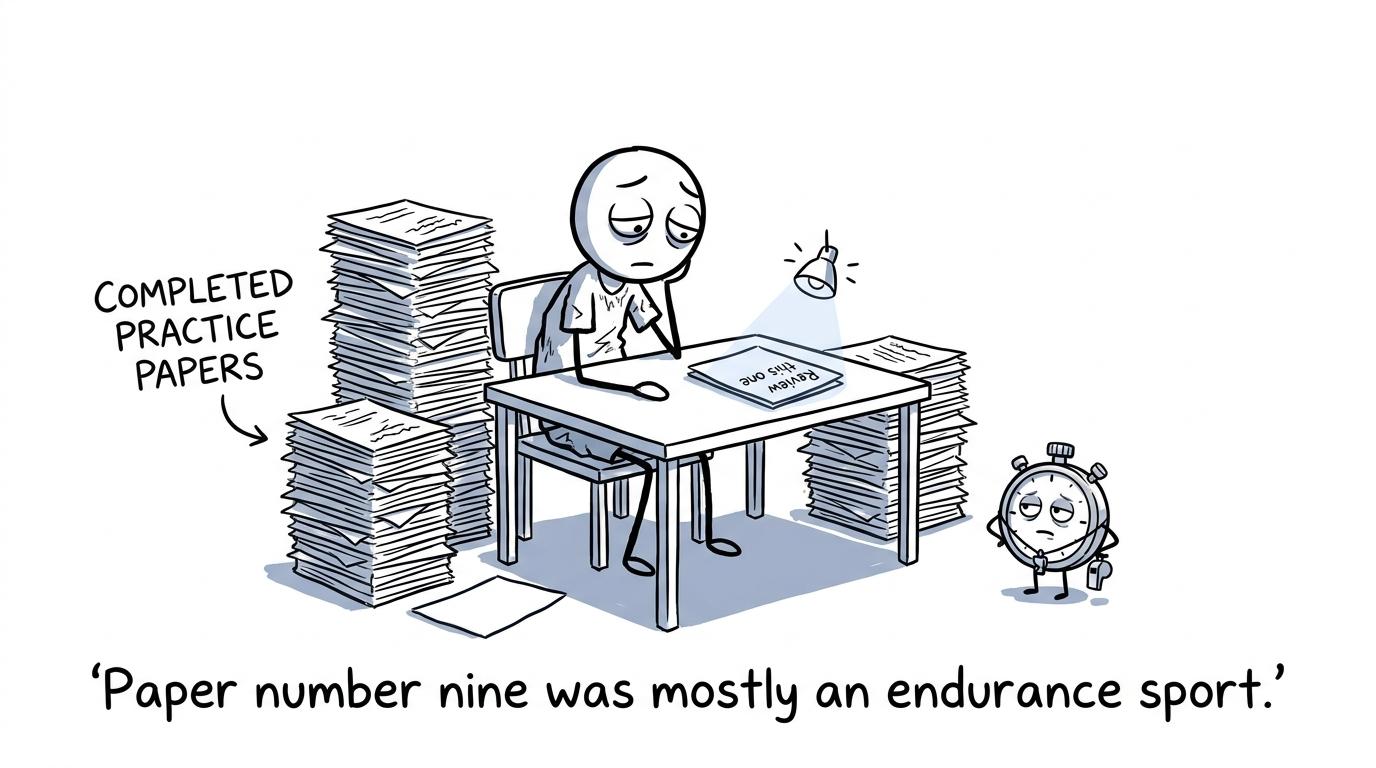 A student surrounded by too many completed papers notices that reviewing one may be more useful
Why the number alone can mislead you
Two students can each complete 555 History papers and gain completely different value from them.
One student finishes a paper, checks the total and moves immediately to the next. The other identifies why marks disappeared: insecure knowledge, weak explanation, an unsupported judgement, poor source analysis or time spent in the wrong place. That second student may complete fewer papers yet become much better prepared.
GCSE History assesses more than recall. Across regulated specifications, students must demonstrate knowledge and understanding, analyse historical events through concepts such as causation and change, evaluate contemporary sources, and make judgements about interpretations. A full timed paper can test all these demands together, but it does not automatically teach them.
Think of a practice paper as a scan rather than a cure. It shows where revision needs to go next.
What each full paper should achieve
Every timed sitting should have a specific purpose. Otherwise, the timer becomes theatre: it looks like exam preparation without necessarily changing your performance.
Your first paper diagnoses the real problem
Complete your first full sitting once you have covered most of the relevant content. Its purpose is not to produce an impressive mark. It should answer questions such as:
- Can you finish within the official time?
- Which question types slow you down?
- Are your factual details precise enough?
- Do you explain links rather than list facts?
- Can you reach and support a judgement?
- Do source and interpretation questions require different habits?
Mark it carefully, then sort lost marks into three categories: knowledge, exam technique and timing. That distinction matters. Memorising more dates will not fix an answer that ignores the wording of the question, while learning a paragraph structure cannot replace missing historical knowledge.
Middle papers build control
Your next 222 to 444 sittings should test whether specific repairs have worked. Between papers, use shorter tasks: one timed essay, one source question or a closed-book retrieval session on a weak topic.
This is where spacing matters. Completing three papers on consecutive evenings may create familiarity, but it leaves little time to revisit content or change your writing. Spread full sittings across several weeks where possible. The gap gives you time to mark, relearn and return.
The principle transfers directly to maths. MathsGenie's active recall guide shows how recall, checking and later retesting can turn mistakes into useful prompts rather than forgotten red marks.
Final papers rehearse exam conditions
Your last one or two sittings should feel close to the real assessment:
- use the correct current paper and time allowance
- remove notes and unnecessary devices
- do not pause the clock
- use only permitted materials
- answer the options taught by your school
- leave time to check that every required question is attempted
Choose a recent paper that matches the current assessment model, or ask your teacher for an approved mock if public papers reflect an older structure. This is especially important when an exam board has updated timings or question wording.
A practical schedule before GCSE History
The best schedule depends on when you begin.
If you have eight or more weeks
Start with one diagnostic paper. Spend the next week repairing the largest weaknesses, then complete another component. Continue at roughly one full timed sitting every 777 to 101010 days, using shorter questions between them.
This gives room for 444 to 666 full sittings without allowing History to consume your entire revision timetable.
If you have three to six weeks
Aim for one full sitting each week, with an additional final rehearsal if your workload permits. Prioritise coverage: practise each component before repeating the one you already prefer.
A compact revision routine can help on school days. The structure in MathsGenie's 20-minute GCSE revision routine is written for maths, but its short cycle of retrieval, practice and marking can also organise History knowledge checks.
If you have fewer than two weeks
Do not attempt to force 666 papers into the remaining time. Complete 111 or 222 full sittings that cover your weakest or least familiar components. Then use timed individual questions to improve the specific areas exposed.
At this stage, rest and content security may be more valuable than another long sitting. A tired paper followed by no review is rarely the best use of an evening.
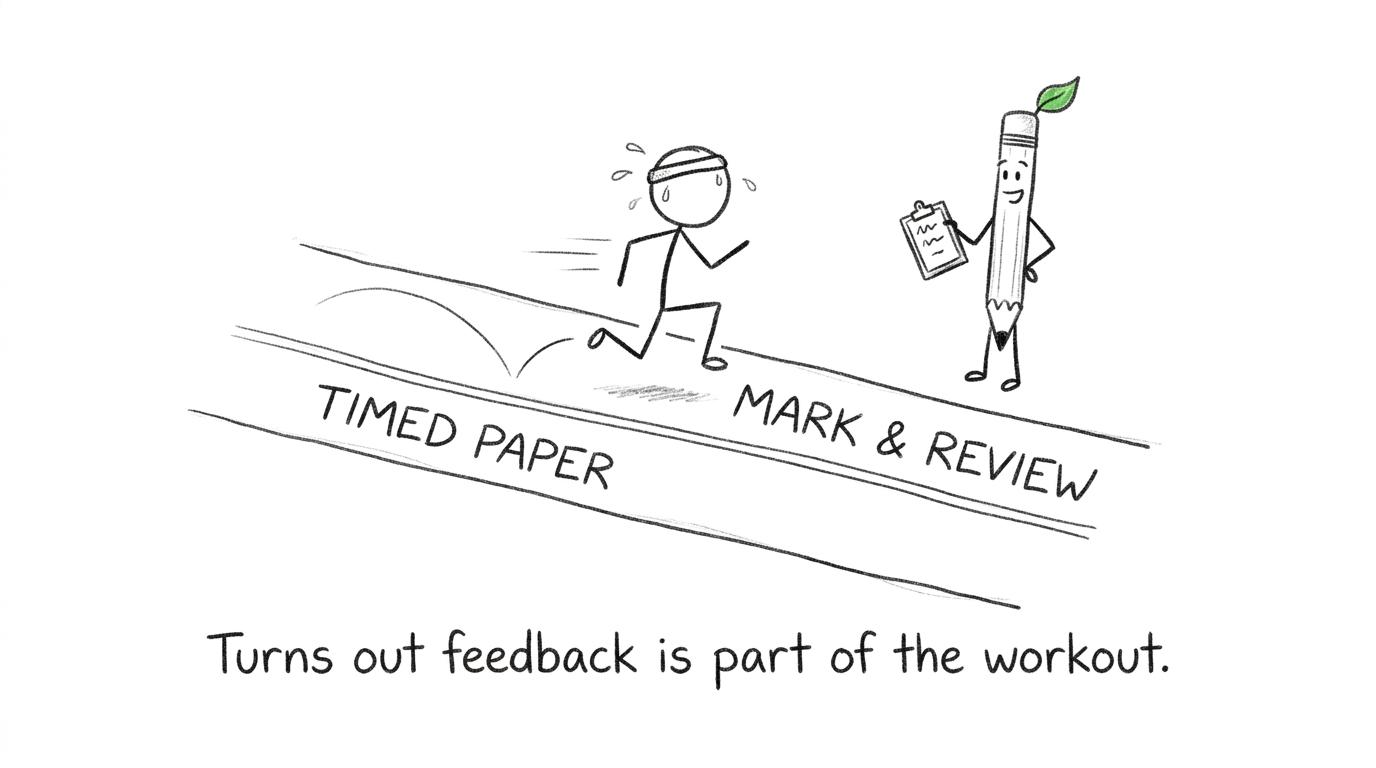 A student alternates timed practice with marking and review as part of the same training routine
How to review a GCSE History practice paper
Allow substantial review time after each sitting. A useful rule is that marking, diagnosis and repair deserve at least as much attention as completing the paper itself.
First, mark what you can using the relevant mark scheme. For extended responses, teacher feedback is especially valuable because level-based marking involves the quality of analysis, support and judgement, not simply the presence of isolated phrases.
Then create a short marks-leak list:
| Type of problem | Next action |
|---|---|
| Missing factual knowledge | Relearn the precise event, development or individual and retrieve it later without notes |
| Description without explanation | Practise connecting evidence directly to the question |
| Weak source analysis | Revisit the board's requirements for content, provenance and contextual knowledge |
| Unsupported judgement | Plan a conclusion based on stated criteria and weighed evidence |
| Unfinished final question | Rebalance time and practise that question separately |
| Misread command word | Highlight the task before planning the response |
Keep the list short. Choose the two or three weaknesses responsible for most lost marks, repair them, and test them again before sitting another complete paper.
For maths students, this mirrors the process in how to use Edexcel GCSE Maths past papers properly: sit, mark, diagnose, practise and reattempt. The subject changes, but the logic does not.
When more practice papers stop helping
More full papers are no longer the best choice when:
- your scores remain similar because the same content gaps keep appearing
- you mark papers but do not revise the mistakes
- you know the specific paper so well that recall replaces genuine thinking
- full sittings leave no time for topic revision or feedback
- fatigue causes careless writing that does not reflect your normal standard
- you keep practising one component while avoiding another
- you are sacrificing sleep immediately before an exam
A plateau is not automatically a signal to work longer. It may be a signal to change the type of work.
Replace the next full sitting with a narrower intervention: factual retrieval, an essay plan, a timed source question, interpretation analysis or a discussion with your teacher. Return to a fresh paper after the weakness has been addressed.
This is why shorter tests can be powerful. In maths, GCSE Maths mini tests isolate skills without the physical and mental cost of another full paper. History students can apply the same idea by completing one question type under time rather than repeatedly sitting an entire component.
Common mistakes with timed History papers
Counting papers instead of changes
A completed-paper total can feel reassuring, but it measures activity rather than learning. After every sitting, write down what will be different in the next one.
Using the wrong paper format
Specifications and assessment models can change. Verify the timing, optional questions and paper structure with your teacher or current exam-board materials before starting.
Marking essays too generously
A long answer is not necessarily an analytical answer. Use the level descriptors carefully and seek teacher feedback when you are unsure whether evidence is precise, explanation is sustained or judgement is substantiated.
Practising only your favourite unit
Confidence can hide gaps. Your plan should represent the complete course your school has entered, including source and interpretation skills where required.
Doing full papers before learning enough content
Early testing is useful, but repeated blank responses provide limited practice. If a diagnostic paper reveals widespread knowledge gaps, pause full sittings and rebuild the content first.
Treating predicted material as certainty
No predicted paper can guarantee what will appear. The safer strategy is full specification coverage combined with practice in every required question type. The same warning applies in maths: predicted topics should guide priorities, not replace complete revision.
Make every paper earn its place
For most students, 444 to 666 full timed GCSE History sittings is enough to build familiarity, stamina and better time control. Fewer can still be valuable when time is short. More can help when they are spaced out, marked honestly and followed by targeted revision.
The useful question is not simply, “How many papers have I done?” It is, “What can I now do that I could not do before the last one?”
Once your History plan is settled, bring the same discipline to maths. Use MathsGenie's free GCSE Maths revision resources alongside revision lessons, practice questions, mini tests, past papers, mark schemes, video solutions and predicted papers. Start with a manageable test, find the marks you are losing, repair the underlying topic and return stronger. That cycle is what turns practice into progress.