GCSE German vs French: What Do Employers Notice?
GCSE German vs French employers explained: learn what recruiters and colleges value, which language may suit you, and how to make your choice count.
Choosing between French and German can feel strangely permanent. You are asked to predict which language a future employer might value before you have chosen your A Levels, degree or career. Search for GCSE German vs French employers, however, and the practical answer is reassuring: most employers and colleges do not automatically prefer one. They are more likely to notice your grade, communication skills and evidence that you continued using the language.
German may be particularly relevant to some engineering, manufacturing and finance roles. French has wide international use across business, government and international organisations. But a strong result in the language you can sustain usually matters more than choosing a supposedly perfect subject and losing motivation.
The short answer
Use this checklist when deciding:
- Choose the language in which you are most likely to earn a strong grade.
- Consider future sectors, but do not attempt to plan your entire career at fourteen.
- Check individual college requirements, especially if you may continue the language at A Level.
- Look beyond the subject name. Speaking, listening, resilience and cultural awareness give the qualification value.
- Protect your wider GCSE results. English and maths are commonly specified in college, apprenticeship and university entry requirements.
Neither French nor German is a secret code that unlocks employment. The value comes from what the qualification shows and what you eventually learn to do with it.
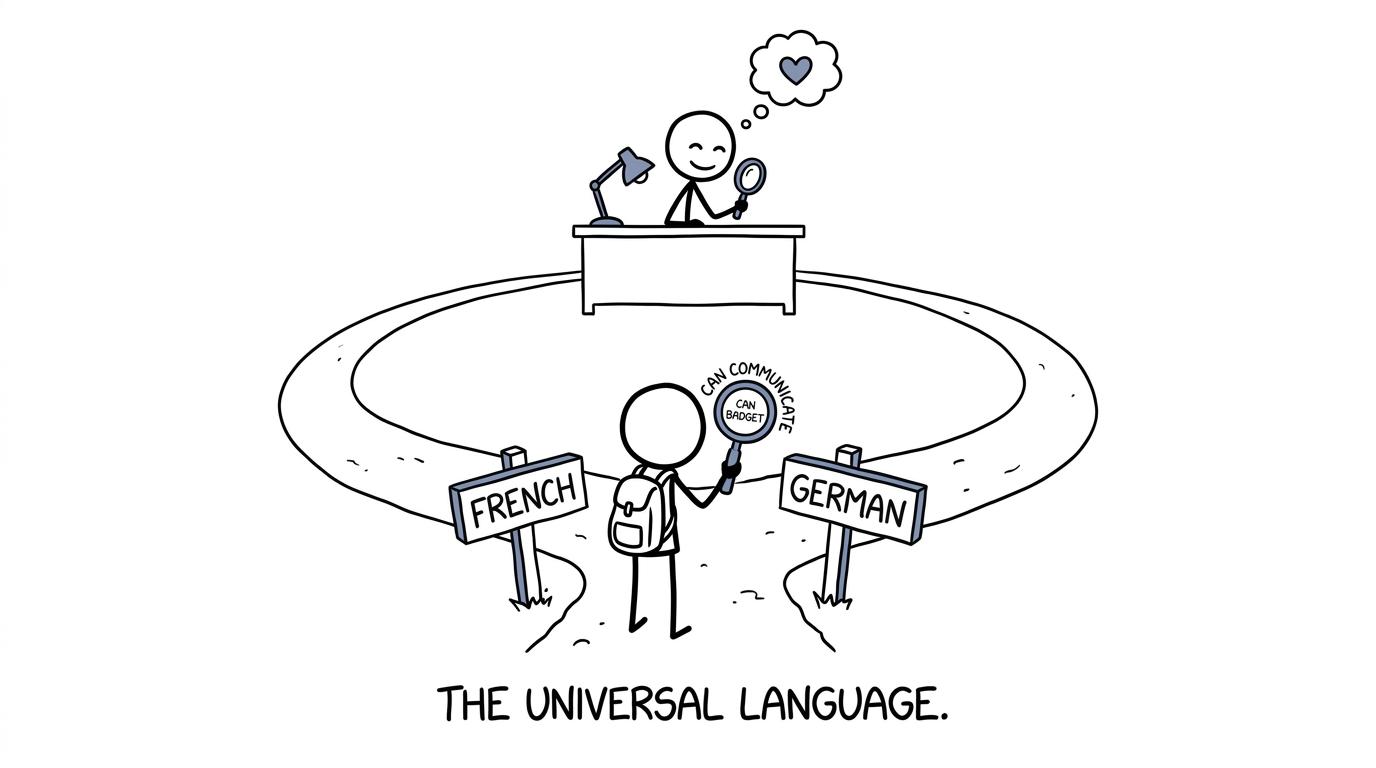 A student discovers that French and German can lead towards the same employer
Do employers care more about GCSE German or French?
Usually, no. For a general application, an employer is unlikely to reject one candidate because they took French while another took German. At GCSE level, the qualification mainly provides evidence of academic breadth, communication, memory, accuracy and the willingness to work beyond your first language.
The distinction can become relevant when a job has a genuine connection to a country, customer base or industry. German may fit naturally with organisations working in German-speaking markets and sectors such as engineering, automotive manufacturing, scientific research or finance. French can be useful across France, parts of Belgium and Switzerland, Canada, several African countries and international institutions.
That does not make every German learner an engineer or every French learner a diplomat. It means context matters.
British Council research has consistently identified both French and German among the languages important to the UK's economic, cultural and international interests. Government statements have also reported business demand for language skills. These findings support learning a language, but they do not prove that one GCSE guarantees better employment prospects.
A recruiter seeking professional fluency will normally expect much more than GCSE study. Yet the GCSE can be the first visible step towards that fluency.
What employers actually notice on an application
Your grade and overall GCSE profile
A grade shows how successfully you handled the course. If your realistic choice is between a high grade in French and a much weaker grade in German, French is normally the stronger application signal, and the reverse is equally true.
Employers may also view your results as a group. A language alongside English, science and maths suggests breadth, while your maths grade can remain especially important for technical apprenticeships, finance and many graduate routes.
If maths is one of the subjects competing for your revision time, begin with the GCSE Maths revision hub. It brings together board-specific revision for Edexcel, AQA, OCR and Eduqas, including Foundation and Higher tier resources.
Whether you can explain what the subject taught you
Simply listing “GCSE German” or “GCSE French” tells an employer very little. A better application explains the skills behind it. You might discuss:
- communicating when you do not know every word;
- listening carefully for meaning;
- preparing and delivering spoken responses;
- applying grammar accurately;
- remembering vocabulary over time;
- adapting your tone for different situations.
These claims should be honest and supported by something you actually did. The language becomes memorable when you can connect it to evidence.
Whether you kept using the language
A GCSE result is useful. Continued use is stronger. This might mean taking the subject at A Level, joining an exchange, completing a relevant project, travelling, volunteering or independently maintaining your speaking and reading.
Do not describe yourself as fluent unless you genuinely are. “Studied German to GCSE and continue to practise through weekly conversation” is more credible than an inflated claim that could unravel in an interview.
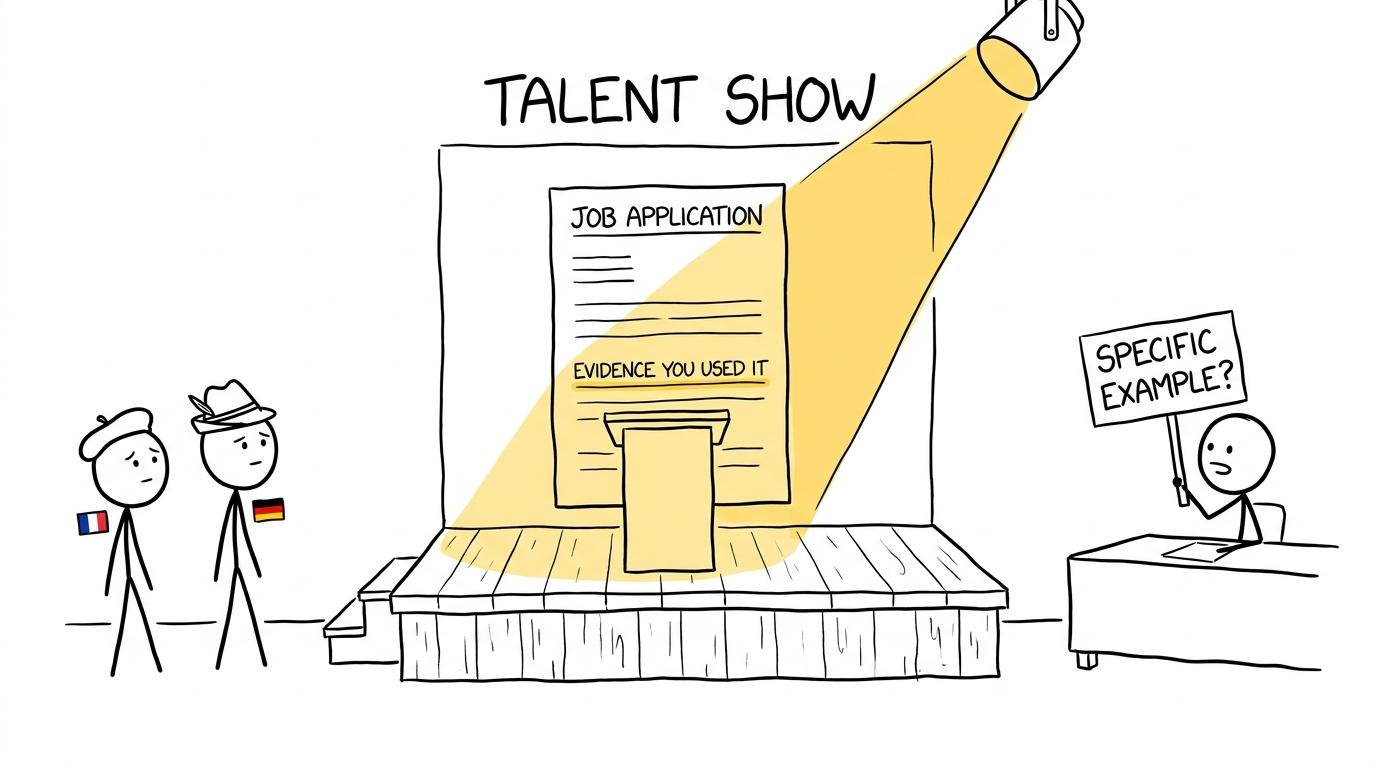 French and German wait while an employer asks for a specific example
Do colleges care which language you choose?
For most sixth-form and college courses unrelated to languages, French versus German will not be the deciding factor. Institutions set their own entry requirements, and these vary by course. English and maths grades are much more commonly named requirements.
If you want to take French or German at A Level, the relevant GCSE and grade may matter. Check the precise course page and ask the college rather than relying on assumptions. Some university language degrees require prior study for a particular route; others offer beginner pathways in selected languages.
A small number of university courses or institutions may expect a modern foreign language GCSE or an accepted alternative. Again, the exact requirement belongs to the individual provider. UCAS guidance is clear that universities and colleges determine their own entry criteria, so there is no universal rule that German outranks French or vice versa.
The sensible approach is simple: investigate any course already on your shortlist, but do not build your whole decision around a hypothetical admissions rule.
French or German: how should you decide?
Start with the subject you are more likely to continue
Motivation is not a soft extra. Languages depend on repeated exposure, and repetition is easier when the sound and culture of the language interest you.
Ask yourself:
- Which lessons do I engage with more readily?
- In which language is pronunciation becoming clearer?
- Which vocabulary am I more willing to revisit?
- Which teacher or school programme gives me the best support?
- Could I imagine taking this language further?
You are not selecting a label for your CV. You are choosing hundreds of future practice sessions.
Consider career relevance without overestimating it
If you already have a credible interest in German engineering, French politics or international business, that context deserves some weight. But interests change. A broad language foundation is rarely wasted because the underlying habits, listening, interpreting and communicating across cultures, transfer beyond one country.
Treat career relevance as one factor, not the whole calculation. A rough decision model could give equal attention to enjoyment, likely attainment, teaching support and future relevance. It is a thinking tool, not a scientific prediction.
Think about the complete GCSE timetable
The best subject choice still needs a realistic revision plan. New GCSE French and German specifications were first taught from September 2024 for first assessment in summer 2026. They assess listening, speaking, reading and writing, with prescribed content and renewed attention to vocabulary, grammar, dictation and reading aloud. Check your own AQA, Edexcel or Eduqas specification because assessment details differ.
Languages improve through frequent recall. Maths improves through frequent problem-solving. Both suffer when postponed until the final week.
The GCSE maths revision timetable guide can help you build a workable week around multiple subjects. If exams are closer, use the one-month GCSE maths revision plan to prioritise weak areas rather than revising everything equally.
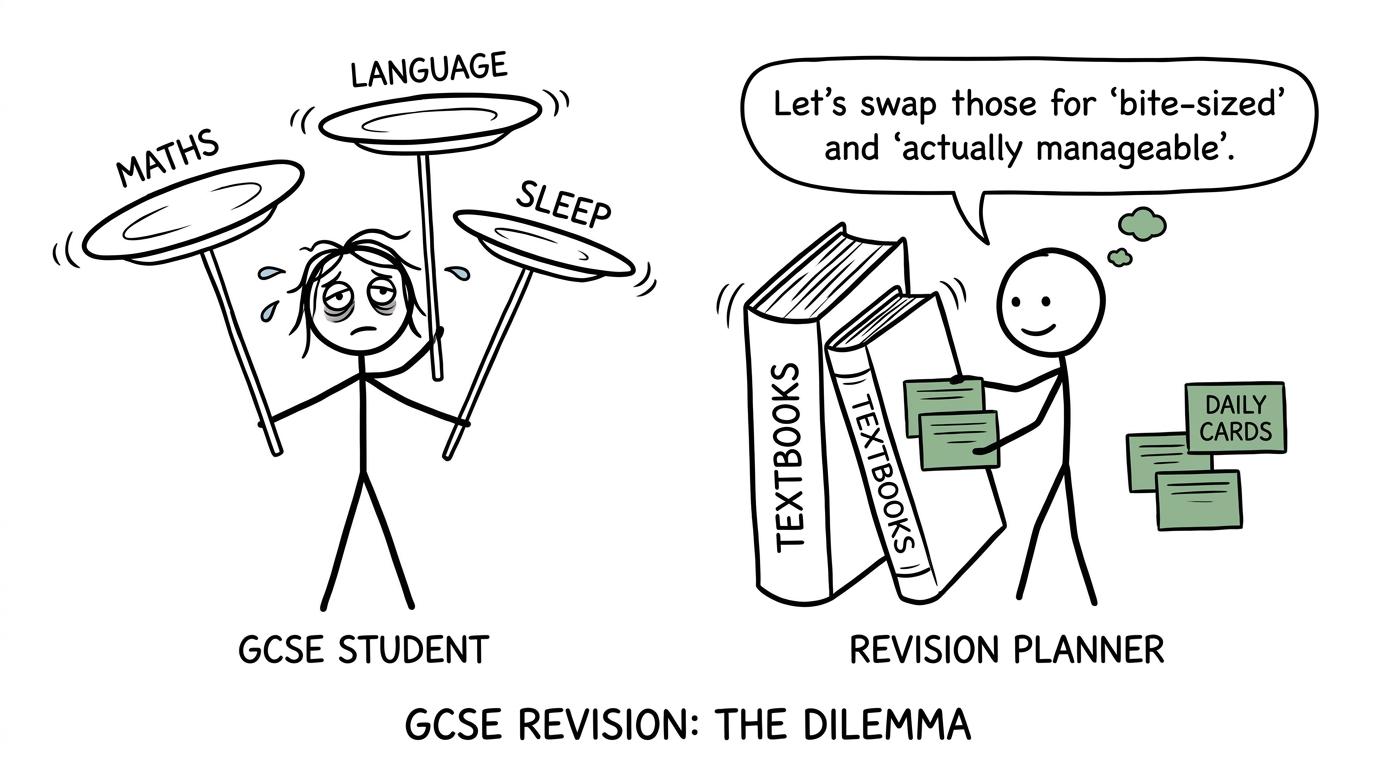 A student balances maths, a language and sleep with help from a revision planner
How to make either language more valuable
Aim for usable communication
Marks matter, but the long-term value of a language is being able to understand and respond. Practise speaking aloud, listening regularly and retrieving words without immediately checking notes. Exam preparation and genuine communication do not need to be opposites.
Build a specific story for applications
Later, an employer may ask what you found difficult or how you developed a skill. Keep examples grounded in reality. Perhaps preparing for a speaking assessment taught you to recover after forgetting a word. Perhaps regular vocabulary retrieval improved your organisation.
The strongest answer is not dramatic. It is specific.
Keep your core grades moving too
A language can distinguish your profile, but it does not replace core entry requirements. Protect regular time for English and maths, particularly if an apprenticeship or college course specifies a minimum grade.
For maths, diagnose gaps with short topic practice before completing full papers. Then use the right board resources, such as AQA GCSE Maths past papers or Edexcel GCSE Maths predicted papers. The guide to using GCSE past papers properly explains how to turn every lost mark into a revision action.
Common mistakes when choosing French or German
Following a claim that one language guarantees a job
Labour-market needs change by sector, location and employer. Both languages can be useful, but neither GCSE guarantees employment. Be cautious when old survey findings are presented as permanent rankings.
Choosing only because a friend chose it
Shared lessons may feel reassuring, but your friend will not sit your listening paper or revise your vocabulary. Teaching quality, enjoyment and likely attainment are better criteria.
Confusing a GCSE with professional fluency
A good GCSE is an achievement, not the end of language development. Describe your level accurately and show how you are extending it.
Ignoring actual entry requirements
Do not assume that every college has the same rules. Read the current course information and ask admissions staff about anything unclear.
Sacrificing the rest of your revision timetable
Students sometimes spend the most time on whichever subject feels urgent that evening. A written plan prevents one speaking assessment or mock paper from consuming the week. Use short, repeatable sessions, and let marked work decide what comes next.
Choose the language you can turn into evidence
For most students asking whether employers or colleges prefer GCSE German or French, the answer is neither by default. German can carry particular relevance in some commercial and technical settings. French offers broad international reach. Both can demonstrate communication, discipline and curiosity.
Choose the one you are most likely to learn well, check any genuine course requirements, and keep using it after the exam if you want employers to notice it later.
Then return your attention to what you can control now: strong grades and consistent revision. Open the MathsGenie GCSE revision hub, select your exam board and tier, and use free revision lessons, practice questions, mini tests, past papers, predicted papers, mark schemes and video solutions. One subject choice will not decide your future. The habits you build around it may travel much further.