GCSE German Paper 1: What to Actually Expect
GCSE German Paper 1 varies by exam board. Check current AQA, Edexcel and Eduqas timings, task types and practical revision strategies for 2026.
The phrase GCSE German Paper 1 sounds reassuringly specific. Then you compare notes with a friend at another school and discover that their Paper 1 involves speaking, while yours involves headphones and dictation.
That is not a misunderstanding. Paper 1 is different across exam boards. Under the current specifications first assessed in 2026, AQA Paper 1 is Listening. Pearson Edexcel Paper 1 is Speaking. Eduqas calls its first assessment Component 1, and that is also Speaking. Each contributes 25%25\%25% of the qualification, but the experience, timing and questions are very different.
So your first revision task is not memorising another vocabulary list. It is confirming your exam board, qualification code and tier with your teacher or exams officer.
GCSE German Paper 1 at a glance
Use this checklist before planning your revision:
- AQA German 8662: Paper 1 is Listening.
- Pearson Edexcel German 1GN1: Paper 1 is Speaking.
- Eduqas German from 2024: Component 1 is Speaking.
- Foundation and higher tier timings differ.
- The current courses were first assessed in summer 2026, so use materials for the correct specification.
- Sample assessment materials may be more useful than older papers when practising a newly introduced format.
- Do not assume that advice labelled simply “GCSE German Paper 1” applies to your board.
If you are uncertain, look at the qualification code on a school document. If your information mentions another board, including OCR, ask your teacher to confirm the exact specification rather than relying on a generic online guide.
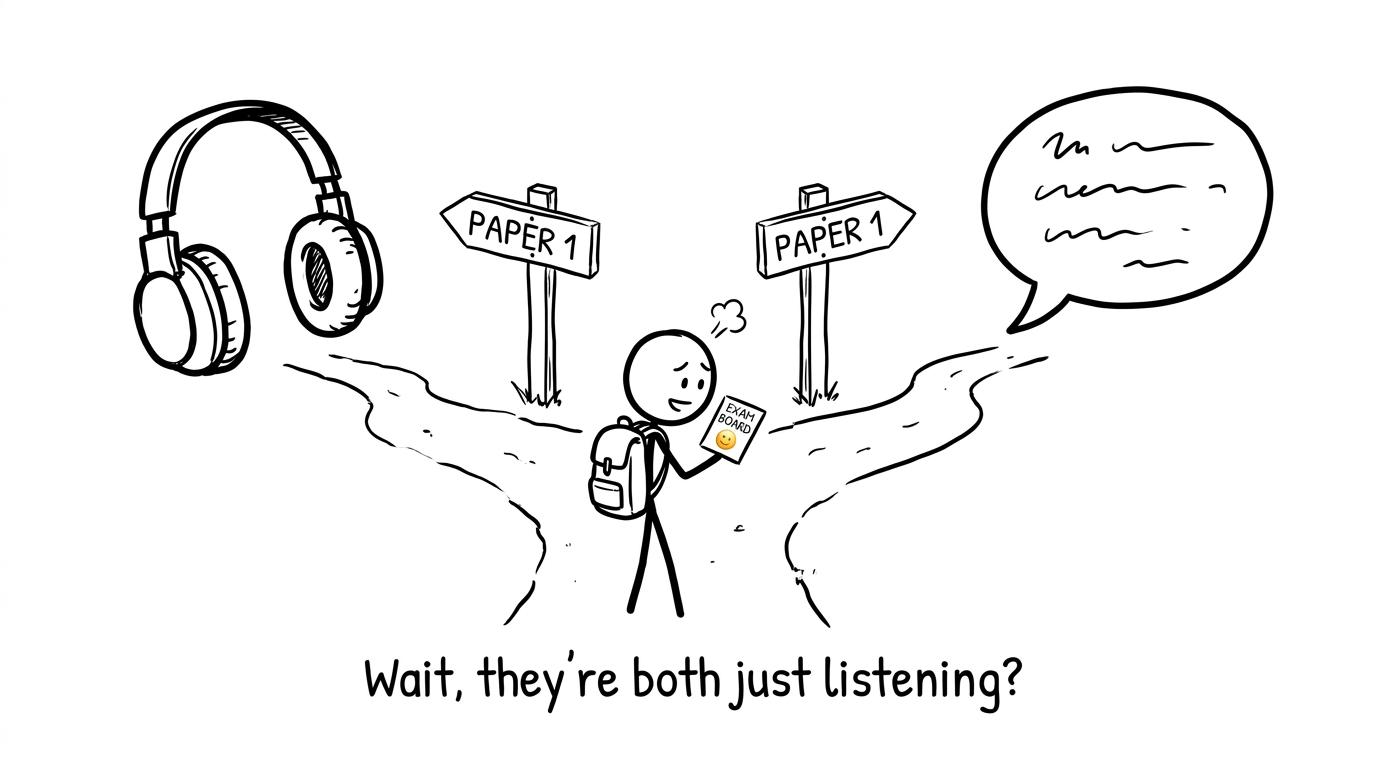 A student discovers that Paper 1 leads to either headphones or speaking depending on the exam board
AQA GCSE German Paper 1 is a listening exam
For current AQA GCSE German, Paper 1 assesses how well you understand spoken German. It is worth 25%25\%25% of the GCSE.
The foundation paper has 404040 raw marks and lasts approximately 353535 minutes. The higher paper has 505050 raw marks and lasts approximately 454545 minutes. Those totals include five minutes of reading time before the recording begins and two minutes for checking at the end.
The recording is controlled by the invigilator. Repetitions and pauses are already built in, so you cannot ask for an extract to be replayed whenever you choose.
What the AQA questions favour
Section A uses listening-comprehension questions written in English. You respond in English or give a non-verbal response, such as choosing a letter. The extracts can include announcements, conversations, podcasts, bulletins and spoken descriptions.
Questions test more than isolated vocabulary. You may need to identify:
- the overall message or gist;
- key details;
- a speaker’s opinion;
- positive and negative attitudes;
- who said what;
- information expressed through different wording from the question;
- whether an idea refers to the present, past or future.
The final part is dictation. You hear short German extracts and write exactly what you hear in German. The minimum total is 202020 words at foundation and 303030 words at higher. Two words outside the prescribed vocabulary list are included at both tiers.
Each dictation sentence is played three times: once as a complete sentence, once in shorter sections and once again in full. Marks reward both communication of meaning and accurate transcription, including spelling and grammar.
How to use the reading time
Five minutes can disappear surprisingly quickly. Do not attempt to predict every answer. Instead:
- read the instructions and identify the required response format;
- underline contrasts such as “advantage” and “disadvantage”;
- notice whether you need one answer or more than one;
- anticipate the kind of vocabulary you might hear;
- leave yourself mental space to listen rather than constructing a complete imaginary script.
On the first playing, establish meaning. On the repeat, confirm the detail that earns the mark. This is similar to good mathematical reading: first understand what the question is about, then isolate the information that matters.
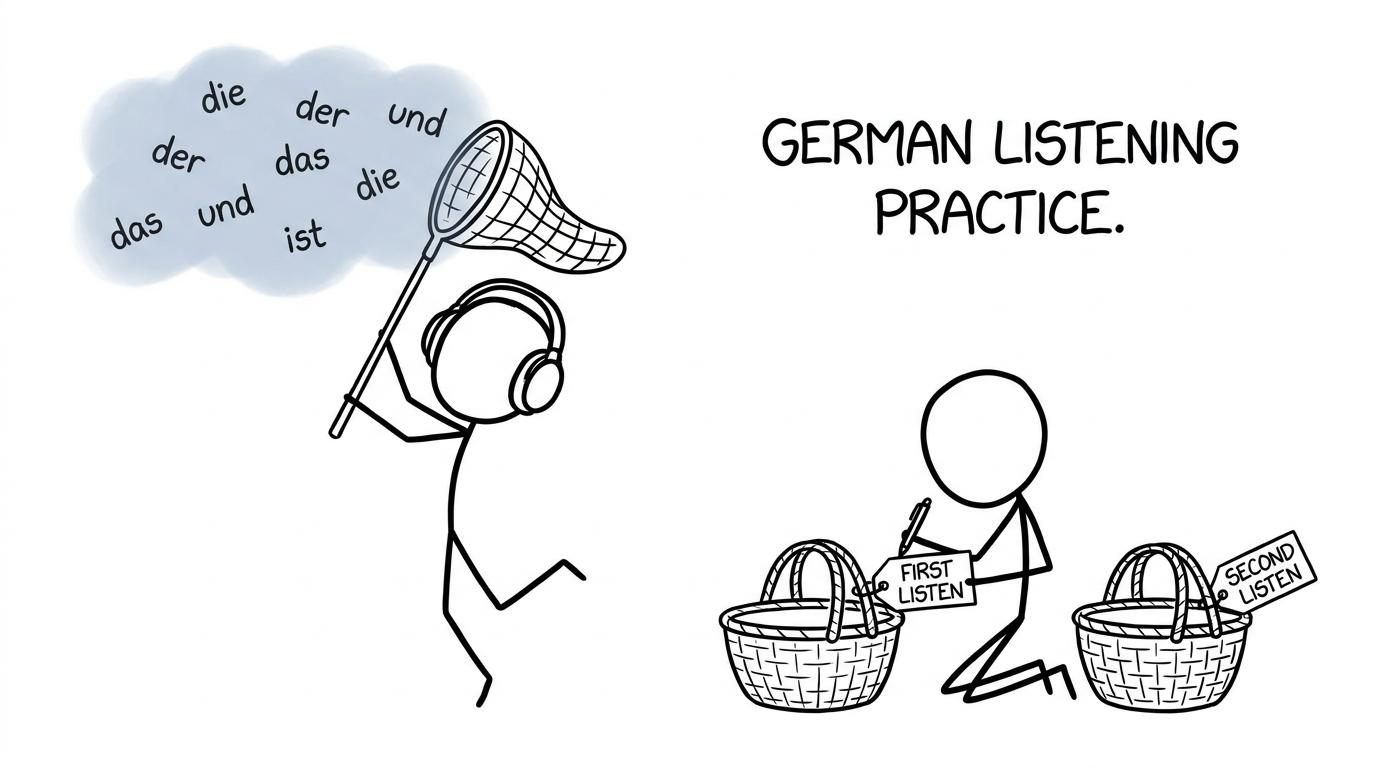 A student catches passing German words by separating the first and second listen
Edexcel GCSE German Paper 1 is a speaking assessment
For Pearson Edexcel GCSE German 1GN1, Paper 1 is not a written listening paper. It is a speaking assessment conducted by a teacher, recorded and externally assessed by Pearson. It is worth 505050 marks and 25%25\%25% of the qualification.
Foundation students speak for 777 to 999 minutes. Higher students speak for 101010 to 121212 minutes. Both tiers receive 151515 minutes of supervised preparation.
The assessment contains three consecutive tasks.
Read aloud and short interaction
You read a short German text aloud, then answer two straightforward questions connected with its content. The complete task is worth 121212 marks: 888 for the read-aloud section and 444 for the interaction.
This task favours clear, comprehensible pronunciation rather than a theatrical accent. Revise sound-symbol correspondences: how written combinations such as German vowels and consonants are normally pronounced. If you stumble, correct yourself calmly and continue.
Transactional role play
The role play is worth 101010 marks. It places you in a defined practical setting, such as a café, station or doctor’s surgery. You need to communicate the information indicated on the card and ask required questions.
This rewards direct communication. A short accurate response that completes the task is more valuable than an ambitious sentence that never answers the prompt. Learn flexible language for requesting information, stating preferences, explaining problems and asking questions.
Picture task and conversation
The picture task and connected conversation are worth 282828 marks. You describe one picture from a choice of two, answer compulsory questions and move into an unprepared conversation based on the broader thematic context.
This is the largest part of the assessment, so avoid spending all your preparation time polishing the read-aloud passage. Prepare useful observations about people, activities, location and mood, then think about opinions and experiences that could support the wider conversation.
Eduqas Component 1 is also speaking
Eduqas technically uses the title Component 1: Speaking, although students may still casually call it Paper 1. It is worth 505050 marks and 25%25\%25% of the GCSE.
Foundation lasts 777 to 999 minutes and higher lasts 101010 to 121212 minutes, with 151515 minutes of preparation at both tiers. The assessment is conducted by a teacher-examiner, audio recorded and externally marked. Dictionaries are not permitted.
The three tasks are:
- a read-aloud text followed by an unprepared conversation;
- a role play involving questions and answers;
- a discussion based on two connected photographs, followed by unseen questions.
The photograph task differs from Edexcel’s choice-and-description format, so board-specific practice matters. Eduqas expects you to discuss both connected photographs. Practising a generic “describe one picture” script is therefore not enough.
 A German speaking candidate learns from a houseplant that clarity beats unnecessary complexity
How to revise for the paper you will actually sit
Revision becomes easier when the practice resembles the assessment.
For AQA listening
Use short recordings and give each listen a purpose. On one attempt, focus on gist. On the next, retrieve precise details. Regularly practise dictation without pausing after every word, then compare your version with a transcript.
Create an error log with categories such as vocabulary, distractor, tense, negative, spelling and lost concentration. “I am bad at listening” is too vague to fix. “I miss negatives when the speaker changes their mind” gives you a specific target.
For Edexcel or Eduqas speaking
Record your answers. Listening back can feel uncomfortable, but it reveals hesitation, unclear sounds and answers that drift away from the prompt.
Practise the exact task sequence for your board. Rehearse recovering after a forgotten word by paraphrasing rather than stopping. Speaking assessments reward successful communication; silence cannot communicate anything.
Do not memorise one oversized paragraph for every theme. Prepare adaptable building blocks: opinions, reasons, time phrases, comparisons, questions and ways to extend an answer. The aim is controlled flexibility.
Borrow the best habits from maths revision
The subject is German, but the learning loop familiar to MathsGenie students still works: attempt, mark, diagnose, repair and retest. The guide to finding your weakest GCSE topics explains how to turn lost marks into precise revision targets.
Keep maths moving alongside German by using the GCSE maths revision hub. Short sessions are easier to protect during a crowded exam week, and the 20-minute maths revision routine offers a practical structure.
Common GCSE German Paper 1 mistakes
Revising the wrong board format
This is the most expensive mistake because it can shape weeks of ineffective practice. Put your board, qualification code and tier at the top of your revision plan.
Using outdated materials without checking them
Older listening and speaking questions may still help develop language, but their task structure might not match the current specification. Label old resources as general skills practice, not exact exam simulation.
Treating listening as vocabulary recognition
Knowing individual words does not guarantee that you understand the message. Speakers can correct themselves, contrast two opinions or mention an option before rejecting it. Listen for the completed thought.
Giving elaborate but irrelevant speaking answers
Answer the task first. Extend only after the required message is secure. Clear German is not simplistic German; it is German that successfully communicates.
Ignoring the final checking opportunity
AQA provides checking time after the recording. Use it to inspect unanswered items and dictation spellings. Speaking candidates should use preparation time to organise ideas, not write a script they cannot deliver naturally.
Letting German revision replace maths completely
A language assessment can demand focused preparation, but dropping maths for a week creates avoidable rust. Use GCSE mini tests and past-paper practice to keep retrieval active. When exams approach, GCSE predicted papers can add structured, timed maths practice without requiring you to design another revision session yourself.
Walk into the correct Paper 1
The number on the front of an exam tells you less than the exam board behind it. For AQA, GCSE German Paper 1 means listening comprehension and dictation. For Edexcel, it means a recorded speaking assessment containing a read aloud, role play and picture-based conversation. For Eduqas, the equivalent first component is a speaking assessment with its own distinct photograph task.
Confirm your board. Practise its exact format. Analyse mistakes by type, then return to the task while the correction is still fresh.
And keep the rest of your revision steady. MathsGenie gives you free revision lessons, practice questions, mini tests, real GCSE past papers with mark schemes, predicted papers and video solutions. Use the one-month GCSE maths revision plan to protect your maths progress while you prepare for German. The goal is not to revise everything at once. It is to know what comes next, then practise it deliberately.