

GCSE German Different Exam Centre: Your Options
GCSE German different exam centre options explained: enter privately, arrange the speaking test, check fees and protect your GCSE maths revision time.
The difficult part may not be learning German. It may be discovering that your school does not offer the subject, cannot provide a German teacher or will not make the examination entry.
The short answer to GCSE German different exam centre questions is yes: you can usually take the qualification at another approved school, college or examination centre as a private candidate. However, the centre must accept your chosen exam board, specification, tier and examination series. Crucially, it must also be able to conduct the German speaking assessment.
You can continue taking GCSE maths and your other subjects at your usual school. Your German entry can be made separately by another centre, provided everyone has the correct candidate information and you are not entered twice for the same qualification.
Your quick checklist
Before paying an examination centre, confirm all of the following in writing:
- The centre accepts private candidates for GCSE German.
- It offers your exact awarding body and specification.
- It can administer every component, including the speaking assessment.
- It will enter you for the correct foundation or higher tier.
- Its internal entry deadline has not passed.
- You know the complete fee, refund terms and any late charges.
- Any access arrangements have been discussed early.
- The dates do not clash with your other GCSE examinations.
- You will receive and check a statement of entry.
That final document matters. It is where a vague plan becomes an actual examination entry.
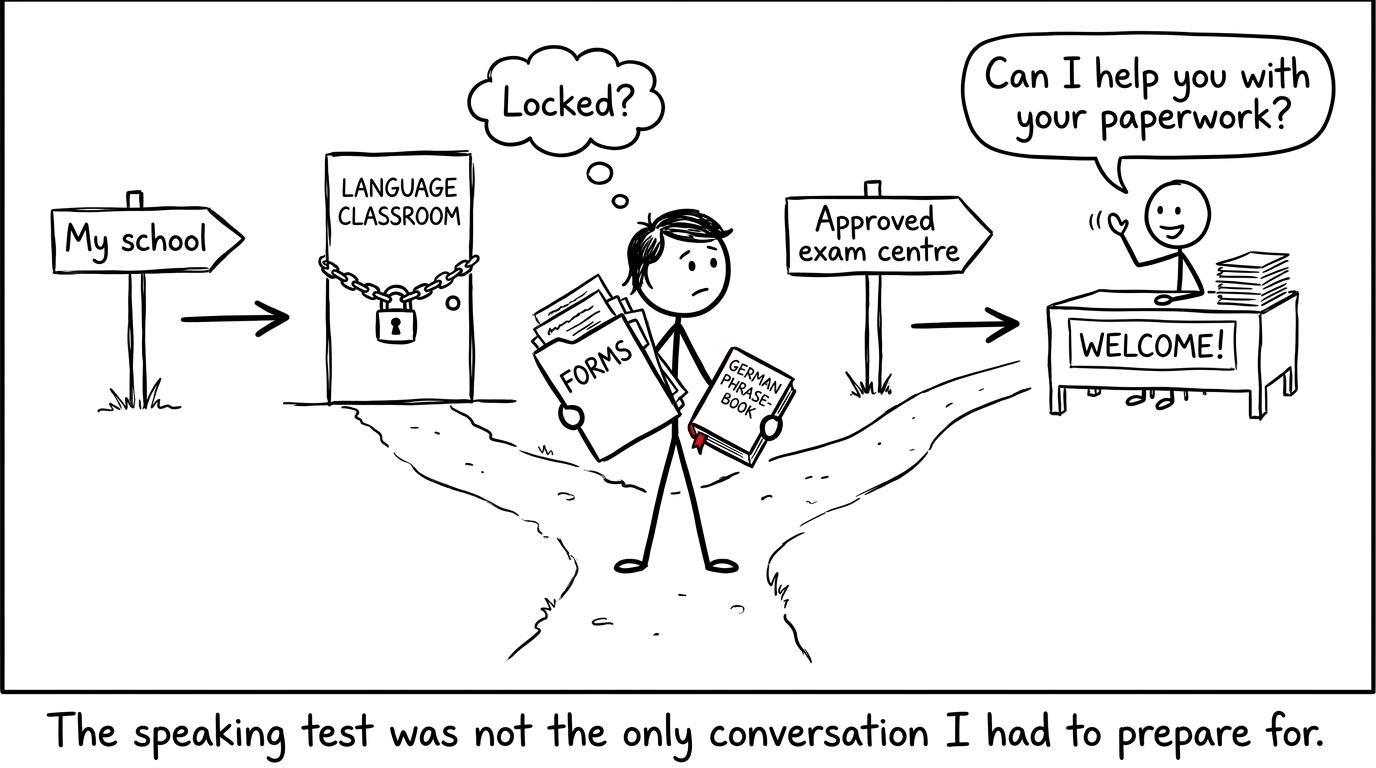 A student choosing between a locked language classroom and an approved examination centre
What if your school does not offer GCSE German?
Start by speaking to your school’s exams officer, head of languages or another appropriate member of staff. A school not teaching German does not automatically mean it is forbidden from entering you. It may be willing to investigate an entry, particularly if it can arrange a suitably qualified person and meet the speaking-assessment requirements.
There is an important distinction, though. A school might be approved by an awarding body but still decide that it cannot support German. The speaking component creates practical and administrative responsibilities. The centre needs suitable staff, secure assessment materials, appropriate rooms, recording arrangements and the ability to follow the specification’s instructions.
If your school declines, ask for a clear answer about what it cannot provide. Then you can search for another approved centre with the right questions already prepared.
You would normally be treated as a private candidate at the alternative centre. This means you take the assessment there without being one of its enrolled students. The centre, not you or your parent, sends the entry to the awarding organisation.
Private-candidate arrangements can apply to students who are home educated, self-taught, receiving tuition or taking a subject unavailable at their own school. Acceptance is still the centre’s decision. Being an approved centre does not oblige a school or college to accept external candidates.
How to find a centre for GCSE German
The Joint Council for Qualifications, usually called JCQ, provides a private-candidate centre finder. Search by location, qualification and awarding body, then contact several centres rather than relying on the first listing.
A directory result is only a starting point. JCQ advises candidates to confirm details directly because availability, subjects, fees and internal deadlines are controlled by each centre. A centre may accept private candidates for written GCSEs without offering modern foreign language speaking assessments.
Your first message should include:
- Your full name and current school year.
- The subject: GCSE German.
- Your preferred awarding body and specification code.
- The examination series you need.
- Your intended tier.
- Confirmation that you require all components, including speaking.
- Any access arrangements you may need.
- Whether you have previously received a Unique Candidate Identifier, or UCI.
Contact centres early. Their own booking deadlines may be earlier than the awarding body’s final entry deadline, and places can be limited. A late entry may also cost more.
Ask about the exact specification
GCSE German is offered through awarding organisations including AQA, Pearson Edexcel and Eduqas. Availability varies between centres, so do not choose a specification solely because you already own a textbook for it.
Reformed GCSE French, German and Spanish specifications were first awarded in summer 202620262026. Students take the assessments at either foundation or higher tier, and the components must be taken at the same tier in the same examination series. Check the current specification directly with the exams officer because old course codes and revision materials may still appear in searches.
A general reply such as “we offer GCSEs” is not enough. You need confirmation of GCSE German, the board, specification, tier and series.
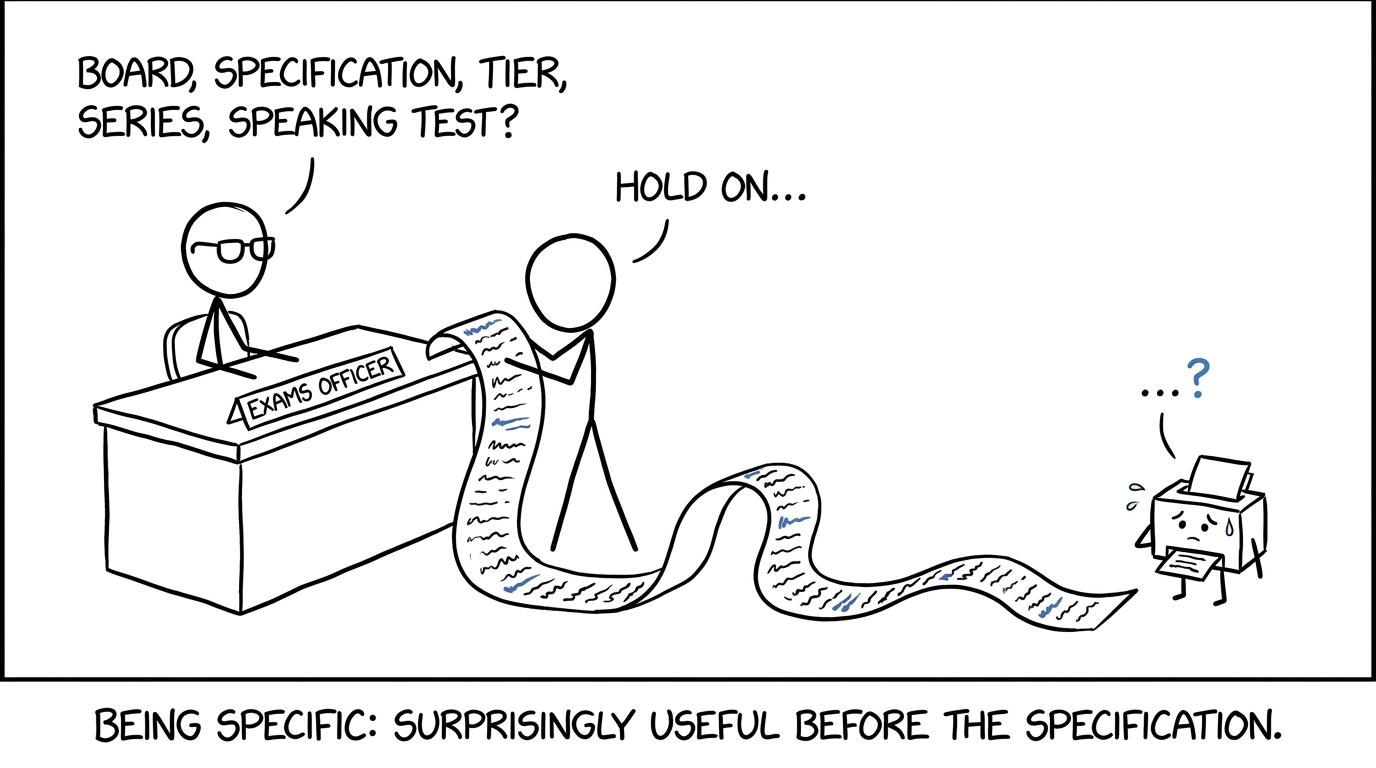 A worried printer watches an unusually thorough private-candidate checklist
Why the German speaking assessment matters
The speaking assessment is the part most likely to determine whether a centre can accept you. Under current GCSE German specifications, speaking is a formal assessed component rather than an informal conversation with a tutor.
For example, awarding-body requirements may expect the entering centre to supervise, authenticate, administer and record the assessment in accordance with secure instructions. The precise tasks and procedures depend on the specification. The centre cannot simply let you submit a recording made at home.
Ask these questions before booking:
- Will the centre conduct the speaking assessment for this exact specification?
- Who will act as the teacher-examiner?
- Where and during which assessment window will it happen?
- Is the speaking fee included in the quoted price?
- Will the centre provide the required recording equipment?
- What happens if you cannot attend the allocated speaking appointment?
For current AQA GCSE German, the qualification is available to private candidates, but the entering centre must accept responsibility for the speaking component. Eduqas similarly requires the speaking assessment to be carried out and recorded under formal centre arrangements. Pearson also directs private candidates to centres that can complete the registration and assessment process.
This is why it is safer to ask about speaking in your opening enquiry, not after paying.
Can you take German elsewhere while sitting maths at school?
Yes. In a normal arrangement, your school can enter you for GCSE maths and your other subjects while a different centre enters you privately for German. Tell both exams officers what you are doing and provide your existing UCI if you have one. This helps awarding bodies connect your examination record correctly.
Do not assume that your school can make the German entry and casually send you elsewhere on the day. Once an entry has been made, using a host centre may require a formal transferred-candidate arrangement and awarding-body approval. JCQ transfer rules generally apply to defined circumstances, such as a diagnosed medical condition or moving home after entry, rather than simple convenience.
The cleaner route is usually to arrange the German entry with the centre that will actually administer its assessments from the beginning.
Also check the complete timetable. Speaking takes place within a controlled assessment window, while listening, reading and writing papers have fixed dates. Your German centre should provide the venue and reporting instructions for each component.
Fees, identification and access arrangements
Private candidates are normally responsible for paying their own fees. The total can include the awarding-body entry charge, centre administration, invigilation and the speaking assessment. Centres set their own prices, so request an itemised quotation and refund policy before committing.
You may need photo identification, personal details, previous candidate information and evidence of your date of birth. Once entered, check every detail on your statement of entry, including:
- The spelling of your legal name.
- Your date of birth.
- The awarding body and specification code.
- Foundation or higher tier.
- Every required component.
- The correct examination series.
If you require extra time or another access arrangement, raise it during your first discussion. The external centre is responsible for considering evidence and putting approved arrangements in place. Existing support at your school may not transfer automatically because the new centre must follow the current JCQ process and establish the required evidence.
Protecting your GCSE maths revision time
Arranging an external examination can consume attention far beyond the hours it actually takes. One unanswered email becomes a week of background worry. The best response is to separate administration from revision.
Give yourself one short weekly slot for German-centre emails, fees and documents. Keep the rest of your timetable for learning. MathsGenie’s free GCSE maths revision hub lets you choose your board, tier and topics without creating another complicated system.
Use the MathsGenie revision planner to schedule German practice alongside maths rather than allowing one subject to displace the other. On busy days, the twenty-minute GCSE maths revision routine offers a manageable way to maintain momentum.
Once your German entry is confirmed, return your attention to marks. Use revision lessons and practice questions for weak maths topics, then check progress with papers and mark schemes. If you take AQA maths, the AQA GCSE maths past papers provide board-specific practice. The broader guidance on when to start GCSE past papers can help you build a sensible sequence.
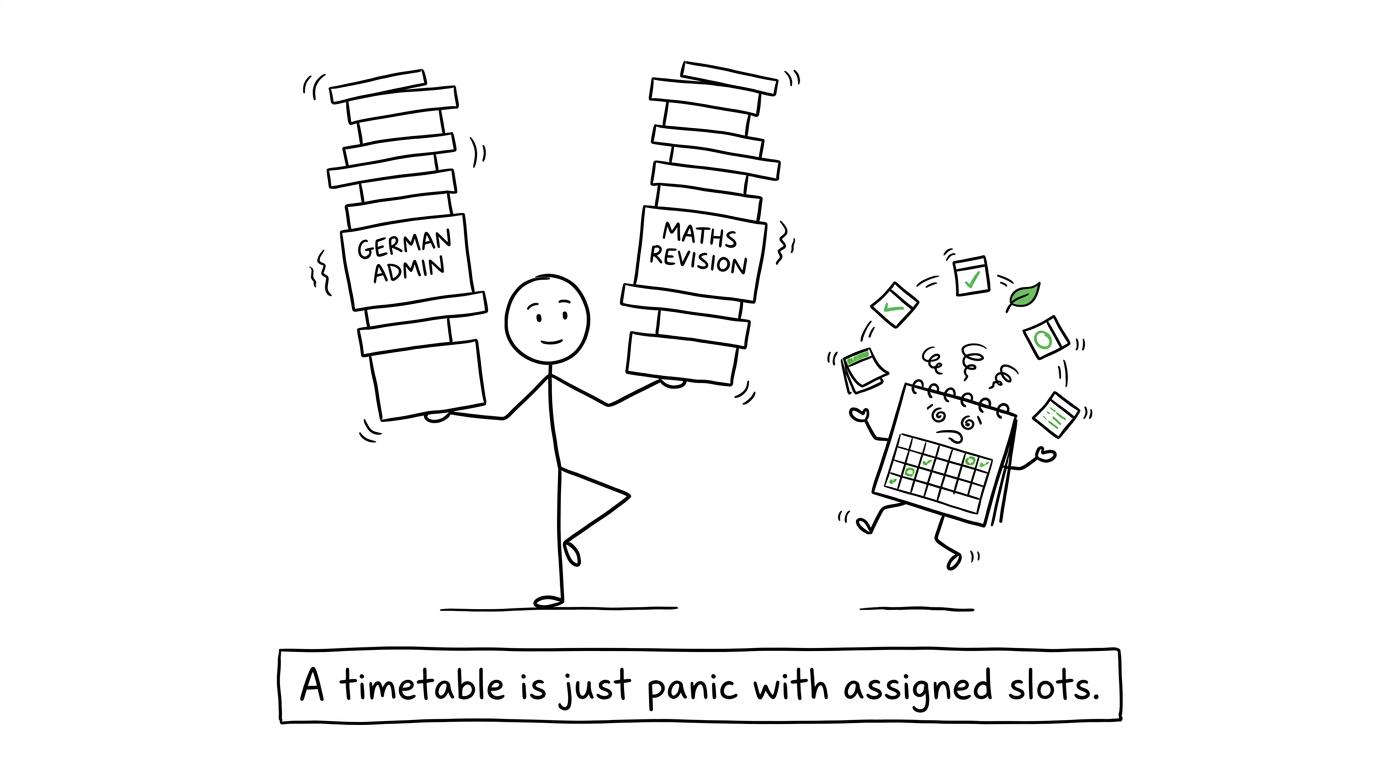 A student balances German administration with GCSE maths revision
Common mistakes to avoid
Booking a centre that does not conduct speaking
A centre accepting private candidates does not prove that it can administer GCSE German. Obtain explicit written confirmation for the speaking assessment and every written paper.
Using an old course code
Specifications change. Confirm the current awarding body, qualification title and entry code with the exams officer before buying resources or paying fees.
Leaving access arrangements until later
Access arrangements involve evidence, decisions and deadlines. Discuss them when you first approach the centre, not a few weeks before the examination.
Assuming your school will coordinate everything
If another centre enters you as a private candidate, you or your parent or carer will usually need to manage communication, payment and attendance. Keep copies of emails, receipts and your statement of entry.
Choosing a tier without checking
Modern foreign languages are tiered. Make sure the centre records foundation or higher correctly across all components and discuss the decision with a teacher or tutor who understands the current specification.
Neglecting your other GCSEs
Administrative uncertainty can feel urgent, but it should not swallow your revision timetable. Keep using short, consistent maths sessions, then build towards GCSE predicted papers once you have repaired your main topic gaps.
Make the arrangement early, then return to learning
You can sit GCSE German at a different examination centre when your school does not offer it. The practical route is to find an approved centre accepting private candidates, confirm the exact specification and tier, ensure it can conduct the speaking assessment, agree fees and access arrangements, and check your statement of entry.
There is paperwork, but the process becomes manageable when each question has a named person and a written answer. Start with your school’s exams officer, then contact suitable private-candidate centres early.
Once the entry is secure, let revision become the main story again. Use MathsGenie’s free revision lessons and practice questions to strengthen individual maths topics, mini tests to check recall, and past papers, mark schemes, video solutions and predicted papers to prepare for the real examination. One clear administrative plan protects the time and concentration your grades actually need.










