GCSE Geography Homework Grade Impact: Does It Matter?
GCSE geography homework grade impact explained: learn what affects your final result, which tasks help most, and when maths revision should take priority.
A homework mark can feel oddly powerful. A low score may seem like evidence that your final grade is already slipping; a high score can feel like money in the bank. Neither interpretation is quite right.
The GCSE geography homework grade impact is usually indirect. For current GCSE Geography qualifications in England, ordinary homework marks are not added to your final grade. Your grade is determined by your performance in the formal assessments. Homework matters when it improves the knowledge, geographical skills and exam technique that those assessments measure.
That distinction is important, especially if you are balancing Geography with GCSE Maths. Completing every task may help, but time alone is not the goal. The useful question is whether a piece of homework changes what you can recall, interpret or explain without support.
The short answer
Use this checklist when deciding how seriously to treat a Geography task:
- Homework does not normally contribute marks directly to your final GCSE Geography grade.
- Good homework can improve exam performance by strengthening recall, application and written judgement.
- Quality matters more than sheer quantity. A focused task followed by feedback is more useful than an hour of copying notes.
- Fieldwork preparation matters, even though your notebook is not simply handed in for a GCSE grade, because fieldwork understanding is assessed in written examinations.
- Geographical maths and statistics deserve attention. At least 10%10\%10% of GCSE Geography subject marks are allocated to mathematical and statistical techniques.
- Your school’s deadlines still matter. Homework may influence teacher feedback, reports, predicted grades and decisions about extra support, even when it is not part of the exam-board total.
Start from the GCSE Geography revision hub if you need resources matched to AQA, Edexcel, OCR, Eduqas or WJEC.
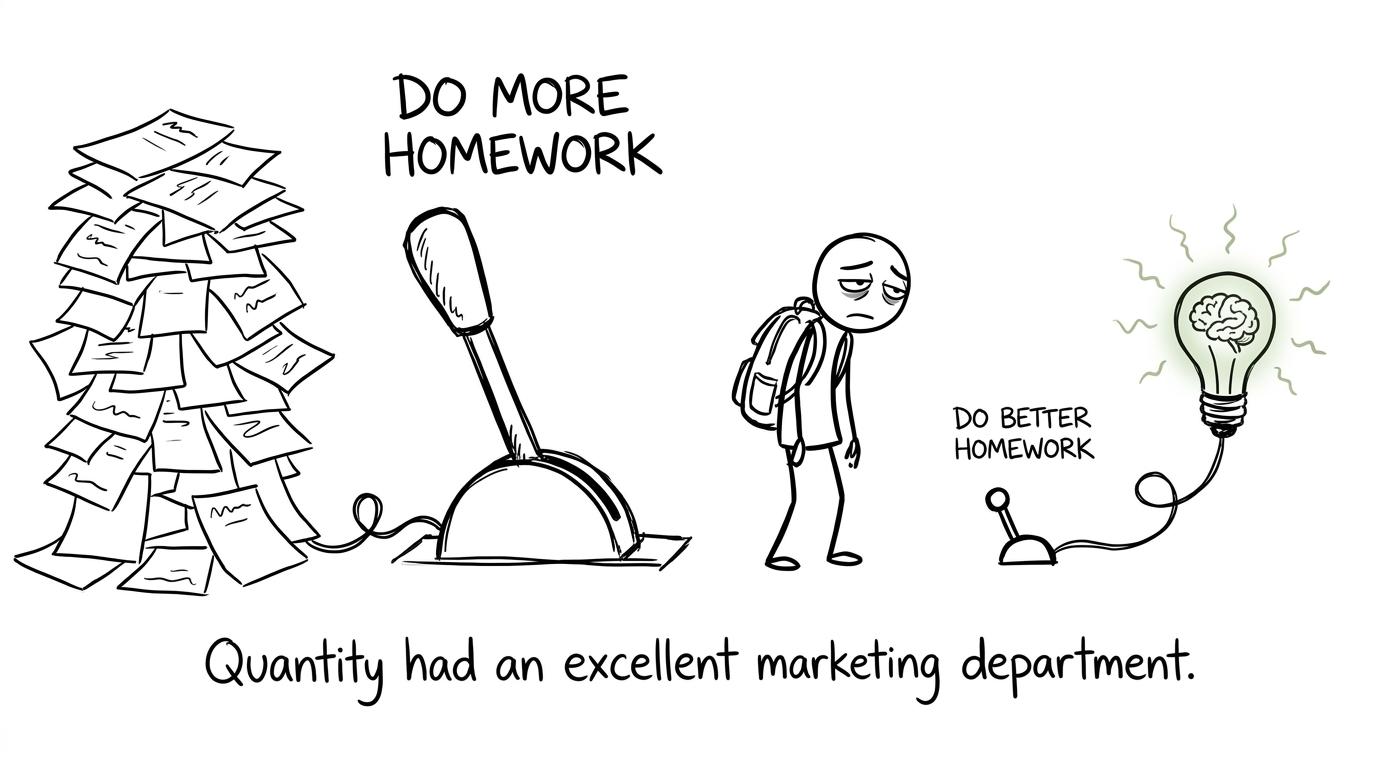 A student discovers that better homework beats more homework
Does Geography homework count towards your final grade?
In the usual sense, no. A worksheet score, online quiz result or teacher-marked essay is not automatically sent to the exam board and added to your final total.
Current GCSE Geography specifications are linear qualifications assessed through formal papers at the end of the course. They also contain fieldwork requirements, but fieldwork knowledge and enquiry skills are assessed through written examination rather than through an ordinary homework portfolio. The precise paper structure varies between AQA, Edexcel, OCR and Eduqas, so always check your own specification.
This means a missed homework does not directly remove exam marks. It can still create a gap that later costs marks. If the task was designed to practise evaluating a fieldwork method, for example, skipping it may leave you less prepared to discuss reliability, accuracy or sampling in the examination.
There is also a separate issue: internal school decisions. Teachers may use classwork, homework and mock examinations to monitor progress. Homework can therefore affect the feedback or support you receive. Predicted grades are not normally calculated by simply averaging homework scores, and individual schools may use evidence differently. Ask your teacher if you are unsure.
What research says about homework and attainment
The Education Endowment Foundation’s current evidence review reports a positive average effect for homework, with the effect stronger in secondary schools than in primary schools. Its headline estimate for secondary homework is the equivalent of around five additional months of progress.
That figure needs careful reading. It is an average across studies, subjects and settings, not a promise that Geography homework will lift every student by a particular number of grades. The EEF also rates the security of the homework evidence as low and highlights substantial variation between studies.
The most useful conclusions are less dramatic:
- homework linked closely to classroom learning tends to be more effective;
- tasks with a clear purpose are more valuable than work set merely to occupy time;
- feedback is associated with stronger effects;
- the quality of a task appears more important than the amount completed;
- returns can diminish as the time spent increases.
So homework matters, but not all homework matters equally. A short retrieval quiz that exposes forgotten case-study details may do more for your grade than producing a beautifully coloured page you never test yourself on again.
Which Geography homework moves your grade most?
Retrieval that strengthens memory
GCSE Geography contains places, processes, vocabulary and case-study evidence that must be available under pressure. Useful retrieval tasks ask you to recall information before checking notes.
Flashcards, closed-book questions and brief brain dumps can work well when they reveal what is missing. The important step is correction. Recalling an incorrect fact repeatedly only makes the error more familiar.
Exam questions followed by honest marking
Exam-style homework connects knowledge to command words such as describe, explain, assess and evaluate. Those words require different kinds of response. An answer can contain correct Geography and still lose marks because it does not perform the requested task.
Mark schemes and teacher comments show whether you used evidence, developed chains of reasoning and reached a supported judgement. Do not treat the mark as a verdict. Treat it as directions.
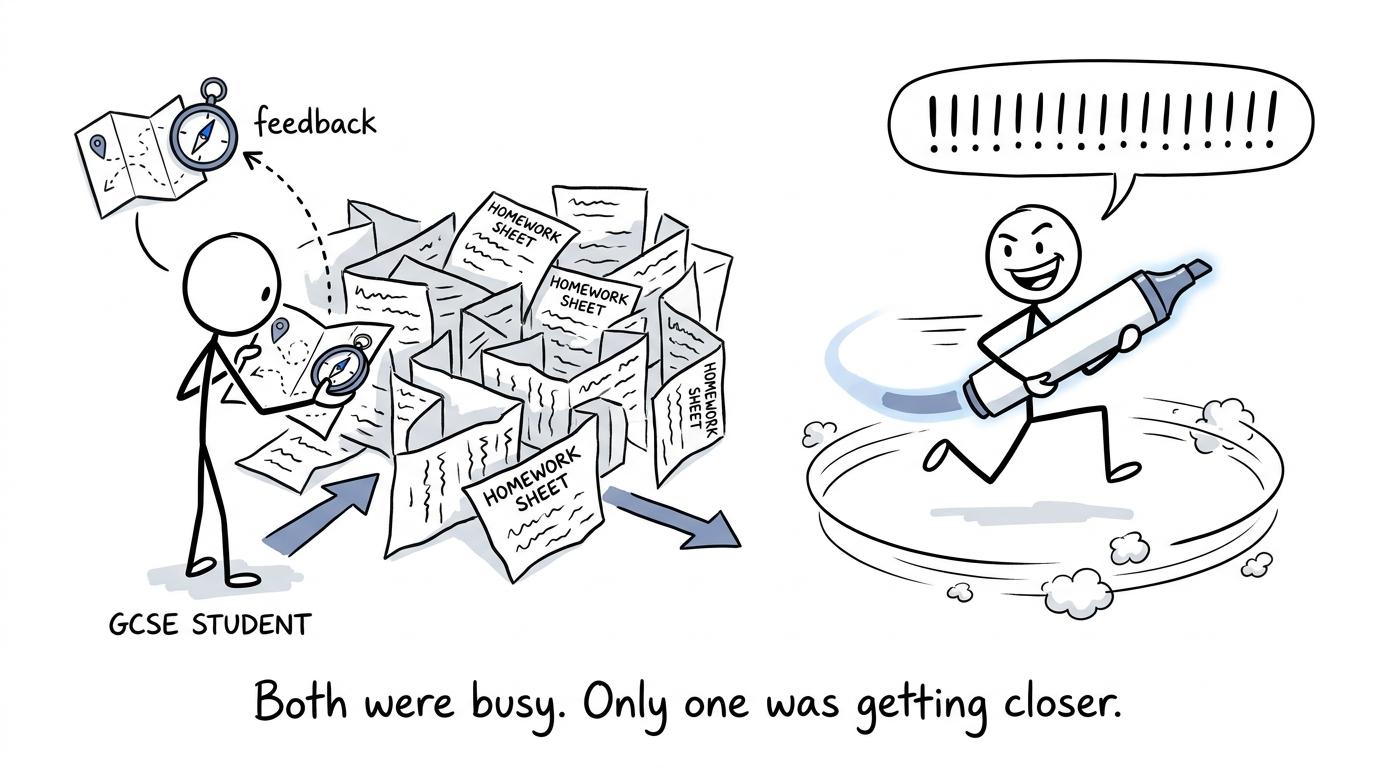 One student follows feedback while another revises in circles
Fieldwork and enquiry practice
Fieldwork is not a day out that disappears once the coach returns. You may need to understand how an enquiry was planned, how data was sampled, whether a conclusion was supported and how the method could be improved.
The OCR A fieldwork skills resources organise this process from question to evaluation. Even if you follow another board, the broad lesson remains useful: effective revision reconnects each method to the enquiry question rather than memorising generic advantages and disadvantages.
Graphical, numerical and statistical tasks
Geography assesses more maths than many students expect. Ofqual’s requirements allocate at least 10%10\%10% of the subject marks to mathematical and statistical techniques. These may include percentages, ratios, averages, scale, graphical interpretation and conclusions drawn from data.
The OCR A numerical and statistical skills guide covers geographical calculations and evidence, while the AQA graphical skills guide develops the reading of graphs, maps, trends and anomalies.
These tasks offer useful overlap with GCSE Maths. Work on percentages, averages, ratio and graphs can support both subjects, provided you also learn how to interpret the result geographically. If the underlying calculation is weak, use the GCSE Maths revision hub to repair the method before returning to its geographical context.
When should maths revision take priority?
Time is limited. The aim is not to give every subject an identical number of minutes, but to put the next block of time where it can recover the most marks.
Maths should usually take priority over optional extra Geography work when:
- a Maths mock or examination is closer;
- you have a clearly diagnosed Maths weakness affecting several question types;
- the Geography task is low-value repetition you can already complete accurately;
- you are behind on a core Maths topic that later topics depend on;
- your teacher has identified an urgent gap in your foundation or higher-tier preparation.
Geography should usually receive the time when:
- required homework has a deadline;
- you cannot recall essential case-study knowledge;
- fieldwork or geographical skills repeatedly cost you marks;
- an exam-style answer needs redrafting from feedback;
- you have neglected Geography while repeatedly revising comfortable Maths topics.
A simple decision rule is to compare likely marks recovered with time required:
revision priority=likely marks recoveredtime required\text{revision priority} = \frac{\text{likely marks recovered}}{\text{time required}}revision priority=time requiredlikely marks recoveredThis is not a precise prediction. It is a way to resist choosing work solely because it feels comfortable. The guide to finding your weakest GCSE topics explains how a lost-marks log can turn that judgement into evidence.
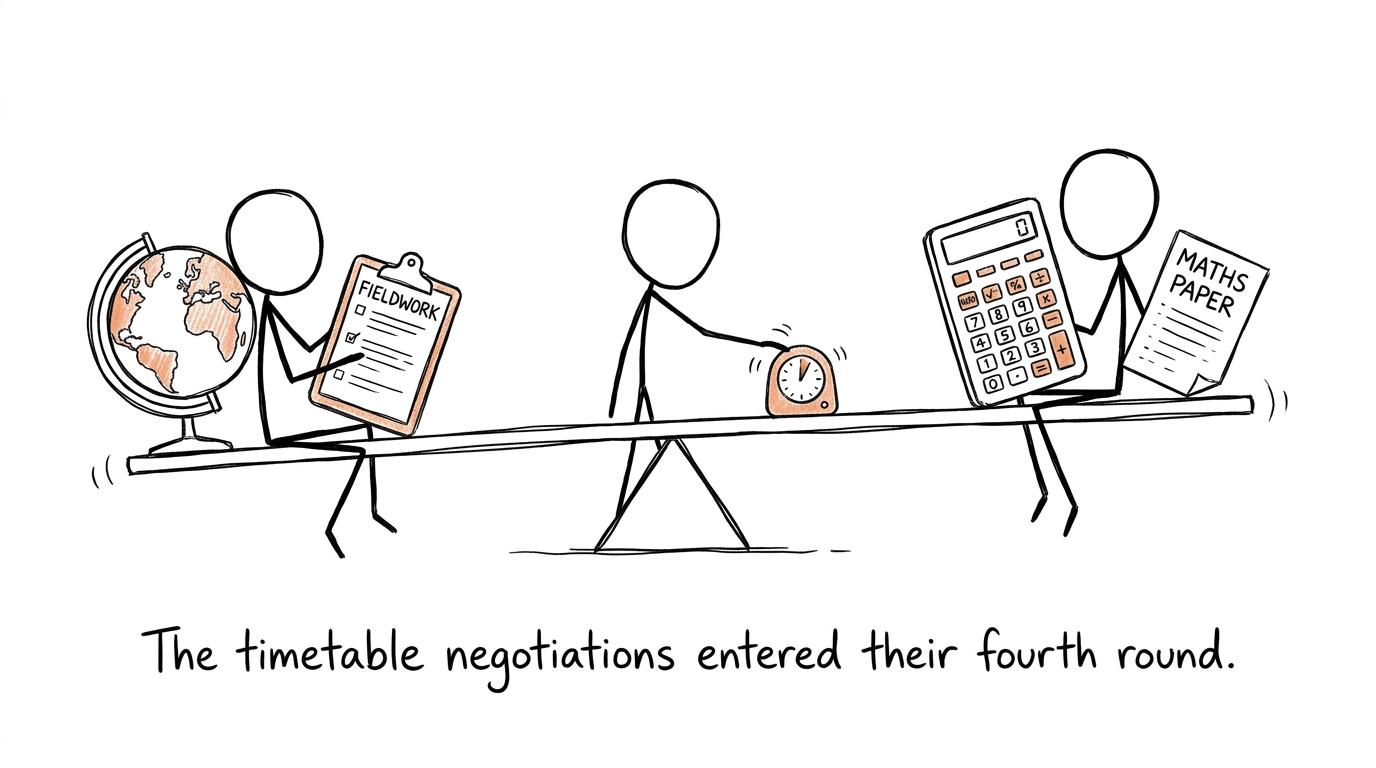 Geography and maths negotiate for space in the revision timetable
A better way to complete Geography homework
Identify the purpose
Before starting, ask what the task is training: recall, application, data handling, extended writing or fieldwork evaluation. If you cannot tell, ask your teacher. Purpose changes how you should approach the work.
Attempt it without immediate support
Notes can make a task look easy without proving that you could answer independently. Begin closed-book where appropriate. Use your notes afterwards to check and repair gaps.
Mark and classify mistakes
Separate errors into useful categories:
- missing knowledge;
- weak geographical understanding;
- misread command word;
- unsupported judgement;
- numerical or graphical error;
- poor timing.
The category tells you what to do next. More reading will not necessarily fix weak timing, and more calculations will not fix an unsupported evaluation.
Reattempt after a gap
A correction made while the mark scheme is open can create false confidence. Return to a similar question later and answer independently. That second attempt is better evidence of learning than the original homework percentage.
If your course is Edexcel B, the Edexcel B GCSE Geography revision area brings together lessons, questions, revision tools and past papers. Students on other boards can choose the appropriate route from the main Geography hub.
Common mistakes when judging homework’s impact
Assuming completion means learning
Finishing a task proves that it was finished. It does not prove that you can reproduce the thinking in an examination. Check your learning with a later closed-book question.
Chasing a perfect homework score
Using notes to secure 100%100\%100% may protect the score while hiding the gap. A lower independent score, followed by correction, can be more useful because it shows you what needs attention.
Ignoring feedback
The mark records the past. Feedback can change the future. Rewrite one paragraph, correct one calculation or reattempt one question while the advice is still clear.
Spending too long on presentation
Clear work matters, particularly for graphs and maps. Decoration is different. Stop when presentation no longer improves accuracy, interpretation or communication.
Treating every subject equally every evening
Equal time is not always fair time. Deadlines, examination dates and weak topics change. Build a weekly plan around evidence rather than guilt. The efficient GCSE maths revision guide offers a learn, practise, mark and fix routine that transfers well to Geography.
Homework matters most when it changes the next answer
Geography homework does not normally sit inside your final grade as a separate pile of marks. Its value lies in what it changes: the case study you can recall, the graph you can interpret, the method you can evaluate and the judgement you can support under timed conditions.
Do required work, but do not confuse hours with progress. Use feedback. Reattempt weak skills. Let deadlines and lost marks guide how you divide time between Geography and Maths.
MathsGenie gives you a free place to make that process concrete. Use the Geography hub for specification-matched revision lessons, worksheets, question banks, flashcards and past papers. For Maths, move from practice questions and mini tests to mark schemes, video solutions, past papers and predicted papers. One focused task, checked properly, is a modest action. Repeated often enough, it becomes revision you can trust.