GCSE Geography Grade Boundaries Explained
GCSE geography grade boundaries explained clearly: learn why raw marks shift each year, how thresholds are set, and how to plan smarter revision.
A mark can feel wonderfully solid. You earned it, wrote it at the top of your paper and perhaps converted it into a percentage. Then someone tells you that the same percentage could produce a different grade next year.
That sounds unfair until GCSE geography grade boundaries are explained properly. Your raw mark records how many marks you earned. Your grade depends on where that exam series' boundaries are placed after the papers have been taken and nearly all marking is complete. Boundaries move because papers are never identical in difficulty. The aim is to keep the standard represented by each grade broadly consistent, not to make a particular percentage permanent.
This matters to geography students, but it is also useful for anyone preparing for GCSE maths. The same central lesson applies: historical boundaries provide context, while the marks you can secure through better knowledge and exam technique remain the part you control.
The essential grade boundary checklist
Before interpreting any Geography result, check all of the following:
- your exam board: AQA, Pearson Edexcel, OCR or Eduqas;
- your exact specification, including Geography A or Geography B where relevant;
- the correct exam series and year;
- your total qualification mark across the required papers;
- the maximum available mark;
- the official overall boundary rather than a notional paper boundary.
You can begin with the MathsGenie GCSE Geography revision hub, then compare published figures through the GCSE and A Level grade boundaries archive.
What is a GCSE Geography grade boundary?
A grade boundary is the minimum total mark required for a particular grade. If a student's total reaches a boundary, that grade is awarded. A total below it falls into the next available grade band.
The raw mark is simply the number of marks awarded according to the mark scheme:
Raw mark=total marks awarded across the assessment\text{Raw mark}=\text{total marks awarded across the assessment}Raw mark=total marks awarded across the assessmentA percentage expresses that mark relative to the maximum:
Percentage mark=raw markmaximum mark×100\text{Percentage mark}=\frac{\text{raw mark}}{\text{maximum mark}}\times 100Percentage mark=maximum markraw mark×100That percentage can be useful for comparing your own performance across papers with different totals. It is not, however, a universal GCSE grading scale. There is no permanent rule saying that a particular percentage must always equal grade 444, 777 or 999.
Most current GCSE Geography qualifications are linear and untiered. Your marks from the relevant papers or components contribute to one overall qualification result, and the full grade range from 999 to 111 is available. This differs from GCSE maths, where students are entered for foundation or higher tier.
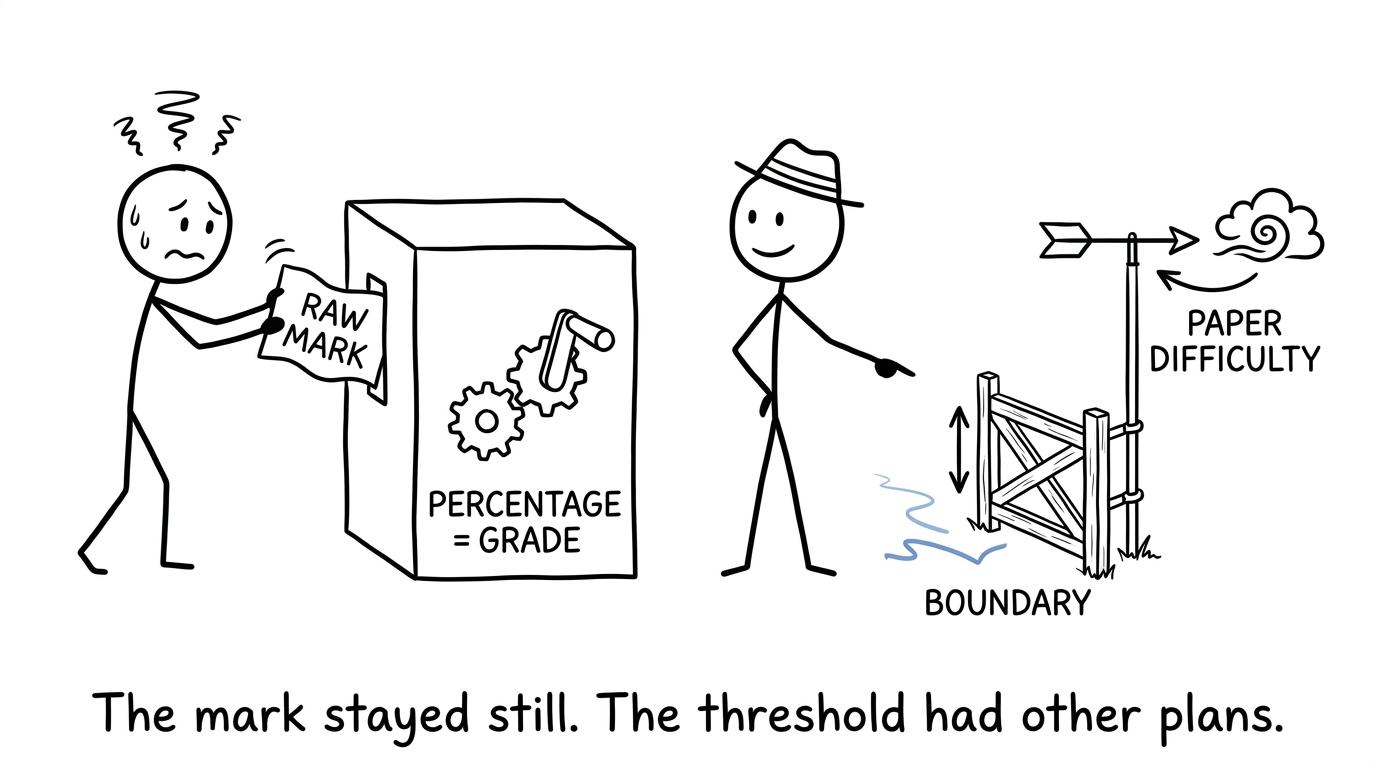 A student discovers that the grade threshold can move even when a raw mark does not
Why the same raw mark can produce a different grade
An exam board cannot know the final boundaries with certainty before students sit the papers. Paper writers work carefully to create comparable assessments, but one series may contain questions that students find slightly more demanding than expected. Another may prove more accessible.
Fixed boundaries would magnify those small differences. If an unusually difficult paper kept an unchanged threshold, students could receive lower grades even though their work demonstrated a similar underlying standard to that of students in an earlier year. Moving the boundary helps compensate for variation in assessment difficulty.
The relationship is usually described simply:
- a more demanding set of papers may lead to lower raw-mark boundaries;
- a more accessible set may lead to higher raw-mark boundaries;
- a change in boundaries does not automatically mean standards became easier or harder.
This is why previous thresholds should never be treated as a promise. The history of GCSE Geography grade boundaries shows movement across examination series, but not a pattern reliable enough to predict the next award.
How exam boards actually set the boundaries
Grade boundaries are set through awarding after the examinations have been taken and marking is nearly complete. The process combines statistical evidence with expert judgement.
Evidence about the examination
Exam boards examine how the assessment performed in practice. They consider patterns in marks and whether students found particular papers more or less demanding than expected. The average mark and the distribution of results can reveal differences that were not fully visible when the paper was written.
Evidence about the cohort
Boards also consider evidence about the overall prior attainment of the group taking the qualification. For GCSEs in England, cohort-level predictions can draw on earlier national assessment information.
This does not assign a grade to an individual student. Your personal prior attainment does not cap or determine your Geography result. Once boundaries are confirmed, your grade depends on your marked work and the same qualification thresholds applied to everyone taking that specification in that series.
Evidence from students' scripts
Senior examiners inspect work around possible key boundaries. They compare its quality with the expected standard and with evidence retained from previous series. This matters because statistics can suggest where a threshold might lie, but examiners must also consider what students at that mark actually wrote.
For GCSEs graded from 999 to 111, key thresholds are considered using the required awarding rules. Other boundaries are then established according to the regulatory process. The final result is therefore neither a casual judgement nor a simple percentage curve. It is an evidence-based attempt to preserve comparable standards between years.
For a broader overview, read how GCSE grade boundaries work.
Latest confirmed GCSE Geography boundaries
At the time of writing, the latest complete confirmed summer series is June 2025. The June 2026 boundaries cannot be known before awarding is completed and they are published on results day.
The table below shows selected overall qualification boundaries from the 2025 series. These are raw-mark thresholds, not percentages.
| Exam board and specification | Maximum mark | Grade 999 | Grade 777 | Grade 555 | Grade 444 |
|---|---|---|---|---|---|
| AQA Geography | 252252252 | 199199199 | 161161161 | 124124124 | 106106106 |
| Edexcel Geography A | 256256256 | 206206206 | 171171171 | 129129129 | 108108108 |
| Edexcel Geography B | 256256256 | 217217217 | 185185185 | 143143143 | 122122122 |
| OCR Geography A | 200200200 | 162162162 | 131131131 | 999999 | 838383 |
| OCR Geography B | 200200200 | 154154154 | 129129129 | 102102102 | 898989 |
| Eduqas Geography A | 252252252 | 184184184 | 149149149 | 115115115 | 999999 |
| Eduqas Geography B | 252252252 | 198198198 | 167167167 | 135135135 | 119119119 |
The complete grade-by-grade comparison is available in GCSE Geography marks per grade.
Do not use this table to decide that one board is easier. The specifications, paper structures, mark totals and questions differ. A raw mark only has meaning within the qualification for which it was awarded.
Overall boundaries and notional paper boundaries
This distinction causes considerable confusion.
The overall qualification boundary determines your final GCSE grade. It is applied to the combined, appropriately weighted total from all required components.
A notional component boundary shows what a grade threshold might look like on one paper considered separately. Exam boards may publish these to help schools understand performance, but they do not normally award separate GCSE grades for each paper in a linear qualification.
Your combined mark can be represented as:
Qualification mark=Paper 1 contribution+Paper 2 contribution+Paper 3 contribution\text{Qualification mark}=\text{Paper 1 contribution}+\text{Paper 2 contribution}+\text{Paper 3 contribution}Qualification mark=Paper 1 contribution+Paper 2 contribution+Paper 3 contributionThe exact paper structure and any scaling depend on the specification. Consequently, a weaker performance on one paper can be balanced by stronger performance elsewhere. Always compare the final total with the overall boundary.
How to use boundaries without letting them control revision
A boundary is a ruler, not a revision plan. It can help you interpret a completed past paper, but it cannot tell you which case study is vague, which command words you misread or why your evaluation stopped one step too early.
Use this routine instead:
- complete a paper or section under realistic conditions;
- mark it strictly with the correct mark scheme;
- combine the relevant marks correctly;
- compare the result with the boundary from that same paper's series;
- record every lost mark by topic, skill and cause;
- revisit the weakness before attempting another paper.
When percentages or data handling are costing marks, the GCSE Geography statistical skills revision guide can strengthen the numerical side of the course. Those skills also transfer well to GCSE maths, particularly percentages, averages, graphs and interpreting data.
A single past-paper grade can fluctuate because different papers suit different strengths. Look for a range across several papers and focus on whether your total is becoming more stable. Building a safety margin above an old boundary is more useful than trying to predict the exact future threshold.
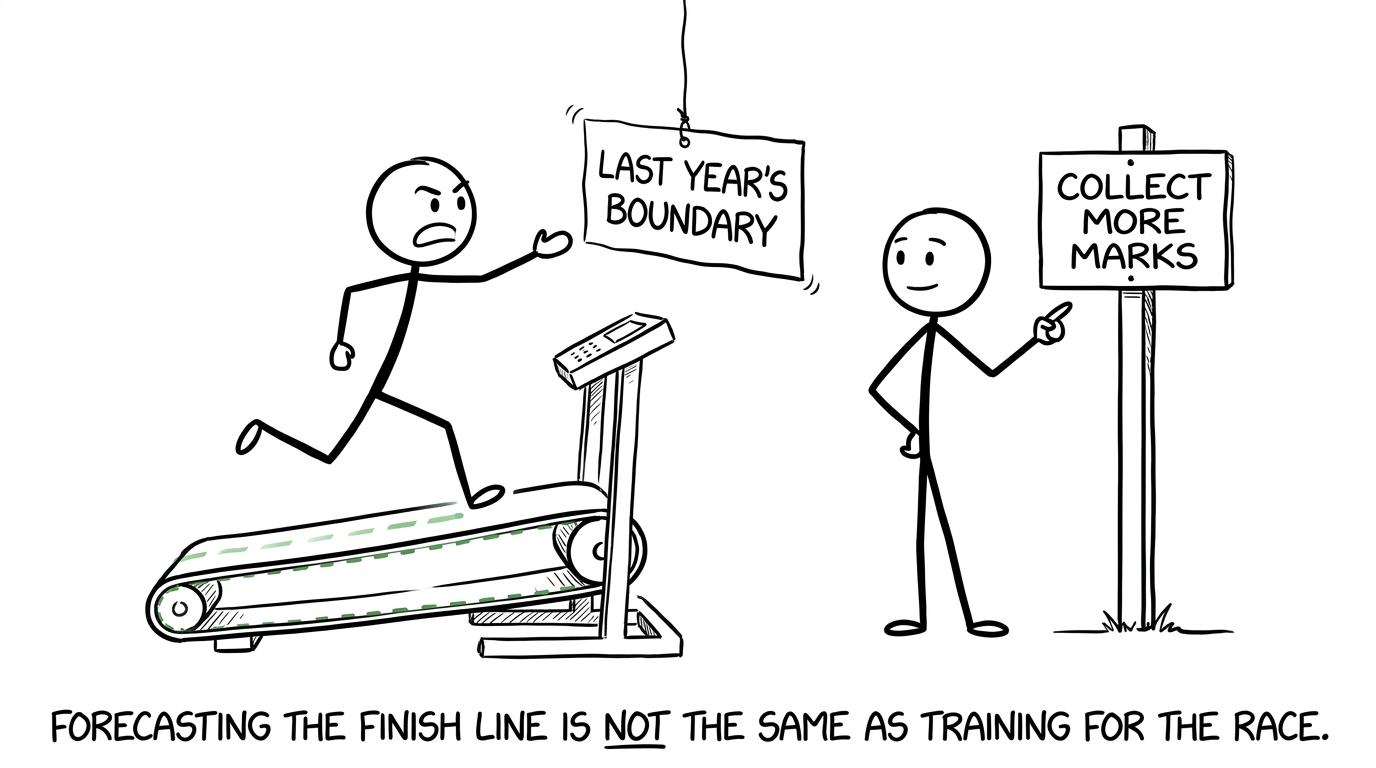 A student chases last year's boundary instead of collecting more marks
Common mistakes when reading Geography boundaries
Treating a percentage as a fixed grade
Schools sometimes use percentage bands for internal assessments. These can support tracking, but they are not automatically the official thresholds for a future GCSE series.
Using the wrong board or specification
AQA figures cannot be applied to Edexcel, OCR or Eduqas papers. Geography A and Geography B may also have different totals and boundaries within the same board.
Looking at one paper in isolation
A notional grade on one component is not necessarily your qualification grade. Add the required component marks and account for any published scaling before using the overall table.
Comparing raw marks with different maximums
A mark out of 200200200 is not directly comparable with the same mark out of 252252252 or 256256256. Even percentage conversion cannot make two different specifications educationally identical.
Assuming a lower boundary means an easier qualification
A lower raw-mark threshold may reflect a more challenging assessment. It does not prove that the subject standard was lower.
Predicting the next boundary from one previous year
Historical figures are useful reference points, not forecasts. Boundaries for a new series are confirmed only after the papers have been sat and the awarding evidence has been reviewed.
Focus on the marks you can still change
Grade boundaries exist because examinations vary slightly while standards should remain comparable. Your raw mark is not converted through a permanent percentage chart, and last year's threshold cannot guarantee this year's grade.
The reassuring part is that you do not need to forecast the boundary. You need to make your knowledge clearer, your evidence more precise and your answers more responsive to the command word.
Start at the MathsGenie GCSE Geography revision hub. Use free revision lessons and guides to rebuild weak topics, then move into practice questions, mini tests, past papers and mark schemes. Near the examination, predicted papers can provide extra rehearsal, while the revision planner helps turn weak areas into a manageable schedule.
After results are released, use the GCSE Geography results day guide to check the correct series and decide what to do if your result is close to another boundary. Until then, let boundaries provide context and let purposeful practice collect the marks.