GCSE Geography Grade Boundaries History 2018-2025
GCSE geography grade boundaries history from 2018 to 2025, with AQA trends, pandemic context and practical advice for interpreting past-paper marks.
A grade boundary can feel like a fixed wall. In reality, it moves after each exam series. This GCSE geography grade boundaries history shows that AQA boundaries have shifted meaningfully since 201820182018, but not in one predictable direction. The practical answer is simple: use the boundary matching each past paper, compare several papers, and never treat a previous boundary as a forecast for your own exam.
The table below tracks AQA GCSE Geography specification 803580358035, where the qualification has a maximum of 252252252 marks. Students following Edexcel, OCR, Eduqas or WJEC must use their own board and specification because marks, papers and boundaries are not interchangeable.
Grade boundary checklist
Before analysing the figures:
- Confirm your exam board and specification.
- Use the boundary from the same year as the paper.
- Add the marks from every component before assigning a qualification grade.
- Treat pandemic-era series separately from normal summer series.
- Look for a range across several papers rather than one reassuring result.
- Remember that the next boundary cannot be known before marking and awarding are completed.
You can identify your course through the GCSE Geography revision hub or go directly to AQA GCSE Geography revision.
Past GCSE Geography grade boundaries by year
These are the confirmed AQA qualification boundaries. Each figure is the minimum total mark out of 252252252 needed for that grade.
| Exam series | Grade 999 | Grade 777 | Grade 555 | Grade 444 |
|---|---|---|---|---|
| June 201820182018 | 183183183 | 144144144 | 107107107 | 898989 |
| June 201920192019 | 184184184 | 147147147 | 112112112 | 959595 |
| November 202020202020 | 175175175 | 139139139 | 101101101 | 828282 |
| November 202120212021 | 172172172 | 135135135 | 989898 | 808080 |
| June 202220222022 | 193193193 | 154154154 | 114114114 | 949494 |
| June 202320232023 | 189189189 | 151151151 | 115115115 | 979797 |
| June 202420242024 | 202202202 | 162162162 | 123123123 | 104104104 |
| June 202520252025 | 199199199 | 161161161 | 124124124 | 106106106 |
The complete set of grades is available on MathsGenie's AQA GCSE Geography grade boundaries page.
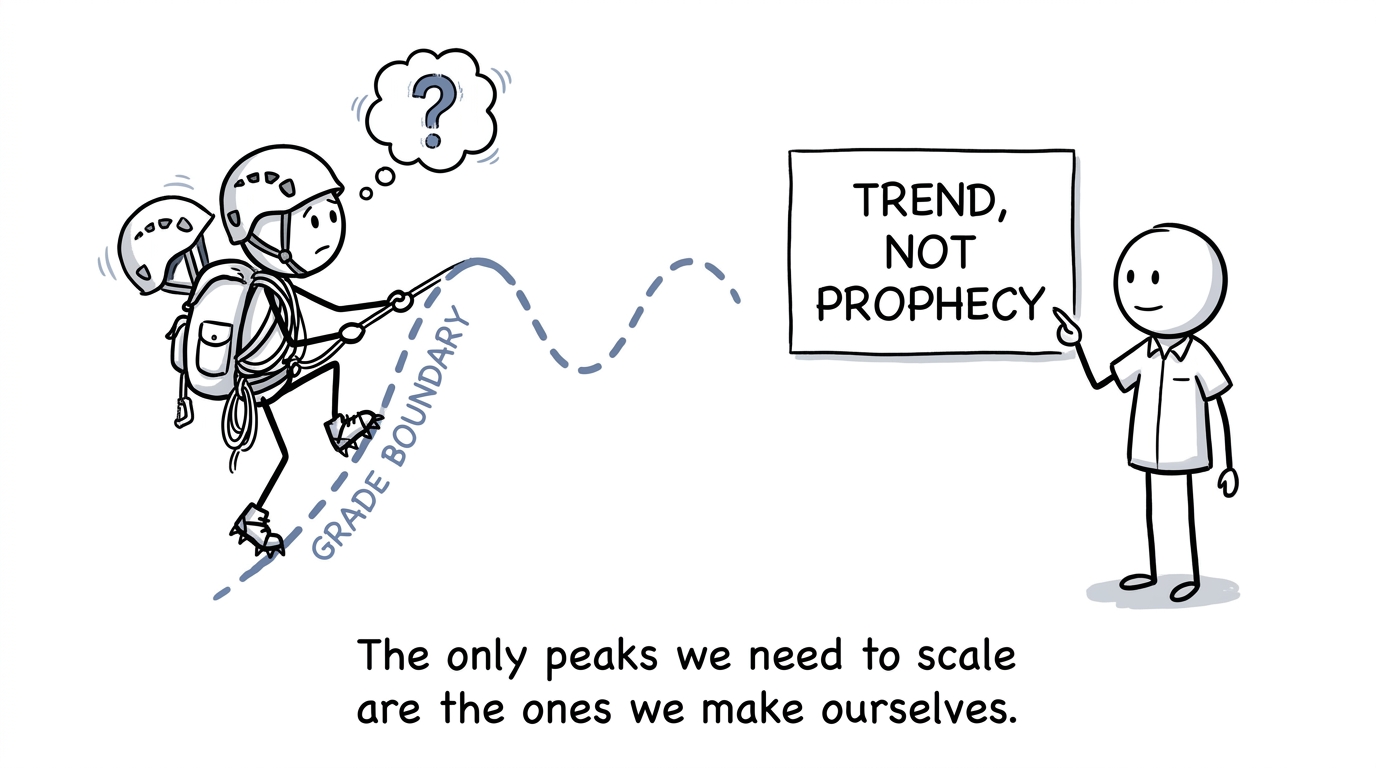 A student treats a small grade-boundary hill like Everest while a teacher recommends looking at the trend
What the year-by-year figures reveal
The pre-pandemic baseline: 201820182018 and 201920192019
AQA's reformed GCSE Geography qualification was first awarded in 201820182018. Its early boundaries were relatively stable. Grade 999 moved from 183183183 to 184184184, while grade 444 rose from 898989 to 959595.
That does not prove that the subject became harder. Boundaries respond partly to the demand of the papers and the quality of work seen by senior examiners. A higher boundary can compensate for a more accessible assessment; a lower boundary can compensate for a more demanding one.
Exceptional series: 202020202020 and 202120212021
There were no summer GCSE exams in England in 202020202020 or 202120212021. The table therefore shows the additional November series, not normal summer cohorts. These boundaries reflected exceptional pandemic grading arrangements and were lower than nearby summer figures.
For example, the grade 777 boundary was 135135135 in November 202120212021, compared with 147147147 in June 201920192019. That makes the November 202120212021 figure unsuitable as a simple target for a normal summer mock.
Ofqual has advised schools to disregard boundaries from exceptional pandemic series when using old papers to indicate grades under normal arrangements. The paper remains useful practice; its historical boundary needs context.
The transition year: 202220222022
Summer exams returned in 202220222022, but grading was deliberately transitional. Ofqual aimed for outcomes broadly midway between 201920192019 and 202120212021, recognising disruption while beginning the return to pre-pandemic standards.
AQA Geography boundaries rose sharply from the small November 202120212021 series. Grade 999 reached 193193193, while grade 444 reached 949494. This jump reflects a changed grading context as well as the particular paper. It should not be read as evidence that students suddenly knew less.
The return to normal grading: 202320232023
In 202320232023, grading returned broadly to pre-pandemic standards, with protection for students built into the process. Geography boundaries did not simply return to their 201920192019 values: grade 999 was 189189189, grade 777 was 151151151, and grade 444 was 979797.
This is an important lesson from GCSE geography grade boundary trends. Maintaining a comparable standard does not require identical raw-mark boundaries. Different papers can require different marks to demonstrate comparable performance.
Recent movement: 202420242024 and 202520252025
The grade 999 boundary rose to 202202202 in 202420242024, the highest figure in this table, before falling slightly to 199199199 in 202520252025. Meanwhile, grade 444 continued upwards from 104104104 to 106106106.
Across the full period from June 201820182018 to June 202520252025, grade 999 increased by 161616 marks and grade 444 increased by 171717 marks. Yet the route was uneven. The sensible conclusion is not that boundaries will keep rising. It is that recent papers have required different raw marks, and no straight line can predict the next award.
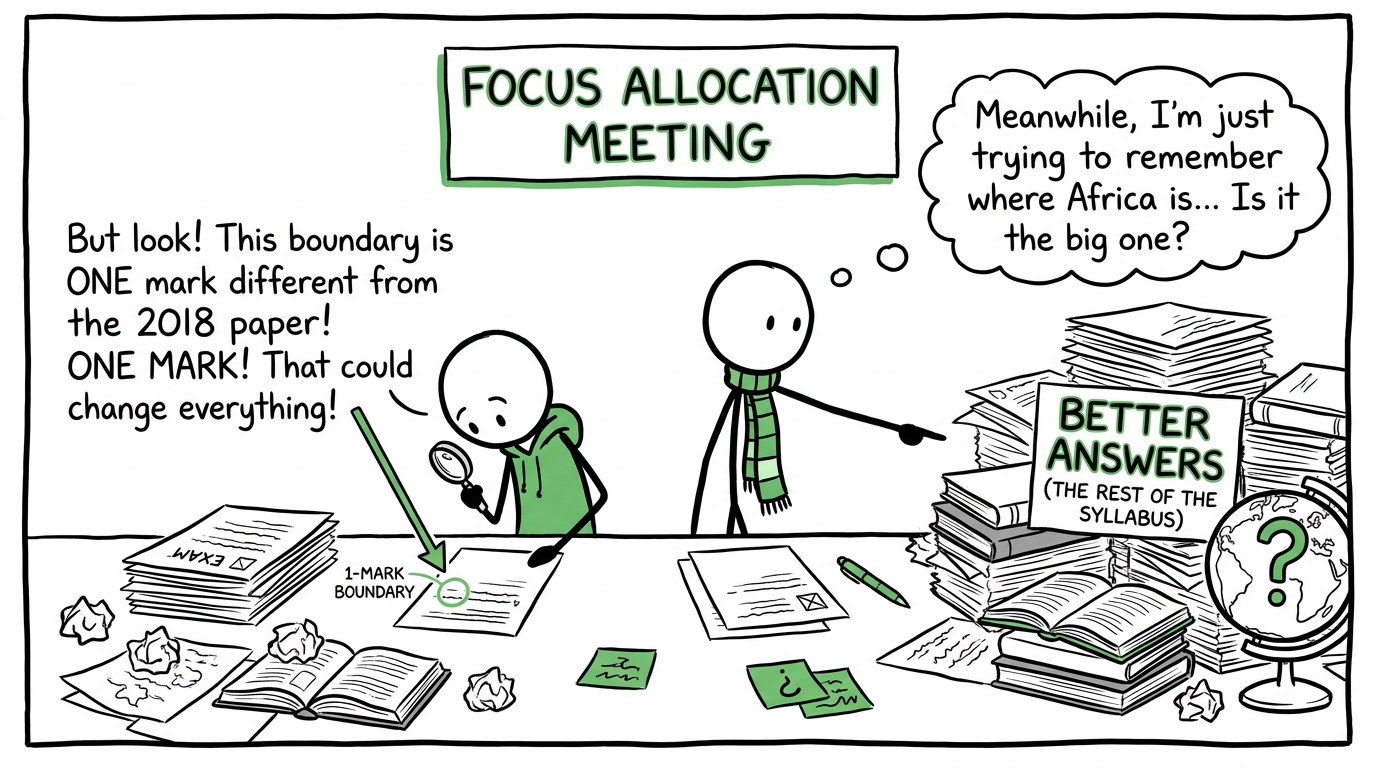 One student studies a tiny one-mark change while another points towards the much larger task of improving answers
How to use boundary trends in revision
Complete a paper under timed conditions, mark it strictly, and use the boundary from that exact series. MathsGenie's AQA predicted grade calculator makes that comparison quicker.
Then repeat the process. Three results around grades 555, 666 and 666 tell you more than one grade 777 achieved on a familiar paper. Record both the grade and the raw mark so you can see whether your underlying performance is improving.
Use boundaries to measure revision, not direct it. The most valuable evidence is still inside your answers: missed command words, unsupported judgements, weak case-study detail or inaccurate graph interpretation. The AQA graphical skills revision guide can help with data questions, while the geographical enquiry and argument guide supports extended responses.
Students on another specification should switch resources rather than borrowing AQA figures. For example, use Edexcel A GCSE Geography revision or the relevant Eduqas Geography grade boundaries.
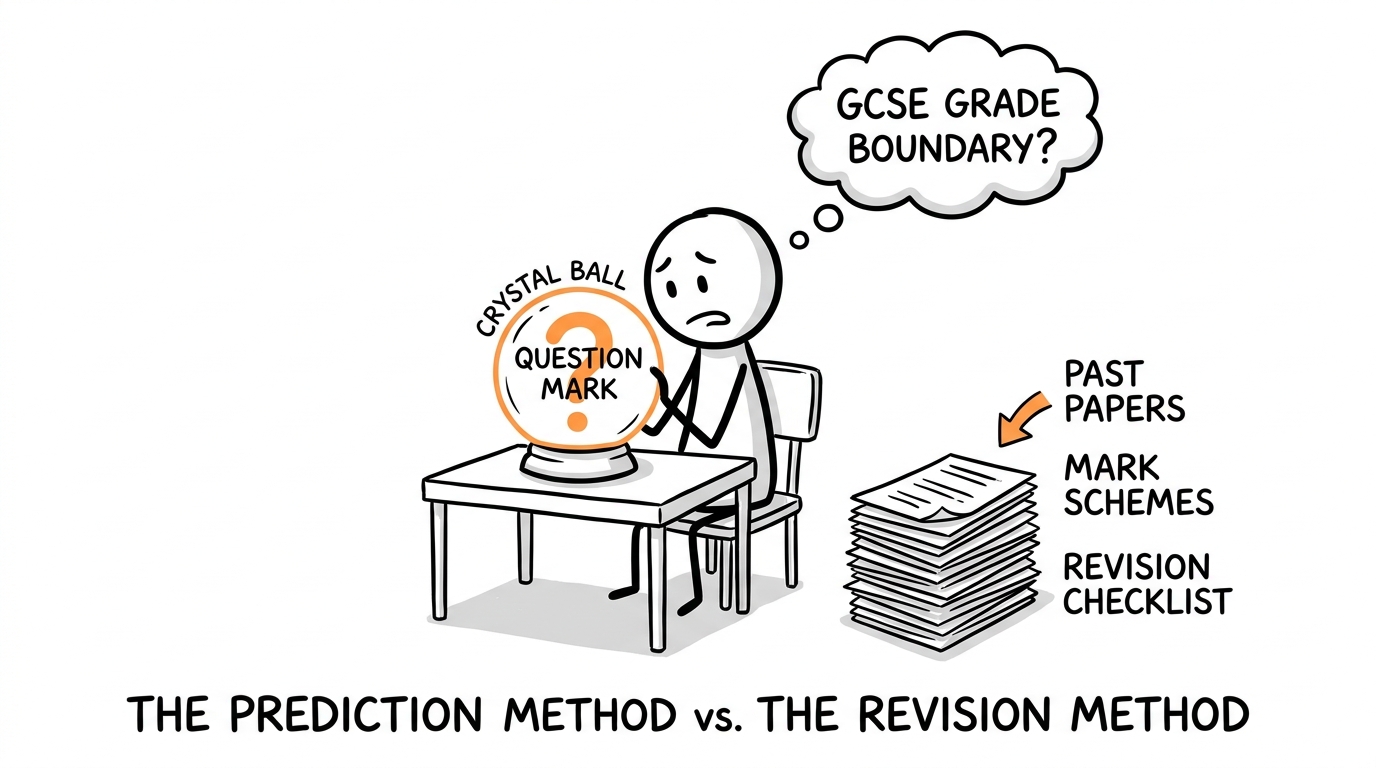 A crystal ball refuses to predict the next boundary while a useful pile of past papers waits nearby
Common mistakes when analysing boundaries
- Mixing exam boards: an AQA total cannot be compared with an Edexcel, OCR or Eduqas boundary.
- Using component boundaries as final grades: notional paper boundaries are illustrative; the qualification boundary applies to the combined total.
- Ignoring changed maximum marks: some pandemic-era assessments were altered, particularly across specifications other than AQA.
- Treating 202020202020 and 202120212021 as ordinary summer years: the normal summer examinations did not take place.
- Predicting the next boundary from a trend line: boundaries are confirmed only after students' work has been marked and reviewed.
- Aiming exactly at the boundary: build a margin for variation in paper difficulty, marking and exam-day performance.
Turn historical data into better preparation
Past GCSE Geography grade boundaries are useful because they translate a marked paper into historical context. They cannot promise your final grade, and they cannot tell you what the next boundary will be.
The productive response is steady: complete unfamiliar papers, apply official mark schemes honestly, investigate lost marks and revisit weaker topics. Start with MathsGenie's free GCSE Geography past papers and revision resources, then use the revision lessons, practice questions, predicted papers and mini tests to close specific gaps. The boundary may move. Better answers remain the part you can control.