GCSE Geography Careers: Jobs and Apprenticeships
GCSE geography careers explained: explore jobs, apprenticeships and valued maths skills, from GIS and surveying to planning and conservation work.
A geography grade can feel strangely difficult to place. You can picture what it means to become a doctor after biology or an engineer after physics, but where does river fieldwork lead? Who employs someone who can interpret a population pyramid?
The direct answer is that GCSE geography careers include geospatial mapping, surveying, environmental management, conservation, planning, transport, logistics, tourism and data analysis. A good grade rarely secures a job by itself. What it can do is provide relevant evidence: you can analyse data, understand places, interpret maps, investigate problems and reach conclusions supported by facts.
That combination becomes especially useful when it sits beside a solid GCSE maths grade.
The quick careers checklist
Geography is particularly relevant if you are interested in:
- maps, location data and Geographic Information Systems (GIS)
- land, property, construction or surveying
- climate, flooding and environmental management
- conservation, agriculture and countryside work
- towns, housing and transport planning
- logistics, retail locations and supply chains
- hazards, risk, insurance and emergency planning
- travel, tourism and international development
Possible routes include A Levels, college courses, T Levels where available, advanced apprenticeships, higher apprenticeships and degree apprenticeships. Entry requirements vary between employers and across England, Scotland, Wales and Northern Ireland, so always check the live vacancy rather than assuming one rule applies everywhere.
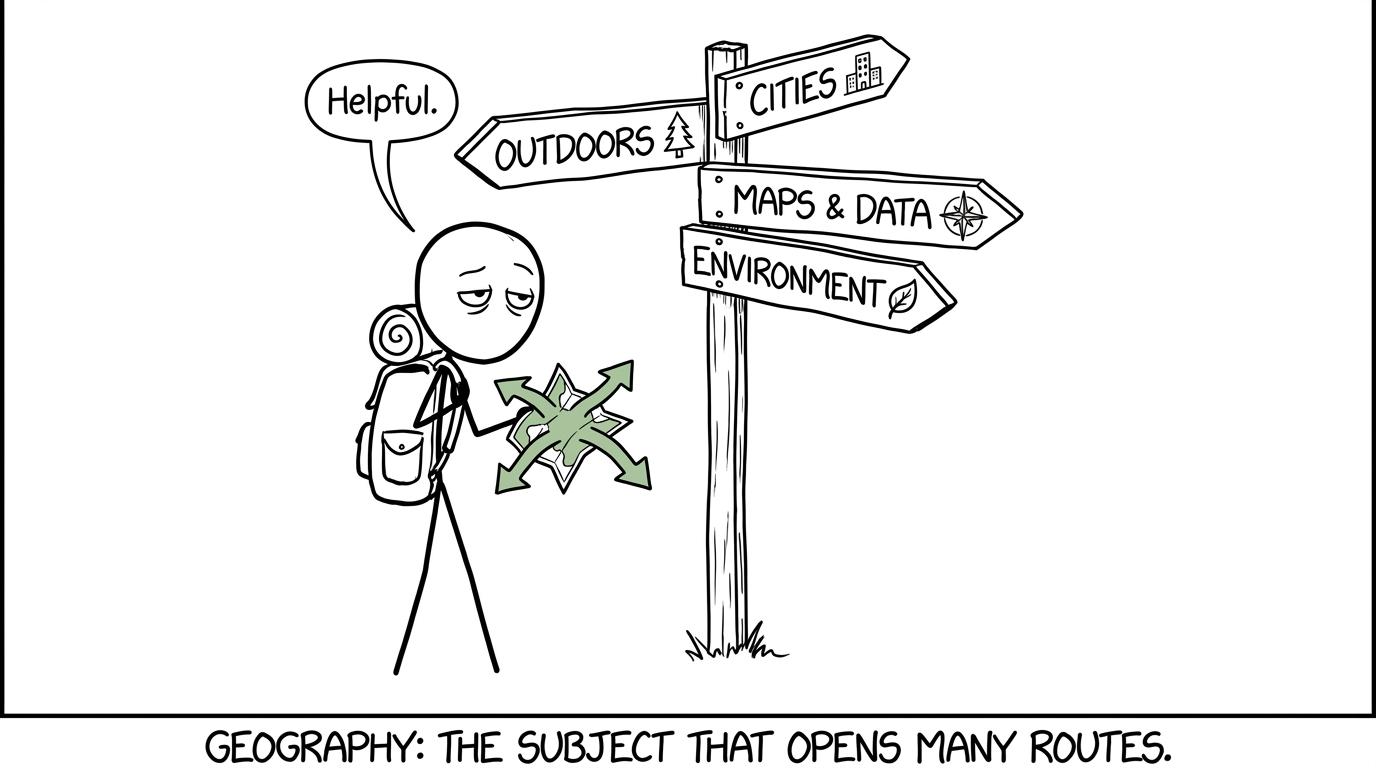 A GCSE student faces several geography career paths while an unhelpful map points everywhere
Where does a good GCSE Geography grade get noticed?
Geography is most likely to be noticed when an application involves place, people, land, data or the environment. It tells an employer or course provider more when you connect the grade to a skill.
For example, fieldwork can demonstrate planning, observation, sampling and teamwork. A data-presentation task can show that you understand suitable graphs and scales. An extended response can demonstrate that you can compare evidence and make a justified decision.
The grade matters differently at each stage:
- Sixth forms and colleges may use it when deciding whether you can continue with A Level Geography or a related course.
- Apprenticeship employers may see it as a useful related qualification, even when their formal GCSE requirements focus on English and maths.
- Universities usually make offers using post-161616 qualifications, but your GCSE profile can still form part of the wider application.
- Employers later on are normally more interested in your highest qualifications, experience and technical skills, although GCSE results can remain relevant early in your career.
The important distinction is between useful and required. Geography may strengthen an application without appearing in the essential-entry-requirements box.
Careers closely connected to geography
GIS, mapping and cartography
GIS is used to store, analyse and display information connected to location. It can help organisations examine flood exposure, plan infrastructure, manage utilities or understand where services are needed.
Relevant roles include GIS technician, mapping technician, cartographer, geospatial analyst and remote-sensing specialist. Some require further technical training or a degree, but apprenticeship and trainee routes also exist.
GCSE geography supports the first layer of this work: coordinates, scale, map interpretation, spatial patterns and evidence-based conclusions. Maths then strengthens the analysis. The overlap includes ratio, units, accuracy, graphs and statistics.
MathsGenie's free geographical graphical skills guide is a useful place to practise choosing and interpreting representations rather than merely looking at them.
Surveying, land and the built environment
Surveyors measure, value and manage land, property and construction projects. The sector includes land surveying, building surveying, quantity surveying, rural surveying and planning and development surveying.
Geography helps because land is never just an empty surface. Its use is shaped by access, terrain, environmental risk, population, planning policy and competing demands. Maths matters because measurements, scale, area, cost and accuracy must be handled reliably.
A GCSE Geography grade can therefore look relevant when applying for surveying, geospatial or construction-related training. However, current apprenticeship vacancies often specify GCSE English and maths explicitly, while geography is treated as useful supporting evidence. Read each vacancy carefully.
Environmental management and conservation
Environmental work covers far more than observing wildlife. Organisations need people who can collect field data, assess environmental effects, manage habitats, monitor water, investigate pollution and communicate findings.
Possible careers include environmental technician, countryside ranger, conservation officer, flood-risk assistant, sustainability officer and, after further training, environmental consultant or hydrologist.
Physical geography provides useful context: ecosystems, rivers, coasts, weather, climate and natural hazards. Human geography matters too, because environmental decisions affect homes, businesses, transport and public spending.
This is where balanced judgement becomes valuable. The AQA issue evaluation revision guide develops the habit of comparing social, economic and environmental evidence before reaching a conclusion.
Town planning, housing and transport
Planners make decisions about how places develop. They may consider where homes should be built, how a town can reduce congestion, whether services are accessible or how development could affect flood risk.
Related careers include town planner, planning technician, transport planner, housing officer and regeneration officer. Professional roles generally require further qualifications, but assistant, technician and apprenticeship routes can offer earlier entry points.
Geography is relevant because planning joins physical and human systems together. You need to understand maps and data, but also stakeholders: residents, businesses, councils, developers and environmental groups may want different things.
Business, logistics and location analysis
A less obvious geography route sits inside ordinary businesses. Retailers consider where customers live. Logistics teams plan how goods move. Insurers assess risks associated with flooding, weather and property location. Tourism organisations examine visitor patterns and the effects of seasonal demand.
Job titles may not contain the word geography, yet the work can still involve spatial thinking. Roles may include logistics coordinator, location-planning analyst, risk analyst, market researcher or tourism officer.
This is why transferable skills matter. Knowing a case study is useful in an examination; knowing how to extract a pattern from imperfect evidence can remain useful for years.
Geography apprenticeships worth exploring
There is no single apprenticeship called simply “geography”. Instead, geographical knowledge appears across several occupational routes.
Current route names and availability can change, but useful search terms include:
| Area | Apprenticeship searches to try | Geography connection |
|---|---|---|
| Geospatial work | Geospatial survey technician; geospatial mapping and science | Coordinates, mapping, spatial data and field measurement |
| Surveying | Surveying technician; land or property pathways | Scale, land use, measurement and development |
| Environment | Environmental practitioner; countryside or water roles | Ecosystems, sampling, sustainability and hazards |
| Planning and transport | Planning technician; transport planning | Settlements, accessibility, population and data |
| Construction and infrastructure | Civil engineering or built-environment technician | Landscapes, risk, maps, units and site evidence |
Official careers information confirms that geospatial routes can include advanced and degree apprenticeships. As a broad guide, an advanced apprenticeship is Level 333, while degree apprenticeships commonly sit at Levels 666 or 777. These levels do not create universal entry rules: the employer decides the requirements for each vacancy.
Many advanced vacancies ask for several GCSEs at grades 999 to 444, commonly including English and maths. A strong geography result can help distinguish you when the role involves mapping, fieldwork or environmental understanding, but it should not be treated as a substitute for the stated essentials.
Why maths makes geography more employable
Modern geography is partly a data subject. Official GCSE specifications from boards including AQA, OCR and Eduqas require cartographic, graphical, numerical and statistical skills. These can include scale, ratio, percentage change, averages, spread, sampling and relationships between variables.
One recurring calculation is percentage change:
Percentage change=new value−original valueoriginal value×100\text{Percentage change}=\frac{\text{new value}-\text{original value}}{\text{original value}}\times 100Percentage change=original valuenew value−original value×100The same reasoning appears when comparing populations, rainfall, traffic, visitor numbers or environmental measurements. Meanwhile, scatter graphs help you examine whether two variables appear related. Correlation must not automatically be treated as causation, an important idea in geography, maths and workplace data analysis.
Use MathsGenie's AQA geographical statistical skills guide alongside the scatter graphs revision guide. If data is a particular strength, the wider GCSE Statistics revision hub can help you explore it further.
How to turn geography into application evidence
Simply writing “I am good at geography” is weak. Show what you did.
A stronger skills record might include:
- planned a fieldwork enquiry and followed a sampling method
- collected primary data accurately and recognised limitations
- used maps, graphs or statistics to identify a pattern
- compared conflicting viewpoints before making a recommendation
- worked with others and communicated findings clearly
- evaluated whether evidence was reliable or representative
Keep your best fieldwork summary, map, presentation or report if your school permits it. You are building a small portfolio of evidence, not just collecting a grade.
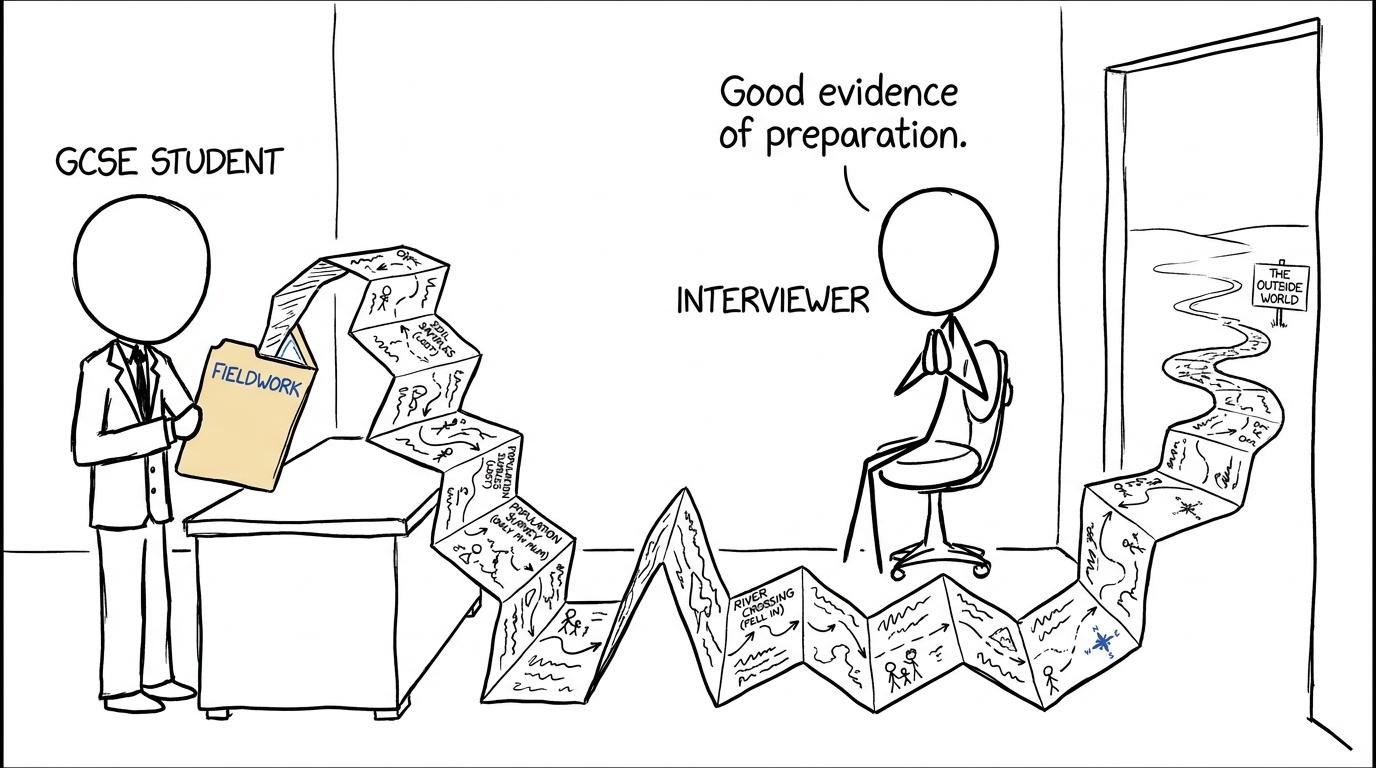 A geography fieldwork map unfolds dramatically across a job interview
Common mistakes when planning a geography career
Searching only for jobs called “geographer”
Most relevant vacancies use titles such as GIS technician, surveyor, planner, environmental officer or risk analyst. Search by skill and sector, not only by school-subject name.
Assuming geography replaces maths
For technical apprenticeships, GCSE maths is frequently an explicit requirement. Geography complements numerical confidence; it does not remove the need for it. Check the full GCSE maths topic list by board and tier to identify gaps in statistics, ratio, units and graphs.
Treating one GCSE as a complete qualification
GCSE Geography is a foundation. Specialist careers may require A Levels, a college course, an apprenticeship, professional accreditation or a degree. Research the whole route before choosing post-161616 subjects.
Ignoring live entry requirements
Apprenticeship standards describe an occupation, but individual vacancies decide what applicants need. Requirements and availability can change. Check the employer's listing and ask your school or college careers adviser if anything is unclear.
Revising knowledge but neglecting skills
Knowing coastal processes will not compensate for misreading an axis or using an unsuitable average. Use revision lessons first, then answer questions and check the mark scheme. The MathsGenie resources collection provides mini tests and self-assessment materials for finding weaknesses.
Your next step starts with the skills you can build now
A GCSE does not choose your future. It gives you evidence and options. Geography is especially valuable when you can say, with examples, that you understand location, analyse information, recognise uncertainty and make reasoned decisions.
Maths makes that evidence stronger. Begin with one weak quantitative topic, use a MathsGenie revision lesson, complete practice questions and check every error against the mark scheme. Then build exam stamina with GCSE predicted papers, past papers, mini tests and video solutions. Add each result to the MathsGenie revision planner so your next session answers a real need.
The career may eventually involve a river, a city, a satellite image or a construction site. For now, the useful move is smaller: strengthen the skills that keep all those routes open.