

GCSE Further Maths to A-Level Jump: What Changes?
GCSE further maths to A-level jump explained: compare pace, proof, abstraction and workload, then learn how to prepare with a practical revision plan.
A difficult GCSE Further Maths question can fill a page. That makes it tempting to imagine A Level Further Maths as the same page, only longer. It is not.
The GCSE further maths to A-level jump is partly a rise in difficulty, but the more important change is how the subject feels. Ideas become more abstract, topics depend more heavily on one another, and unfamiliar problems ask you to choose a strategy rather than recall a familiar sequence of steps.
There is an important distinction too: A Level Further Maths is normally taken alongside A Level Maths. GCSE Further Maths is useful preparation, but it is not a miniature version of the entire A Level course or a compulsory entry ticket.
The jump at a glance
Here is the practical comparison:
- GCSE Further Maths extends Higher GCSE topics and introduces ideas such as calculus and matrices.
- A Level Maths develops the essential algebra, trigonometry, calculus, mechanics and statistics on which Further Maths depends.
- A Level Further Maths introduces substantially broader ideas, including complex numbers, proof by induction and more advanced matrix work.
- Lessons move faster because strong algebraic fluency is often assumed.
- Questions are more likely to combine several topics.
- Notation becomes a working language, rather than something added after the method.
- Consistent practice matters more than occasional long revision sessions.
If you are currently preparing for GCSE exams, begin with the AQA GCSE Further Maths revision area or strengthen your wider foundations through the GCSE Maths revision hub.
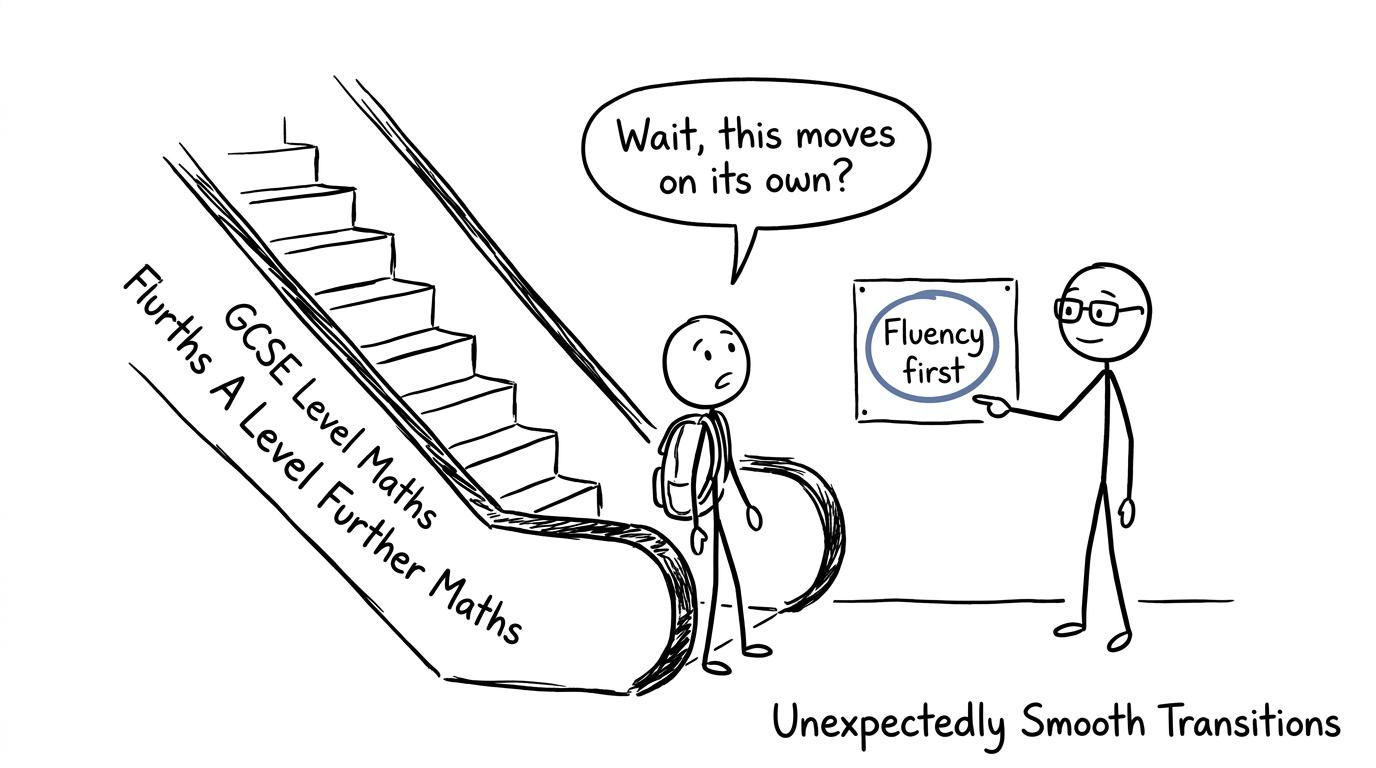 A student discovering that the route from GCSE Further Maths to A Level Further Maths is an unexpectedly moving staircase
GCSE Further Maths and A Level Further Maths are different qualifications
The word “Further” makes the courses sound like consecutive volumes of the same book. In reality, there is another volume between them: A Level Maths.
A common GCSE-stage qualification is the AQA Level 2 Certificate in Further Mathematics. It is an untiered additional qualification intended mainly for students expected to achieve grades 777, 888 or 999 in GCSE Maths. Its content builds on Key Stage 4 mathematics, extending algebra and geometry while introducing calculus and matrices.
That makes it valuable preparation. However, it remains a Level 2 qualification. A Level Further Maths is Level 3 and assumes that students are also developing the content of A Level Maths.
Across AQA, Edexcel, OCR and Eduqas, precise course structures and optional routes vary. National A Level Further Maths subject content requires a prescribed core covering approximately half of the qualification, while exam boards determine routes through the remaining content. Depending on the board and school, options may include further pure mathematics, mechanics, statistics or discrete mathematics.
Always check your prospective sixth form’s entry requirements and chosen exam board. Schools may set their own grade expectations and may teach A Level Maths and Further Maths in different orders.
What GCSE Further Maths genuinely prepares you for
GCSE Further Maths gives you more than a collection of extra topics. Its greatest value is the habit of staying calm when familiar mathematics appears in an unfamiliar form.
Stronger algebraic fluency
Algebra is the infrastructure beneath most advanced mathematics. At GCSE Further Maths, you may work with functions, algebraic fractions, the factor theorem, more demanding equations and sophisticated graph transformations.
At A Level, those skills are rarely isolated. They sit inside calculus, coordinate geometry, sequences, differential equations and mechanics. A small algebraic weakness can therefore interrupt an otherwise correct solution.
Before Year 12, you should be comfortable manipulating expressions involving powers, fractions and surds, and interpreting notation such as f(x)f(x)f(x), f−1(x)f^{-1}(x)f−1(x) and fg(x)fg(x)fg(x). The GCSE topics by exam board and tier guide can help you identify Higher-tier gaps that still need attention.
An introduction to calculus
Level 2 Further Maths can introduce differentiation, including the idea that
dydx\frac{dy}{dx}dxdyrepresents the gradient function. Students may also use derivatives to investigate stationary points.
This is a helpful first encounter, but A Level calculus is much broader. You will meet additional differentiation and integration techniques, connected rates of change, differential equations and more demanding applications. A Level Further Maths then extends the subject again.
The advantage is not that you have “completed calculus early”. It is that notation and rates of change no longer feel completely foreign.
Early experience of matrices
GCSE Further Maths may include matrix multiplication and matrices representing transformations. A Level Further Maths develops matrices much further, potentially including determinants, inverses, three-dimensional transformations, systems of equations, eigenvalues and eigenvectors.
The shared vocabulary creates a useful foothold. It does not remove the climb.
How A Level Further Maths actually feels different
The real jump is easier to understand through the experience of learning, rather than a list of topics.
The pace is faster
At GCSE, a topic may be introduced, practised and revisited over several lessons. In A Level Further Maths, a definition can arrive early in a lesson and become part of a multi-stage argument before the lesson ends.
This pace is manageable when prerequisite skills are automatic. If factorising, rearranging equations or using trigonometric identities still demands most of your attention, there is less capacity left for the new idea.
That is why fluency matters. It is not about racing through easy questions. It is about freeing enough attention to think.
The subject becomes more abstract
GCSE mathematics often connects ideas to measurable quantities, diagrams or familiar graphs. A Level Further Maths moves further into objects defined by their mathematical properties.
Complex numbers provide a clear example. The number iii is defined by
i2=−1.i^2=-1.i2=−1.From that definition grows an entire system involving algebra, geometry, loci and transformations on an Argand diagram. The challenge is not simply calculation. You must accept a new object, understand its rules and move between different representations of it.
Proof by induction creates a similar shift. Instead of confirming that a claim works for several values, you construct a logical argument showing why it must continue to hold. The course rewards precision of thought as much as computational accuracy.
Topics stop living in separate boxes
A GCSE revision list can make topics feel independent: quadratics on Monday, trigonometry on Tuesday, vectors on Wednesday. Advanced questions are less respectful of those boundaries.
A single problem may require you to interpret a geometric situation, form an algebraic expression, use a trigonometric identity and then apply calculus. The individual tools may be familiar. Choosing and connecting them is the difficult part.
This is why mixed practice becomes increasingly important. Topic questions build a method; mixed papers test whether you can recognise when to use it.
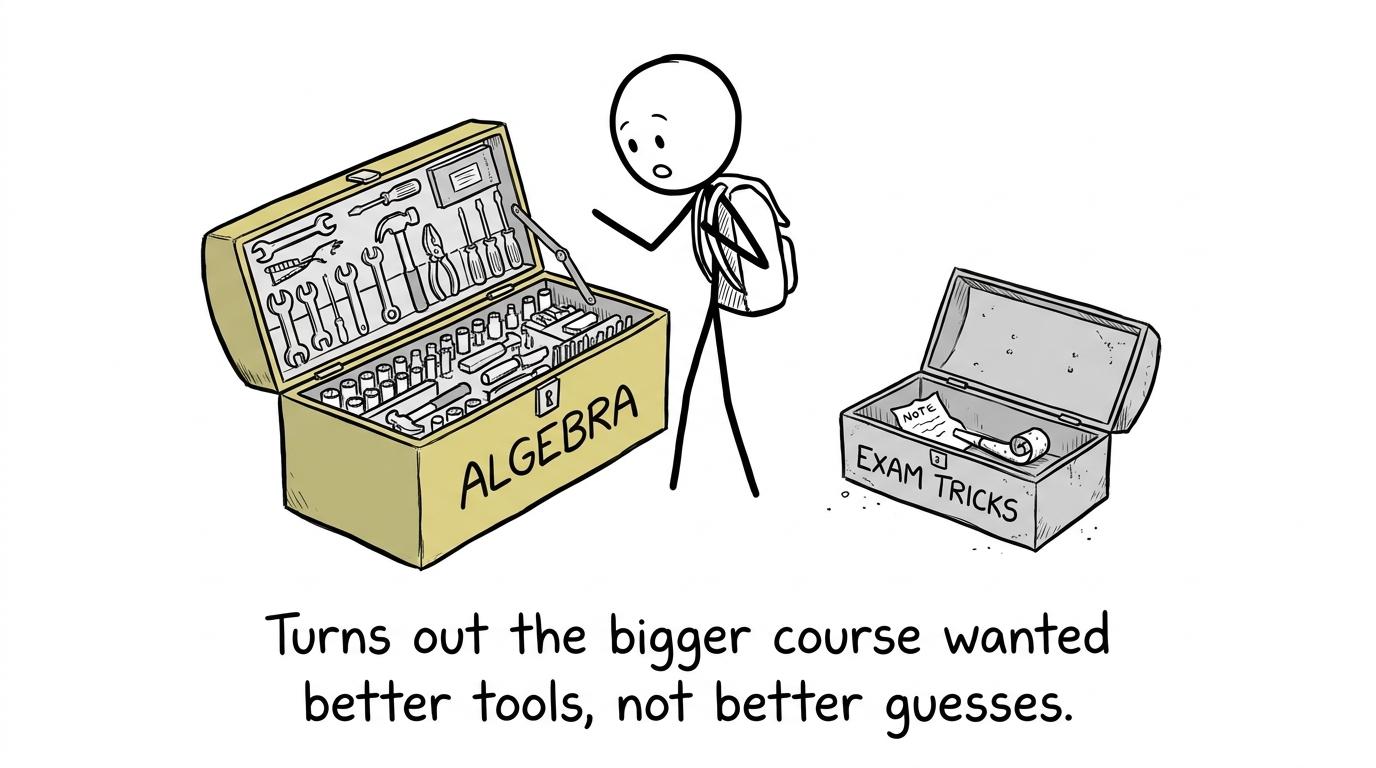 A student finding many useful algebra tools and almost no exam tricks
Explanations carry more weight
At GCSE, a correct numerical answer may sometimes secure most available marks. At A Level, method, notation and logical structure become increasingly important.
You may need to state assumptions, justify an implication or show that a result follows for every permitted value. An answer can be numerically plausible yet mathematically incomplete.
Mark schemes are therefore not merely answer sheets. They reveal the standard of communication expected. When reviewing practice, compare the structure of your reasoning as well as the final result.
Is A Level Further Maths only for exceptionally fast students?
No. Speed can help in timed examinations, but it is not the defining quality of a successful Further Maths student.
More useful qualities include:
- secure algebraic foundations;
- curiosity about why methods work;
- patience with definitions and notation;
- willingness to revisit errors;
- comfort asking for help before confusion compounds;
- regular practice across the week.
GCSE Further Maths performance offers evidence about your readiness, but it is not a perfect prediction. A student who finds Level 2 content demanding can still progress strongly by repairing gaps and working consistently. Equally, finding GCSE Further Maths easy does not guarantee that the A Level transition will require no adjustment.
Your GCSE grade is a snapshot. Your habits travel with you.
How to prepare for the GCSE Further Maths to A-level jump
Preparation should not mean attempting the whole A Level specification during the summer. That often creates shallow familiarity without secure understanding.
Secure Higher GCSE content first
Prioritise algebra, functions, graphs, trigonometry, vectors and proof. These are high-value foundations because they reappear inside many later topics.
Use the best order for learning GCSE maths topics to organise any unfinished revision. If GCSE exams are still ahead, your immediate priority should remain your current specifications and marks.
Revise actively
Watching a video can make a method feel familiar, but familiarity is not the same as recall. A stronger cycle is:
- learn or revisit one idea;
- answer questions without notes;
- mark the work carefully;
- classify each error;
- retry the question after a gap;
- test the skill later in mixed practice.
MathsGenie’s revision lessons, practice questions, mini tests, video solutions and mark schemes support each stage. If you are unsure when to introduce full papers, read the guide to starting GCSE past papers.
Build a short, sustainable routine
Four focused sessions of around 303030 minutes are usually more useful than one unfocused block of 222 hours. During the transition to A Level, divide sessions between algebraic fluency, current class content and mixed retrieval.
A simple weekly structure might include:
- one session revisiting prerequisite algebra;
- two sessions on current lessons and practice questions;
- one short mixed test followed by corrections.
As examinations approach, use the appropriate A Level predicted papers and board-specific resources. For example, the OCR A Level Maths revision area includes lessons, exam-style questions and papers. Use the corresponding page for your own board where available.
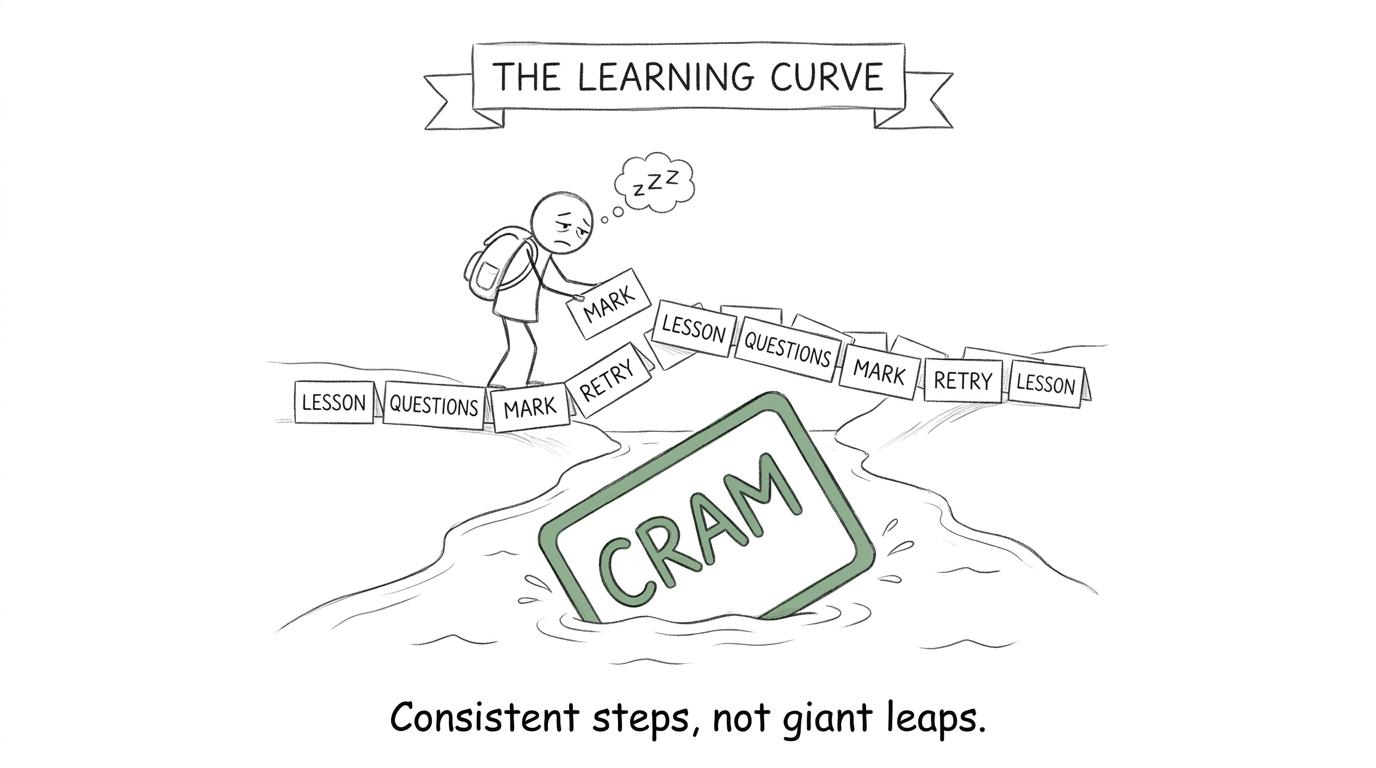 A student building a revision bridge from small consistent steps while cramming sinks
Common mistakes when preparing for the jump
Treating GCSE Further Maths as the whole foundation
A Level Further Maths also relies on ordinary A Level Maths. Do not neglect statistics, mechanics or core pure topics simply because they feel less connected to your GCSE Further Maths course.
Learning advanced topics before fixing algebra
Complex numbers may look more exciting than algebraic fractions, but advanced ideas cannot compensate for unreliable manipulation. Repair the foundation first.
Mistaking recognition for mastery
If a solution looks obvious when it is open beside you, close it and reproduce the reasoning independently. Only unaided recall shows what is secure.
Revising only one topic at a time
Blocked practice is useful while learning. It should eventually be followed by mixed questions, mini tests and papers that force you to select methods.
Ignoring errors after marking
A mark scheme is most useful after you identify why each mark disappeared. Separate conceptual errors, algebra slips, notation problems and misread instructions. Each type needs a different response.
The jump is real, but it is not mysterious
A Level Further Maths feels different because it asks for more than harder calculations. It requires you to hold definitions carefully, connect topics, communicate logical arguments and continue when the route is not immediately visible.
GCSE Further Maths gives you an excellent head start, particularly in algebra, functions, calculus and matrices. The students who adapt best, however, are not necessarily those who race furthest ahead. They are the ones who make their foundations dependable and turn mistakes into a revision plan.
Start with MathsGenie’s AQA GCSE Further Maths lessons and papers, then use revision lessons, practice questions, mini tests and mark schemes to close specific gaps. As you progress, add past papers, predicted papers and video solutions. The jump becomes less intimidating when every practice session gives you one clear next step.










