GCSE Further Maths Time Pressure Mistakes to Avoid
GCSE further maths time pressure mistakes cost easy marks. Learn to pace questions, protect working, check signs and finish your exam calmly and accurately.
The clock changes how a maths question feels. An algebraic step that looked ordinary during revision can suddenly seem uncertain, while a difficult question quietly consumes the minutes needed for several easier ones. The most damaging gcse further maths time pressure mistakes are rarely dramatic. They are missed signs, absent brackets, premature rounding, unanswered parts and correct methods hidden inside rushed working.
The solution is not simply to work faster. It is to make fewer costly decisions under pressure: read precisely, show enough working, move on before one question traps you and reserve time for targeted checks.
A brief qualification note: students often say “GCSE Further Maths”, but the widely taken AQA course is formally the AQA Level 2 Certificate in Further Mathematics. Its current assessment has two compulsory papers, each worth 808080 marks and lasting 105105105 minutes. Paper 111 is non-calculator and Paper 222 allows a calculator. Always confirm the exact specification and arrangements for your own qualification with your school.
The quick time-pressure checklist
Before exploring why marks disappear, keep this short routine in mind:
- Read the command word and required answer form before calculating.
- Use the available marks as a rough pacing signal, not a rigid stopwatch rule.
- Write one clear mathematical step per line.
- Keep brackets, negative signs and powers visible.
- Do not round intermediate values unless instructed.
- If you are stuck, leave useful working, mark the question and return later.
- Check unanswered parts before repeatedly checking answers you already trust.
- In the final minutes, inspect signs, substitutions, accuracy and requested forms.
You can develop this routine with the free AQA GCSE Further Maths revision hub, where lessons and practice materials sit together.
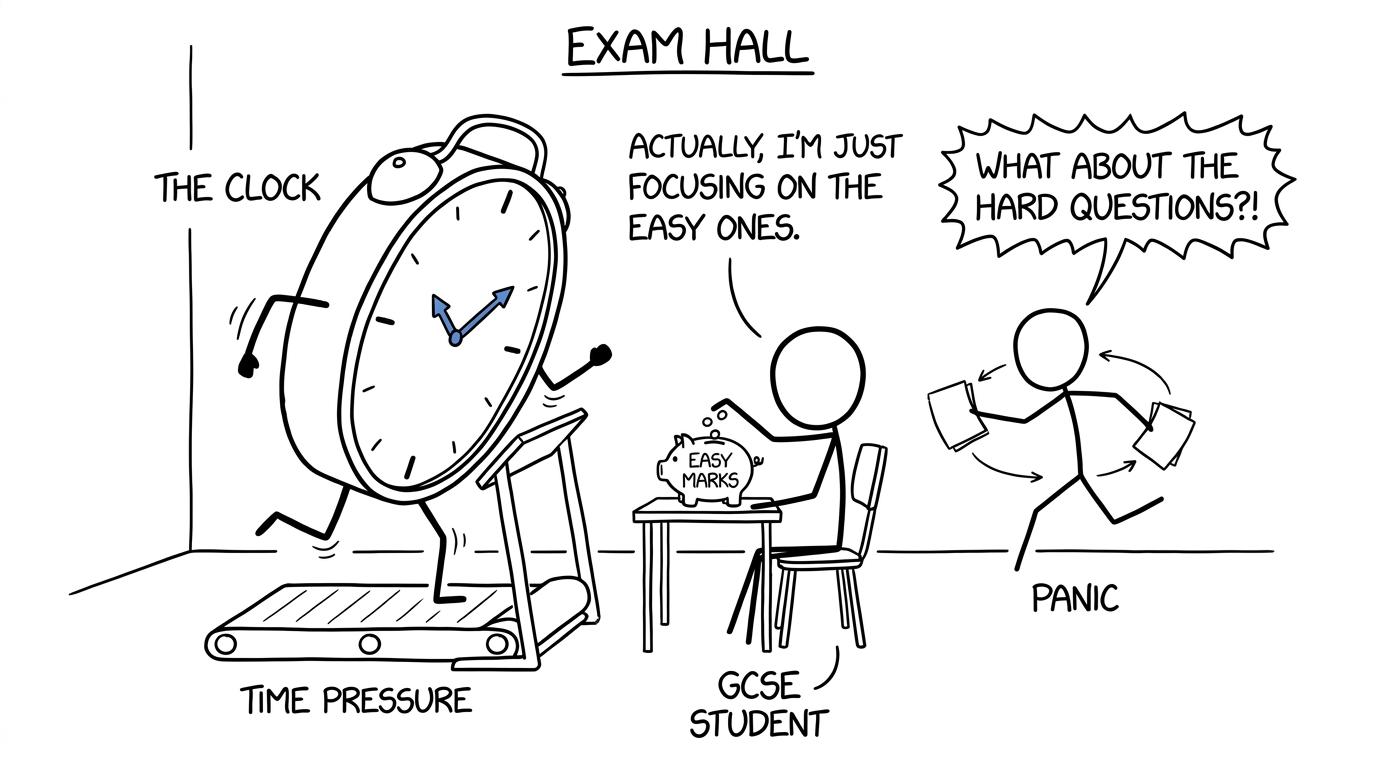 A student calmly banking easy marks while panic races the clock
Why time pressure creates avoidable errors
Pressure narrows attention. A student becomes focused on reaching an answer and stops monitoring the small details that make the method valid. Further Maths makes this particularly costly because its questions often involve linked algebraic stages. One early sign error can travel through factorisation, coordinate geometry, matrices, sequences or differentiation.
AQA examiner materials repeatedly identify issues such as unclear proof, premature approximation, mishandled subtraction and missing brackets. These are not always gaps in understanding. Often, the student knows the mathematics but their written process becomes fragile.
That distinction matters. A knowledge gap needs a lesson. A pressure mistake needs a repeatable exam habit.
Common mistakes that lose easy marks
Spending too long on one difficult question
The hardest question on the page can become strangely persuasive. After investing several minutes, moving on feels like admitting defeat. In reality, staying may sacrifice accessible marks elsewhere.
Use a two-pass approach. On the first pass, answer questions where you can make meaningful progress. If a question stalls, write any relevant formula, substitution, diagram or first algebraic step, then leave a clear return mark. On the second pass, revisit the questions that need deeper thought.
This is not giving up. It is protecting the whole paper.
The number of marks beside a question can help you judge whether your time investment is becoming unreasonable. It should not dictate an exact number of minutes because some short questions require thought and some longer questions unfold quickly. Your timed practice should teach you what reasonable pacing feels like.
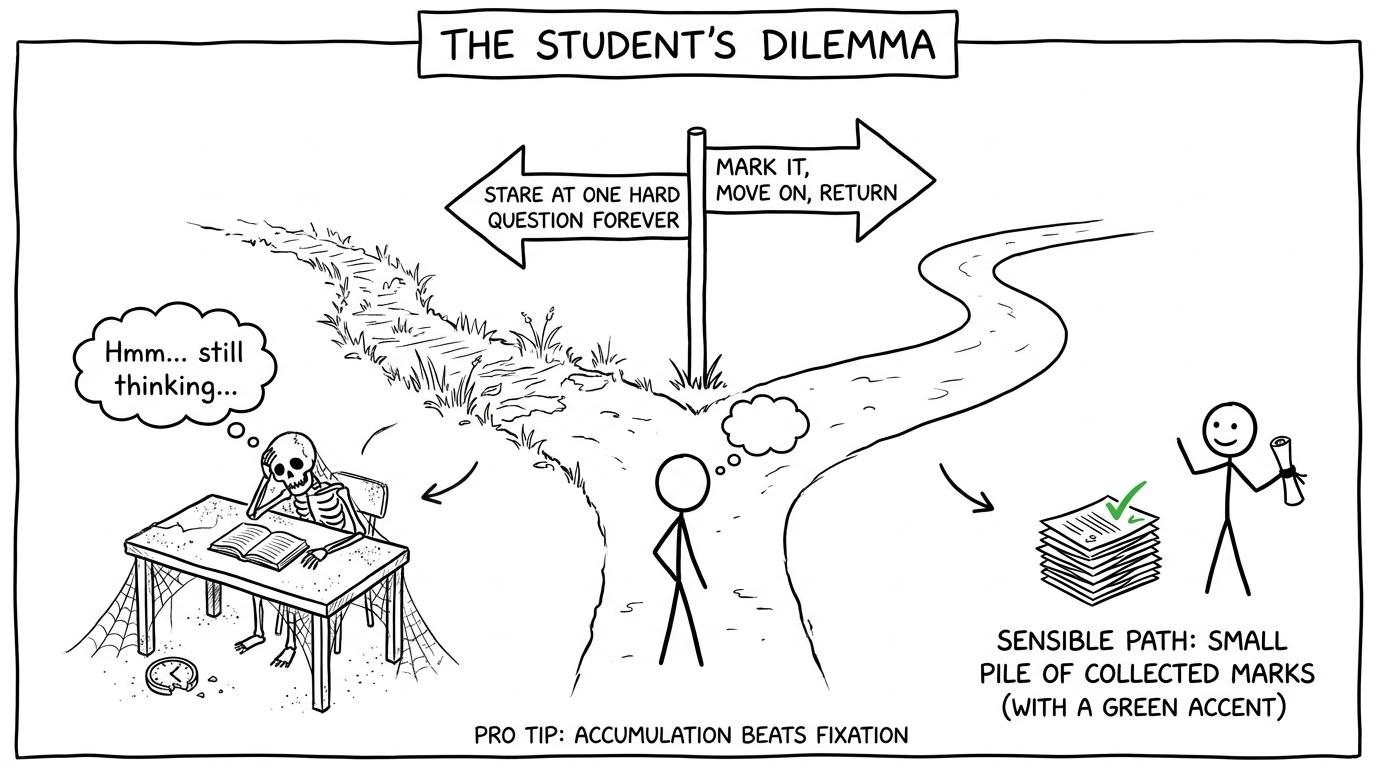 An exam crossroads between staring forever and moving on strategically
Skipping algebraic steps to save seconds
Rushed students often compress three lines of algebra into one. The intended saving is tiny; the risk is large.
In expressions involving subtraction, write the bracket explicitly. In equations, preserve equality from one line to the next. If differentiating or rearranging, keep coefficients and powers visible. Clear working reduces the chance of changing −x-x−x into xxx, losing a factor or applying an operation to only one side.
It also protects access to method marks. A final answer can be wrong while a valid method still earns credit. If the examiner cannot see the method, those marks may be unavailable.
Misreading command words and required forms
“Find”, “show that”, “prove” and “hence” do different jobs. So do instructions such as “give an exact answer”, “write in the form” or “give both solutions”. Under pressure, students sometimes solve the topic they recognise rather than the question actually printed.
Circle or underline the instruction mentally or on the paper where appropriate. Before moving on, ask:
- Have I answered every part?
- Is my answer in the required form?
- Does the question require justification?
- Have I included every solution in the stated interval or domain?
A decimal approximation is not a substitute for an exact form such as a+bca + b\sqrt{c}a+bc when exactness is requested. Equally, an exact value does not satisfy an instruction asking for a stated degree of accuracy unless that rounded answer is also supplied.
Dropping negative signs, brackets and powers
These are the three small symbols that cause disproportionately large problems.
When substituting a negative value, use brackets. When squaring a negative expression, make the grouping unambiguous. When expanding a subtraction, treat the whole following expression as being subtracted. When using indices, check whether the power applies to one term or an entire bracket.
A good final check is not “Does this page look tidy?” It is a symbol check: scan only for minus signs, then brackets, then indices. A narrow check catches more than a vague rereading.
Rounding too early
Premature approximation can move a final answer outside the accepted range. Keep calculator values unrounded during intermediate stages and round only at the end, unless the question tells you otherwise.
Also distinguish significant figures from decimal places. Before writing the final answer, return to the instruction rather than relying on memory.
Calculator fluency matters here. For Paper 222, practise entering complete expressions with the correct brackets and learn how your approved calculator displays fractions, roots and previous answers. JCQ rules place responsibility on candidates to ensure their calculator is compliant and working, so check it before the exam rather than discovering an unfamiliar setting during the paper.
Trusting the calculator more than the mathematics
A calculator executes the entry it receives, not the calculation you intended. A missing bracket or mistyped decimal can produce a polished but incorrect display.
Write the expression before entering it. Then estimate its sign and approximate size. If your algebra suggests a positive result of moderate size but the screen shows a large negative value, stop and inspect the entry.
On the non-calculator paper, the parallel mistake is treating arithmetic as rough work and leaving it unreadable. Keep fraction operations, powers and exact values structured enough to check.
Leaving proof and “show that” answers too compressed
A proof is a mathematical argument, not merely the printed result copied at the end. Each line should follow from the previous one, and the equals sign should connect genuinely equal expressions.
Under time pressure, begin from the information given and show the transformations that establish the required statement. Do not work backwards from the target without making the logic clear. AQA examiner feedback has specifically stressed the importance of showing each step in proof and “show that” questions.
For guidance on how marks attach to visible reasoning, read how to use GCSE mark schemes.
Failing to answer every part
Multi-part questions are easy to abandon accidentally, especially when a page turn separates the instruction from the answer space. Near the end, scan question numbers and part labels before checking calculations.
A blank answer guarantees no credit. A relevant formula, diagram annotation or correct first step may earn something and can help you restart when you return.
A better pacing strategy for the paper
Begin with controlled momentum
Do not sprint through the opening questions simply because they look accessible. Early marks count exactly as much as later marks. Work briskly, but read every condition and show the essential method.
If nerves are high, beginning with a question you understand can settle your attention. The aim is not to prove you are fast. It is to establish a reliable rhythm.
Use three levels of checking
Checking everything from scratch is rarely realistic. Use three levels instead:
- Immediate check: after each question, confirm that you answered what was asked.
- Return check: revisit questions you flagged as uncertain or incomplete.
- Final scan: inspect missing answers, signs, brackets, rounding and required forms.
This prioritises checks by likely mark gain. Spending several minutes confirming a comfortable one-mark response while a multi-part question remains blank is poor time management.
Make your working easy to resume
If you leave a question, do not erase useful progress. Draw a neat line beneath your latest valid step and mark the question for return. When correcting work, cross out the incorrect section clearly and rewrite it legibly rather than overwriting symbols.
AQA marking guidance indicates that genuine methods can still receive credit in various error situations, but the examiner must be able to follow what you have done. Presentation is therefore not decoration. It is part of making your mathematics assessable.
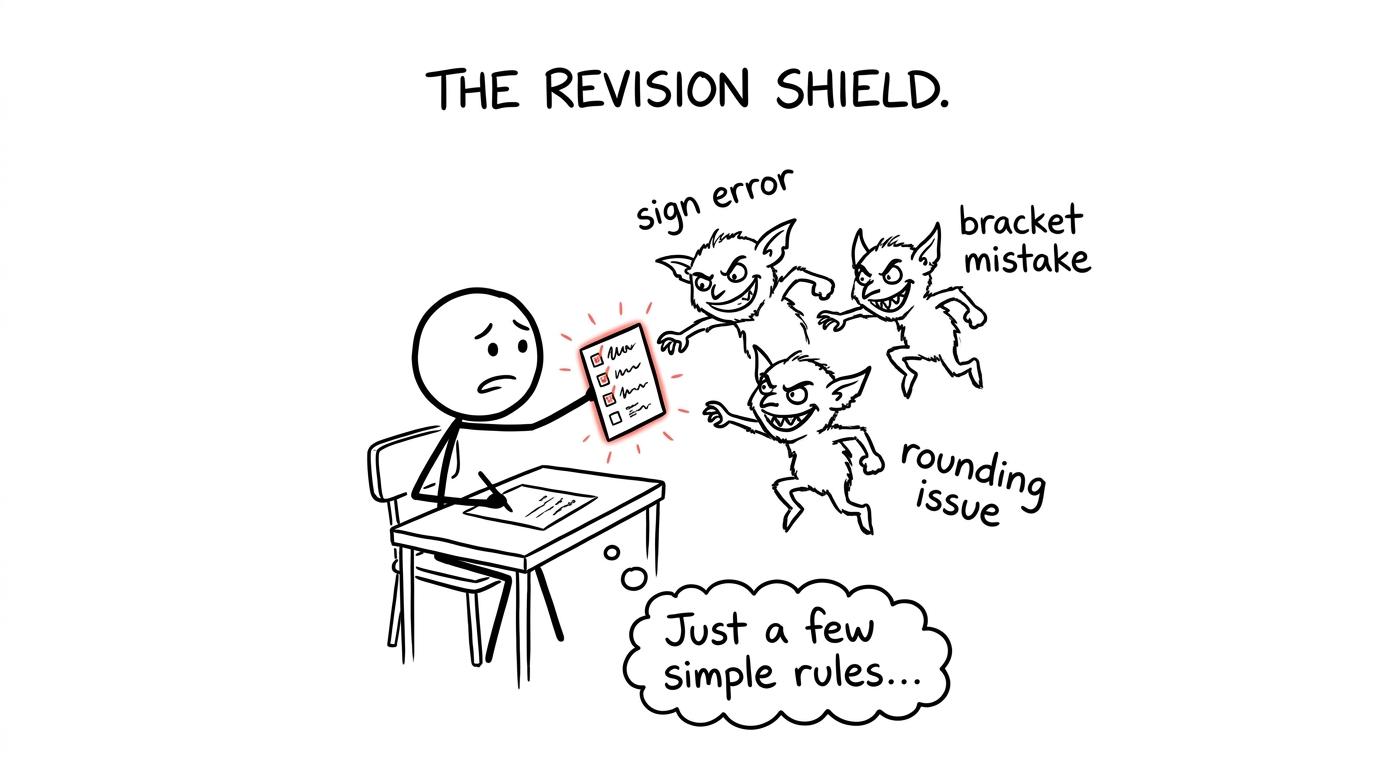 A tiny checklist defending a student from sign, bracket and rounding gremlins
How to train accuracy under time pressure
Timing should be added gradually. If a method is not yet secure, extreme speed practice merely rehearses mistakes.
Start with topic work from the AQA Further Maths lessons and questions. Once your method is accurate, complete a short timed set. Then progress to full AQA GCSE Further Maths past papers under the correct calculator conditions and time limit.
After each attempt, use the mark scheme and classify every lost mark:
- knowledge: the method was unknown;
- execution: the method was known but a sign, bracket or calculation failed;
- communication: insufficient proof or working was shown;
- timing: the question was rushed, trapped too much time or remained unanswered.
Your revision should match the category. Relearn knowledge errors. Repeat execution errors slowly before timing them again. Rewrite communication errors as concise, complete arguments. For timing errors, practise deciding when to move on.
If your underlying GCSE algebra needs strengthening, use the broader GCSE Maths revision hub and AQA GCSE Maths past papers. Fresh GCSE predicted papers can provide unfamiliar timed practice, although they should complement rather than replace official past papers. A structured one-month GCSE revision plan can help you schedule the cycle without cramming.
Turn the clock into a familiar condition
Time pressure feels powerful when it is unfamiliar. It becomes manageable when you have repeatedly practised the decisions it demands.
The goal is not flawless speed. It is a stable process: read, plan, show the method, check the instruction and move on when necessary. Those habits protect the easy marks while leaving you enough time to think about the demanding ones.
Start on MathsGenie today. Use the free revision lessons to secure each method, practice questions and mini tests to improve accuracy, then past papers and predicted papers to build timing. Mark every attempt carefully, use the mark schemes and video solutions where available, and turn each avoidable mistake into one specific habit for the next paper.