GCSE Further Maths: No Background Knowledge?
GCSE Further Maths no background knowledge guide: learn whether starting late is realistic, what you need first and how to catch up efficiently.
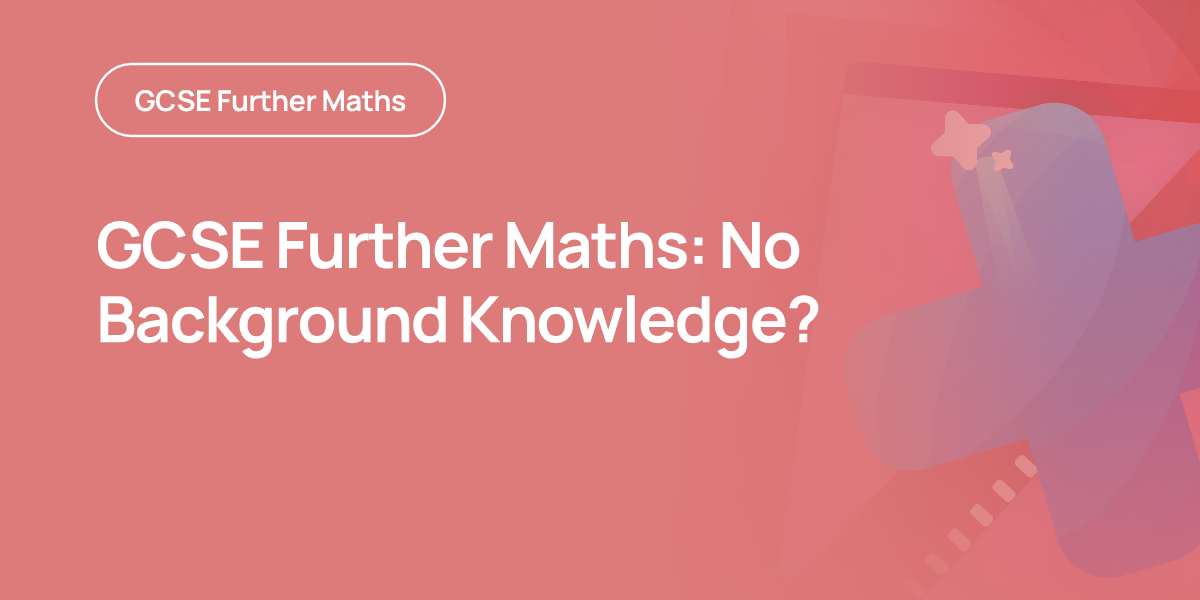
A course can look impossible when everyone else seems to know the language already. They recognise the notation, start questions quickly and speak about surds as if they were old friends. You may feel that you have arrived halfway through a conversation.
The honest answer to GCSE Further Maths with no background knowledge is this: starting without previous Further Maths teaching can be realistic, but starting without secure Higher GCSE Maths knowledge is much harder. If your school permits a late start and you are already confident with algebra, quadratics, graphs and trigonometry, you can catch up. If those foundations are weak, repair them before rushing into calculus or matrices.
This is not a test of whether you are a “maths person”. It is a question of preparation, time and the quality of your revision system.
The quick readiness checklist
Before committing, check the following:
- Confirm which qualification your school teaches and whether it will enter late starters.
- Ask how much teaching time remains and which topics the class has completed.
- Test your Higher GCSE algebra without notes.
- Identify gaps in surds, indices, quadratics, functions, graphs and trigonometry.
- Build a weekly catch-up timetable that protects your main GCSE Maths revision.
- Learn one topic at a time, then answer questions without support.
- Use mark schemes to classify mistakes rather than merely counting marks.
- Move to timed papers only after you can attempt most of the content.
The GCSE Maths revision hub is a useful starting point because you can choose your exam board and move between revision lessons, questions, worksheets and papers.
What does “GCSE Further Maths” actually mean?
The name is often used loosely. Your school may be teaching the AQA Level 222 Certificate in Further Mathematics, or it may offer a different additional mathematics qualification. OCR’s FSMQ Additional Mathematics, for example, is a Level 333 qualification rather than the same AQA Level 222 course. Always ask for the awarding body and specification code before downloading resources or planning revision.
For the commonly taught AQA Level 222 Certificate in Further Mathematics, the official specification says that the course:
- is an additional qualification rather than a replacement for GCSE Maths;
- assumes knowledge of the Key Stage 444 programme of study;
- is aimed at learners who have, or are expected to achieve, grades 777 to 999 in GCSE Maths;
- develops algebraic reasoning, problem solving and mathematical argument;
- is untiered and assessed through two equally weighted written papers.
That wording gives the clearest answer to the background-knowledge question. You are not expected to have learnt Further Maths before beginning the course. You are expected to bring strong GCSE knowledge with you.
Your school decides whom it teaches and enters, so speak to the head of maths or examinations officer. Being willing to work hard matters, but it does not automatically override a school’s timetable, entry policy or judgement about your wider GCSE workload.
Is starting without the usual background realistic?
It depends on what “no background” means.
You have not studied Further Maths before
This is normal. Every student meets topics such as introductory calculus and matrix transformations for the first time somewhere. A late start is possible if your Higher GCSE skills are already reliable and enough teaching time remains.
You should be able to manipulate expressions, rearrange formulae, solve equations and interpret graphs without needing to relearn every intermediate step. New content then attaches to something stable.
You have GCSE gaps but are progressing quickly
A catch-up plan may still work, particularly if the gaps are narrow. Weak surds or circle theorems can be targeted. A broad weakness across fractions, negative numbers, equations and graphs is more serious because those skills appear inside many advanced questions.
Use the GCSE topics by exam board and tier guide to audit Higher content systematically rather than relying on a vague feeling of confidence.
You are currently working mainly at foundation level
Moving directly from foundation material into Further Maths is unlikely to be an efficient route. The problem is not your potential. It is the number of missing links between your present course and the assumed starting point.
Your first priority should normally be securing GCSE Maths and discussing the appropriate tier with your teacher. Further Maths should stretch a strong foundation, not compete with the qualification you need most.
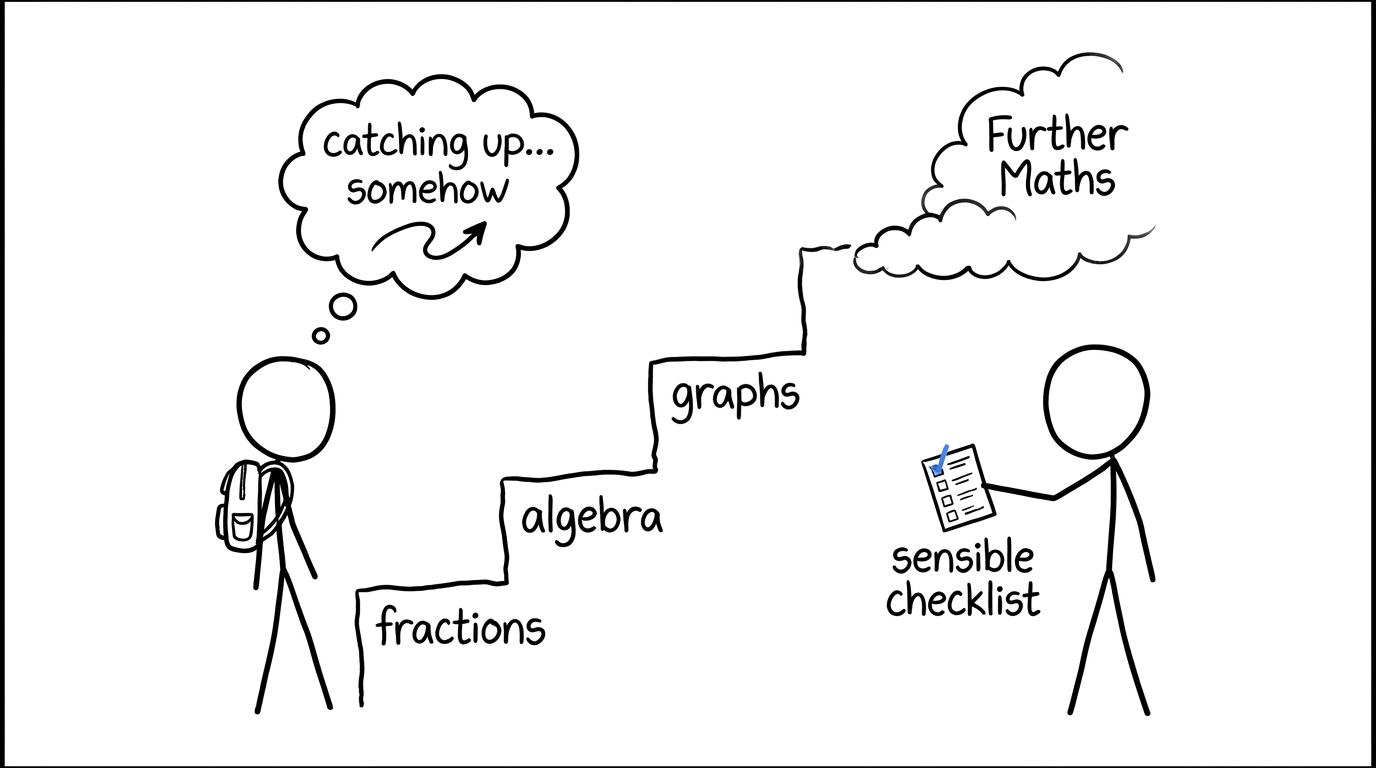 A student faces a revision staircase with a tiny backpack and a helpful checklist
The background knowledge that matters most
You do not need perfect recall of every GCSE topic. Certain skills, however, carry much more weight.
Algebraic fluency
Further Maths often makes the algebra longer, less familiar or more connected. You need confidence with:
- expanding and factorising expressions;
- linear, quadratic and simultaneous equations;
- changing the subject of a formula;
- algebraic fractions and indices;
- functions, sequences and inequalities;
- algebraic proof.
You should recognise structures such as
ax2+bx+c=0 ax^2+bx+c=0 ax2+bx+c=0and handle expressions involving powers and roots accurately. If every rearrangement consumes all your attention, there is little attention left for the new idea in the question.
Exact number skills
Surds and indices are not decorative Higher-tier topics. They support exact algebra and later mathematical work. Revisit AQA surds revision if simplifying roots or rationalising denominators feels uncertain. Students following another board should select the matching version through the main GCSE hub.
Graphs and coordinate geometry
Be comfortable with gradients, straight-line equations, quadratic graphs and geometric reasoning on coordinate axes. Further work may involve circles, tangents, functions and the meaning of a changing gradient.
Trigonometry and geometry
Secure Pythagoras, trigonometric ratios, exact values, circle theorems and multi-step geometric arguments. Memorising isolated rules is not enough; you need to decide which relationship applies when the diagram is unfamiliar.
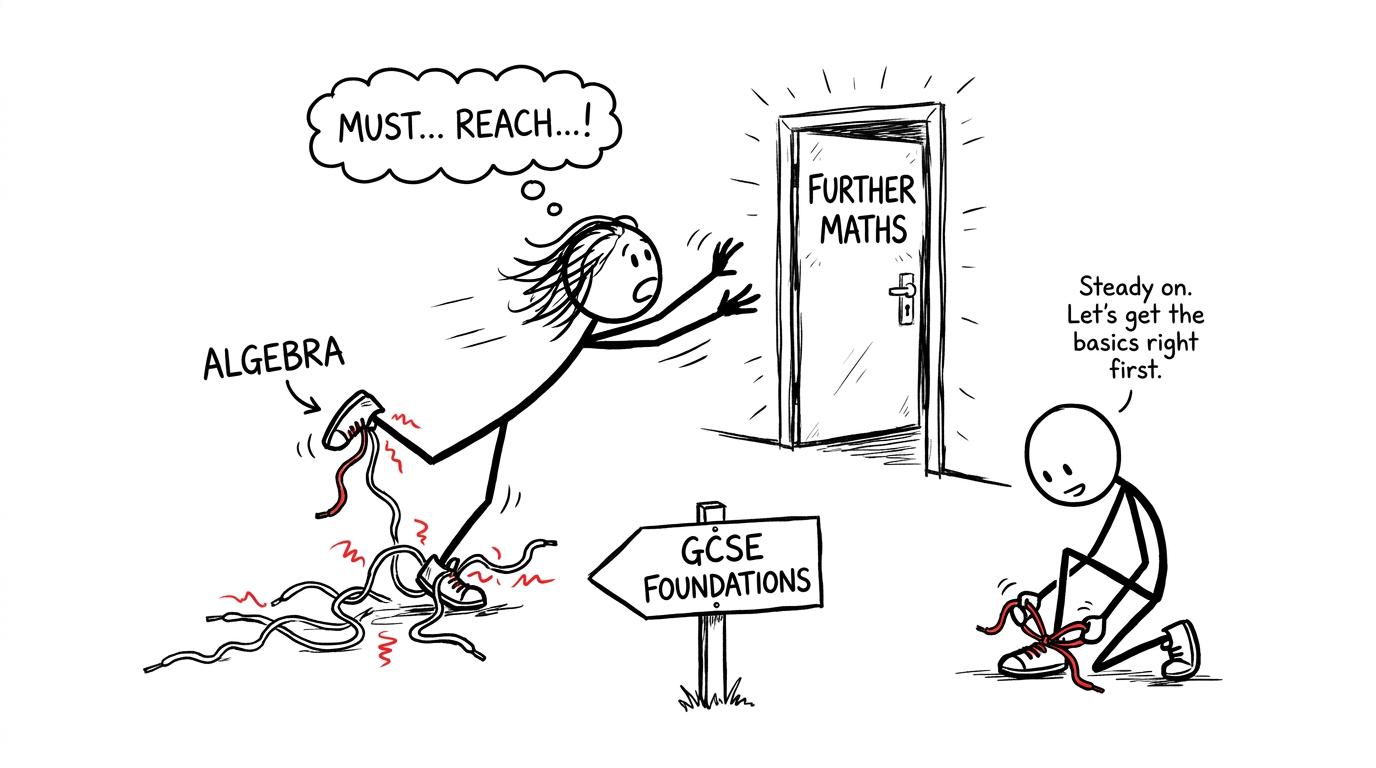 A student trips over untied algebra shoelaces while trying to rush towards Further Maths
How to catch up fast if your school allows it
Catching up quickly does not mean touching every topic once. It means learning in an order that prevents old gaps from repeatedly blocking new work.
Diagnose before making notes
Ask your teacher for the specification and a list of content already taught. Then complete a short Higher GCSE assessment without notes. A mini test or selected paper questions will reveal more than rereading a textbook.
Label each lost mark as one of three types:
- Knowledge: you did not know the fact or method.
- Execution: you knew the method but made an algebraic or arithmetic error.
- Interpretation: you could not translate the question into mathematics.
The distinction matters. Each problem needs a different repair.
Repair GCSE foundations in dependency order
A sensible order is:
- number operations, fractions, indices and surds;
- simplifying, expanding, factorising and rearranging;
- equations, quadratics and inequalities;
- graphs, functions and coordinate geometry;
- trigonometry, circles and proof;
- specification-specific Further Maths content.
The best order to learn GCSE Maths topics explains why prerequisite skills should come before harder extensions. If quadratics are a weakness, use a board-matched lesson such as the quadratic formula revision guide, then practise independently.
Use a learn-practise-test cycle
For each topic:
- learn the idea through a revision lesson or video;
- practise a focused set of questions;
- mark every answer and record the exact cause of each error;
- reattempt missed questions without looking at the solution;
- test the skill again after a short gap.
Add these sessions to the MathsGenie revision planner. A realistic plan might contain several short catch-up blocks each week, while leaving protected time for English, science and your standard GCSE Maths papers.
Introduce papers at the right moment
A full paper taken too early mostly confirms that you have not covered the course. Begin with topic questions and mixed mini tests. Once you can attempt most areas, move to timed assessment.
Use AQA GCSE Maths past papers to strengthen the assumed GCSE skills, but obtain Further Maths papers that match the exact qualification from your teacher. A standard GCSE paper cannot measure all the additional content.
Nearer the exams, GCSE predicted papers can provide fresh practice for your main GCSE course. They should complement specification coverage and past papers, not replace either.
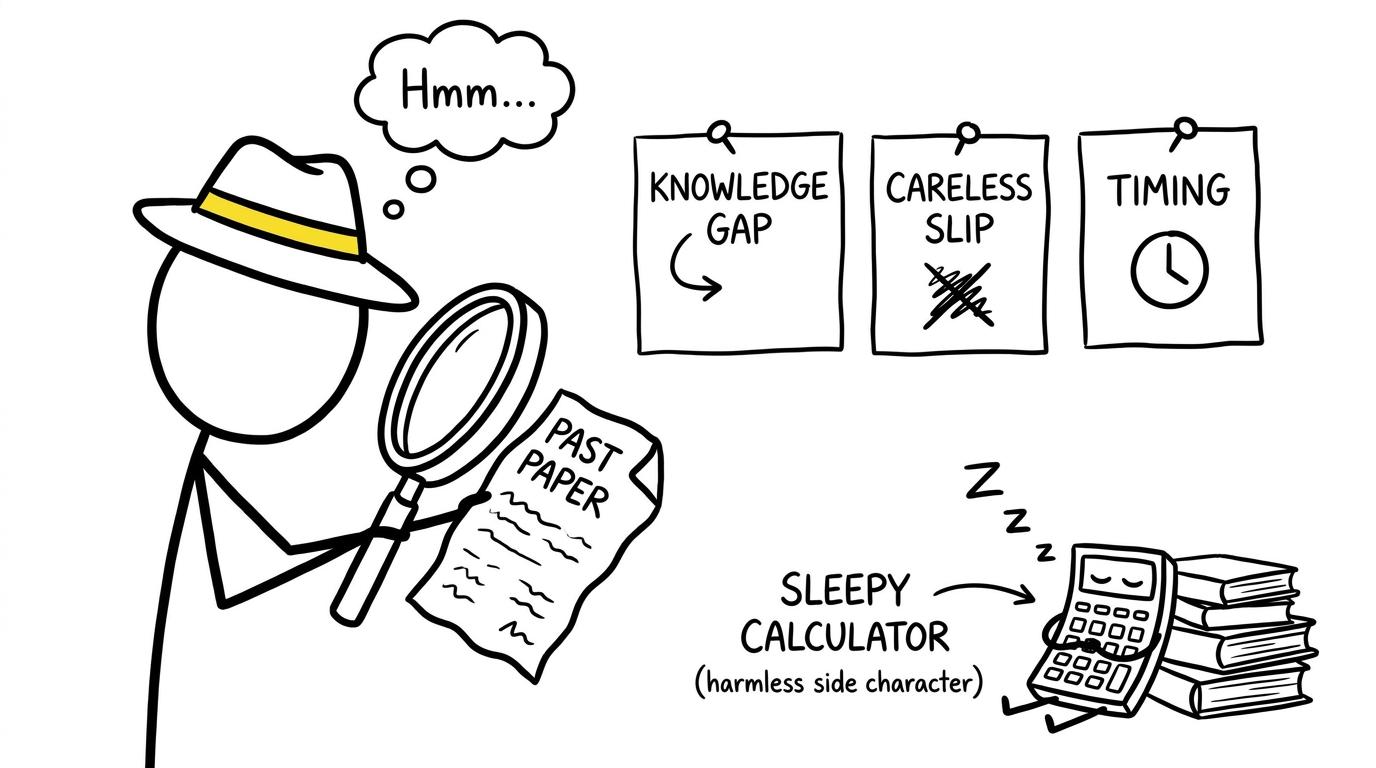 A student detective classifies mistakes from a paper while a sleepy calculator watches
Common mistakes when starting late
Learning advanced topics before fixing algebra
Calculus can appear exciting because it feels like A Level Maths. But differentiation built on unreliable indices and algebra becomes another memorised procedure. Tie the shoelaces before sprinting.
Treating watching as practising
A clear video creates recognition, not necessarily recall. Close the explanation and answer questions from a blank page. If you cannot begin independently, the topic is not secure yet.
Using resources for the wrong qualification
“Further Maths”, “Additional Maths” and “FSMQ” are not interchangeable labels. Their levels, specifications and assessments can differ. Confirm your course before choosing papers.
Sacrificing the main GCSE qualification
Further Maths is additional. If catch-up work causes your core GCSE Maths performance to fall, the plan needs adjusting. Ask your teacher which qualification should receive priority.
Measuring progress only through total marks
A total score hides useful information. Five lost marks caused by one recurring sign error require a different response from five blank questions across unfamiliar topics. Keep a short error log and make each entry specific.
Decide using evidence, not fear
Starting late is neither automatically reckless nor secretly easy. It is realistic when your school allows it, your Higher GCSE foundations are strong, the remaining timetable is workable and you can practise consistently. It is less realistic when you are still repairing broad foundation-level gaps or when the extra course threatens your main GCSE preparation.
Speak to your teacher, identify the exact specification and take a diagnostic test. Then let the evidence guide the decision.
MathsGenie can provide the structure around that decision. Use free revision lessons and practice questions to repair prerequisites, mini tests to check retention, and mark schemes and video solutions to understand lost marks. Build confidence through past papers, then add predicted papers when the exams are closer. If Further Maths is preparing you for the next stage, you can also preview the A Level Maths revision hub once your GCSE foundations are secure.
You do not need to pretend there is no gap. You need a clear map for closing it. Open the GCSE revision hub, choose the first weak prerequisite and begin there.