GCSE Further Maths Cross Curricular Overlap
GCSE further maths cross curricular overlap explained: see which subjects share skills and build a revision plan that avoids repeating the same work twice.
The same graph can appear in two classrooms and feel like two different topics. In maths, its gradient is a number. In physics, that gradient might represent speed or acceleration. The underlying skill has not changed, but the context has.
That is the practical value of GCSE further maths cross curricular overlap. Further Maths can strengthen algebra, graph interpretation, proportional reasoning and structured problem-solving used elsewhere. The strongest overlap is with GCSE Maths and Physics, with useful connections to Computer Science, Geography and Economics. But it does not remove the need for subject-specific revision.
The goal, then, is not to revise everything twice. It is to identify the transferable skill, practise it properly once, and then learn how each subject expects you to apply and communicate it.
Your cross-curricular overlap checklist
Before combining revision sessions, ask:
- Is the underlying mathematical method genuinely the same?
- Does the second subject use different notation, units or vocabulary?
- Does its mark scheme require interpretation as well as calculation?
- Is the topic actually listed in both of your specifications?
- Can one practice task test the shared skill without neglecting subject knowledge?
Your school may use “GCSE Further Maths” as a convenient label for a Level 222 qualification. The exact content depends on the course. For example, AQA’s Level 222 Certificate in Further Mathematics is an untiered additional qualification aimed at students expected to achieve grades 777-999 in GCSE Maths. It extends algebra and geometry while introducing calculus and matrices.
Check your qualification title and specification before building a plan. A topic that appears in one Further Maths course is not automatically assessed in another.
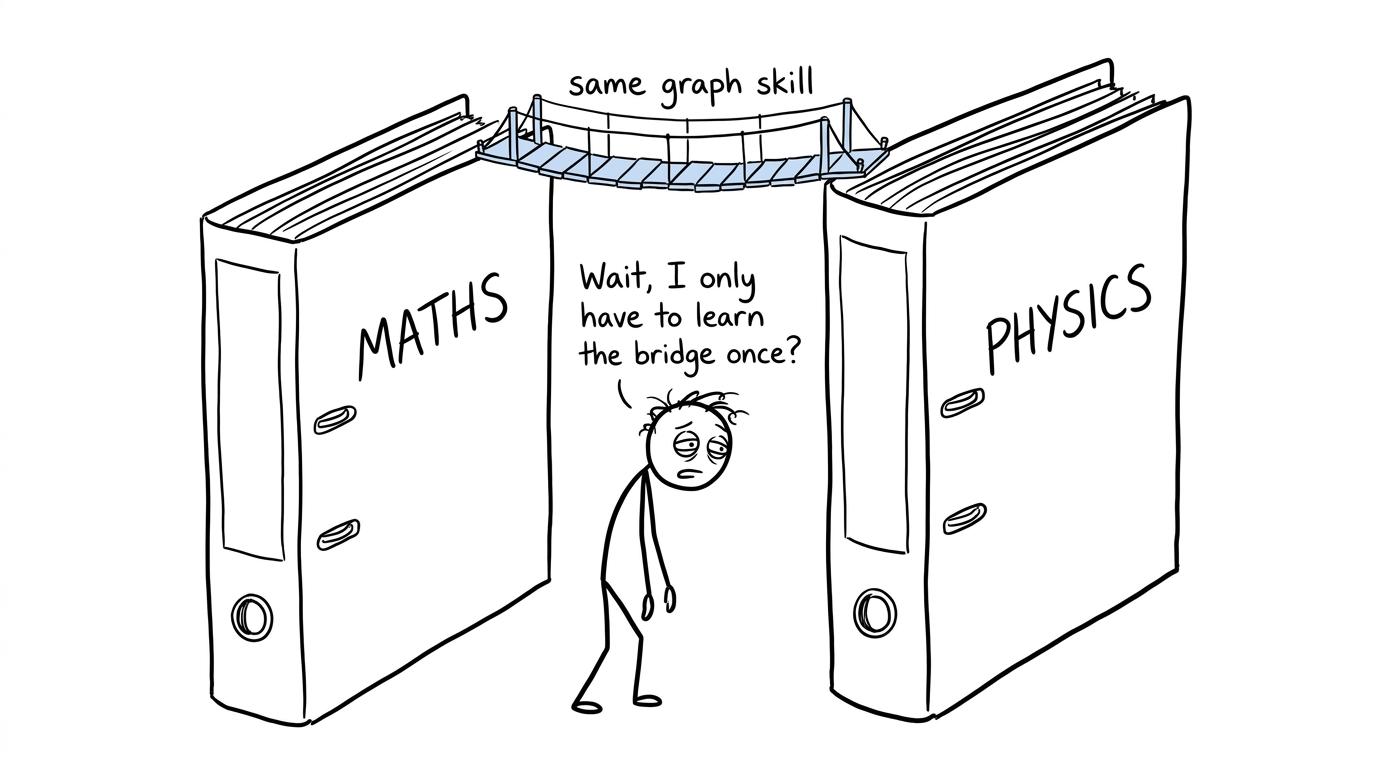 A student discovers a bridge between maths and physics revision
Where Further Maths overlap is strongest
GCSE Maths: the main source of double value
The largest overlap is unsurprisingly with higher-tier GCSE Maths. Further Maths assumes that core techniques are already becoming secure, then makes the algebra or reasoning more demanding.
Shared areas can include:
- surds and index laws;
- quadratics and simultaneous equations;
- functions and graph transformations;
- coordinate geometry;
- trigonometry and exact values;
- sequences, proof and algebraic manipulation.
This means a carefully chosen Further Maths question can also improve your GCSE Maths fluency. Rearranging a complicated expression, for instance, rehearses the same algebraic discipline needed in a higher-tier equation, even when the final question is more advanced.
The connection is not perfectly symmetrical. Introductory calculus and matrix transformations may be new in Further Maths and are not standard GCSE Maths content. They therefore need dedicated teaching rather than being treated as ordinary GCSE revision.
Use the GCSE Maths revision hub to repair the underlying GCSE method before attempting its Further Maths extension. If you are unsure what belongs to your board or tier, consult the GCSE Maths topics by exam board and tier guide.
Physics: algebra gains a physical meaning
Physics has the strongest overlap outside mathematics. Official GCSE Physics specifications require students to substitute into equations, change the subject, interpret linear graphs, determine gradients and use tangents as measures of rates of change. They also include standard form, proportional relationships and areas beneath suitable graphs.
Further Maths can make the mechanics of these tasks feel more natural. If you can confidently transform
y=mx+c,y = mx + c,y=mx+c,then identifying a gradient and intercept in a physics relationship becomes less intimidating. Similarly, fluency in rearranging formulae helps when the unknown quantity is not already isolated.
But Physics adds three layers that a pure maths question may not:
- units, which must remain consistent;
- physical meaning, such as what a gradient represents;
- appropriate precision, including significant figures.
Do not call a physics question “just algebra”. The algebra may be shared, but interpreting the result is part of the physics.
Computer Science: logic and structured thinking
The overlap with GCSE Computer Science is real but narrower. Current subject content includes algorithms, binary and hexadecimal representation, Boolean logic, truth tables, selection and iteration.
Further Maths does not teach programming, yet it develops habits that support it: following definitions precisely, splitting a problem into cases and tracking how one operation changes the next. Functions also provide a useful conceptual connection. An input is transformed according to a rule to produce an output, although mathematical functions and program functions are not identical ideas.
Numerical iteration is another helpful bridge. Revising iteration for Edexcel GCSE Maths can strengthen your ability to follow repeated processes carefully. Computer Science still requires its own pseudocode conventions, data representation and programming knowledge, so the shared skill is structured reasoning rather than shared content in full.
Where the overlap is useful but more limited
Geography and science data
Geography specifications include graphical, numerical and statistical skills. Depending on your course, you may interpret charts, use ratios and scales, calculate percentage change, analyse scatter graphs or discuss the limitations of data.
Further Maths can improve your confidence with coordinates, graph shapes and algebraic relationships. Standard GCSE statistics is usually the more direct preparation, however. Further Maths topics such as matrices or differentiation will rarely replace revision of fieldwork methods, geographical processes or data presentation.
The sensible approach is to group shared graph and data skills together, then schedule separate sessions for geographical knowledge and evaluative writing.
Economics and Business
GCSE Economics requires quantitative skills such as percentages, percentage change, averages, revenue, costs, profit and the construction or interpretation of graphs. Official requirements state that at least 10%10\%10% of GCSE Economics marks reward quantitative skills at Key Stage 333 level or above.
Further Maths may make graphs and algebra feel easier, but most of the required calculations are closer to core GCSE Maths. The harder part is often explaining what the result means in an economic context.
For example, knowing that a gradient is positive is mathematical. Explaining what an upward-sloping relationship suggests, while recognising that a graph alone may not establish cause, belongs to the subject context.
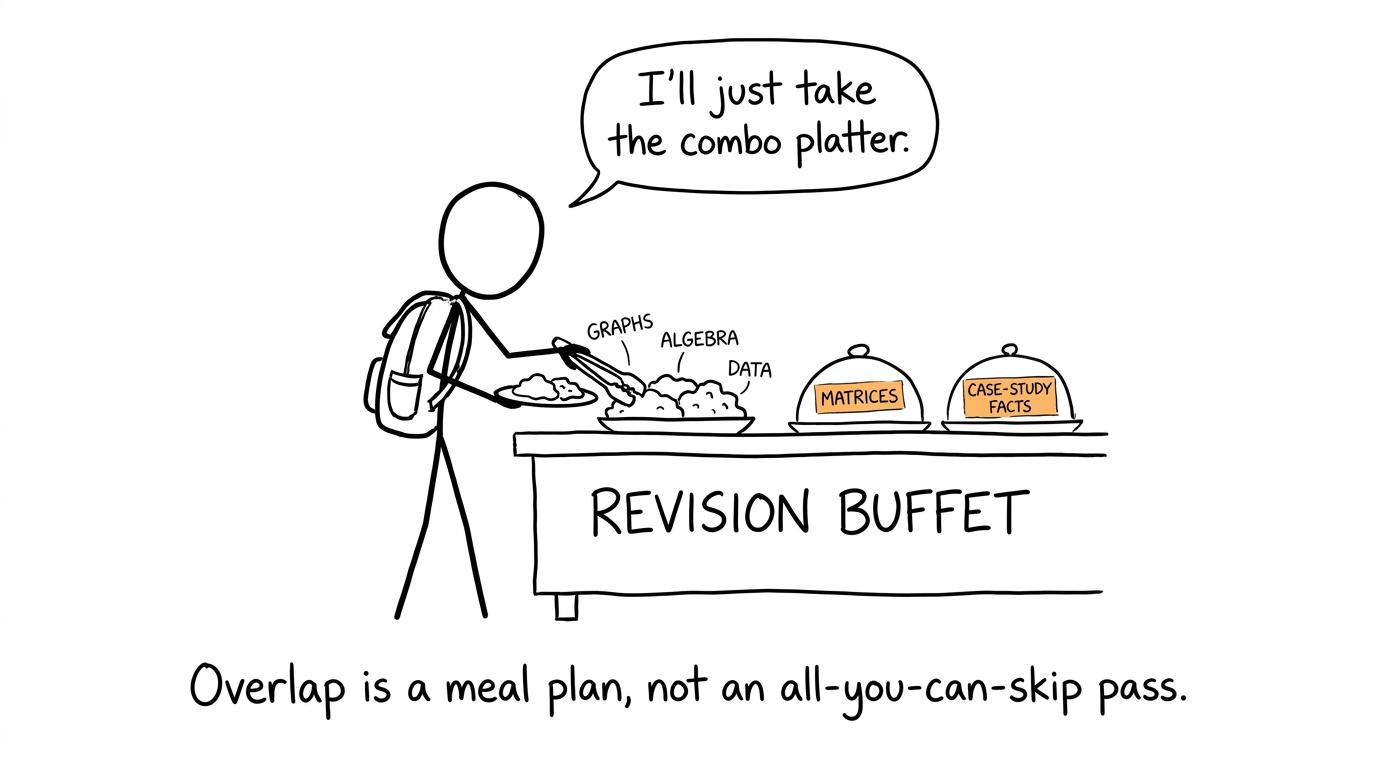 A revision buffet separates transferable skills from subject-specific content
Where overlap is often overstated
Some connections sound impressive but save little revision time.
Matrices may support later work in mathematics, computing, physics and engineering, but GCSE Computer Science does not generally become a matrices course. Introductory differentiation creates a strong foundation for A Level Maths, yet GCSE Physics usually asks students to estimate or use a tangent’s gradient rather than differentiate algebraically.
Likewise, being good at mathematical proof may help you organise an argument in other subjects, but it does not supply evidence for History or quotations for English Literature.
A useful rule is this: transfer the process, not the entire answer. Accuracy, logical sequencing and checking can travel between subjects. Required facts, terminology and mark-scheme conventions usually cannot.
How to revise shared skills without revising twice
Build a skill map, not two topic lists
Create three columns in your revision planner:
| Shared skill | Subjects using it | What changes by subject? |
|---|---|---|
| Rearranging formulae | Maths, Further Maths, Physics | Symbols, units and physical interpretation |
| Graph gradients | Maths, Further Maths, Physics, Geography | Meaning of axes and gradient |
| Percentages and data | Maths, Geography, Economics | Context, conclusions and evaluation |
| Logical conditions | Further Maths, Computer Science | Mathematical notation or Boolean conventions |
Only combine topics when you can clearly name both the shared method and the difference in application.
Use a two-stage revision block
Start with a short, context-free practice set to secure the mathematical process. Then complete one question from the other subject that uses the same process in context.
A productive sequence is:
- revisit the method through a MathsGenie revision lesson;
- answer focused practice questions without notes;
- check the solution and record the exact error;
- apply the skill in Physics, Geography, Economics or Computer Science;
- write down what changed: units, notation, interpretation or command word.
This is more efficient than completing two disconnected hours of revision, but it still respects the differences between specifications.
MathsGenie’s guide to the best order for learning GCSE Maths topics can help you repair prerequisite skills before moving towards Further Maths extensions.
Test transfer under exam conditions
A method that feels familiar in your notes may be harder to recognise inside an unfamiliar context. Mixed and timed questions reveal whether you can select the method independently.
Use Edexcel GCSE Maths past papers or AQA GCSE Maths past papers, depending on your exam board. Mark the paper carefully, then classify each lost mark:
- mathematical method;
- arithmetic accuracy;
- notation;
- units;
- interpretation;
- subject knowledge.
That distinction tells you whether the problem belongs in a shared revision block or a subject-specific one.
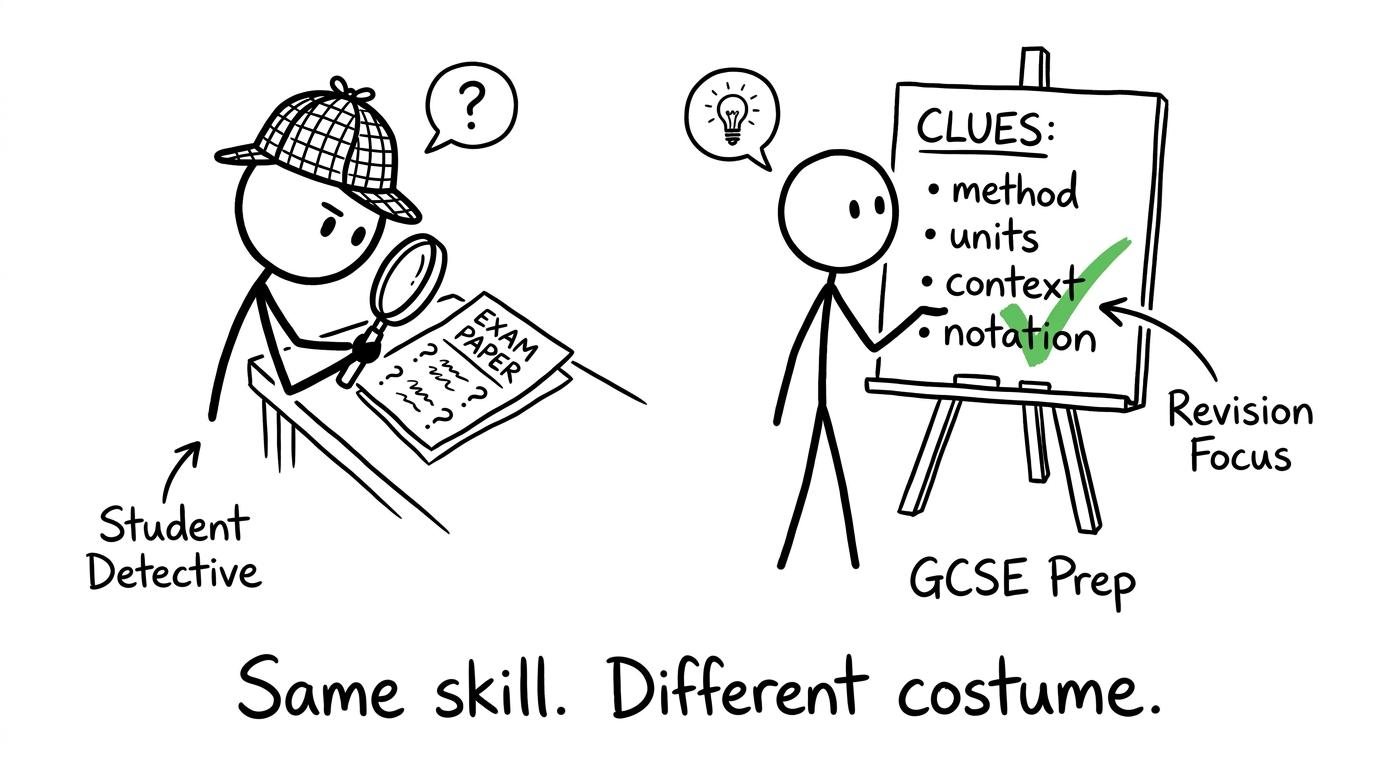 A student detective identifies method, units, context and notation
Common mistakes when using curricular overlap
Assuming familiar means mastered
Recognising a graph or formula is not the same as producing a correct solution without prompts. Test the skill with closed notes before removing it from your plan.
Ignoring units and context
A correct calculation can still lose marks in Physics or Geography if the unit is missing, the scale is misread or the conclusion does not answer the question.
Using Further Maths methods unnecessarily
An advanced technique is not automatically the best technique. GCSE mark schemes reward valid, efficient reasoning. A longer method creates more opportunities for error and may obscure a simple argument.
Combining topics with only superficial similarities
Boolean logic and algebra both use symbols, but their rules and purposes differ. Tangent gradients in Physics resemble calculus, but the assessed method may be graphical. Always check the specification and question wording.
Neglecting the newest content
Calculus and matrices can feel exciting, so students sometimes spend too much time on them while weaker GCSE algebra remains unresolved. Further Maths builds on that algebra; it does not compensate for gaps in it.
Turn overlap into an advantage
Cross-curricular overlap helps when it reduces duplication without erasing context. Algebra supports Physics. Graph fluency supports Geography and Economics. Logical precision supports Computer Science. Most importantly, Further Maths deepens the higher-tier GCSE Maths techniques on which those connections depend.
Start from the MathsGenie GCSE Maths revision area, use revision lessons and practice questions to secure each shared method, and then test it through mini tests, past papers and predicted papers. Mark schemes and video solutions will show whether you lost the mathematics or its application.
If Further Maths is also preparing you for the next stage, explore the A Level Maths revision hub. One well-understood skill can serve several subjects, provided you practise wearing each subject’s different exam-day costume.