

GCSE French: Revise Every Day or Take Rest Days?
GCSE French revise every day or rest? Learn how spacing, retrieval and sleep support retention, then build a balanced revision week around maths exams.
The revision timetable looks reasonable until every subject asks for a daily slot. French vocabulary. Maths questions. Science recall. English quotations. Soon, the plan has become a second school day, except this one continues through the weekend.
So, should you gcse french revise every day or rest? The best answer is neither extreme. Brief, regular contact with French can strengthen retention, but you do not need a demanding French session every day. Spaced retrieval, sleep and genuine rest are more useful than an unbroken chain of exhausting sessions.
For most students, a sensible pattern is four to six short French sessions each week, with at least one day free from formal French revision. The precise balance should reflect your weaknesses, exam dates and the time needed for maths and other GCSE subjects.
The quick revision checklist
Use these principles before building your week:
- Revise French regularly, but avoid long daily sessions performed from guilt.
- Retrieve vocabulary and grammar from memory rather than only rereading them.
- Leave gaps before revisiting the same material.
- Rotate listening, speaking, reading and writing practice.
- Protect sleep, particularly after learning new vocabulary.
- Include at least one flexible or French-free day.
- Give maths enough uninterrupted time for questions, marking and corrections.
- Adjust your plan using evidence from practice, not simply the number of hours completed.
If your whole timetable feels crowded, MathsGenie's GCSE maths revision timetable guide offers a practical way to leave space for school, rest and other subjects.
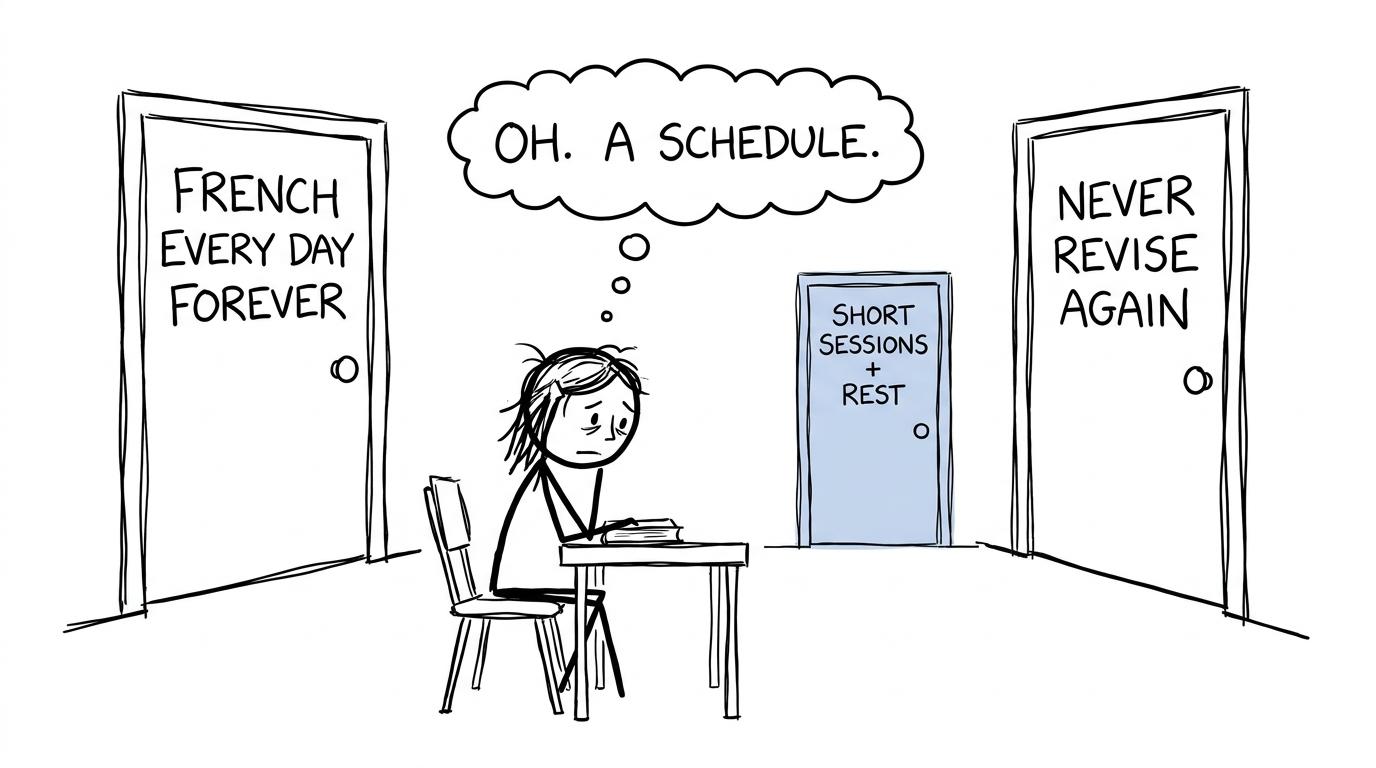 A student discovers the sensible middle door between endless revision and doing nothing
Why daily contact can help GCSE French
Languages contain a large amount of knowledge that must become quickly accessible: vocabulary, verb forms, grammatical structures, pronunciation and sound-spelling relationships. Seeing a French word once may create familiarity, but familiarity is not the same as being able to recall it in an examination.
A major review of learning research published in 2022 concluded that spacing learning opportunities over time and retrieving information from memory are both effective ways to improve retention. The important word is spacing. Several shorter encounters spread across a week generally support longer-term memory better than putting the same total effort into one large session.
This makes frequent French contact useful. A short vocabulary test on Monday, a listening task on Wednesday and a translation check on Friday require the brain to reconstruct knowledge after a delay. That reconstruction is harder than immediate repetition, but the difficulty is productive.
Daily contact can therefore work when it remains light and purposeful. Ten minutes of vocabulary retrieval is different from forcing yourself through an hour of unfocused revision every evening.
Why rest days do not erase your progress
Rest can feel suspicious during exam season. You stop working, yet the list of topics remains. That can make a day off seem like lost ground.
Memory does not work like a bucket that empties the moment revision stops. Some forgetting between sessions is expected. In fact, having to work to recover an answer is part of what makes later retrieval valuable. Revisiting every item immediately may produce fluent performance in the moment without creating equally durable learning.
Sleep matters too. Research on learning and memory indicates that sleep supports memory consolidation. It is not a substitute for practice, but it is one reason why cutting sleep to extend revision is a poor exchange. A rested brain returning to vocabulary tomorrow may learn more effectively than an exhausted brain repeating it tonight.
A rest day can also protect the rest of your GCSE timetable. If French occupies every day, maths may be pushed into occasional marathon sessions. That is not ideal for maths retention either. MathsGenie's guide to revising GCSE maths efficiently uses a repeatable learn, practise, mark, fix and retest cycle rather than relying on endurance.
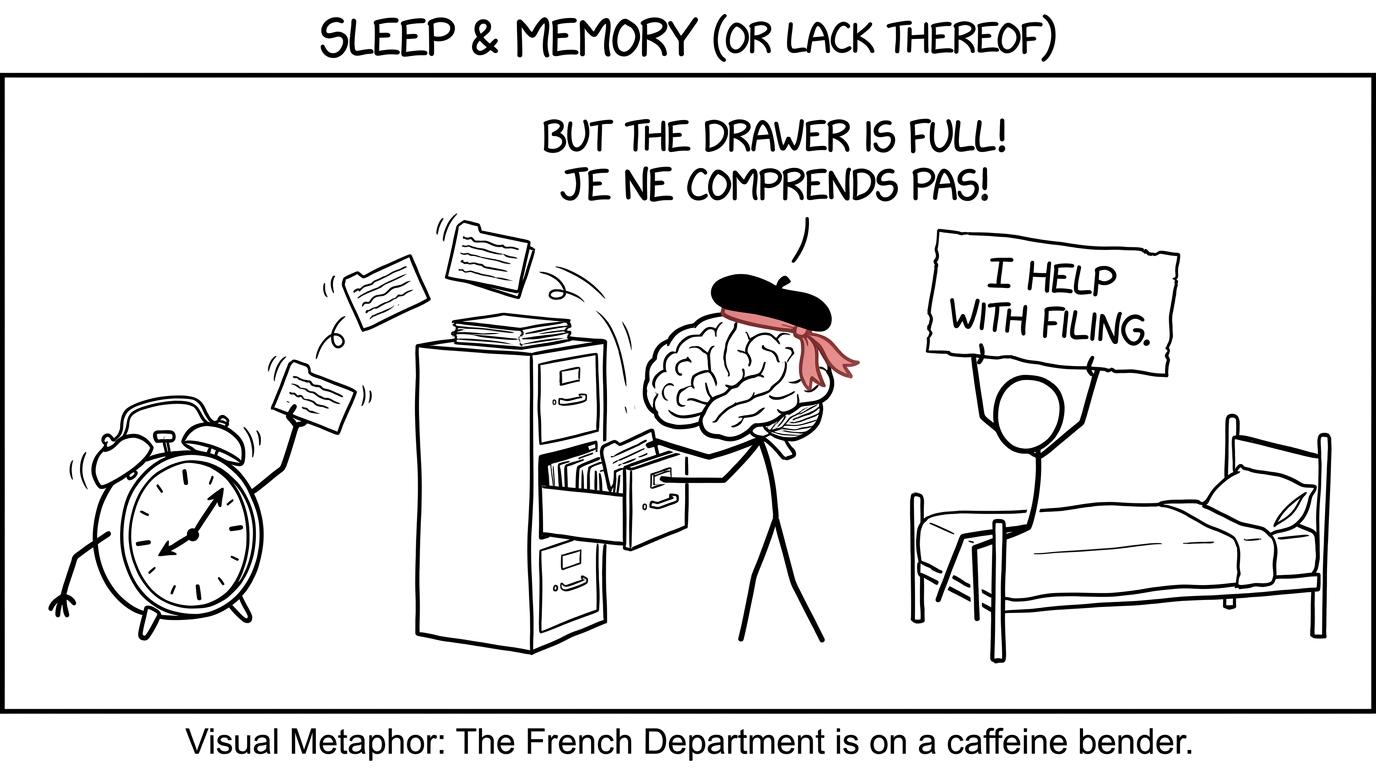 A helpful bed explains its role in filing French vocabulary memories
Daily revision or rest: what retention actually favours
The real choice is not daily revision versus rest. It is well-spaced, active practice versus poorly timed, passive practice.
Daily French works when it is brief
A daily routine may suit you if French is currently weak, the speaking assessment is approaching or you struggle to remember core vocabulary. Keep most contacts short. A session might involve closed-book vocabulary recall, reading a short passage aloud or checking a few previously corrected sentences.
Stop while the work is still accurate. More minutes are not automatically more learning.
Rest days work when revision returns afterwards
A rest day belongs inside a schedule, not at the end of an abandoned one. The benefit comes from returning to the material after a gap and trying to retrieve it again.
You could revise a vocabulary group, leave it alone for a day or two, then test it without looking. Items recalled correctly can move to a longer interval. Items forgotten should return sooner. This is more responsive than testing every word with identical frequency.
Complete rest and subject rest are different
A French-free day might still contain maths revision. A complete rest day means stepping away from formal revision altogether. Both can be useful.
During a busy week, you might take one complete rest period and use another day mainly for maths. Near a speaking assessment, you might maintain a very short French pronunciation check while resting from written work. The plan should respond to what is imminent without turning every day into an emergency.
Build a balanced French and maths revision week
Start with fixed commitments: school, meals, sleep, clubs and travel. Next, add the assessments that are closest. Only then fill the remaining spaces with revision.
A balanced week could contain:
- two short French vocabulary retrieval sessions;
- one listening or dictation session;
- one speaking session;
- one reading, translation or writing session;
- one day with no formal French revision;
- several separate maths sessions for topic practice and marking;
- one flexible slot for anything missed.
These are categories rather than compulsory totals. Your teacher's feedback and exam-board specification should guide the details.
The reformed GCSE French qualifications taught in England from September 2024 are assessed for the first time in summer 2026. Official specifications continue to require competence across listening, speaking, reading and writing, although the precise tasks and timings vary between AQA, Edexcel, OCR and Eduqas. Check your own board, tier and specification rather than following a generic checklist blindly.
The same rule applies to maths: match your practice to your board and foundation or higher tier. The GCSE maths revision hub lets you choose the correct course and move between revision lessons, questions and exam papers.
Use active tasks in both subjects
For French, close the vocabulary list and recall the meanings. Say an answer aloud before checking it. Attempt a translation, compare it with the correction and record the exact grammar error.
For maths, attempt questions before opening the solution. Mark every set, identify where marks disappeared and revisit the skill later. Short GCSE Target Tests can fit into a busy week without requiring a full paper every evening.
This shared structure simplifies revision across subjects:
- retrieve;
- check;
- correct;
- leave a gap;
- retrieve again.
The subject changes. The learning principle does not.
How the schedule should change near the exam
Early in the revision period, leave wider gaps and build secure knowledge gradually. As an assessment approaches, increase contact with the relevant skill without removing sleep or every rest period.
Before a French speaking assessment, brief and frequent spoken practice may become more valuable. Before listening, use unfamiliar audio and practise recovering after missing a phrase. Before writing, retrieve flexible grammatical structures and complete timed responses suitable for your specification.
Maths also needs a gradual shift from topic practice towards timed papers. MathsGenie's guide to when you should start GCSE past papers explains why shorter diagnostic work should come before repeated full papers.
During the final weeks, protect quality. One well-marked paper followed by targeted correction is more valuable than several rushed papers. If you take Edexcel, the guide to using GCSE maths past papers properly shows how to turn lost marks into specific next actions.
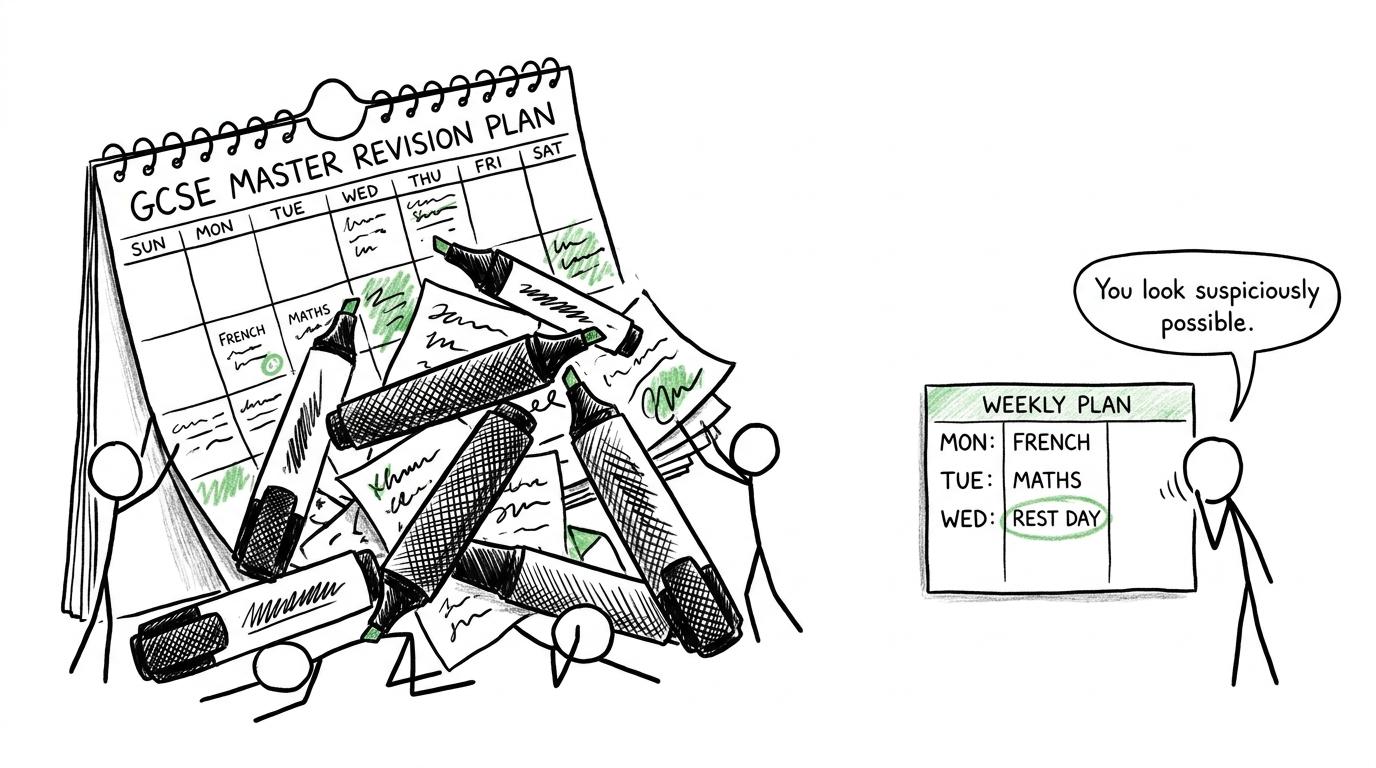 An impossible revision calendar meets a smaller plan that a student can actually follow
Common mistakes when planning French revision
Treating every day as equally intense
A timetable filled with long sessions leaves no capacity for a difficult school day, illness or an unexpected deadline. Use a mixture of short, medium and rest days.
Counting exposure as retrieval
Highlighting vocabulary and watching French videos may support learning, but they do not prove that you can produce an answer independently. Include closed-book recall and exam-style tasks.
Revising only vocabulary
Vocabulary matters, but GCSE French also requires you to understand and communicate through different skills. Balance word learning with grammar, pronunciation, listening, speaking, reading and writing according to your specification.
Using rest as a reward you must earn
Rest is part of a sustainable plan, not evidence that you lack commitment. Schedule it before exhaustion makes the decision for you.
Letting French crowd out maths
Language revision expands easily because there is always another word to learn. Set a finishing time. Then give maths the focused question practice it requires. MathsGenie's one-month GCSE revision plan can help you create a repeatable weekly rhythm.
Sacrificing sleep before an exam
Late-night cramming can reduce alertness when you need to understand instructions, recall vocabulary and work accurately. The GCSE maths exam-week checklist also prioritises targeted correction, sensible stopping points and protected sleep.
The best plan is one you can repeat
You do not need to choose between revising GCSE French every day and disappearing from the subject for a week. Use frequent short contact, active retrieval and gaps between repetitions. Keep at least one French-free period, protect sleep and increase practice selectively when a particular assessment approaches.
Most importantly, judge the plan by what you can recall and apply, not by how crowded the calendar looks.
Then give maths the same disciplined structure. Start with MathsGenie's free GCSE maths revision resources, rebuild weak topics through revision lessons and practice questions, check your work with mark schemes and video solutions, and progress to mini tests, past papers and predicted papers. A calm plan does not ask you to work constantly. It helps each session earn its place.










