GCSE French Easter Holiday Revision: Balanced Plan
GCSE French Easter holiday revision made manageable: balance speaking, listening, reading and writing while protecting rest and time for other subjects.
Easter revision often begins with an impossible-looking list. French needs attention. Maths needs practice. Science has several papers of its own. Meanwhile, the holiday is supposed to contain some actual holiday.
The answer is not to fill every available hour. Effective GCSE French Easter holiday revision should use short, purposeful sessions across listening, speaking, reading and writing, while leaving room for other subjects, sleep and time away from a desk. A balanced plan might include French on 666 to 888 days of a two-week break, usually for 303030 to 606060 minutes at a time.
The aim is not to complete French. It is to identify weaknesses, practise the right skills and return to school knowing exactly what still needs attention.
Your Easter revision checklist
Before planning individual sessions, check that your approach includes:
- your correct exam board and tier
- the date of your school’s speaking assessment
- all four skills: listening, speaking, reading and writing
- vocabulary retrieval rather than passive rereading
- grammar in sentences rather than isolated notes
- timed exam-style practice
- marking and correction time
- protected rest days
- enough space for maths and your other GCSE subjects
GCSE French specifications differ between AQA, Pearson Edexcel and Eduqas, so use materials that match your course. The reformed French qualifications taught from September 202420242024, with first assessment in summer 202620262026, include features such as dictation and reading aloud. Exact task structures and timings vary, which makes your specification, teacher guidance and exam-board sample assessment materials essential.
Start with the exam, not the textbook
A thick exercise book encourages a misleading kind of revision. You begin at the first page, copy familiar notes and feel busy. But the exam does not reward how neatly you travelled through your folder.
Start instead with the assessment. Find out:
- which tasks appear in each paper
- how long each assessment lasts
- which vocabulary and grammar are prescribed for your tier
- what the mark scheme rewards
- which speaking tasks your board uses
Foundation and higher tier students should revise the material required for the tier they will actually sit. For the reformed qualifications, students take their assessments at one tier across the qualification. If you are unsure about your entry, ask your teacher rather than building a plan around a guess.
Then complete a short diagnostic task in each skill. This does not need to be a full paper. A listening section, a reading extract, one writing task and a recorded speaking response are enough to reveal where your attention belongs.
The same principle works in maths. MathsGenie’s guide to finding your weakest GCSE topics explains how evidence from questions can replace vague feelings about what you do and do not know.
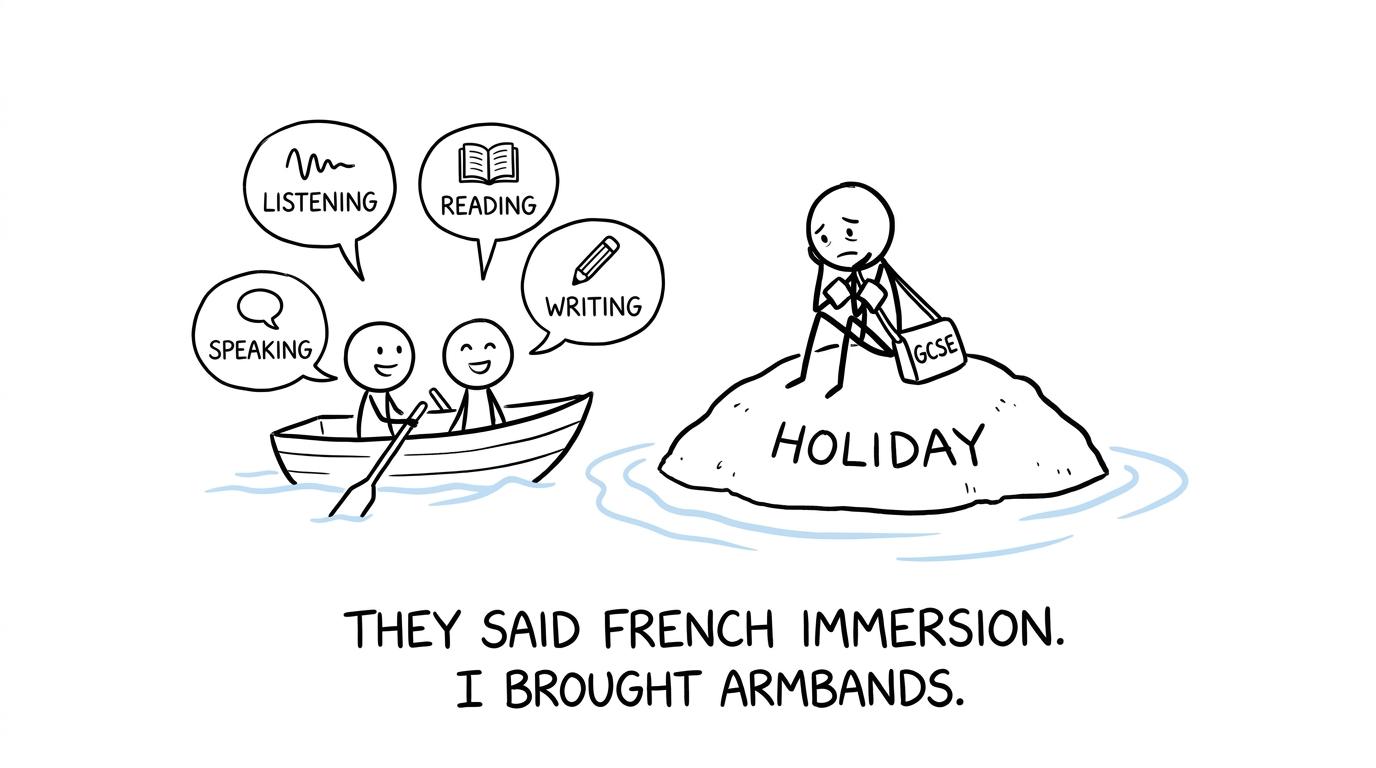 A student protects a holiday island as four French skills arrive by boat
Build a plan that leaves space to breathe
A revision timetable fails when it assumes that every day will contain perfect concentration. Holidays include family plans, tired mornings and days when starting feels unusually difficult. Build around that reality.
Use three kinds of day
A practical two-week plan can contain three different day types:
- Focused days: one French block of 454545 to 606060 minutes, perhaps followed by another subject.
- Light days: 151515 to 252525 minutes of vocabulary, listening or speaking.
- Rest days: no scheduled French at all.
Decide which days belong in each category before choosing topics. This prevents the common mistake of making every day a focused day and abandoning the timetable after the first interruption.
If you also have substantial maths revision, use the GCSE Maths revision hub to choose one lesson, mini test or paper section in advance. Reducing the number of decisions you make each morning protects time for both subjects.
Give each session one clear outcome
“Revise French” is too broad. A useful session has a visible finish line:
- retrieve vocabulary for one theme
- complete and mark one listening section
- record answers to three speaking prompts
- revise one grammar feature and use it in original sentences
- complete one timed writing response
- correct errors from a previous task
Stopping when the outcome is complete matters. Revision expands to occupy the whole afternoon when the task has no boundary.
Balance the four French skills
Students naturally return to the activity that feels safest. For some, that means making vocabulary cards. For others, it means reading model answers. Comfort is not the same as coverage.
Listening
Listening needs regular contact with spoken French. Use short exam-board recordings or resources supplied by your school, then check your answers carefully.
After marking, identify why each answer was missed. Was the word unknown? Did you recognise it too late? Did a negative change the meaning? Did you write the first detail you heard instead of the detail the question requested?
Dictation deserves deliberate practice if it forms part of your specification. Listen for sound-spelling relationships, agreements and small grammatical words rather than treating the task as vocabulary recognition alone.
Speaking
Speaking improves through speaking. Reading an answer silently does not test pronunciation, pace or recall.
Record yourself answering prompts without stopping every time you hesitate. Listen back once and choose one improvement: clearer pronunciation, a more accurate verb, a justified opinion or a better-developed response.
For specifications that include reading aloud, practise unfamiliar short passages as well as rehearsed material. Your goal is clear, comprehensible delivery, not an imitation of a particular accent.
Your speaking assessment may take place close to Easter, depending on your school and exam board. Confirm the date with your teacher and give speaking more space if it is your earliest assessment.
Reading
Reading practice should train you to locate evidence. Underline time phrases, negatives, opinions and changes of viewpoint. When you meet an unfamiliar word, use the surrounding grammar and context before deciding that the whole sentence is inaccessible.
Translation into English should preserve meaning rather than copy French word order. After marking, collect phrases that you misunderstood and revisit them later in the holiday.
Writing
Timed writing reveals what you can produce independently. Keep your notes closed during the first attempt, then use the mark scheme or teacher guidance to review accuracy and coverage.
Check:
- whether every bullet point has been addressed
- verb tense and subject agreement
- adjective agreement where required
- accents and spelling
- whether opinions have been explained
- whether the response remains relevant
Do not spend the holiday memorising one large answer in the hope that the exam question will match it. Build flexible sentence patterns and accurate language that can be adapted.
Use a repeatable revision block
A simple French block can be divided into three stages:
- Recall for 101010 minutes: retrieve vocabulary or key structures without looking.
- Apply for 252525 minutes: complete listening, speaking, reading or writing practice.
- Review for 101010 minutes: mark the task and write down corrections.
The review is the part most likely to disappear when revision runs late. It is also the part that tells you what to do next.
Keep a small error log with three headings: the error, the correction and the next action. “Writing was bad” is not useful. “Past participle agreement was inconsistent; review the rule and write five new sentences” gives tomorrow a starting point.
This attempt-mark-fix pattern also makes cross-subject planning easier. MathsGenie’s 20-minute maths revision routine uses the same idea: recall briefly, answer questions, mark honestly and choose the next small target.
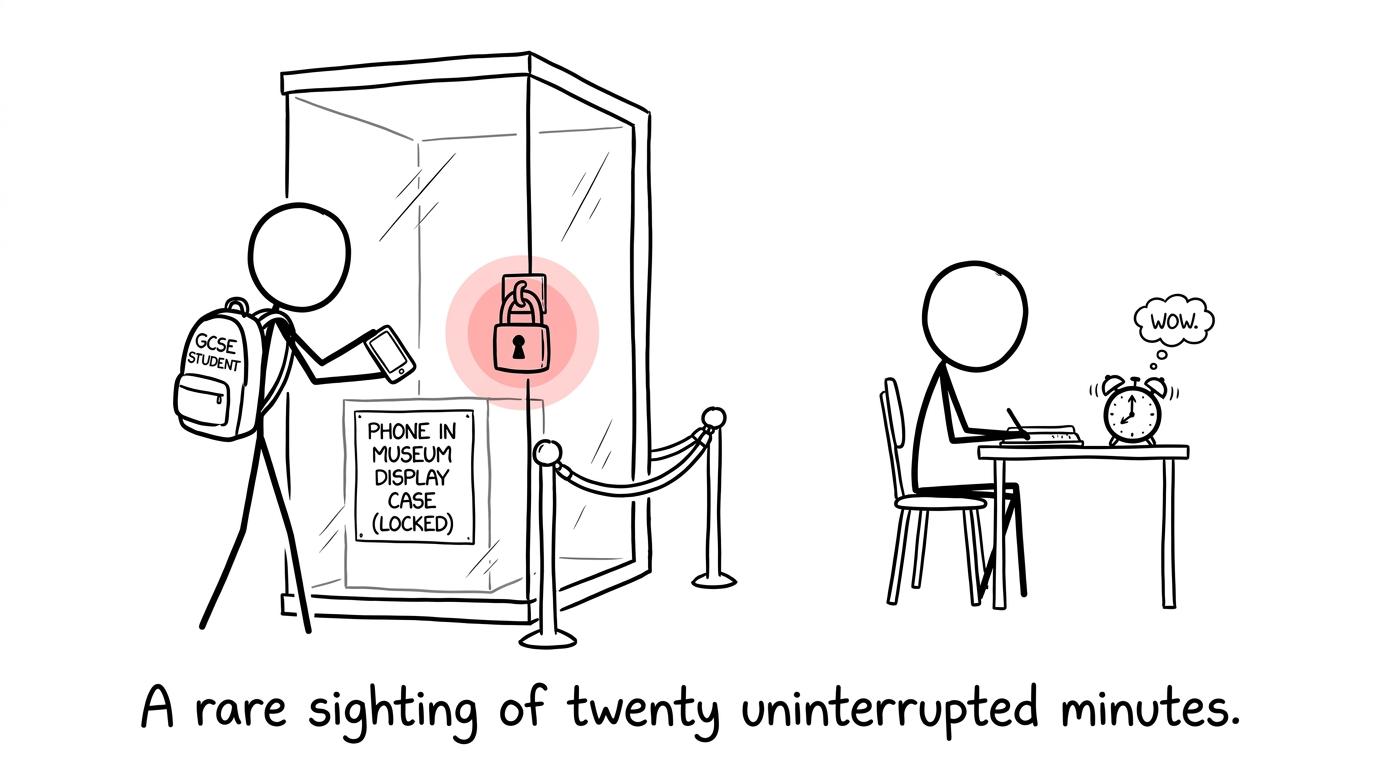 A phone is locked away for a short uninterrupted revision session
Fit French around maths and other GCSE subjects
Balance does not mean giving every subject identical time. It means allocating time according to evidence, deadlines and the amount of improvement available.
At the start of Easter, list your subjects and choose no more than three priorities for each. French might need listening, spontaneous speaking and verb accuracy. Maths might need algebra, ratio and geometry. These smaller lists are easier to schedule than entire specifications.
Alternate mentally different tasks where possible. A French speaking session followed by a timed maths paper may feel more manageable than two long writing-heavy activities.
For maths, shorter resources can sit neatly beside language practice. Edexcel GCSE Maths mini tests provide focused timed practice, while the one-week GCSE maths revision plan can help you organise one half of the holiday.
Save full papers for days when you have enough energy to complete and review them properly. If you use Edexcel GCSE Maths past papers, include time for the mark scheme and video solutions. A paper that is never analysed is mainly a measurement exercise.
Protect the holiday as well as the revision
Rest should not be treated as the reward you receive after finishing everything. GCSE revision is never completely finished, so that bargain has no end.
Choose a stopping time. Keep several evenings clear. Put full rest days into the timetable before filling the remaining spaces. If a session is missed, move the most valuable task rather than doubling the next day’s workload.
A sustainable plan also avoids using guilt as a timer. Once a focused task has been attempted, marked and corrected, you are allowed to stop. The purpose of Easter revision is to return more prepared, not merely more tired.
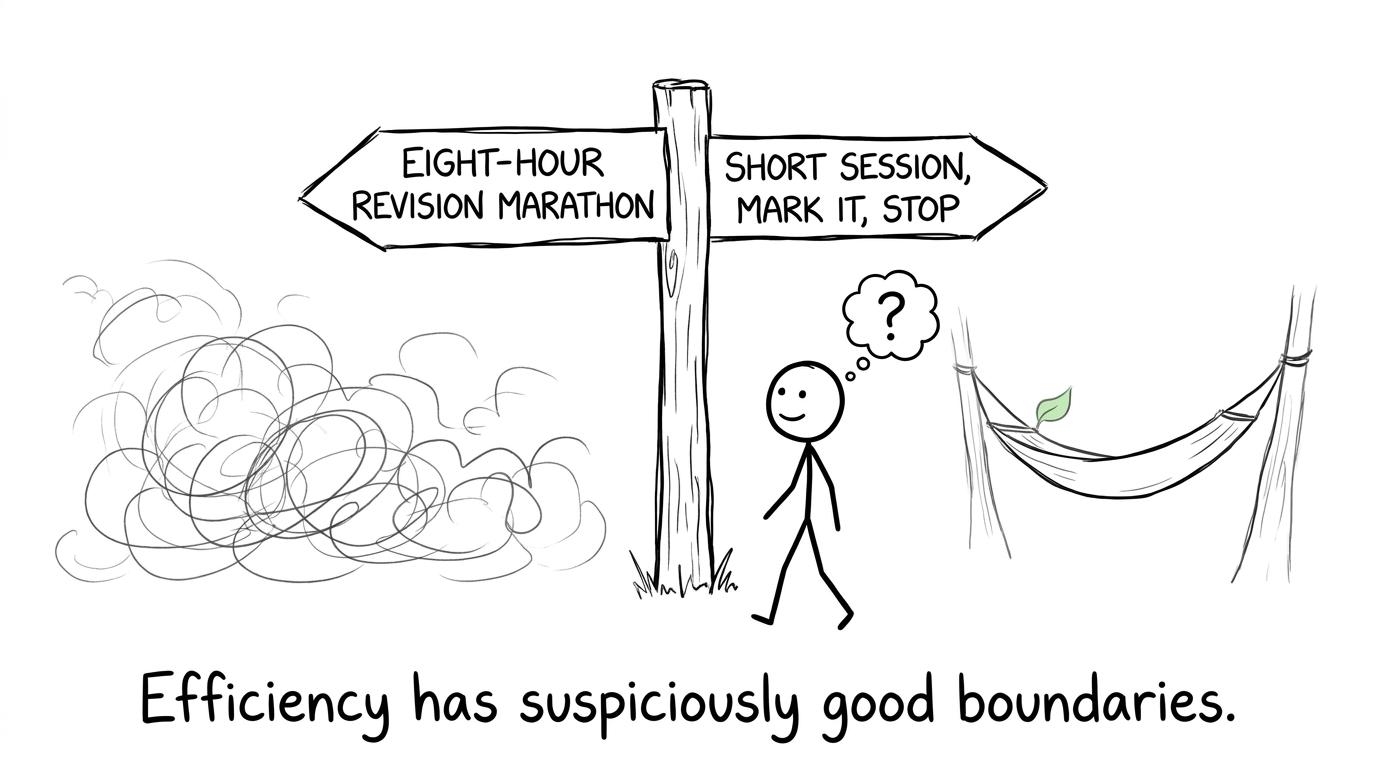 A student chooses short focused revision over a marathon into the fog
Common Easter revision mistakes
Planning every hour
An overfilled timetable has no room for delays or low-energy days. Plan a few specific blocks and leave generous blank space.
Revising only vocabulary
Vocabulary matters, but the examination asks you to understand and use language. Connect words to listening, speaking, reading, writing and grammar.
Avoiding speaking because it feels awkward
Silent preparation cannot reveal pronunciation or recall problems. Record short responses and accept that hesitation is useful evidence.
Completing tasks without correcting them
Marks alone do not explain what changed. Review errors, write accurate corrections and return to the weak skill later.
Using materials from the wrong specification
Old tasks can sometimes provide additional language practice, but they may not reflect your current assessment. Prioritise resources for your board, tier and specification.
Letting one subject consume the break
A difficult French task can expand into several hours, while a maths paper can do the same. Set clear limits. Maths students can use the structured process in how to use Edexcel past papers properly to stop paper practice from becoming aimless.
Finish Easter with evidence, not exhaustion
On the final weekend, do not attempt to repeat the entire holiday. Complete one short task in each French skill, compare the results with your opening diagnostic and write a concise list for the return to school.
Your list might contain one grammar issue, one vocabulary theme and one examination skill. That is enough. A clear next step is more useful than a folder full of unreviewed work.
For the maths part of your Easter plan, make MathsGenie your free revision base. Use revision lessons and practice questions to repair individual topics, mini tests to check recall, and past papers or predicted papers to build exam confidence. Mark your work with the available mark schemes and use video solutions when a method is unclear.
Start with the MathsGenie GCSE Maths revision area, add your French priorities to your revision planner, and build a holiday that prepares you for the exams without allowing the exams to take the whole holiday.