GCSE French 6 to 8: A Practical Grade-Up Plan
GCSE French 6 to 8 guidance: improve accuracy, vocabulary, speaking and exam technique with a focused plan for moving up the higher tier.

A grade 6 in GCSE French usually means you can communicate successfully. You understand the main message, express opinions and use more than one tense. Yet the performance may still be uneven: a strong writing paper, perhaps, followed by missed details in listening or hesitant speaking.
The journey from GCSE French 6 to 8 is not mainly about collecting impressive phrases. It is about becoming more precise, flexible and dependable across listening, speaking, reading and writing. You need broader vocabulary, but you also need to retrieve it quickly. You need ambitious grammar, but controlled grammar earns more than complexity you cannot manage.
There is no fixed mark that always guarantees a grade 8. Grade boundaries are set after each exam series and differ by exam board and paper. The useful target is therefore not a guessed score. It is a stronger standard of performance, repeated under exam conditions.
The grade 6 to grade 8 checklist
The most important changes are:
- replace general revision with diagnosis based on marked work;
- learn vocabulary as usable phrases, not isolated words;
- control present, past and future time frames accurately;
- develop answers with reasons, details and contrasts;
- improve listening through transcription and sound recognition;
- practise spontaneous speaking rather than memorising one script;
- answer every bullet point and respect the required register;
- use mark schemes and teacher feedback to identify recurring losses;
- complete regular timed tasks and revisit mistakes.
These principles resemble effective maths revision. MathsGenie's guide to finding your weakest GCSE topics explains the essential loop: gather evidence, label mistakes, practise narrowly and retest. The subject changes. The logic does not.
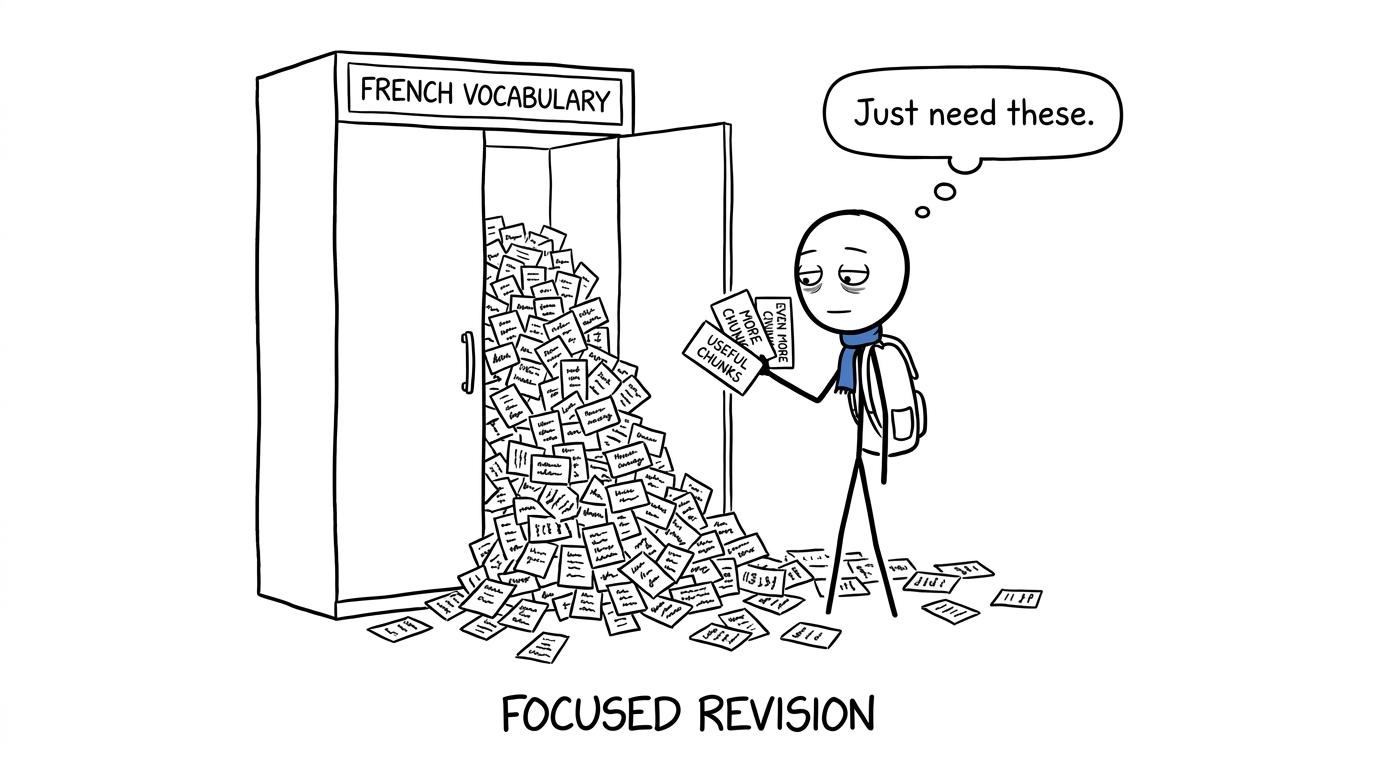 A student choosing useful French phrases from a vocabulary avalanche
What separates a grade 6 from a grade 8 in GCSE French?
A grade is based on total performance, so no single feature automatically produces a grade 8. Nevertheless, higher-level answers tend to show several recognisable qualities.
Communication becomes developed, not merely complete
A grade 6 student may answer the question clearly but briefly. A grade 8 candidate is more likely to add a reason, relevant detail, comparison or consequence while staying focused on the task.
This does not mean making every answer long. In a role-play, concise communication may be exactly what the task requires. In an extended response or conversation, however, undeveloped statements restrict how much language you can demonstrate.
Train yourself to extend naturally through:
- an opinion followed by a justification;
- a statement followed by a specific detail;
- a present situation contrasted with the past;
- a plan followed by a condition or consequence;
- one viewpoint balanced against another.
The goal is purposeful development, not padding.
Grammar becomes controlled and flexible
Students often assume that grade 8 French must contain the most complicated grammar possible. That is only half true. Range matters, but accuracy matters too.
The stronger shift is from occasionally producing an ambitious structure to controlling a useful bank of structures across unfamiliar topics. Priorities normally include:
- secure present-tense forms;
- accurate past and future reference;
- adjective agreement;
- negatives;
- pronouns;
- common modal constructions;
- connectives and subordinate clauses;
- justified opinions;
- appropriate formal and informal language.
Keep an accuracy checklist based on your own errors. If agreement, verb endings or accents repeatedly cost marks, those are not small details to ignore. They are the next part of your grade.
Vocabulary becomes adaptable
Vocabulary breadth helps with every paper, but recognition alone is insufficient. You need to understand a word in speech, recognise it in writing, spell it where required and retrieve it during speaking or writing.
Learn high-frequency language in chunks. Include the article with a noun, the preposition that follows a verb, or a connective with the clause it introduces. Then vary the context. A phrase known only inside one memorised answer is fragile; a phrase you can adapt to school, holidays, technology and health is useful language.
For qualifications first assessed from summer 2026, the reformed GCSE specifications use defined vocabulary and grammar lists. Higher tier includes additional vocabulary beyond foundation tier. Use the list for your own board: AQA, Pearson Edexcel, OCR or Eduqas, rather than an old generic checklist.
Build a four-skill improvement plan
The reformed GCSE French qualifications assess listening, speaking, reading and writing. Each component contributes one quarter of the qualification, although Ofqual's assessment objectives combine spoken language, written language, and accurate grammar and vocabulary in a more detailed way.
That balance matters. A student hoping one excellent writing paper will compensate for permanently weak listening is taking an unnecessary risk.
Listening: move from recognising topics to capturing detail
At grade 6, you may identify the subject and overall opinion but lose marks on negatives, time references, numbers, changes of mind or similar-sounding words. Grade 8 performance depends more reliably on precise details.
Use short audio sections actively:
- listen once for the overall message;
- listen again and write what you hear;
- compare your transcription with the original;
- identify the sound-to-spelling link you missed;
- replay the same extract after a delay.
The new specifications include dictation, so spelling from sound is directly relevant. Do not limit listening revision to completing comprehension questions. Practise distinguishing verb endings, contractions, negatives and common sound patterns.
Speaking: prepare building blocks, not a speech
Memorised answers can create confidence, but they can also collapse when a question changes. Prepare flexible components instead: opinions, reasons, tense markers, repair phrases and ways to extend an answer.
The reformed speaking assessments include a read-aloud element, a role-play and discussion linked to visual material, with unprepared interaction. Exact task arrangements vary by board, so check your current specification and sample assessment materials.
Record short responses and assess three things separately: comprehensibility, grammatical control and development. If possible, ask your teacher to identify the one feature most limiting your mark. Correcting one repeated pronunciation pattern can be more valuable than learning another paragraph.
 A very serious cat conducting a French speaking assessment
Reading: prove every answer from the text
Grade 8 reading is not just knowing more words. It involves noticing detail, using grammar to work out who did what and inferring plausible meanings from context.
When reviewing a question, underline the exact evidence. If your answer was wrong, classify the reason:
- unknown vocabulary;
- a familiar word used differently;
- missed negative;
- incorrect tense;
- pronoun confusion;
- assumption based on one keyword;
- incomplete English response.
Current specifications may test the inference of unfamiliar words embedded in clear context. Instead of panicking at one unknown item, inspect the surrounding sentence, word family and grammatical role.
Writing: make accuracy visible under pressure
For each writing task, plan around the compulsory content before choosing impressive language. Cover every bullet, choose the correct register and make time frames unmistakable.
Then proofread in layers. First check whether the task is complete. Next inspect verbs and time frames. Then check agreements, negatives, spelling and accents. A general final read often misses familiar mistakes because your brain sees what you intended to write.
Formal and informal contexts may be assessed differently depending on the board. Practise openings, closings and forms of address that fit each situation, but avoid turning the whole response into a memorised template.
Use an error log to find the missing marks
After each marked task, record the skill, the cause and the correction. “Listening was bad” is not a diagnosis. “I missed two negatives and confused present with past” gives you something to practise.
A useful weekly rhythm is:
- one vocabulary retrieval session;
- one grammar accuracy session;
- one short listening transcription;
- one recorded speaking response;
- one reading or translation task;
- one timed writing task;
- one review session for previous mistakes.
Space these activities through the week rather than putting them into one exhausting evening. You can organise sessions with the free MathsGenie revision planner. If you are balancing French with maths, the GCSE Maths revision hub helps you keep mathematical revision structured too.
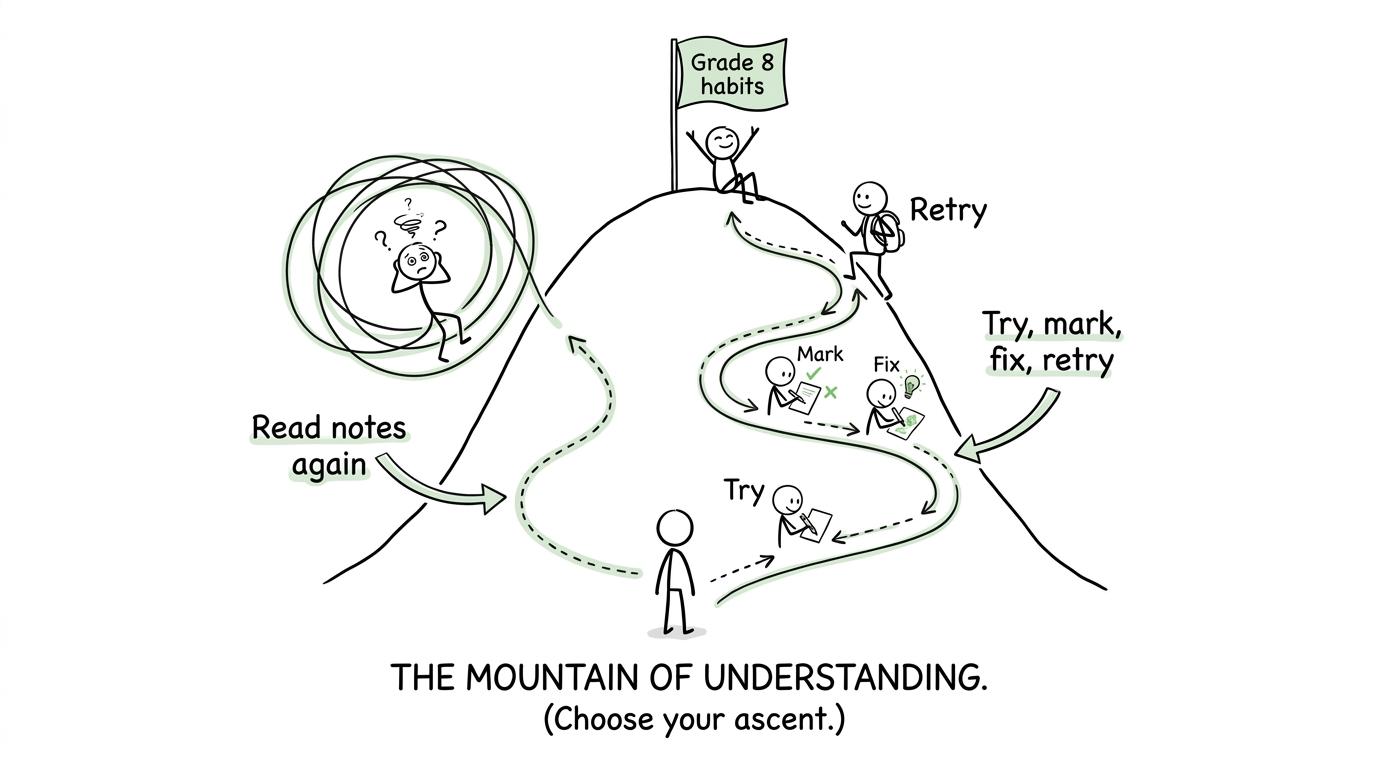 Two revision paths: rereading in circles or trying, marking and fixing
Practise under conditions that reveal weaknesses
Comfortable revision can create misleading confidence. Recognising vocabulary cards is easier than retrieving French in a timed response. Reading a transcript is easier than understanding an unfamiliar speaker.
Gradually remove support:
- begin with notes or a model;
- repeat without the model;
- change the topic or tense;
- add a time limit;
- complete an unseen task;
- mark it and retry the weak element later.
This is the same reason maths students progress from lessons to questions and then papers. MathsGenie's free revision resources, Edexcel GCSE Maths mini tests and GCSE past-paper timing guide demonstrate how practice becomes more realistic over time.
For French, use current materials from your school and exam board. Older papers can still develop language skills, but task formats changed for specifications first assessed in 2026. Prioritise the sample materials and guidance matching the qualification you will actually sit.
Common mistakes when aiming for grade 8
Collecting sophisticated phrases without mastering basics
A rare idiom cannot rescue frequent errors in ordinary verbs. Secure high-utility language first, then add complexity you can control.
Revising only the strongest skill
Writing may feel satisfying because you control the pace. Listening and spontaneous speaking can feel less comfortable, which is precisely why they need regular attention.
Memorising answers word for word
Memorisation can support retrieval, but whole scripts are difficult to adapt. Learn interchangeable chunks and practise responding to unexpected wording.
Ignoring the exact task
Excellent French that misses a bullet point, uses the wrong register or answers a different question cannot earn the marks it might have earned elsewhere. Read instructions twice and create a brief content plan.
Marking without correcting
A score measures the past. Improvement comes from the correction that follows it. Rewrite inaccurate sentences, repeat missed listening sections and answer speaking questions again.
Treating a predicted grade as a ceiling
A predicted grade is evidence from previous performance, not a limit on future performance. Use it to locate the current gap, then collect better evidence through timed work and careful feedback.
Turn grade 8 habits into a repeatable system
Moving from grade 6 to grade 8 in GCSE French is less about one dramatic revision week than a series of small upgrades: more accurate verbs, sharper listening, fuller responses, broader retrieval and fewer repeated mistakes.
Start with one recent assessed task. Identify the three clearest mark losses. Build next week's French sessions around them, then complete a fresh task to see whether the weaknesses have changed. That is how a target becomes evidence rather than hope.
MathsGenie remains your free home for GCSE and A Level maths revision. Use the revision planner to balance your subjects, then strengthen maths through revision lessons, practice questions, mark schemes and video solutions. As exams approach, add Edexcel GCSE Maths past papers and GCSE predicted papers. Different subjects reward different knowledge, but disciplined improvement follows a familiar path: practise, check, correct and return.