GCSE Food and Nutrition Revision Timetable: Worth It?
GCSE food and nutrition revision timetable worth it? See when a written plan helps, when flexible revision works, and how to protect maths practice time.
The timetable looks impressive. Every subject has a colour, every evening has a purpose, and somehow the next eight weeks fit neatly on one sheet of paper. Then Tuesday arrives, homework takes longer than expected, and the whole plan begins to feel fictional.
So, is a GCSE food and nutrition revision timetable worth it? Yes, if it is brief, flexible and built around specific revision tasks. No, if making it becomes a substitute for revising or if one missed session causes the entire plan to collapse.
A timetable does not improve results by itself. Its value comes from the behaviour it encourages: starting on time, revisiting content across several weeks, testing your memory and protecting enough space for other subjects, especially GCSE maths.
The short answer: use a timetable as a guide, not a contract
A useful plan should help you answer four questions:
- What Food Preparation and Nutrition content needs attention?
- When will you return to it rather than cramming once?
- What active task will you complete in each session?
- How will Food revision fit alongside maths and your other GCSEs?
If a written timetable answers those questions in a few minutes, it is worthwhile. If you spend an evening choosing fonts, moving boxes and planning every day until the examination, use a simpler system.
The strongest option for many students is a flexible weekly timetable: reserve a few realistic revision windows, choose priorities from a short task list, and review the plan at the end of each week.
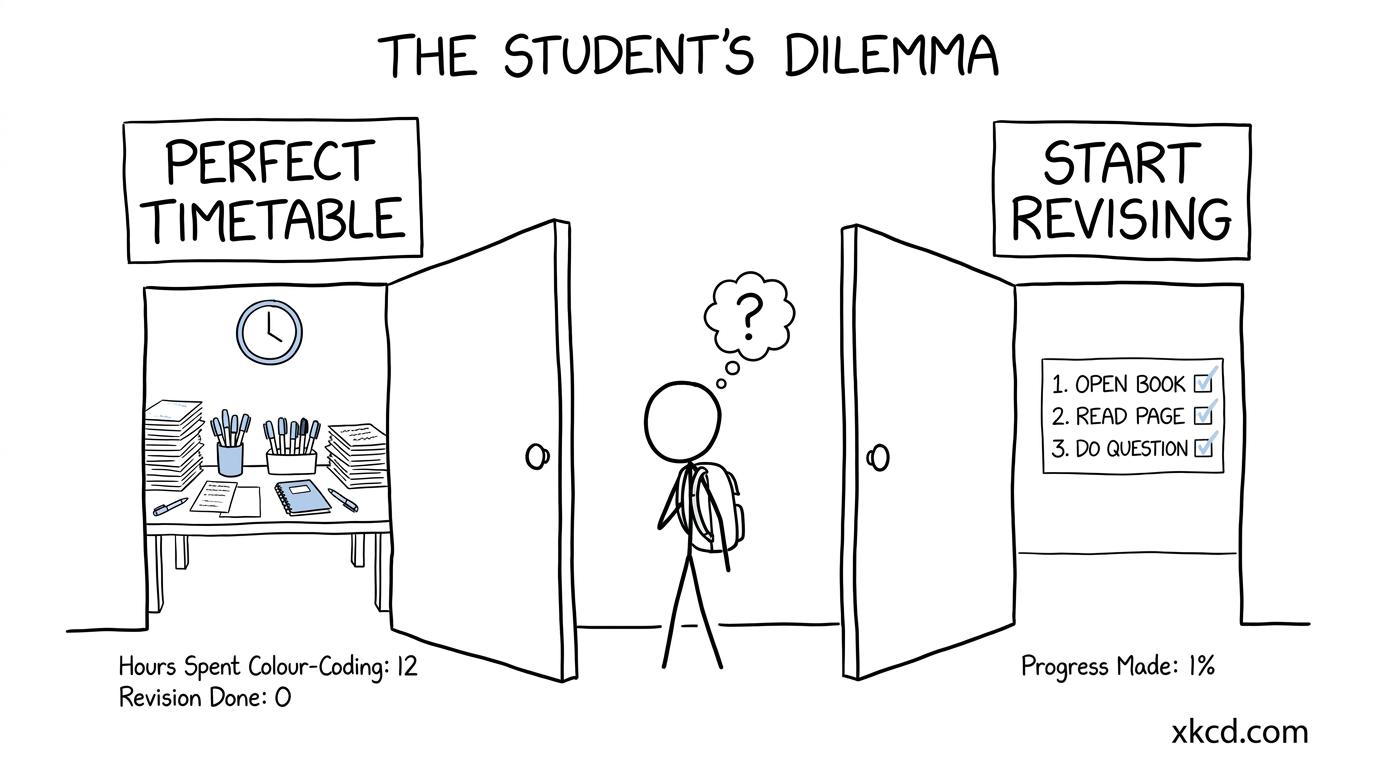 A student chooses between perfect planning and starting revision
What a Food and Nutrition timetable can actually change
A timetable cannot guarantee a grade. It can change the conditions in which useful revision happens.
Current guidance on metacognition and self-regulated learning emphasises planning, monitoring and evaluating learning. It also notes the value of spaced practice, where revision is distributed across shorter sessions instead of being concentrated into one long period. The important distinction is that planning must remain connected to subject content and genuine practice.
For Food Preparation and Nutrition, that matters because the course combines several kinds of knowledge. Depending on your exam board, you may need to recall nutritional functions, explain food science, apply food-safety principles, analyse choices and write developed responses.
For example, AQA currently assesses the qualification through a written examination worth 50%50\%50% and non-exam assessment worth 50%50\%50%. Eduqas also divides the qualification between a written component and non-exam assessment with the same overall weighting. Exact requirements and terminology should always be checked against your own specification and your teacher's instructions.
A revision timetable can therefore prevent one familiar mistake: treating the subject as if it were only a collection of facts. Your plan should include recall, application, extended responses and feedback, not just reading notes.
Written timetable or flexible revision?
Neither approach is automatically better. The right choice depends on what usually stops you from revising.
A written timetable is useful when you struggle to begin
Use a visible timetable if you frequently reach an evening without deciding which subject to revise. A reserved slot removes one decision.
It also helps when several deadlines compete for attention. Food coursework or teacher-set preparation can feel urgent, while maths topic practice is easier to postpone. A weekly plan makes that imbalance visible before it becomes a problem.
Keep each entry specific. “Food revision” is vague. Better tasks include:
- retrieve the functions and sources of selected nutrients;
- answer questions on food safety and contamination;
- compare two cooking methods using scientific explanations;
- plan an extended response and check it against assessment guidance;
- complete a mixed recall quiz without notes.
Flexible revision works when your week changes often
Some students have changing homework, practical commitments, caring responsibilities or unpredictable energy levels. A rigid timetable may create guilt without creating useful work.
In that case, write a weekly task menu rather than assigning every task to an exact hour. Decide which three or four tasks matter most, then complete them in the revision windows that become available.
Flexibility is not the same as improvising indefinitely. You still need a minimum commitment and a way to check what has been completed. A simple list headed must do, should do and could do is often enough.
A hybrid plan is usually the most durable
Fix the time, but allow the task to change.
You might reserve two short Food Preparation and Nutrition sessions each week. At the start of each session, select the weakest suitable task from your list. This preserves consistency without pretending you can predict every school day in advance.
The same principle works for maths. The MathsGenie GCSE maths revision timetable guide explains how to combine spaced topic work, exam questions and timed papers without filling every spare hour.
How to build a timetable that survives a real week
The best timetable is not the most ambitious one. It is the one you can still follow after a tiring Wednesday.
Start with fixed commitments
Add lessons, homework deadlines, meals, travel, activities and rest before revision. Time that does not genuinely exist cannot be allocated twice.
Next, identify small repeatable windows. A focused 202020-minute session can be more useful than a theoretical two-hour block that is repeatedly postponed. For maths, the GCSE 202020-minute revision routine provides a compact learn, practise and review structure.
Use tasks that produce evidence
At the end of a session, you should be able to point to something that shows what happened: completed questions, recalled information, a marked response or a short error list.
Passive activities can feel smooth because the material is familiar while it is in front of you. Close the book first. Retrieve what you know, answer a question, and then use notes to correct gaps.
Plan revisits rather than one-off coverage
A topic is not permanently finished because it appeared in one revision session. Return to difficult material on later days. This is why a modest timetable stretching across several weeks generally has more value than a heroic weekend plan.
Do not attempt to calculate a perfect spacing interval. The practical goal is simply to revisit material after some forgetting has occurred and to use the result to decide what needs attention next.
Leave a catch-up window
Keep at least one period unassigned each week. If everything goes to plan, it becomes rest or optional practice. If schoolwork expands, it absorbs the disruption.
Without spare capacity, one missed Tuesday session gets pushed into Wednesday, Wednesday moves to Thursday, and by the weekend the timetable owes you several impossible hours.
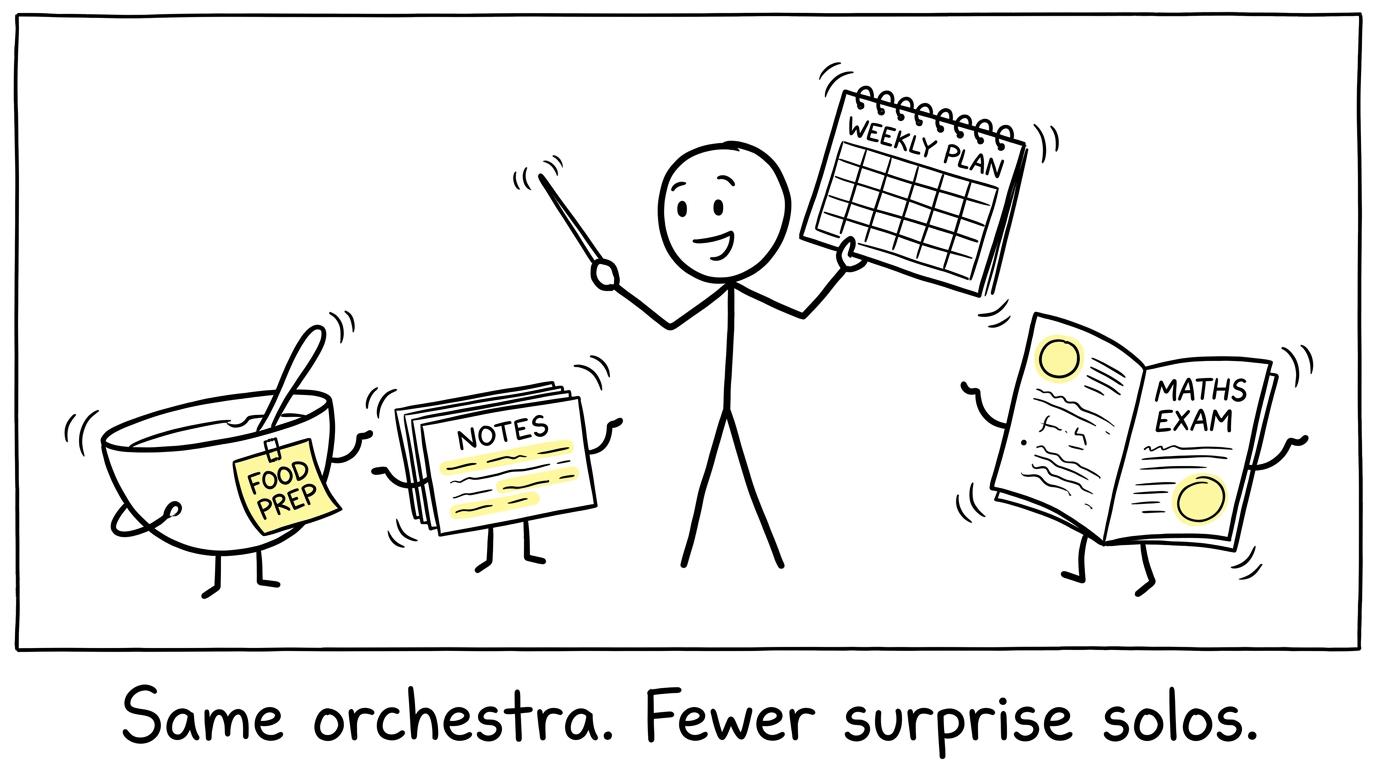 A revision plan conducts a kitchen orchestra
Balancing Food and Nutrition with GCSE maths
Food Preparation and Nutrition may contain numerical work, but it should not replace dedicated maths revision. GCSE maths demands repeated practice across number, algebra, ratio, geometry, probability and statistics, matched to your foundation or higher tier.
Begin by identifying where marks are being lost. The MathsGenie guide to finding your weakest GCSE topics shows how paper evidence can turn a vague concern into a focused list.
A balanced week might contain:
| Revision slot | Main purpose |
|---|---|
| Short Food session | Retrieval of knowledge and terminology |
| Short maths session | One weak topic using practice questions |
| Second Food session | Application or extended-response practice |
| Longer maths session | Mini test or timed paper section, followed by marking |
| Catch-up window | Missed work, targeted correction or rest |
This is a framework, not a prescribed allocation. Your teachers, assessment dates and current weaknesses should determine the balance.
For maths resources, start with the free GCSE maths revision hub, where you can choose your exam board and find revision lessons, questions and papers. If you have a full month available, the GCSE one-month maths revision plan can help you organise the progression from diagnosis to timed practice.
How to tell whether your timetable is working
Do not judge the plan by how many boxes you tick. Judge it by what you can now do without help.
At the end of each week, ask:
- Can I recall more accurately without looking at my notes?
- Can I apply knowledge to an unfamiliar question?
- Have I corrected repeated errors?
- Am I still completing maths questions, not merely reading solutions?
- Is the plan realistic enough to repeat next week?
For maths, use mini tests and paper questions to generate honest feedback. As examinations approach, board-specific papers become increasingly useful. Students following Edexcel can use the Edexcel GCSE maths past papers, while the broader GCSE hub covers AQA, OCR, Eduqas and other boards.
A timetable should change when the evidence changes. If food science recall is improving but extended responses remain weak, move time towards application. If algebra repeatedly costs marks, protect additional maths practice. Adaptation is a sign that the plan is working, not that the original plan failed.
Common revision timetable mistakes
Planning subjects instead of actions
“Revise Food” and “do maths” do not define a finish line. Name the topic, resource and intended output.
Making every session too long
Long blocks are fragile. Shorter sessions are easier to start and easier to repeat, particularly on school days.
Rewriting the timetable after every disruption
Move the important task into your catch-up window. Do not redesign the whole system because one evening changed.
Confusing notes with retrieval
Neat summaries may support understanding, but they do not prove that you can recall or apply knowledge. Include closed-book questions and feedback.
Giving every topic equal time
Revision should respond to need. Use teacher feedback, marked work and practice results to prioritise weaker areas.
Forgetting to mark maths work
Questions reveal performance only when you check them properly. Use mark schemes and video solutions, record the exact error, then practise the skill again. The guide to using Edexcel GCSE maths past papers properly explains this paper, mark, repair and retest cycle.
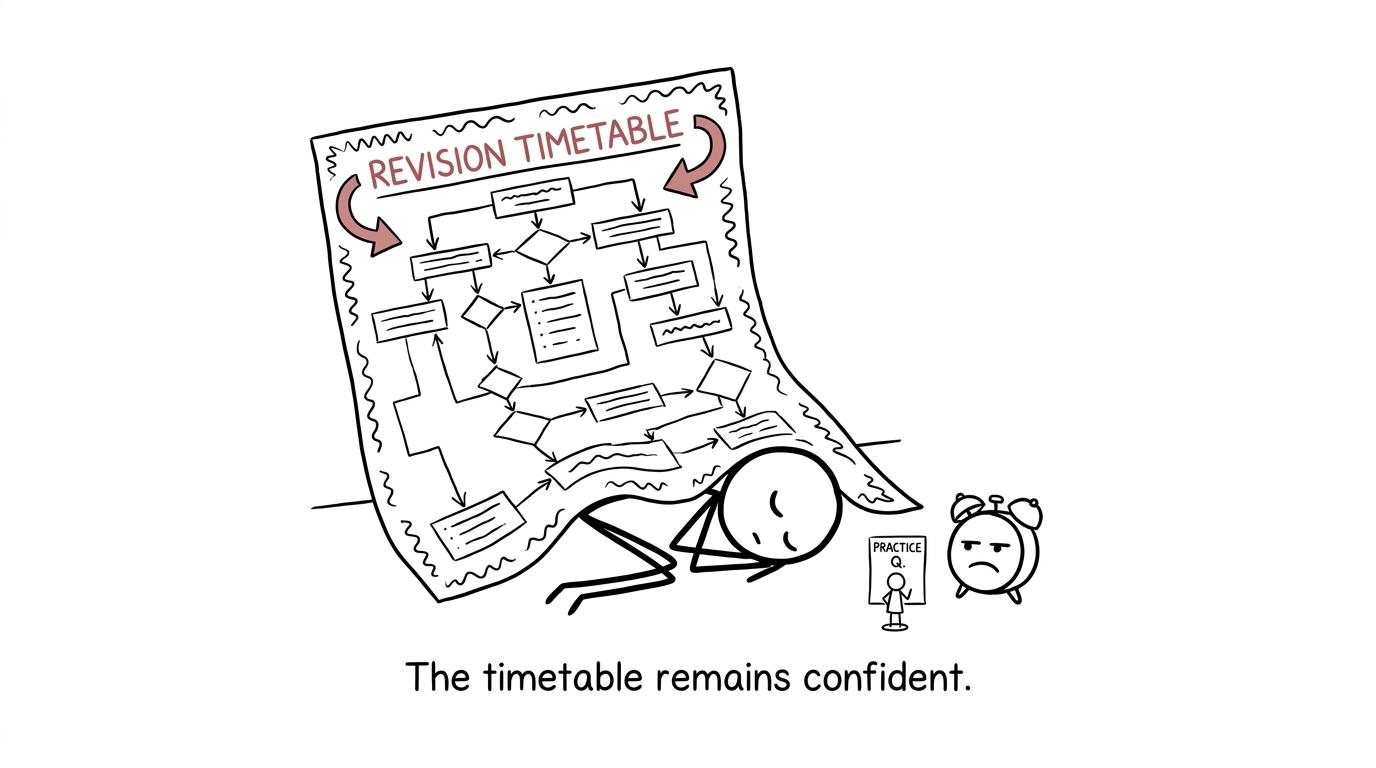 An ornate timetable remains confident while no revision happens
Make the plan smaller, then start
A GCSE Food and Nutrition revision timetable is worth making when it reduces decisions, spaces practice across time and leaves room for adaptation. Flexible revision can work equally well when it still includes clear priorities, regular sessions and honest checks on progress.
The timetable is not the achievement. The useful work happens when you retrieve a fact, attempt a response, solve a question, inspect a mark scheme and return to a weakness.
Build a simple weekly structure for Food Preparation and Nutrition, then let MathsGenie organise the maths side of your revision. Start with free revision lessons and practice questions, check progress through mini tests, and move towards past papers and predicted papers with mark schemes and video solutions. A plan only needs to be clear enough to reveal your next action. Then you begin.