GCSE Food and Nutrition Grade Boundaries Explained
GCSE Food and Nutrition grade boundaries explained clearly: learn why raw marks change by year, how assessments are weighted and how grades are set.
A mark can feel wonderfully definite. You count what you earned, divide by what was available and turn it into a percentage. It seems as though the grade should follow automatically.
But GCSE grading is not quite that mechanical. With GCSE Food and Nutrition grade boundaries explained, the central idea is simple: your raw mark is judged against boundaries set for your exam board and exam series after the assessments have been marked. Those boundaries can move because the difficulty of the assessment can change.
A percentage remains useful, but it does not decide the grade by itself. Your written examination and non-exam assessment also need to be combined according to the specification's weighting.
The quick grade-boundary checklist
Before interpreting any Food Preparation and Nutrition mark, check:
- your exam board, usually AQA, OCR or Eduqas
- the exact exam series and year
- whether the figure is a component mark or an overall subject mark
- the maximum mark for that component or qualification
- whether the exam board scales any component
- the official overall grade-boundary table
A boundary is the minimum mark needed for a grade. If a grade 777 boundary is 142142142, then 142142142 reaches grade 777 while 141141141 does not. It does not mean that everybody above the boundary produced identical work.
MathsGenie's GCSE grade boundaries guide gives a broader explanation of the same principle across GCSE subjects.
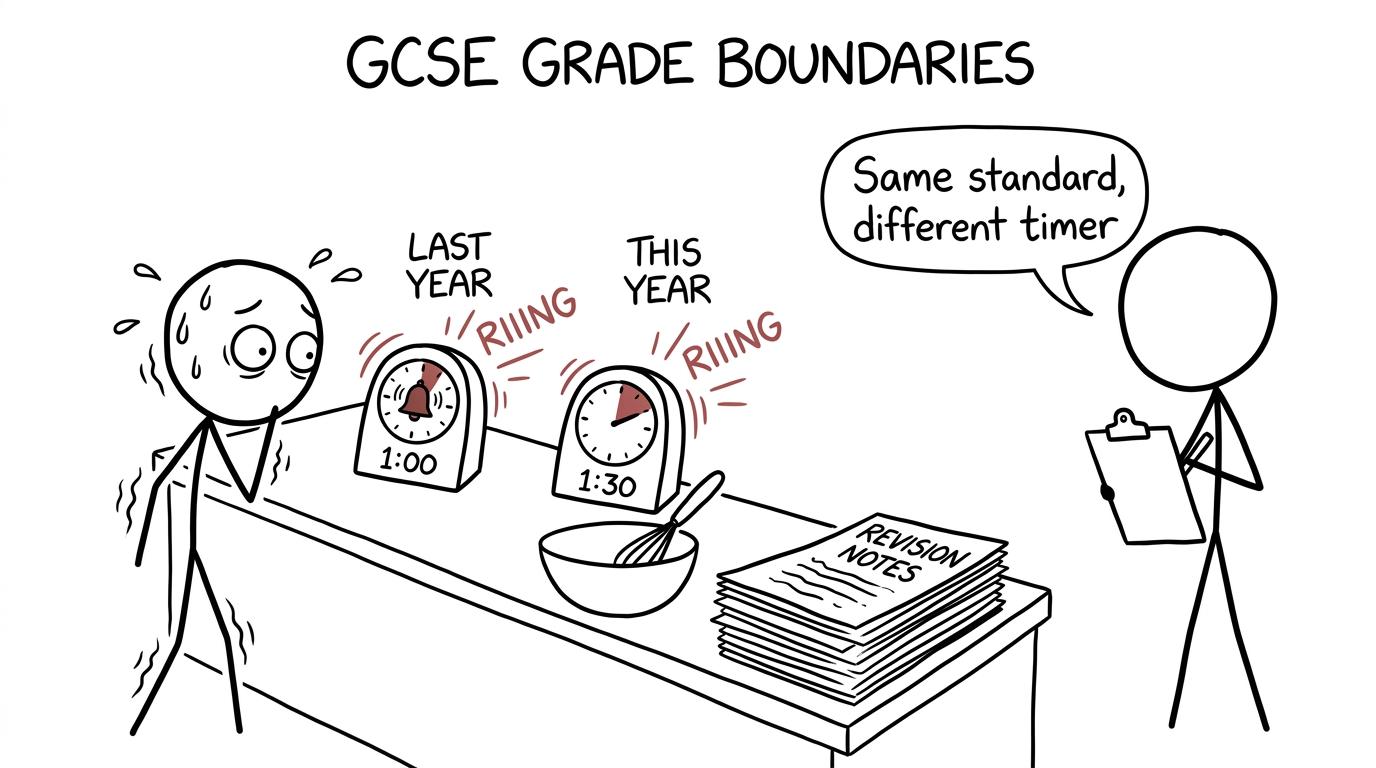 A student compares two differently timed assessments while an examiner explains that the standard stays the same
Why your raw mark is not just a percentage
A raw mark is the number of marks awarded by the examiner or moderator before any required scaling. A percentage simply expresses that mark out of 100100100:
Percentage=raw markmaximum raw mark×100\text{Percentage} = \frac{\text{raw mark}}{\text{maximum raw mark}} \times 100Percentage=maximum raw markraw mark×100That calculation describes your share of the available marks. It does not say what standard the assessment represented in that particular year.
Exam boards aim to maintain comparable standards over time. Even carefully designed papers cannot be perfectly equal in difficulty. Students may find one year's questions slightly more accessible, while another paper may demand more unfamiliar application or contain a particularly challenging extended response.
If an assessment proves harder, a comparable quality of work may produce fewer raw marks, so boundaries may be lower. If it proves easier, boundaries may be higher. The purpose is not to make a particular year generous or harsh. It is to avoid making a grade easier or harder to obtain merely because of the paper a cohort happened to sit.
This is why an old boundary should be treated as context, not a promise.
How GCSE Food and Nutrition grade boundaries are set
Grade boundaries are not normally fixed before students complete the assessments. Once marking and moderation have taken place, awarding organisations consider several kinds of evidence.
Statistical evidence identifies possible boundaries
Exam boards analyse how the cohort performed and compare that evidence with previous cohorts. Prior-attainment data can help indicate whether the overall group is broadly comparable with earlier groups. It is used at cohort level, not to predict the grade that an individual student ought to receive.
The aim is to maintain standards over time, not to force exactly the same number of students into each grade every year.
Senior examiners review real work
Statistics inform the process, but they are not the whole process. Senior examiners inspect work around possible boundaries and compare its standard with relevant evidence from previous years. They consider whether the proposed threshold represents the expected quality for that grade.
Final boundaries are applied consistently
Once confirmed, the same overall boundaries apply to students taking that specification in that exam series. AQA, OCR and Eduqas use different assessments and mark structures, so their raw boundaries should not be compared as if the papers were interchangeable.
A lower raw boundary on one board does not automatically mean that board is easier. It may instead reflect a harder assessment, a different maximum mark or component scaling.
What the assessment structure changes
Food Preparation and Nutrition combines a written examination with non-exam assessment, usually shortened to NEA. The qualification is untiered, so there are no separate foundation and higher papers.
Across the current AQA, OCR and Eduqas specifications, the written examination contributes 50%50\%50% of the qualification and the combined NEA contributes 50%50\%50%. However, the raw-mark structures are not identical.
| Exam board | Written assessment | NEA | Overall mark structure |
|---|---|---|---|
| AQA | 100100100 raw marks, worth 50%50\%50% | Two tasks totalling 100100100 marks, worth 50%50\%50% | Overall total out of 200200200 |
| OCR | 100100100 raw marks, worth 50%50\%50% | Tasks worth 454545 and 105105105 raw marks | Exam mark is scaled by 32\frac{3}{2}23, producing an overall total out of 300300300 |
| Eduqas | 100100100 marks, worth 50%50\%50% | 100100100 marks, worth 50%50\%50% | Overall total out of 200200200 |
OCR's scaling matters. Simply adding its 100100100-mark written paper to the 150150150 raw NEA marks would make the written component worth less than half. The written mark is therefore weighted to 150150150:
OCR weighted written mark=raw written mark×32\text{OCR weighted written mark} = \text{raw written mark} \times \frac{3}{2}OCR weighted written mark=raw written mark×23The two sides of the qualification then each contribute 150150150 marks to the 300300300-mark total.
This is the same proportional thinking used throughout GCSE maths. If percentages or scaling feel uncertain, MathsGenie's free percentages revision resources and ratio revision guide help strengthen the underlying skills.
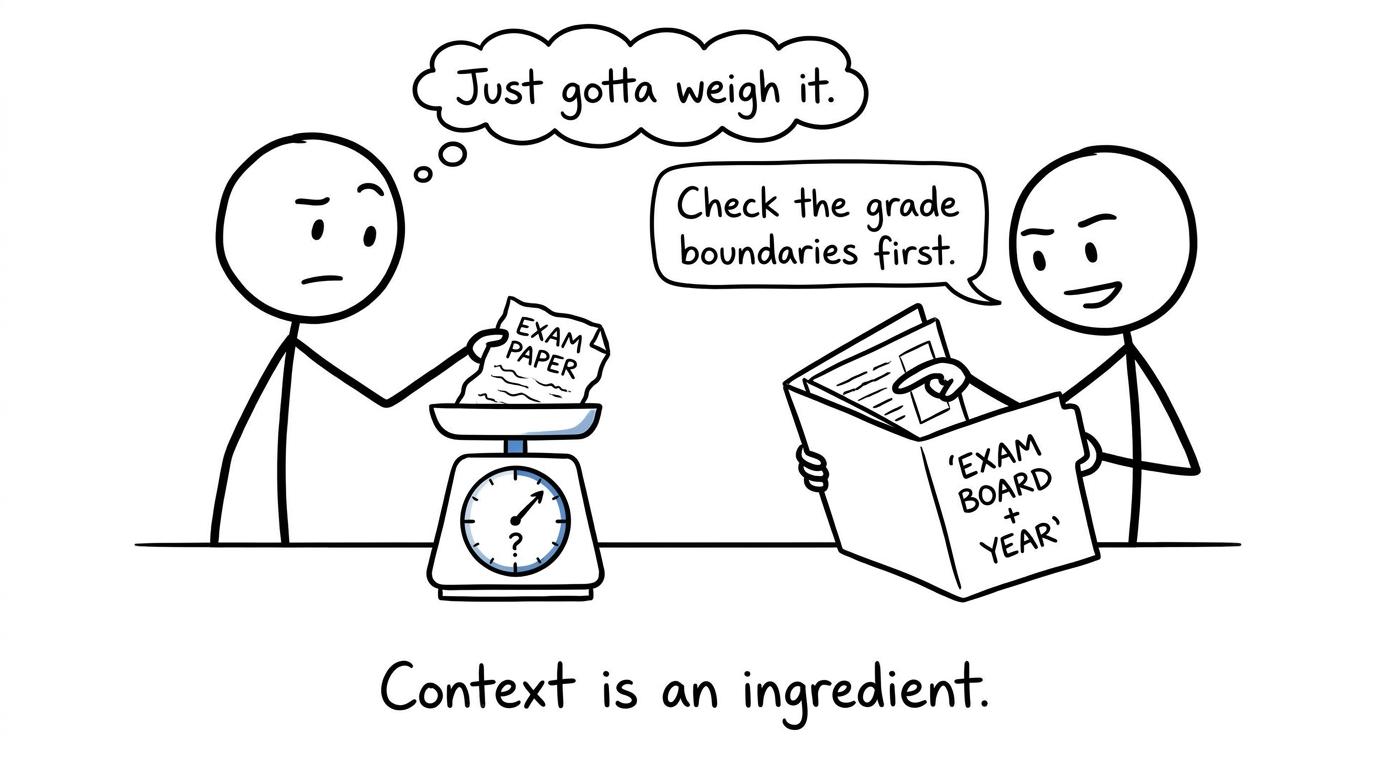 A student weighs an exam paper while another checks the correct exam board and year
What recent boundaries reveal
The June 2025 overall boundaries show why the exam board and maximum mark must always accompany a raw figure.
| Board | Maximum mark | Grade 999 | Grade 777 | Grade 555 | Grade 444 |
|---|---|---|---|---|---|
| AQA | 200200200 | 169169169 | 142142142 | 110110110 | 959595 |
| OCR | 300300300 | 230230230 | 190190190 | 146146146 | 125125125 |
| Eduqas | 200200200 | 164164164 | 139139139 | 109109109 | 959595 |
These are confirmed boundaries for that series, not permanent targets. You can explore the complete tables on MathsGenie's AQA Food and Nutrition grade boundaries and Eduqas Food and Nutrition grade boundaries pages.
Movement between years is normal. On AQA, for example, the overall grade 999 boundary was 174174174 out of 200200200 in June 2024 and 169169169 out of 200200200 in June 2025. The grade 444 boundary moved from 969696 to 959595.
This does not show that the grade itself changed value. It shows that different raw marks were judged to represent the required standard in different assessment series.
Overall and component boundaries are not the same
A component table may show suggested or notional boundaries for the written paper or NEA. These can help teachers understand performance, but the certificated GCSE grade comes from the combined, appropriately weighted subject mark.
That distinction matters because a student can perform more strongly in one component than another. There is no requirement to earn the same notional grade in the written examination and both NEA tasks. The final outcome depends on the combined total.
For revision, this creates a useful shift in attention: NEA marks already earned are part of the picture, but they should not become a reason to guess a guaranteed final grade. Concentrate on collecting every available written-paper mark while using only the official overall boundary from the matching series when results are released.
How to use old boundaries without misleading yourself
Past boundaries can help you interpret mock and past-paper totals, provided you label them properly.
A sensible record includes:
- the assessment year
- the exam board
- the component or overall qualification
- your raw mark and the maximum available
- the published boundary used for comparison
- the topics or question types that lost marks
Do not revise merely to scrape the previous year's threshold. Boundaries can rise, and mock marking may not reproduce final moderation or awarding exactly. Build a buffer and focus on improving the underlying work.
For maths exam preparation, the same evidence-led habit is powerful. Use GCSE past papers with mark schemes, record lost marks by topic and return to the relevant revision lesson. Near the examination, GCSE predicted papers provide fresh exam-style practice, but they cannot predict official grade boundaries.
Common mistakes when reading Food and Nutrition boundaries
Treating a percentage as a universal grade
There is no permanent rule saying that one percentage always equals one GCSE grade. Use the official raw boundary for the correct board and series.
Comparing raw marks from different maximum totals
A mark out of 200200200 cannot be directly compared with a mark out of 300300300. Convert to percentages only if you want a common numerical scale, and remember that the percentage still does not determine the grade independently.
Adding OCR components without scaling
OCR's written paper is scaled from 100100100 to 150150150 marks so that it contributes 50%50\%50%. Ignoring this weighting gives the wrong overall total.
Using a component boundary as the final grade
Notional component boundaries are informative, but the final qualification grade is based on the combined weighted subject mark.
Assuming last year's boundary will return
Previous tables are useful reference points, not forecasts. Exact boundaries cannot be known until the awarding process has been completed.
Comparing boards and deciding one is easier
Different question papers, mark totals and assessment structures produce different raw thresholds. The number alone cannot measure difficulty.
 A student chef combines topic practice and past papers while pushing panic aside
Turn boundaries into a calmer revision plan
A boundary is a measuring tool, not a revision method. The useful question is not simply, "What grade is this mark?" It is, "Where can the next marks come from?"
For GCSE maths, begin with a short assessment such as the Edexcel GCSE Maths mini tests. Mark it strictly, identify the two weakest skills and use MathsGenie's revision lessons, practice questions and video solutions to repair them. Then test the same skills again before moving to a full paper.
That routine makes raw marks more meaningful because improvement comes from evidence rather than boundary speculation. MathsGenie's one-month GCSE maths revision plan can help turn that cycle into a manageable weekly structure.
Grade boundaries move because assessments vary, while the intended standard remains stable. Your safest strategy is therefore wonderfully ordinary: know your specification, understand component weightings, practise the work and interpret each result in its proper context.
Use MathsGenie as your free revision base. Learn through clear revision lessons, build accuracy with practice questions, diagnose gaps using mini tests, and develop exam stamina with past papers, mark schemes, video solutions and predicted papers. The boundary will eventually be set by the exam board. The marks you give yourself a chance to earn are built much earlier.