Best GCSE Food and Nutrition Quizlet Flashcards
GCSE food and nutrition flashcards Quizlet guide: find reliable exam-board decks, avoid weak sets and build effective revision cards quickly.
A flashcard can look reassuringly complete while teaching you almost nothing. The definition is on the back, the colours are tidy, and after three quick flips it feels familiar. But familiarity is not the same as being able to explain gelatinisation, apply nutritional knowledge or analyse a food choice under exam pressure.
If you are searching for GCSE food and nutrition flashcards Quizlet sets, the short answer is this: choose a deck matched to your exam board and specification, check several cards against your class materials, and favour cards that test application as well as definitions. Quizlet can be useful, but user-created sets vary in quality. The strongest approach is usually to adopt a reliable deck for coverage, then build a smaller personal deck from your own mistakes.
Your quick flashcard checklist
Before investing time in any online deck, check that it:
- names your exam board and qualification clearly
- covers the current specification rather than an older course
- separates nutrition, food science, food safety, food choice and provenance
- uses accurate scientific terminology
- includes questions requiring explanation and application
- avoids unsupported health claims and outdated safety guidance
- can be divided into manageable topic sets
- supports exam practice rather than replacing it
The exam board matters. AQA groups its content around food, nutrition and health; food science; food safety; food choice; and food provenance. OCR and Eduqas organise some material differently, while still reflecting the national subject content. The wording and emphasis of questions can therefore differ.
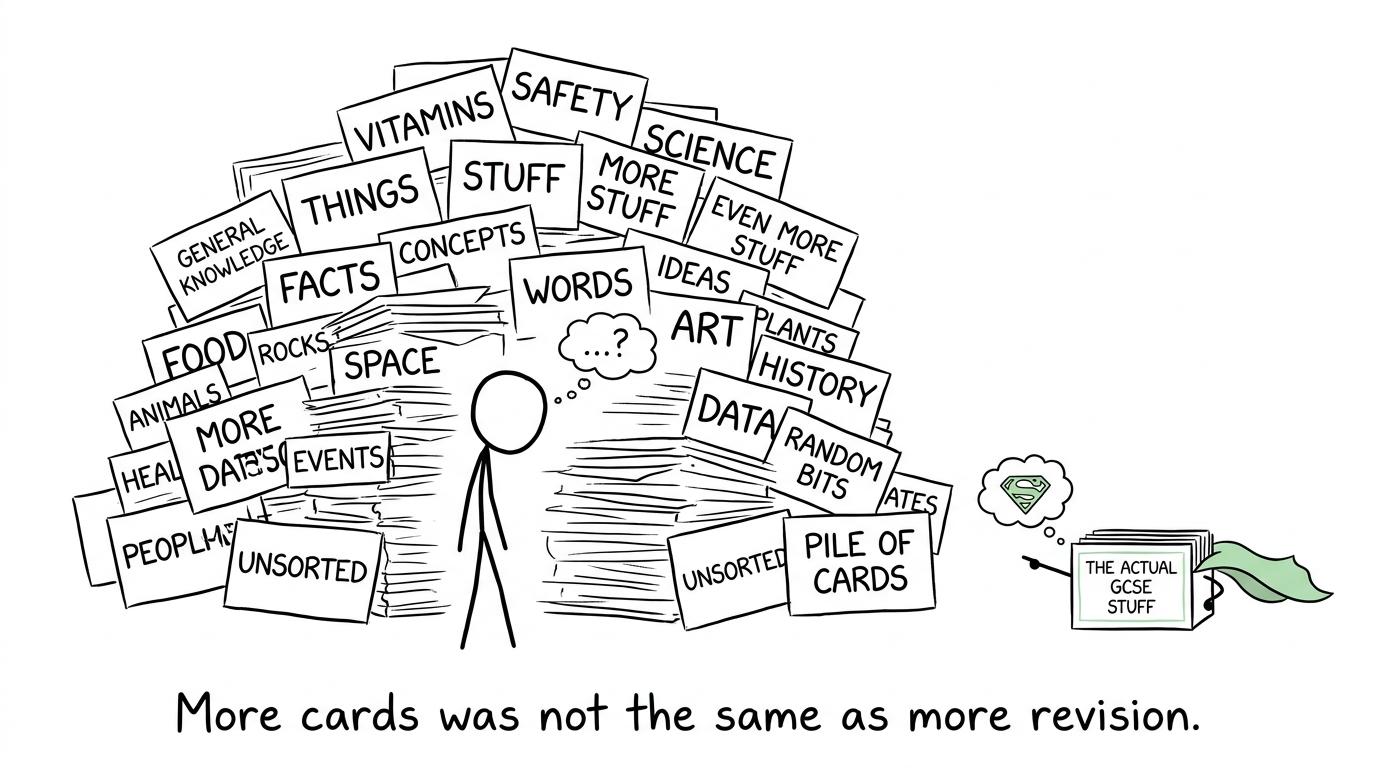 A tiny organised flashcard box defeats an enormous wall of revision cards
Which GCSE Food and Nutrition decks are worth using?
There is no single public Quizlet deck that can safely be called the best for every student. Sets can be edited, duplicated or removed, and a deck made for another school may follow a different teaching order. Popularity is not proof of accuracy.
Instead, search Quizlet using your board, qualification and one specification topic. Promising search titles include:
- AQA GCSE Food Preparation and Nutrition Revision
- AQA Food Preparation and Nutrition Key Terms
- OCR GCSE Food Preparation and Nutrition
- Eduqas GCSE Food Preparation and Nutrition
- Food Science GCSE Flashcards followed by your board
- Food Safety GCSE Flashcards followed by your board
An OCR GCSE Food Preparation and Nutrition set is publicly discoverable on Quizlet, as are several AQA-labelled key-term and revision sets. Their existence does not guarantee that every card is correct, so treat them as candidates to inspect, not endorsed answer books.
The best deck structure
A useful collection normally consists of several focused decks rather than one enormous pile.
| Deck | What it should test |
|---|---|
| Nutrition | Macronutrients, micronutrients, sources, functions, deficiencies, excess and dietary needs |
| Food science | Protein denaturation, coagulation, gluten formation, gelatinisation, dextrinisation, caramelisation, emulsification and raising agents |
| Food safety | Contamination, microorganisms, storage, preparation and control measures |
| Food choice | Health, culture, religion, ethics, cost, availability and sensory factors |
| Food provenance | Farming, fishing, processing, sustainability, food miles, seasonality and food security |
| Practical knowledge | Functions of ingredients, cooking methods, sensory analysis and reasons for selecting techniques |
Small topic decks make weak areas visible. If every subject appears in one set of several hundred cards, it becomes easy to revise what you already know and avoid what you do not.
Board-specific coverage is essential
Official requirements confirm that GCSE Food Preparation and Nutrition is split equally between examination and non-exam assessment, with 50%50\%50% of the total marks available through each route. Flashcards can support theoretical knowledge and the reasoning used in practical work, but they cannot replace cooking, investigation, planning or evaluation.
For example, AQA's written examination is worth 50%50\%50% and assesses theoretical knowledge across its five content sections. OCR's written component is also worth 50%50\%50%, alongside a food investigation task worth 15%15\%15% and a food preparation task worth 35%35\%35%. Eduqas likewise gives 50%50\%50% to its written component and 50%50\%50% to non-exam assessment.
Those shared percentages can disguise meaningful differences in specification language and paper structure. Check your exact board before trusting a deck.
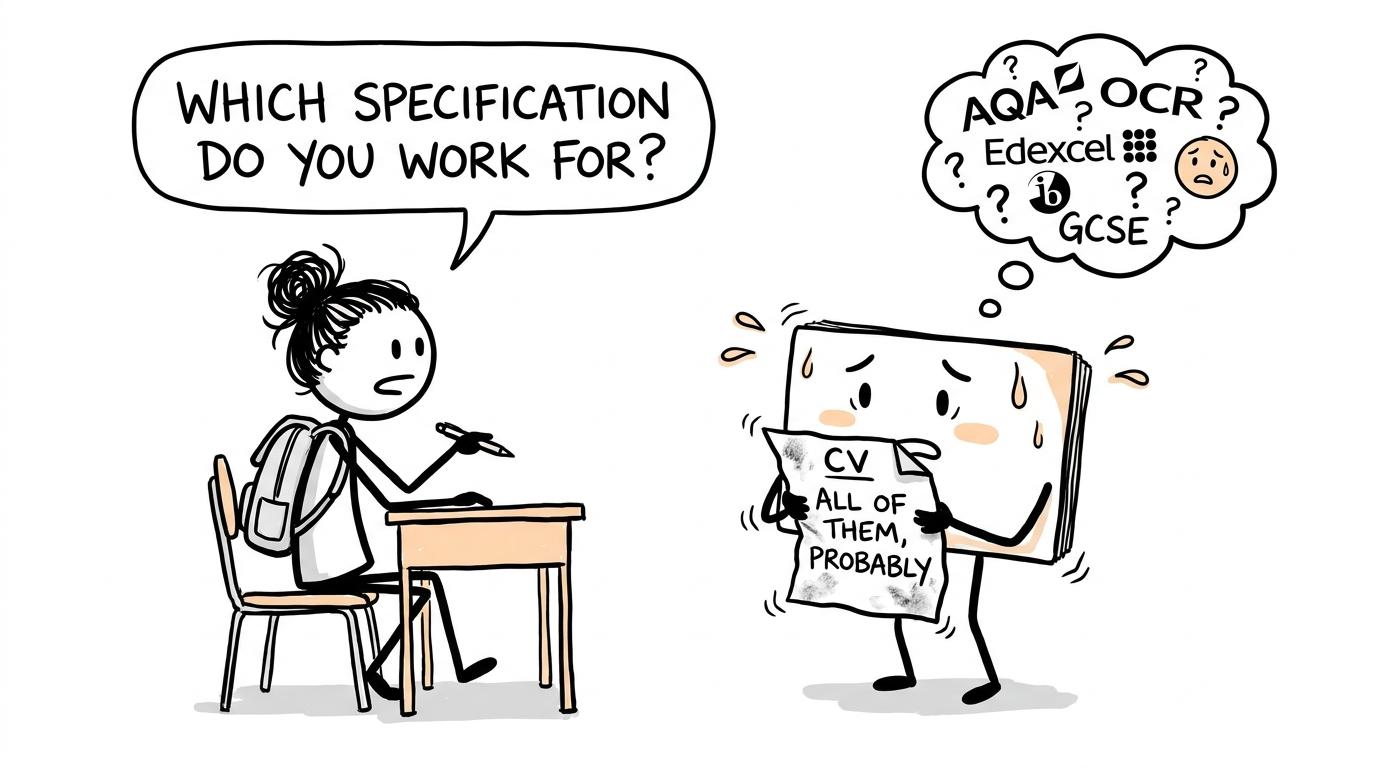 A student interviews a suspiciously vague flashcard about its exam-board credentials
How to judge a Quizlet set in five minutes
Open a candidate deck and sample cards from the beginning, middle and end. Do not judge it by the first polished definition.
Check specification coverage
Compare its headings with the specification checklist supplied by your teacher or exam board. A deck that contains excellent nutrition cards but ignores food provenance, sensory analysis or functional properties is a topic deck, not a complete course deck.
Check scientific precision
Good cards distinguish processes that students often confuse. They should not treat gelatinisation, coagulation and caramelisation as interchangeable forms of “cooking”. Each answer should state what changes, under what conditions and why that matters to the food product.
Be particularly cautious with temperatures and health guidance. Food safety recommendations can change, while storage and cooking advice must be understood in context. Verify such cards against current teacher or official guidance rather than copying them automatically.
Look beyond one-word recall
Definitions are useful for building vocabulary, but GCSE assessment also rewards application, analysis and evaluation. Ofqual's assessment objectives allocate 20%20\%20% to knowledge and understanding, 30%30\%30% to application, 30%30\%30% to planning and practical preparation, and 20%20\%20% to analysis and evaluation across the qualification.
A balanced deck should therefore contain prompts such as:
- explain why an ingredient performs a particular function
- compare two choices for a named consumer
- predict what happens when a method or ingredient changes
- justify a modification using nutrition, cost or sensory qualities
- identify a food safety hazard and explain an appropriate control
These prompts are harder than “state the meaning”, which is precisely why they are more useful.
How to build your own deck quickly
Making every card from scratch is often unnecessary. Start with the specification and your class checklist, borrow broad coverage from a carefully checked public set, then create personal cards only where they add value.
Build from headings, not pages of notes
Turn each specification statement into a question. If the statement contains several ideas, divide it. One card should test one retrievable idea wherever possible.
A long answer that fills the screen is usually a compressed revision note rather than a flashcard. Break it into definition, conditions, result and application cards.
Use three useful card types
Recall cards test a precise fact or definition.
Connection cards ask how two ideas relate, such as how a nutrient's function connects to a life stage or dietary requirement.
Application cards provide a short context and ask you to recommend, explain, predict or justify.
This mixture takes you from recognition towards the kind of thinking needed in written responses.
Turn mistakes into cards immediately
After a class test, practice question or teacher-marked task, create a card for each genuine knowledge gap. Do not simply copy the original question. Ask what missing idea caused the error.
This is the same principle behind effective maths revision: diagnose the precise weakness, repair it, then test it again. The GCSE Maths revision hub brings that cycle together through lessons, active-recall flashcards, questions, mini tests and papers.
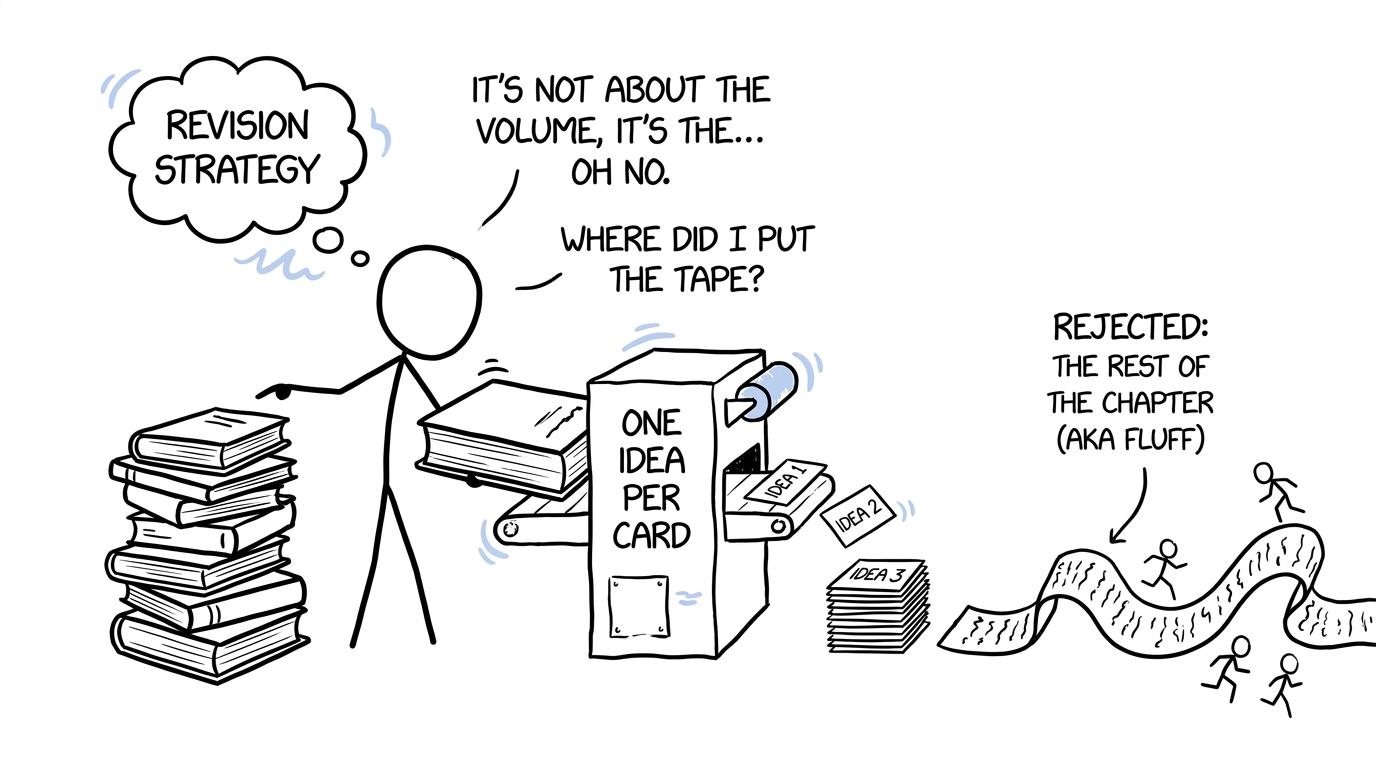 A machine turns a giant textbook into short one-idea flashcards
Use flashcards actively, not decoratively
Read the front, hide the answer and say or write a complete response before turning the card. Then judge yourself honestly:
- Secure: accurate, specific and fluent
- Developing: broadly right but missing detail
- Weak: incorrect, vague or impossible to recall
Review weak cards sooner and secure cards later. Shuffle topics so that you must identify the idea rather than relying on the deck's order. Occasionally answer application cards in complete sentences, because recognition alone will not prepare you for extended responses.
A simple weekly pattern is:
- two short recall sessions
- one mixed application session
- one set of exam-style questions
- one review in which mistakes become new cards
If planning revision is difficult, adapt the structure in MathsGenie's GCSE revision timetable guide: short recall, focused practice, marking and a clear next action.
Do not forget the maths inside Food and Nutrition
Food Preparation and Nutrition includes quantitative thinking: interpreting nutritional information, comparing proportions, scaling recipes, analysing sensory data and presenting investigation results. Students preparing for GCSE maths can strengthen both subjects by treating these as connected skills.
For nutritional labels and dietary comparisons, revisit percentages revision and fractions, decimals and percentages. Recipe adjustment relies on multiplicative reasoning, so the GCSE ratio revision guide is particularly relevant.
Food investigations may involve repeated results and sensory scores. The mean is calculated using:
mean=total of the valuesnumber of values\text{mean}=\frac{\text{total of the values}}{\text{number of values}}mean=number of valuestotal of the valuesMathsGenie's averages revision and GCSE Statistics hub can help you interpret data rather than merely calculate it. Keep units attached to measurements and make graph labels unambiguous.
Common mistakes with Food and Nutrition flashcards
Choosing by size
A deck with more cards is not automatically more complete or accurate. A shorter specification-matched set that you repeatedly retrieve is usually more valuable than a giant set you scroll through once.
Using another board's wording without checking
Core knowledge overlaps, but organisation, terminology and assessment emphasis vary. Always search with AQA, OCR, Eduqas or your relevant board included.
Copying incorrect cards
Public decks are not mark schemes. Check unfamiliar claims against your specification, teacher materials and current official guidance.
Revising definitions only
Knowing that emulsification involves combining liquids that do not normally mix is a beginning. You must also be able to apply the idea to ingredients, processes and outcomes.
Treating flashcards as complete exam preparation
Flashcards develop recall. They do not fully train extended writing, interpretation of unfamiliar contexts, time management or practical skill. In maths, the equivalent mistake would be memorising formulae without answering questions. MathsGenie's guide to using past papers properly explains the wider cycle: attempt, mark, diagnose, repair and retest.
Turn cards into reliable knowledge
The best GCSE Food and Nutrition Quizlet deck is not necessarily the one with the highest card count. It is the one that matches your board, uses precise language, covers the specification and forces you to retrieve knowledge in useful forms. Start with a checked board-specific collection, then build a lean personal deck from omissions and mistakes.
Keep flashcards in their proper place. Use them to secure knowledge, exam questions to practise application, and teacher feedback to improve evaluation and practical reasoning.
For your GCSE maths preparation, make MathsGenie your free revision base. Begin at the GCSE Maths revision hub, strengthen connected skills such as percentages, ratio and averages, then move into practice questions, mini tests, past papers, predicted papers, mark schemes and video solutions. A good card helps you remember. Good practice teaches you when and how to use what you remember.