GCSE Food and Nutrition Exam Clash Same Week Plan
GCSE food and nutrition exam clash same week? Use a calm revision plan to protect maths practice, food recall, sleep and confidence across every paper.
Exam weeks rarely arrive in neat subject-sized boxes. Maths may be on Monday, Food Preparation and Nutrition on Wednesday, then another paper on Thursday. When you search for help with a GCSE food and nutrition exam clash same week, the answer is not to divide every evening equally. Give the next exam more attention, keep later subjects warm with short retrieval sessions, and protect sleep.
That is the core plan. You are not trying to feel completely ready for every subject at once. You are trying to make the best next decision without allowing another important paper to disappear from view.
Your quick revision checklist
- Confirm the date, session and duration of every paper from your school timetable.
- Identify which exam comes next, rather than which subject feels most worrying.
- Give that paper the largest revision block.
- Keep maths active with short practice sessions and marked questions.
- Revise Food and Nutrition through recall and exam questions, not endless rereading.
- Adjust the plan after each exam.
- Stop revision early enough to sleep properly.
- Speak to your exams officer immediately if two papers are scheduled in the same session.
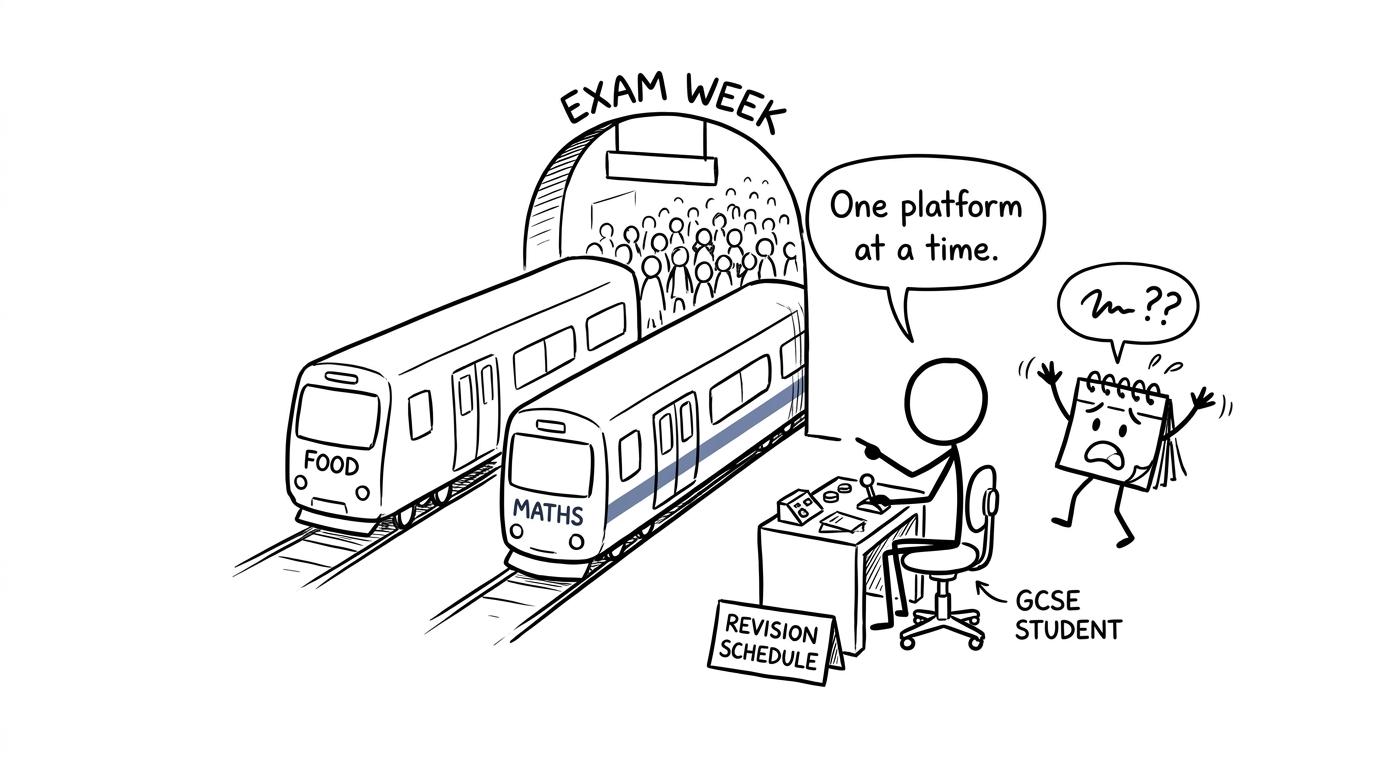 A student calmly directing Food and Maths trains through exam week
First, check whether it is an official exam clash
A crowded week is difficult, but it is not necessarily a timetable clash. Under JCQ guidance, an official clash occurs when a candidate is entered for two or more exams scheduled at the same time on the same day.
If that appears on your timetable, do not attempt to solve it yourself. Contact your school’s exams officer. The school will arrange the papers according to the official examination rules, which may involve consecutive exams, a supervised break or a different session. Follow the written instructions from your centre, particularly the rules concerning supervision and access to phones.
If Food and Nutrition and maths are simply in the same week, the challenge is different. It is a revision-planning problem. That is something you can control.
Understand what the Food and Nutrition paper demands
The exact written paper depends on your exam board, so check your specification and school timetable rather than relying on a friend’s schedule.
For the current AQA, OCR and Eduqas GCSE Food Preparation and Nutrition specifications, the written examination contributes 50%50\%50% of the qualification. AQA and Eduqas currently use a written paper lasting 111 hour 454545 minutes, while OCR’s written paper lasts 111 hour 303030 minutes. The remaining assessment is non-examined assessment completed during the course.
The written paper may assess broad areas such as:
- nutrition and health;
- food science and the functions of ingredients;
- food safety;
- food choice and provenance;
- cooking and preparation principles;
- analysis and evaluation.
This breadth matters. Food revision should not become an attempt to memorise one predicted theme. Use your own exam board’s specification, teacher guidance and past questions to identify gaps across the course.
Maths needs a different kind of readiness. Recognition is not enough. You must select and carry out a method under pressure. That is why a short session of genuine problem-solving is usually more valuable than a long session spent looking over familiar examples.
Split attention by urgency, weakness and exam demands
Equal time sounds fair. It often is not useful.
Suppose maths is first, Food and Nutrition follows two days later, and you also have another subject after that. Maths should receive the largest share before its paper because it is both imminent and dependent on active practice. Food should still receive a short recall block so that important knowledge remains accessible.
After the maths exam, the balance changes. Food becomes the next priority. A timetable should behave like a living plan, not a promise you made to yourself three weeks ago.
Use these three questions each evening:
- Urgency: Which examination comes next?
- Weakness: Where are you currently losing marks?
- Demand: Does the subject require factual recall, extended responses, calculations or sustained problem-solving?
A subject that is soon, weak and demanding deserves the biggest block. A later subject still needs a short maintenance session, but it does not need to dominate the evening.
The free GCSE maths revision area helps reduce decision-making because you can choose your board, tier and topic before starting. If your week still feels shapeless, use the GCSE maths revision timetable guide to build a broader plan around your actual papers.
Use a flexible plan for the days between papers
The purpose of a revision block should be clear before it begins. “Revise maths” is vague. “Complete a short algebra test, mark it and repair two errors” is actionable.
| Situation | Main block | Maintenance block | Final task |
|---|---|---|---|
| Maths is the next exam | Timed maths questions | Food recall and one structured response | Mark maths and record errors |
| Food is the next exam | Food recall, application and exam questions | Short maths topic practice | Check command words and weak facts |
| Two exams are equally close | Prioritise the weaker subject first | Short active session for the other | Prepare equipment and stop on time |
| An exam has just finished | Take a proper break | Switch priority to the next paper | Remove the completed exam from the plan |
Keep sessions realistic. On a school day, a focused block of around 252525 to 404040 minutes can be more productive than an ambitious two-hour session that turns into phone checking and anxious rereading. Include a brief break between subjects so the second session does not feel like an extension of the first.
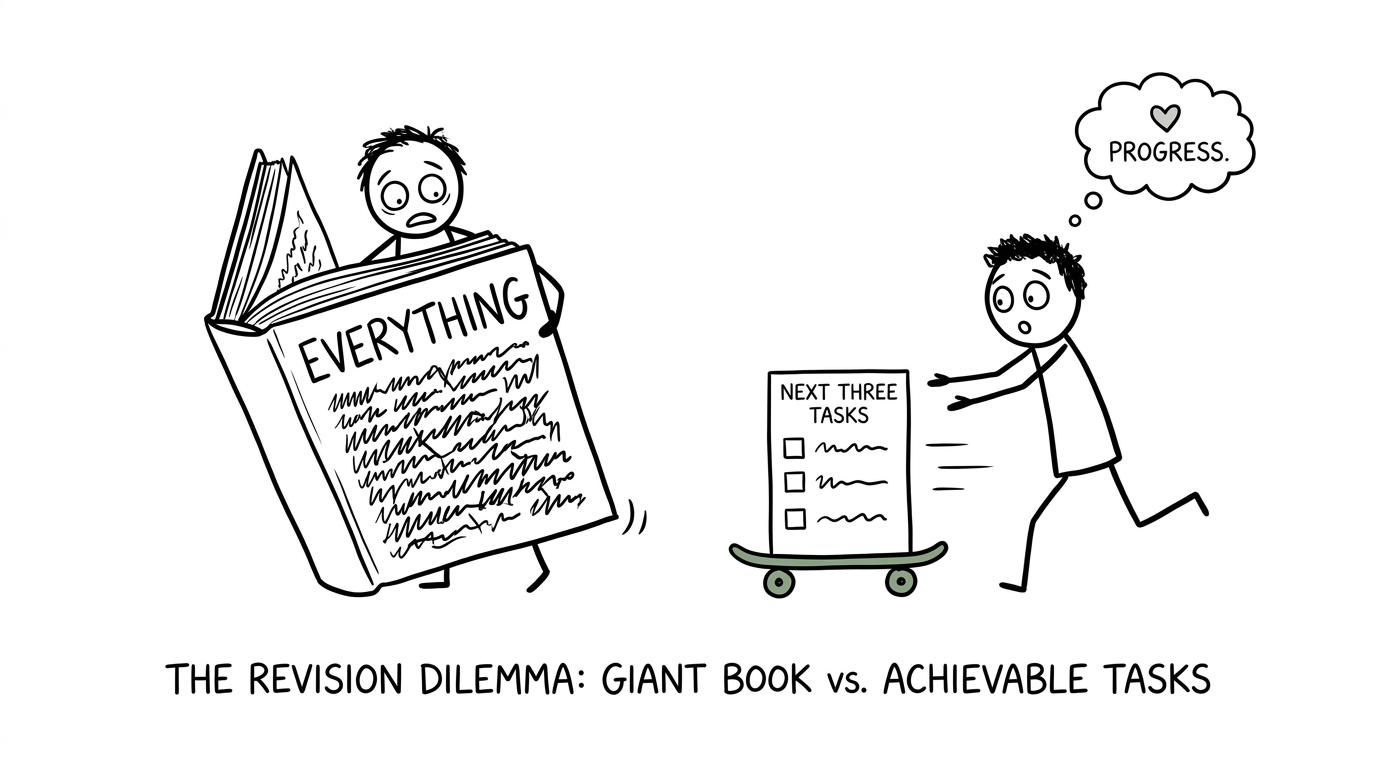 A small practical checklist escaping from an enormous revision book
Keep maths alive without letting it consume the week
Maths revision can expand indefinitely because there is always another topic to practise. During a crowded exam week, use a closed feedback loop:
- attempt a small set without notes;
- mark it immediately;
- identify the exact reason for each lost mark;
- revisit only the weak method;
- reattempt a similar question later.
If a full paper is unrealistic, that does not mean the session has failed. A mini test, timed section or carefully chosen group of questions can preserve fluency with less fatigue. MathsGenie’s past paper library brings papers and official mark schemes together, while Edexcel GCSE maths past papers provide board-specific practice for Foundation and Higher tier students.
Close to the examination, GCSE predicted papers can provide fresh practice. Treat them as rehearsal, not as a promise about what will appear. Specifications remain the boundary of what may be assessed.
Choose maths tasks according to the available energy. Earlier in the evening, tackle a method that requires concentration. Later, use a shorter test, formula check or error review. The guide to starting GCSE past papers explains how to move from smaller diagnostic tasks towards complete timed papers.
Revise Food and Nutrition actively
Food and Nutrition can create a dangerous illusion: notes about nutrients, food safety and ingredient functions often look familiar, so rereading feels productive. Familiarity is not the same as recall.
Close the book and retrieve what you know. Useful activities include:
- listing the functions, sources and effects of deficiency or excess for a nutrient;
- explaining why a food-science process occurs;
- comparing cooking methods for a stated person or dietary need;
- identifying food-safety hazards and suitable controls;
- planning an extended response from a command word;
- answering a past question before checking the mark scheme.
Move beyond isolated definitions. Written papers also require application, analysis and evaluation. Practise linking a fact to the context in the question: identify the relevant principle, explain its effect, and connect it directly to the person, ingredient, process or product described.
Research into learning consistently supports spacing and retrieval over passive restudy. In practical terms, several short attempts to recall material across different days are preferable to one large rereading session immediately before the examination.
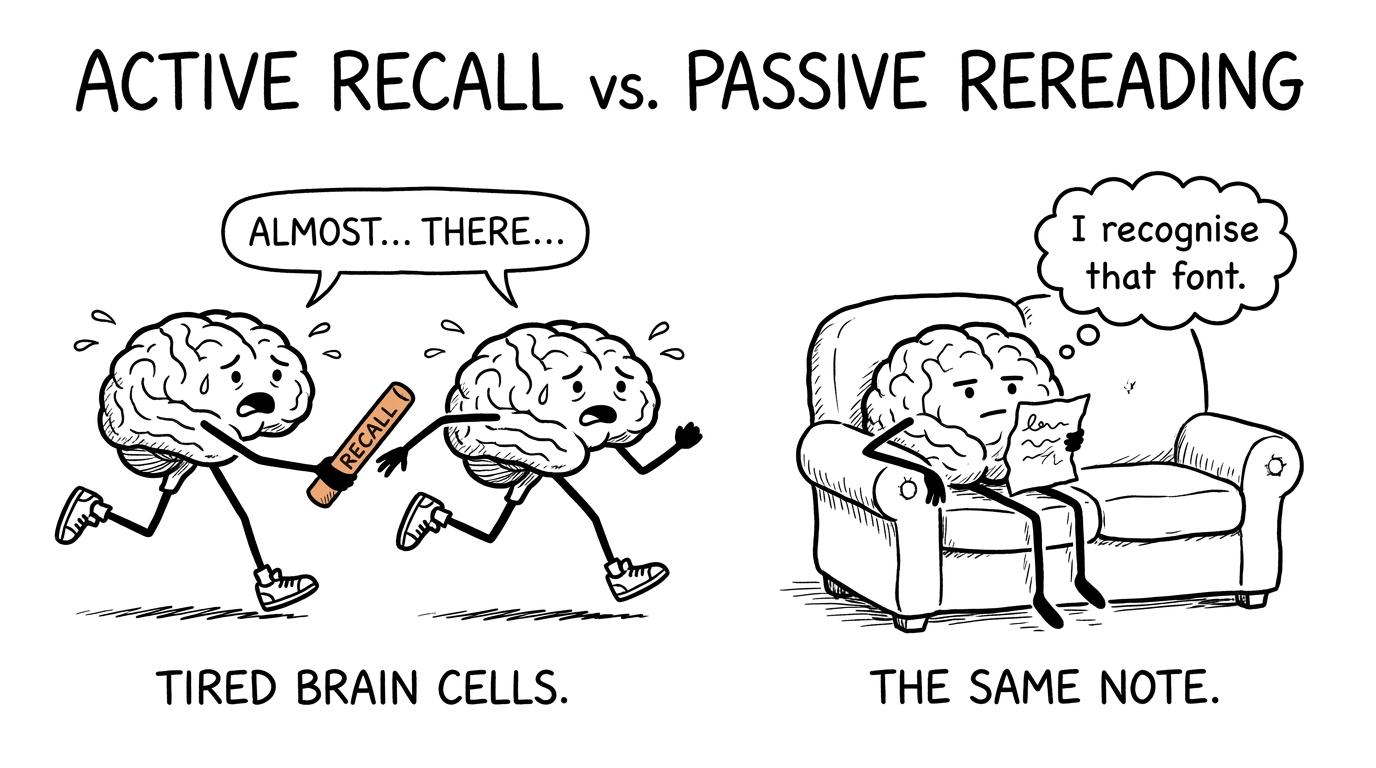 Brain cells passing an active-recall baton while another rereads notes
Plan the evening before each examination
The night before is for consolidation, not rebuilding the whole course.
For maths, choose a short set at the correct tier, mark it, and review a few recurring mistakes. Check your calculator where permitted, along with pens, pencils, ruler, protractor and compasses. The GCSE maths night-before plan gives a focused alternative to late cramming.
For Food and Nutrition, retrieve the broad content areas, review precise terminology and practise planning concise responses. Avoid trying to predict the paper from a handful of remembered topics.
Set a stopping time. Another exhausted hour may feel responsible, but it can weaken concentration across several papers. Eat normally, prepare what you need and follow any examination instructions issued by your school.
Common mistakes when several GCSE exams share a week
Dividing every evening equally
Equal time ignores exam order and personal weakness. Rebalance after every paper.
Dropping maths completely until the night before
Mathematical methods become less fluent without use. Keep a short, active session in the plan even when Food and Nutrition is temporarily the main priority.
Revising Food and Nutrition only by reading
Recognition can hide weak recall. Close the notes, answer questions and explain ideas without prompts.
Completing papers without reviewing them
A paper only becomes revision when you learn from it. Use mark schemes and video solutions to identify whether a lost mark came from knowledge, method, accuracy or interpretation.
Treating predicted papers as forecasts
Predicted papers are valuable practice, but they cannot reduce the specification. Use them alongside revision lessons, topic questions and real past papers.
Sacrificing sleep to rescue the timetable
A plan that requires repeated late nights is overloaded. Reduce low-value tasks before reducing sleep.
Make the week smaller
A crowded timetable feels frightening when you hold the entire week in your head. It becomes more manageable when you ask a narrower question: what is the most useful task I can complete next?
Give the nearest paper the largest block. Keep other subjects active with short retrieval. Mark what you practise. Then change the balance as soon as an exam is finished.
MathsGenie can be your free maths base throughout that process. Start with revision lessons and practice questions, use mini tests when time is tight, then build confidence through past papers, predicted papers, mark schemes and video solutions. Open the GCSE maths revision hub, choose one precise task for your tier, and let the result decide what you do next.