GCSE Food and Nutrition 5 to 7: Grade Guide
GCSE food and nutrition 5 to 7 guidance: improve application, technical skills, analysis, NEA evidence and exam answers with a focused revision plan.

A grade 555 often means you know a fair amount. You can name nutrients, describe cooking methods and produce competent practical work. Yet longer questions and evaluations may still feel unpredictable.
Moving from GCSE food and nutrition 5 to 7 is less about collecting more facts and more about using knowledge with precision. You need to explain why something happens, apply ideas to the situation in the question, justify choices and evaluate evidence. Your practical work must show the same shift: from completing dishes competently to making deliberate, well-supported decisions.
There is no official grade 777 descriptor for this subject. Ofqual publishes broad descriptors at grades 222, 555 and 888, so the grade 777 qualities below are a practical bridge between the published grade 555 standard and the stronger grade 888 standard. Grade boundaries also change between exam series, so do not build your plan around one historical mark.
Your grade 555 to grade 777 checklist
Focus on these changes:
- Replace general recall with accurate food-science and nutritional terminology.
- Link each point to the person, dish, ingredient or investigation in the question.
- Build explanations through cause and consequence.
- Analyse results rather than merely describing them.
- Justify practical and nutritional decisions using evidence.
- Choose demanding skills that genuinely suit the brief.
- Make NEA evidence concise, relevant and easy to follow.
- Strengthen percentages, proportion, averages, units and graph interpretation.
- Use mark schemes to identify the difference between a correct point and a developed answer.
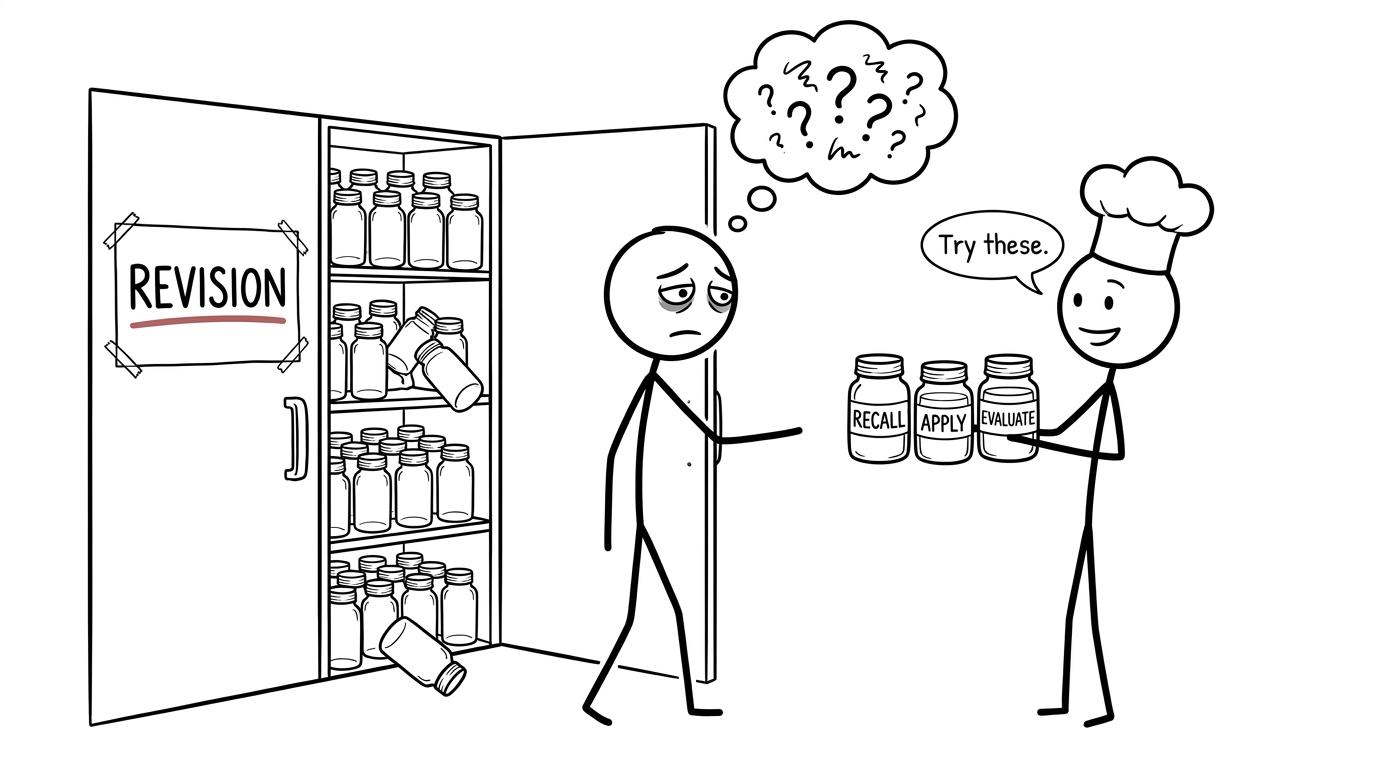 A student finds recall, apply and evaluate among the revision ingredients
What separates a grade 555 from a grade 777?
Ofqual describes grade 555 performance as mostly accurate and appropriate knowledge, competent technical skills applied safely, and coherent analysis and evaluation. To move towards grade 777, those qualities need to become more consistent, detailed and purposeful.
| Grade 555 tendency | Grade 777 direction |
|---|---|
| Recalls a relevant fact | Selects the most relevant fact and applies it |
| Describes what happens | Explains how and why it happens |
| Gives a reasonable conclusion | Uses evidence to justify a precise conclusion |
| Uses competent practical skills | Combines well-chosen, demanding skills accurately |
| Mentions sensory qualities | Analyses specific sensory results and their significance |
| Suggests a broad improvement | Proposes a realistic improvement linked to evidence |
| Includes nutritional information | Interprets the information for the target group |
The important word is consistency. A single excellent paragraph will not transform the whole grade. The stronger student repeatedly turns knowledge into explanation across the written exam, food investigation and practical assessment.
Know what the qualification rewards
GCSE Food Preparation and Nutrition is not divided into foundation and higher tiers. Assessment arrangements vary by board, so check whether you study AQA, OCR or Eduqas and use the correct specification and mark scheme.
Across regulated GCSE specifications, the assessment objectives give a useful map:
- AO1 rewards knowledge and understanding.
- AO2 rewards application.
- AO3 rewards planning, preparation, cooking and presentation.
- AO4 rewards analysis and evaluation.
The national weightings are 20%20\%20% for AO1, 30%30\%30% for AO2, 30%30\%30% for AO3 and 20%20\%20% for AO4. This reveals why memorising notes has a ceiling: isolated knowledge represents only part of the qualification.
For AQA and Eduqas, the written examination is currently worth 50%50\%50% of the GCSE and the non-exam assessment is worth 50%50\%50%. OCR also combines a written examination with two NEA tasks, although its raw-mark structure differs. Always follow your own board's current instructions and your teacher's guidance.
Turn food knowledge into applied explanations
A grade 555 answer may correctly state a nutrient's function. A stronger answer selects the function that matters for the named person, explains the likely consequence and connects it to an appropriate food choice.
Use this reasoning chain:
Relevant fact →\rightarrow→ scientific or nutritional reason →\rightarrow→ consequence →\rightarrow→ judgement.
Command words tell you how far to travel along that chain:
- State or identify usually requires a short, precise response.
- Describe requires relevant characteristics or events.
- Explain requires reasons and linked consequences.
- Analyse requires you to examine relationships, patterns or evidence.
- Evaluate requires a balanced, evidence-based judgement.
- Justify requires reasons showing why your choice is suitable.
Do not automatically write everything you remember. Relevance is part of quality. Underline the target group, dietary need, ingredient, process and command word before planning a longer response.
Make food science specific
Food science is where vague language quietly loses marks. “The mixture changes” says little. Stronger responses identify the process, the conditions required, the role of the ingredient and the effect on the final product.
Build precise revision cards around:
- gelatinisation;
- coagulation and denaturation;
- gluten formation;
- dextrinisation and caramelisation;
- aeration and raising agents;
- emulsification;
- shortening and plasticity;
- enzymic browning;
- heat transfer and microbial control.
For each process, recall five things: what it is, what causes it, which ingredients are involved, what can disrupt it and how it affects the finished food. That structure prepares you to apply science rather than repeat a definition.
 A chef-hatted student juggles practical work while the examiner asks them to explain why
Raise the quality of your NEA evidence
NEA is not improved by making every section longer. It improves when every section helps answer the task.
Investigation work
A stronger food investigation has a focused hypothesis or prediction, controlled variables, repeatable methods and results displayed appropriately. Your analysis should identify patterns and anomalies, explain them using food science and state whether the evidence supports the hypothesis.
When evaluating, distinguish between reliability and validity. Repeating a test can improve reliability. Controlling relevant variables helps the investigation measure the intended effect. Improvements should address a real weakness in the method rather than offer a generic promise to “be more accurate”.
Practical assessment
Complexity does not mean adding unnecessary components. Select techniques because they answer the brief, demonstrate control and can be completed safely within the permitted time. A well-dovetailed plan should show sequencing, quality checks, food-safety points and realistic timings.
Your evaluation should refer to specific evidence: sensory results, nutritional analysis, technical execution, appearance and suitability for the target group. Name what succeeded, explain why, identify what limited the result and propose a feasible modification.
Rules governing task conditions and teacher assistance matter. Follow the instructions issued by your school and exam board; your submitted evidence must remain your own work.
Use maths as evidence, not decoration
Food Preparation and Nutrition includes meaningful numeracy. Calculations may involve nutritional values, portions, recipe scaling, cost, percentages, averages, measurements and data presentation.
Useful relationships include:
percentage=partwhole×100\text{percentage} = \frac{\text{part}}{\text{whole}} \times 100percentage=wholepart×100 scaled quantity=original quantity×required portionsoriginal portions\text{scaled quantity} = \text{original quantity} \times \frac{\text{required portions}}{\text{original portions}}scaled quantity=original quantity×original portionsrequired portions mean=sum of resultsnumber of results\text{mean} = \frac{\text{sum of results}}{\text{number of results}}mean=number of resultssum of resultsThe grade-raising step is interpretation. After calculating a value, explain what it means for the dish, dietary requirement or investigation.
MathsGenie's proportion revision guide is especially useful for scaling recipes. Use the ratio revision guide for comparing quantities, percentage change revision for changes in results or cost, and conversions and units practice to prevent errors involving mass, volume and time.
Keep units throughout, avoid premature rounding and check whether nutritional data refers to a portion or to 100 g100\text{ g}100 g.
Build a revision system that changes your answers
Start with evidence rather than optimism. Complete an exam question or timed section, mark it strictly and classify each lost mark:
- missing knowledge;
- weak application;
- incomplete explanation;
- unsupported evaluation;
- numerical error;
- poor timing or misreading.
MathsGenie's guide to finding your weakest GCSE topics explains this diagnostic approach. You can adapt its learn, practise, mark, fix and retest cycle to Food Preparation and Nutrition.
A balanced week might include one knowledge-recall session, one longer-answer session, one maths-and-data session, one NEA reflection session where permitted, and one timed mixed section. The GCSE revision timetable guide can help you build a plan that also protects time for maths and other subjects.
For your maths papers, use the GCSE maths revision hub to access revision lessons, practice questions, mini tests and board-specific papers. Food revision should not quietly consume the time needed for Edexcel, AQA, OCR or Eduqas maths preparation.
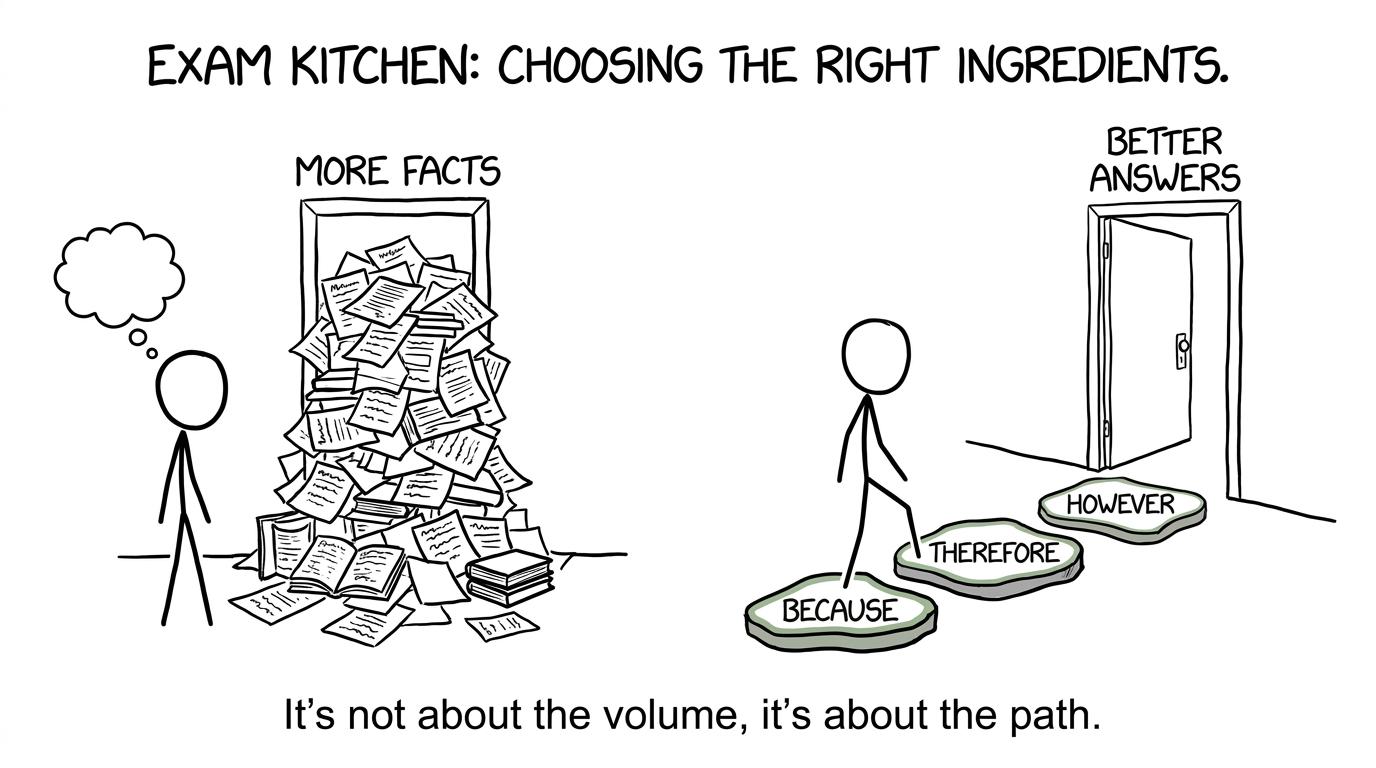 A student chooses the better-answers path instead of carrying an enormous pile of facts
Common mistakes that hold students at grade 555
Revising only with flashcards
Flashcards support AO1, but they do not fully train application, analysis or evaluation. Follow recall with questions that require a decision or judgement.
Writing generic nutrition answers
Always connect advice to the named life stage, health concern, activity level or dietary requirement. A fact without context may be correct but underdeveloped.
Describing results instead of analysing them
Analysis asks what the pattern means and why it may have occurred. Refer to data, identify anomalies and connect observations to food science.
Choosing complexity for appearance
A crowded plate is not automatically a technically demanding one. Prioritise appropriate skills, accuracy, timing, safety and suitability for the brief.
Ignoring units and bases for comparison
Confusing a portion with 100 g100\text{ g}100 g can undermine an otherwise sensible conclusion. Label units and compare like with like.
Treating the mark scheme as a score sheet
Use it as a description of quality. Notice where credit comes from application, linked reasoning, evidence and justified conclusions. Then rewrite one weak response while the feedback is fresh.
From competent to convincing
The journey from grade 555 to grade 777 is not a demand for perfection. It is a shift from knowing to using, from describing to explaining, and from opinion to evidence.
Begin with one recent question. Mark it against the correct board materials. Identify whether your biggest leak is knowledge, application, practical justification, analysis or numeracy. Then repair that precise weakness and retest it.
MathsGenie can support the numerical side of the course while keeping your GCSE maths revision moving. Use its free revision lessons and practice questions to strengthen percentages, ratio, proportion, averages and units, then build exam stamina with mini tests, past papers, predicted papers, mark schemes and video solutions. Start from the MathsGenie GCSE revision area, choose the skill that is costing you marks, and make today's revision specific.