GCSE English Literature Key Terminology Mistakes
GCSE English Literature key terminology mistakes explained: learn which terms students misuse, why precision matters and how to protect your exam marks.
A student can understand a quotation perfectly and still weaken the paragraph with one inaccurate label. Calling personification a metaphor, confusing tone with mood, or describing every pause as a caesura does not erase the underlying insight. But it makes the analysis less convincing.
That is why GCSE English Literature key terminology mistakes matter. Examiners reward clear explanation of how writers create meaning. Technical vocabulary can make that explanation more precise, but terminology does not earn marks merely by appearing on the page. If the label is wrong, vague or unsupported, it can distract from an otherwise thoughtful interpretation.
For students balancing English with foundation or higher tier maths revision, there is a useful connection: precision matters in both subjects. A nearly correct theorem or formula can send a calculation in the wrong direction. A nearly correct literary term can do the same to an argument.
A quick terminology accuracy checklist
Before using a technical term, ask:
- Can I define it in plain English?
- Can I identify the exact word, phrase or structural feature that creates it?
- Am I describing language, form or structure?
- Have I explained the effect rather than simply named the method?
- Does my interpretation fit the text and the question?
- Would a simpler, accurate word be better than an impressive but uncertain one?
This final question is often the most valuable. Precision beats decoration.
Why incorrect terminology can cost marks
Across GCSE English Literature specifications from AQA, Edexcel, OCR and Eduqas, students are expected to analyse writers' methods. Exam-board wording differs, but language, form and structure are central parts of literary analysis. Some assessment criteria also refer explicitly to relevant subject terminology.
The important word is relevant. An examiner is not counting techniques as if each one has a fixed value. Naming five devices without discussing meaning is weaker than identifying one method accurately and explaining how it shapes the reader's or audience's understanding.
Misused terminology can cause three problems:
- The evidence no longer supports the claim. If a student calls a literal description a metaphor, the analysis begins from a false premise.
- The explanation becomes generic. Statements such as “the imagery engages the reader” do not explain what the language suggests.
- The argument loses authority. Repeated inaccuracies can make a secure interpretation appear less controlled.
This resembles marking a maths paper. A correct method must be visible and logically connected to the answer. MathsGenie's guide to using GCSE mark schemes as a revision coach explains the same feedback principle: do not merely record that something went wrong; identify the exact reason and correct it.
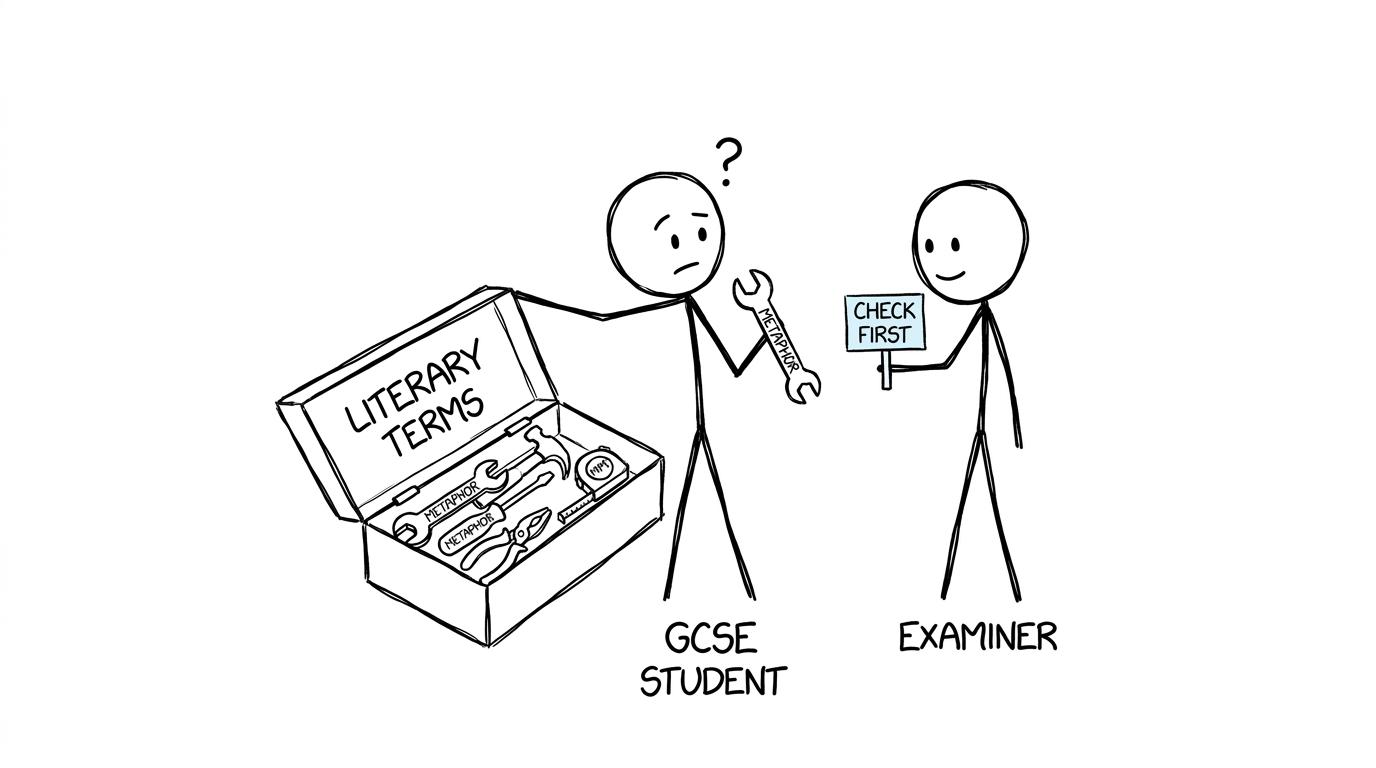 A student discovers that not every literary tool is a metaphor
Metaphor, simile and personification
These familiar terms are among the easiest to use too quickly.
A metaphor describes one thing as though it were another. A simile makes an explicit comparison, commonly using words such as “like” or “as”. Personification gives human qualities, actions or emotions to something non-human.
There can be overlap. Personification may operate metaphorically, but “metaphor” is not always the most precise label. If a storm is said to be furious, personification identifies the specific feature more clearly.
Another frequent problem is calling any descriptive phrase a metaphor. Literal sensory description is not automatically figurative. Test the wording: is one thing genuinely being presented as another? If not, use a different term or discuss the word choice directly.
Imagery and semantic fields
Imagery is a broad term for language that creates sensory or figurative impressions. It is not a precise substitute for every technique. Saying “the writer uses imagery” is only a starting point; the analysis must identify what kind of image is created and what it implies.
A semantic field is a group of words connected by meaning. One word cannot form a field by itself. Students also sometimes list several vaguely related words without explaining the pattern they create.
Use this term only when multiple choices develop a recognisable area of meaning, such as conflict, disease, religion or confinement. Then explain why that pattern matters. The label identifies the pattern; the interpretation earns its place in the argument.
Tone, mood and atmosphere
These words are related but not interchangeable.
- Tone describes the attitude or manner communicated by a voice, speaker or writer.
- Mood describes the emotional quality produced for the reader or audience.
- Atmosphere usually refers to the broader feeling surrounding a scene or setting.
A voice might have a mocking tone while creating an uncomfortable mood. Writing that something “has a sad tone” may be valid, but it needs evidence from diction, sentence construction, imagery or another identifiable choice.
Avoid claiming that every reader will feel exactly the same emotion. “This may create unease” is usually more defensible than “this makes the reader terrified”. Literature permits interpretation, but good interpretation remains anchored to evidence.
Author, narrator and speaker
Treating the author, narrator and character as the same voice is one of the most consequential terminology errors.
The author or playwright is the person who created the text. A narrator tells a story. A speaker is the voice heard in a poem, and a character's speech belongs to that character. These voices may communicate the writer's ideas, but they are not automatically direct statements of the writer's personal beliefs.
Instead of writing that the author feels guilty because a narrator expresses guilt, explain that the writer presents guilt through the narrator. This small change preserves the distinction between creator and created voice.
In drama, remember the audience rather than defaulting to the reader. A play is written for performance, even when encountered on a printed exam page.
Language, form and structure
These categories are often bundled together, yet they refer to different levels of a text.
Language includes individual words, phrases, imagery, syntax and sound choices. Structure concerns organisation and development: shifts in focus, contrasts between sections, chronology, openings, endings and the placement of information. Form is the kind of text and the conventions through which it operates, such as a play, novel, dramatic monologue, sonnet or tragedy.
A short sentence is primarily a language or syntactical choice. Its placement after a long descriptive passage may also create a structural contrast. A first-person narrator is a narrative choice, not the entire form of a novel.
When uncertain, describe exactly what happens: “The focus shifts from the crowd to the isolated character” is better than attaching the vague label “structural technique”.
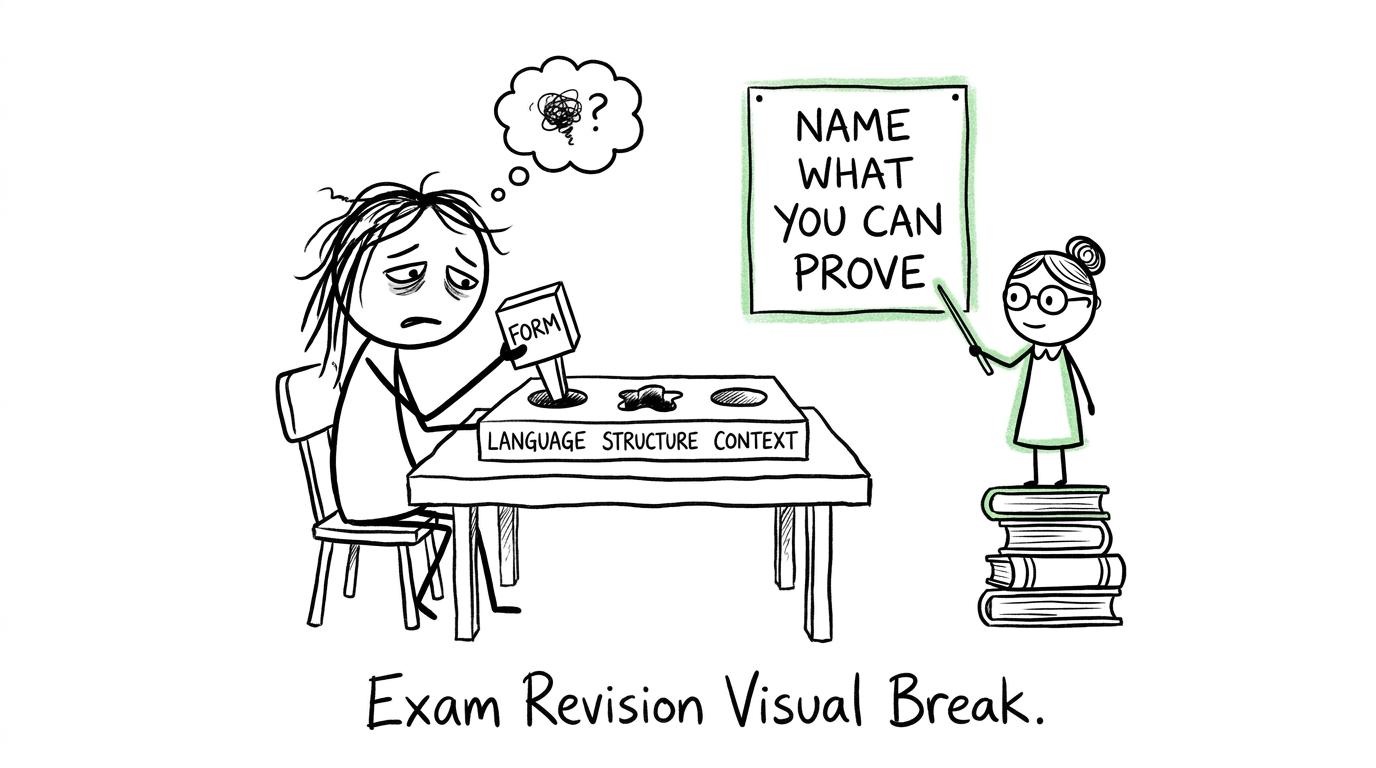 A revision student attempts to force form into every analytical category
Irony, dramatic irony and foreshadowing
Irony involves a meaningful gap between appearance and reality, expectation and outcome, or what is said and what is meant. It is not simply an unfortunate event.
Dramatic irony occurs when the audience knows something that one or more characters do not. The knowledge gap must be present. If a statement merely becomes incorrect later, that does not automatically make it dramatic irony.
Foreshadowing plants a meaningful indication of something that will happen later. It should be supported by the later development. A gloomy setting may create foreboding, but it is not necessarily foreshadowing a specific event.
These distinctions matter because each term leads to a different analytical question: what does the audience know, what expectation is overturned, or what later event is anticipated?
Contrast, juxtaposition and oxymoron
A contrast is a difference emphasised by the text. Juxtaposition is the deliberate positioning of elements near each other so their relationship becomes noticeable. Two characters can contrast across an entire novel without being directly juxtaposed in every scene.
An oxymoron combines apparently contradictory terms in a compact expression. It is not any contradiction in a character's behaviour, nor is it the same as a paradox, which is a broader statement or idea that appears self-contradictory but may reveal a truth.
If physical placement matters, juxtaposition may be the accurate term. If the difference matters but not proximity, contrast is safer.
Repetition, anaphora and sound terminology
Repetition is the reuse of a sound, word, phrase or idea. Anaphora is a specific form of repetition at the beginning of successive clauses, lines or sentences. Repeated words elsewhere should not automatically be labelled anaphora.
Similarly, alliteration repeats initial consonant sounds, while sibilance is the repetition or concentration of hissing sounds. A repeated letter is not enough if the pronunciation changes. Sound analysis should be based on what can be heard.
Be cautious with claims such as “plosive sounds show anger”. Sounds do not have fixed meanings. Their significance depends on context, concentration, rhythm and the ideas surrounding them.
Enjambment, caesura, rhythm and rhyme
In poetry, enjambment occurs when a grammatical unit continues beyond the end of a line without a terminal pause. A line ending without punctuation is a useful clue, but syntax is the deciding factor.
A caesura is a noticeable pause within a poetic line, often indicated by punctuation. Not every comma is automatically a significant caesura; explain how the pause alters pace, emphasis or thought.
Rhythm is the movement or pattern of stresses, while metre is a regularised stress pattern. Rhyme concerns matching or related sounds. Describing a poem as rhythmic does not prove that it uses a regular metre, and identifying rhyme without discussing its pattern or disruption adds little.
Symbol, motif and pathetic fallacy
A symbol is something that carries significance beyond its literal role. A motif is a recurring element that develops an idea across a text. An object may become both, but it is not a motif if it appears only once.
Pathetic fallacy is the attribution of human emotion or mood to nature, often through weather or landscape. It is more specific than ordinary personification. A talking household object may be personified, but it is not an example of pathetic fallacy.
Do not assume that rain always symbolises sadness or light always represents hope. Symbols gather meaning from their context, development and relationship to the wider text.
Common GCSE English Literature terminology mistakes
The largest mistake is not choosing the wrong sophisticated word. It is allowing terminology to replace analysis.
Watch for these habits:
- Technique spotting without explaining meaning
- Calling every comparison a metaphor
- Treating the narrator as the author
- Using “imagery” for any descriptive word
- Claiming one word creates a semantic field
- Confusing a character's tone with the reader's mood
- Calling every line break enjambment
- Describing any punctuation as a caesura
- Treating an unfortunate event as irony
- Assuming sound devices have one fixed effect
- Labelling themes as techniques
- Using “structure” without identifying an organisational choice
The remedy is a compact sequence: identify the evidence, name the method only if certain, explain what it suggests, and connect it to the question. If the term is uncertain, accurate description is safer than confident mislabelling.
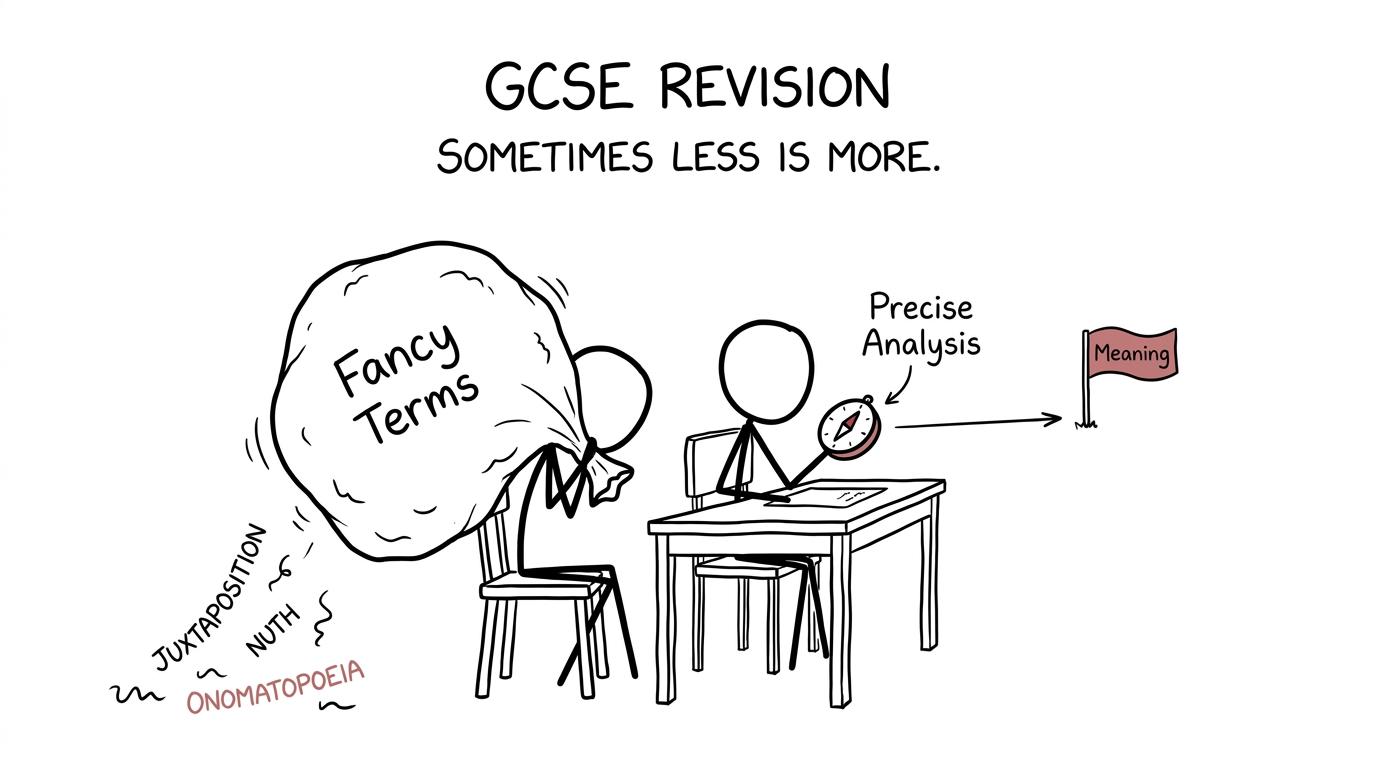 Precise analysis reaches meaning while a sack of fancy terminology falls over
How maths students can revise terminology efficiently
Students preparing for maths exams rarely have time to rewrite an entire English glossary. Use the same diagnostic approach that works in maths:
- Retrieve definitions without notes.
- Sort easily confused terms into pairs or groups.
- Check each term against a genuine textual feature.
- Record misidentifications in an error log.
- Revisit the same distinctions on another day.
A short, repeated routine is more manageable than one long session. MathsGenie's twenty-minute GCSE maths revision routine offers a useful model for organising recall, practice and correction. The method can be transferred to terminology revision without confusing the two subjects.
Keep the subjects properly balanced. Use GCSE past papers organised by exam board to diagnose maths gaps, then use Edexcel GCSE maths mini tests when a full paper would be too much. The guide to avoiding common GCSE revision mistakes can also help you replace passive rereading with active practice.
Precision is the real objective
Literary terminology is valuable because it lets you describe a writer's decisions efficiently. It is not a performance of memory. An accurate ordinary phrase will always serve an argument better than an incorrect specialist label.
Approach each term as you would a mathematical method: understand what it means, recognise when it applies and use it for a clear purpose. Then return to the evidence and explain the idea that matters.
When it is time to switch back to maths, make MathsGenie your free revision base. Use revision lessons and practice questions to repair individual topics, then test your progress with mini tests, GCSE past papers, mark schemes, video solutions and predicted papers. The subject changes, but the habit remains the same: find the precise mistake, correct it and practise until it no longer costs you marks.